
Here lies the body of this world,
 Whose soul alas to hell is hurled.
 This golden youth long since was past,
 Its silver manhood went as fast,
 An iron age drew on at last;
 'Tis vain its character to tell,
 The several fates which it befell,
 What year it died, when 'twill arise,
 We only know that here it lies.
 Anthony Bourdain and Philosophy by Calef Scott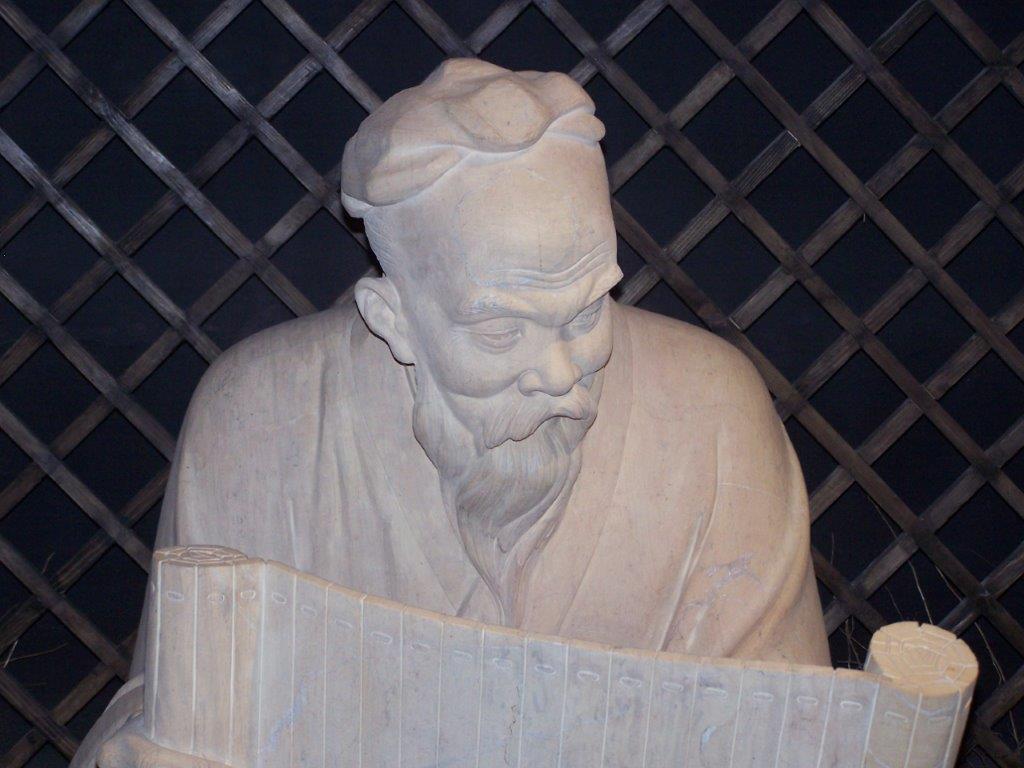
The scholar sits, contemplating
the world's perfect order,
but finds that "perfect" is a stretch.
"It's close to the border
between Disorder and Chaos.
mere miles from the junction
of Great Malady and Mayhem
deep within Dysfunction."
 Around the World in 80 Books by David Damrosch
6.) Thor & Loki in the Land of Giants (Norse): There’s no shame in putting a mere dent in the impossible.
5.) Rama & Sita (Hindu / from the Ramayana): Careful with your assumptions. You may end up looking like a jerk even if you’ve proven yourself generally virtuous.
4.) Anansi the Trickster (Ghanan / Akan): Don’t do favors for tricksters.
3.) Arachne the Weaver (Greek): Don’t be arrogant, even if you’re the best.
2.) Izanagi & Izanami (Japanese [creation myth]): Hell hath no fury…
1.) White Buffalo Calf Woman (Native American / Lakotan): Don’t let your lust get away from you and be careful in your assumptions.
Reading translated novels is a good way to gain insight into the culture and history of a country in a way that is both entertaining and that exposes the deep nuances of national character. I’ve selected works that both highlight aspects of culture and / or history and that are pleasant reading–some are humorous and others are adventures, but none are drudgery. (Includes two Nobel Prize winners and one guy who gets nominated every year only to have the prize handed to folk-rock musicians or the like.)
[The hyperlinks go to my review of said book in GoodReads.]
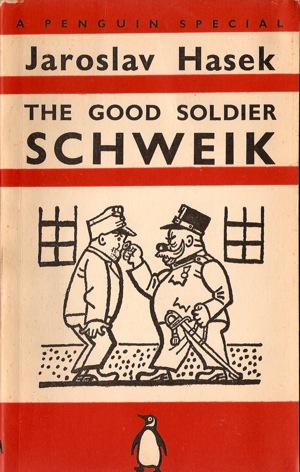
1.) The Good Soldier Švejk by Jaroslav Hašek (Czech): The lead character in this farcical comedy is a bumbling, but likable, idiot who is drawn into military service. The book highlights the fact that in times of war the greatest acts of idiocy are not perpetrated by greatest idiots.
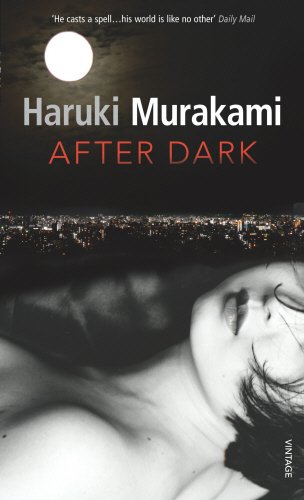
2.) After Dark by Haruki Murakami (Japan): One can’t go wrong with Murakami. I almost picked Norwegian Wood, which is more a work of realist literary fiction, but this novel about what happens when the trains stop running in Tokyo may shed a little more light on Japan. (anti-pun not intended.)
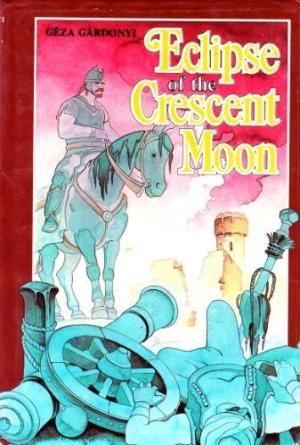
3.) Eclipse of the Crescent Moon by Géza Gárdonyi (Hungary): The story of how a small Hungarian castle village held out against a siege by the Ottoman juggernaut.
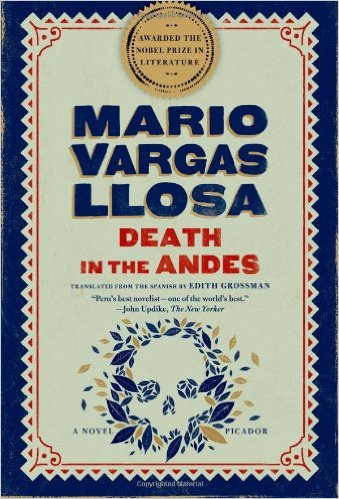
4.) Death in the Andes by Mario Vargas Llosa (Peru): When three men disappear from a small mining village in the Andes, the Army sends a Corporal and his deputy to investigate.
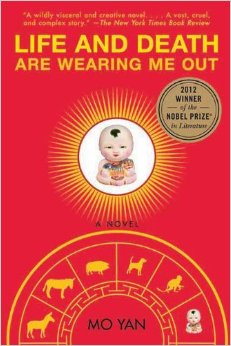
5.) Life and Death are Wearing Me Out by Mo Yan (China): A wealthy land owner is executed during the Communist revolution and must live out several lives as various animals in the service of the family of his [former] beloved hired-hand. The books shows the generational change between when China first became Communist through the reform period that led to a more market-friendly approach.
 Life from Elsewhere: Journeys Through World Literature by Amit Chaudhuri
My rating: 3 of 5 stars
“Life from Elsewhere” is a collection of essays written by writers from around the world on culture, multiculturalism, and the struggles of life (and writing) in a culture-infused world. The book consists of an introduction and ten essays by authors from India, Congo, Argentina / Spain, China, Israel, Syria, Palestine, Iran, Poland, Russia, and Turkey. It’s being put out to celebrate the 10 year anniversary of a program that seeks to translate more global literature into English (English PEN’s Writers in Translation.)
This was a hard work to rate, and so you may want to take the number of stars with a grain of salt. If you’re part of the niche audience of contemporary world literature devotees, you may love this book from beginning to end. For a more general reader—such as myself–there are golden nuggets scattered among a field of shiny gravel. I found the essays by Asmaa al-Ghul (i.e. “When Ideas Fall in Line”) and Andrey Kurkov (i.e. “Sea of Voices”) to be fascinating, even for the general reader. The former tells the story of a journalist who reaped a firestorm by posting a Facebook picture sans veil, but it offers insight into life under blockade in Gaza. The latter offers a Russian author’s experience of traveling in the Middle East, and the incidences of clash of cultures it offers was thought-provoking.
The countries represented by authors in this book are well chosen. Authors were chosen from locales that would have once been underrepresented in such a work. However, one might question the fact that half of the essays are from countries of the Middle East. While this may seem odd, one must admit that a writer or artist in most of the Middle East faces challenges that a writer from Osaka, Sao Paulo, or Prague would not. This isn’t only addressed in the al-Ghul essay mentioned above, but also in pieces such as those by Mahmoud Dowlatabadi (i.e. “Literature: Forbidden, Defied,”) and Elif Shafak (i.e. “A Rallying Cry for Cosmopolitan Europe.”)
I’d recommend this book for ardent devotees of contemporary global literature. Other readers will gain insight into what it’s like to be an artist in a world defined by culture–and particularly fascinating insight into cultures which are threatened by modern literature—and should make up their mind about how fascinating they find said topic. (Otherwise, one may find the book a bit dry.)
 Maphead: Charting the Wide, Weird World of Geography Wonks by Ken Jennings
My rating: 4 of 5 stars
In a sad commentary TV’s popularity, you may only know Ken Jennings from his record winning streak on Jeopardy, and the books he’s written since then may have escaped your attention. But Jennings isn’t just a fast-handed font of trivia, he writes nonfiction that is approachable, intriguing, and displays a good sense of humor.
Maphead is about maps and the people who love them, and–in some cases–who build their lives around various forms of graphic depiction of our world. In 12 chapters, Jennings not only reflects upon the many forms of map and geography fetish, he also presents insight on the opposite–the often dismaying and sometimes hilarious geographic illiteracy of college students and beauty queens. Besides learning about the million dollar outlays of rare map collectors and the intense rivalry of geocache hunters, Geography Bee contestants, and Traveler’s Century Club members (only those who’ve been to 100+ countries need apply), you’ll hear about a college professor who was fired for letting fly the fact that a majority of his incoming students hadn’t the vaguest idea of the whereabouts of metropoles like London or Chicago.
This book may seem like it’s only for those geeky to an obsessive level, but it’s one intriguing work of geo-geekery. It’s certainly for the intellectually inclined, but Jennings doesn’t bludgeon the reader with his intellect. True, you’ll be introduced to terms like hypsometric maps and cartacacoethes, but never in a manner that suggests a normal person would know such arcane terms. As might be expected from a trivia master, Jennings heavily seasons his book with fascinating tidbits and factoids—particularly in the chapter of the National Geographic “geography bee.” You’ll learn how the borders work between countries that drive on opposite sides of the road (I’ve experienced this myself from Cambodia to Thailand, and that may be the only place in the world where it occurs.) You’ll learn what’s in a name, and why one like “Whorehouse Meadows” was doomed from the start. You’ll learn about why maps that are wrong are often the most prized.
But it’s not all trivia. Jennings takes on serious questions as well. For example, he reflects on the degree to which kids being prohibited from venturing out into the world because of an overblown concern about pedophilic maniacs has contributed to a geographically uninterested and incapable student body. The reader is exposed to a history in which mapmakers were adventurers—the stuff of legends. In doing so, Jennings attempts to reignite a passion for geography that is lacking in a post-frontier world. We’ve become jaded by our planetary proliferation. But the book’s excitement isn’t all in the past. One learns about vintage map thieves and the sometimes wild and wooly world of modern travel (e.g. where one should get passport stamps on a separate sheet of paper to avoid border rectal exams.)
Maybe it’s the maphead in me, but I’d recommend this book for anyone who reads nonfiction. And if you’re not sure whether you’re a maphead or not, there’s a handy quiz in the back of the book.

How deep is it? No one knows.
In the interest of enhancing global understanding and camaraderie, I’ve built a translator of common first world (FW) problems–putting them in terms of their Rest of the World (RoW) equivalents.
FW: This food needs salt.
RoW: This food needs food.
FW: My health insurance premiums went up $20 per month.
RoW: My right foot, which recently turned from purple to black, just fell off.
FW: My car is in the shop again.
RoW: My right foot, which recently turned from purple to black, just fell off.
FW: It’s raining again today.
RoW: My house was washed off its foundations and is currently floating down the Brahmaputra River.
FW: Looks like those devils from the other party got a majority in the legislature.
RoW: This coup was particularly bloody.
FW: Squirrels are getting into my bird feeder.
RoW: A tiger ate my family.
FW: A traffic jam made me late for Pilates class.
RoW: While limping through the Kyber Pass to get antibiotics for my right stump, I was socked in by an unanticipated blizzard.
FW: My GPS says this road cuts under the interstate, but now I’ve got to go around.
RoW: What’s GPS?


 Tiger Riding for Beginners