 Only reading books that you’re comfortable with doesn’t make you educated, it makes you indoctrinated.
TODAY’S RANDOM THOUGHT: What Does It Mean To Be Educated?
2

 The Art of Peace by Morihei Ueshiba
My rating: 5 of 5 stars
The edition of The Art of Peace that I read is divided into three parts. Part I is a brief biography of Morihei Ueshiba, who was known as Ō-sensei to Aikidō practitioners and other admirers. Part II contrasts the art of war to Ueshiba’s art of peace. Part III is a collection of aphorisms and brief statements outlining the art of peace.
Ueshiba is the founder of Aikidō, a martial art that was derived in part from Daitō-ryū Aiki-jūjutsu, but which is distinct from that art in many ways. (e.g. the lack of set forms and emphasis on randori.) Along with Jigorō Kanō, Gichin Funakoshi, and a few others, Ueshiba is one of the pioneers of gendai budō, modern Japanese martial arts that take as their primary aim non-bellicose objectives like sport and self-defense. This is in contrast to the koryū budō (kobudō) which evolved primarily for war fighting. In contrast to Kanō’s Judō, which was first and foremost a competitive sport, Ueshiba’s Aikidō offered a particular approach to self-defense that was purely defensive and in which movement was harmonized to the opponent’s actions so as to perpetrate the least violence possible.
The biographic portion of the book is intriguing, but on a few occasions drifts from biography to hagiography. I feel that the suggestion of supernatural abilities does a disservice in the telling of Ueshiba’s story. By all accounts, Ueshiba was an accomplished and highly skilled martial artist, and I would like to read a full biography of his life (a biography exists, but I can’t comment on how well written it is yet.) Given Ueshiba’s pacifistic views, it would be easy to dismiss him as a pie-in-the-sky idealist who had no idea of the realities of the world. I don’t believe that is the case. However, when the biography tells stories of god-like superpowers, it makes it hard to take the man seriously as a martial artist. Either Ueshiba was skilled as an illusionist / mentalist (a distinct possibility) or some of the stories were embellished to deify the man. The story that comes to mind is one in which Ueshiba voluntarily faced a firing squad and emerged unharmed due to either ninja-like or Hollywood vampire movie style actions. This story is attributed to one of his students, Gozo Shioda, who passed away in the 1990’s.
We may get an indication of the roots of this appeal to the supernatural in an early statement about Ueshiba’s childhood fascination with individuals like En no Gyoja and Kukai who are themselves attributed supernatural abilities in stories. Ueshiba is clearly a man of faith. He suggests life should be lived on basis of 70 percent faith and 30 percent science. Full disclosure: I’m more skeptical than Descartes, and obviously favor an outlook more firmly rooted in science and rationality.
Part two includes extensive quotes from Ueshiba himself. It contrasts the arts of war with Aikidō in mental and physical aspects. A core theme of the book is that the martial arts shouldn’t be about learning to die, but rather learning to live. Ueshiba criticizes the past Shoguns who used the art of war to control people. Ueshiba’s views on the purpose of martial arts are stated in this part. From a physical point of view, Ueshiba emphasizes the lack of forms in Aikidō (Bruce Lee echoed similar sentiments on this subject.) There is an interesting comparison of Ueshiba to swordsman and Zen master Tesshu Yamaoka (about whom John Stevens also wrote a biography.)
Part three reads like the work of an ancient yogi in places, and, in other places, offers the stern admonitions to train hard that one would expect from a martial arts teacher. A recurring theme is that the martial artist should purge himself of pettiness, be it in the form of being judgmental, materialistic, fearful, selfish, or malicious. He goes as far as to say, “Be grateful even for hardship, setbacks, and bad people.”
Another theme is that one should strive to be natural and to make one’s movement natural. Ueshiba’s advice in this book is about virtue and the mind, and rarely strays into the subject of physical tactics. It does offer a little advice about types of distancing, where one should place one’s gaze, the power of circular movement, as well as discussing technique in the abstract. This is not a criticism. There are other books to learn more about physical technique. However, one should be aware that if one would like to know what Aikidō looks like, this isn’t the book for you.
This thin book provided me with a great deal to think about. I’d recommend it for martial artists, as well as for those interested in the life of this extraordinary man.
 A man once said to me, with evident pride, that he’d never failed a test of any kind in his life.
I guess he was expecting admiration, and must have been disappointed when I blurted, “how sad for you.”
But here is a person who has never stepped outside his comfort zone, who has no idea what he is capable of, and–moreover–he’s pleased as punch with that state of affairs.

Taken in the summer of 2011 in Hungary.
There are two ways to survive a harsh winter: you can squirrel away your pile of acorns or you can bear it by just not needing much.

“What’s the ‘Rabbit’s Foot?'” “I don’t know, but I’m going to shoot her in the head if you don’t give it to me.” Source: Paramount
Critics often bemoan the effectiveness of MacGuffins. A “MacGuffin” is an object so intrinsically valuable that people are willing to kill for it, die for it, or chase each other across the universe for it… and this is the important bit…without knowing precisely why said object is so valuable. In other words, it’s a plot device designed to propel plots forward that would have no reason to advance otherwise. Its exact characteristics are unimportant, and sometimes even its general characteristics remain unrevealed.
Prime examples from the cinema include “the case” from Pulp Fiction, the “Maltese Falcon” from the same-named movie, the “one ring” from Lord of the Rings, the sword “Destiny” from Crouching Tiger, Hidden Dragon, the “Rabbit’s Foot” from Mission Impossible III, the “Tesseract” from The Avengers, or “Genesis” from Star Trek II: The Wrath of Khan.
So, why would people kill, die, or chase after something that they didn’t understand? That’s what the aforementioned critics say, but I have my own theory as to why MacGuffins work well and frequently. MacGuffins work because people are used to spending their lives chasing something that they don’t precisely understand. Call it bliss or legacy or a missing part of oneself. If one spends one’s life chasing after a key that may or may not achieve one’s desired goal, it would be hypocritical to not have sympathy for characters who do the same.
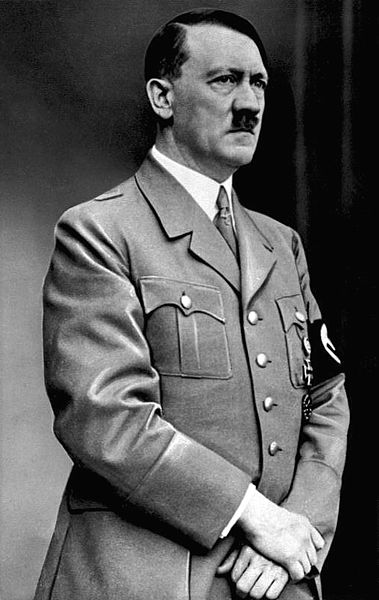
Source: German Federal Archives
Hitler killed the short-stache (a.k.a. the “toothbrush mustache.”) Imagine that, almost 70 years after his death, he still holds power over people’s decisions about facial hair.
This is a misplaced take-away lesson. It’s the unbridled narcissism, the icy hatred, and the irrational exuberance in the power of evil of Hitler that should be abandoned (yet, somehow, those intangibles still quietly exist.) It’s not the superficial aspects of Hitler that should be shunned, but the ones at the bastard’s core.
I’m not saying the toothbrush-stache was a good look. On the contrary–as one who has had a mustache his entire adult life and has worn a beard now for several years–I’m a little offended by the lack of commitment to one’s choice of facial hair that the toothbrush-stache represents. (Incidentally, I feel the same about the sole patch and mutton chops.) In my mind, one should go full-stache or go home to shave.
Still, there being no accounting for taste, I think those individuals who would otherwise find the short-stache appealing (i.e. you know, indecisive types who wear culottes and eat with sporks) should revive the toothbrush mustache as a big fuck-you to Hitler–don’t let tyrants boss you around from the grave.
Toothbrush mustache admirers of world, unite! (No, I won’t be joining you.)
I don’t think Death should be depicted as a cowled, faceless Grim Reaper.
Instead, I think Death should be the wise drinking buddy who can hold his liquor. Not the one who acts like an idiot an encourages friends to do the same. Rather, the one who spurs you to ask out a girl who’s way out of your league, and keeps you classy if (when) she declines.
 Yoga Sutras of Patanjali by Charles Johnston
My rating: 4 of 5 stars
There are about a billion editions of Patanjali’s The Yoga Sutras. The one I got was a free or very cheap on Kindle, and is, therefore, probably not the best edition. I don’t know that the Kindle version I got still exists because it included a supplemental essay by Swami Vivekananda that the version I linked to on Amazon doesn’t. However, the translation is the same, and is by Charles Johnston.
For many old works, the edition might not matter too much, but for Patanjali’s Sutras it matters a great deal. First, there’s the issue of the quality of the translation. Beyond that, however, is the question of the analysis. The Yoga Sutras are extremely brief, consisting of only 196 aphorisms. Owing to the terse brevity of the Sanskrit language, many of these aphorisms are only a few words long. That means that there isn’t a high degree of precision in the language of the Sutras, and, consequently, there’s a great deal of room for misunderstanding and misinterpretation. It’s for good reason, therefore, that most editions are 90% or greater commentary on Patanjali’s words.
The Sutras are typically divided into 4 chapters (this convention apparently came well after Patanjali wrote them.) The first section lays out the objective of yoga. The central notion is the need for Chitta Vrtta Nirodha, which basically means to transcend the fluctuations of the mind. Patanjali’s point is that the problem faced by mankind is that people’s minds are run amok. There is a need for some system to facilitate correction of all this monkey-mindedness. That’s where Chapter 2 comes in.
The second chapter lays down an outline of Ashtanga Yoga, which is the eight-fold path of Raja Yoga (i.e. Royal Yoga). While modern-day people tend to think of yoga only as pretzel-like physical postures, that’s just one of the eight limbs of yoga. The eight limbs are: commandments (yama), rules (niyama), postures (asana), control of breath (pranayama), withdrawal of the senses (pratyahara), concentration (dhanara), meditation (dhyana), and liberation (samadhi.)
It’s interesting to note that the limb that many think of as yoga, i.e. the postures, is one of the most briefly covered. Most famously, Patanjali says in Ch.2, Sutra #46, “Sukham Sthiram Asanam” (i.e. postures should be stable and effortless.) The massive body of asana that developed in Hatha Yoga were initially just a means to give one the ability to sit still for a long periods of time comfortably enough to get one’s mind in order.
The third chapter talks a little bit about the last three of the eight limbs (i.e. concentration, meditation, and liberation.) However, the bulk of this chapter is devoted to the supposed magic powers that yogis claimed to have had as a result of their work on improving their minds. For skeptics and scientifically-minded individuals (e.g. yours truly), this is where the Sutras take a silly turn. The translation in question came out in 1912, and it’s clear that rationalism was already gaining hold and magic was getting to be a harder sell. I suspect that was the reason for the inclusion of Swami Vivekananda’s essay entitled “The Powers of the Mind”—to capitalize on the gravitas of the renowned yogi to convince people that chapter 3 isn’t bunk.
The fourth chapter wraps up the book neatly–discussing karma and the liberation of the karmic cycle achieved through the state of higher consciousness called samadhi.
If one has more than a superficial interest in yoga, it’s pretty much obligatory to read some edition of Patanjali’s The Yoga Sutras. I didn’t find this edition to be devastatingly poor, but there seems to be a consensus among reviewers that it’s not among the best translations / commentaries.
I would recommend that one read some version of these sutras, be it BKS Iyengar’s Light on the Yoga Sutras of Patanjali, Swami Vivekananda’s edition, or Swami Satchidananda’s version. I don’t have any experience with these other editions, though I have read works by BKS Iyengar and Swami Vivekananda, and found works by both to be well-written and clear. Notwithstanding the parts about magical superpowers, the book does provide a lot of food for thought, and in nice bite-sized pieces.

“What happened to the good ole days when I ate you people–not lived in your cages?”
Paleolithic dieting is all the rage these days. I’m no expert on the paleo-diet, but–as I understand it–this refers to the practice of eating the foods consumed by our pre-agrarian ancestors. The idea is that if one consumes the foods that our species is evolutionarily-optimized to eating, one will be healthier. Whether one believes in the merits of the paleo-diet or not on the whole, it’s hard to argue that one wouldn’t be better off eating less highly-processed and highly-refined foods and more things that look like food at a glance.
Our diet isn’t all that has changed since the days of our pre-agrarian ancestors. Modernity has brought with it an entirely new way of experiencing stress. Eliminating or reducing stress is a common topic of discussion, but not all stress is created equal. There’s a necessary form of stress, a stress that makes one better, stronger, faster, and smarter. We don’t want to willy-nilly eliminate stress; we want to reduce the wrong type of stress.
Our ancestors—like animals–experienced brief periods of intense stress (e.g. saber-tooth tiger attacks), followed by longer periods in which they were free of deadlines, carpools, and after-school activities. Now, no one likes to have a saber-tooth tiger stalking them. It’s unpleasant. Modern humanity has gone to great lengths to eliminate those short bursts of terror, but not without cost. (If you don’t believe me read Robert Sapolsky’s Why Zebras Don’t Get Ulcers.)
Whether or not you believe that eliminating acute instances of terrifying stress is bad for mankind, it’s hard to argue that modernity’s leveling process didn’t eliminate stress, but instead resulted in a chronic stress on a smaller scale. People today have impossibly long daily to-do lists, and they have to accept trade-offs between work, family, and personal development.
It’s true that you don’t get eaten by a giant cat when you drop the ball, but life is so packed diverse events that one may feel like one is dropping some ball constantly. If your boss thinks you’re a model employee, then your kids are probably going to need therapy. If you have a contented home life, your boss may have his or her eyes open for someone who can give the firm consistently 70+ hour work weeks. If you feel you’re doing alright on both the work and family front, your body and / or mind is probably a train wreck.
Chronic [mini] stress may feel better than acute [catastrophic] stress, but it takes its tolls in various ways. First, with our sympathetic nervous system (fight-or-flight reaction) constantly engaged our body’s power to heal itself is reduced. When the parasympathetic nervous system is engaged, the body devotes resources to long-term goals like getting healthier, but in stress mode activities not relevant to immediate survival shut down. This is a great system if you have periodic life and death stress, but is not so good if you’re under constant stress.
Second, chronic stress reduces sleep, and sleep is essential to one’s mental and physical well-being. There are a wide variety of symptoms associated with sleep deprivation such as forgetfulness, decreased concentration, decreased alertness, reduced reasoning ability, diminished problem-solving capacity, and depression—all of which can diminish our physical health through accidents, ailments, suicide attempts, and lack of energy for exercise.
Third, chronic stress can make one fat, with all the health issues that result. Some people use food as a coping mechanism. Other people eat too fast or choose their food poorly because of time constraints or because they are not mindful of eating as their monkey minds churn at a mile a minute. Then there is the more convoluted and complex issue of cortisol–a hormone released under stress that is linked to weight gain in at least some cases. Even if you don’t have a problem on the calorie intake side, the stressed individual may not do so well on the calorie burning side—either because of a lack of time to exercise or a lack of energy.
Modern humans are uniquely suited to chronic stress because we are the only species that achieves the same physiological stress response by remembering and obsessing about a stressful event as experiencing it. Abandoning the modern approach to living isn’t an option most are willing to entertain; but there are ways to combat chronic stress.
Move – Meditate – Mindfully Breath: The bad news is you’ve got to shoehorn these activities into your schedule daily (or at least several times a week.) The good news is that they don’t need to take up a lot of your day. There are a number of systems that address all three components in one handy package such as Qi Gong, Yoga, and some martial arts. I don’t think it matters so much which one chooses as how one goes about one’s practice.
Movement strengthens and strategically stresses the body, but it also increases one’s bodily awareness so that one becomes aware of how stress is manifesting itself in one’s body. Meditation teaches one how to live in the present moment, and it trains one to recognize the seeds of negative thought and emotion earlier so that one can counter-act them. Obviously, breathing is essential to life, but learning to be aware of one’s breathing patterns and to “manually override” the breath patterns associated with harmful emotional states is a beneficial skill.
Massage / Bodywork: Whether self-administered or other-administered (the latter allowing greater distressing–particularly if the masseuse is skilled) massage is an activity, like movement, that can help one become aware of where one is physically holding one’s stress. These physical manifestations of stress can exacerbate the whole experience of stress. One should take time periodically to have bodywork done. A day rarely goes by in which I don’t work on my own neck, shoulders, head, or face, and I occasionally get professional Thai Yoga Bodywork done.
The Places that Scare You: Force yourself to go someplace (not necessarily literally a “place”) that scares you once in a while. This needn’t be skydiving or hand-gliding—but it could be. It may be a martial arts class in which one has to put on the gloves occasionally and go at it. It may be joining Tostmasters and having to give a speech in front of a crowd. It may be traveling to some backwater where you don’t know the language, but you want to learn. This is a very personal issue. (i.e. A Type-A personality he-man may not find that skydiving is outside his comfort zone. If so, sorry, skydiving doesn’t count, he may need to learn ballroom dancing, or something else that truly takes him outside being comfortable.) KEY POINT: The problem with hiding from all stressors is that it doesn’t result in a stress-free life, what happens is that smaller and smaller stressors loom bigger and bigger in one’s mind. Which brings us to…
Perspective: One must put life’s challenges in perspective. Each person’s problems are important to them, and I don’t want to diminish anyone’s problems, but—come on—you’re not going to be eaten by a freaking saber-tooth tiger.

How deep is it? No one knows.
In the interest of enhancing global understanding and camaraderie, I’ve built a translator of common first world (FW) problems–putting them in terms of their Rest of the World (RoW) equivalents.
FW: This food needs salt.
RoW: This food needs food.
FW: My health insurance premiums went up $20 per month.
RoW: My right foot, which recently turned from purple to black, just fell off.
FW: My car is in the shop again.
RoW: My right foot, which recently turned from purple to black, just fell off.
FW: It’s raining again today.
RoW: My house was washed off its foundations and is currently floating down the Brahmaputra River.
FW: Looks like those devils from the other party got a majority in the legislature.
RoW: This coup was particularly bloody.
FW: Squirrels are getting into my bird feeder.
RoW: A tiger ate my family.
FW: A traffic jam made me late for Pilates class.
RoW: While limping through the Kyber Pass to get antibiotics for my right stump, I was socked in by an unanticipated blizzard.
FW: My GPS says this road cuts under the interstate, but now I’ve got to go around.
RoW: What’s GPS?


 Tiger Riding for Beginners