I knew a man, a common farmer, the father
   of five sons,
 And in them the fathers of sons, and in
   them the fathers of sons.

This man was of wonderful vigor, calmness,
   beauty of person,
 The shape of his head, the pale yellow and
   white of his hair and beard, the
   immeasurable meaning of his black eyes,
   the richness and breadth of his manners,
 These I used to go and visit him to see, he
   was wise also,
 He was six feet tall, he was over eighty years
   old, his sons were massive, clean,
   bearded, tan-faced, handsome,
 They and his daughters loved him, all who
   saw him loved him,
 They did not love him by allowance, they
   loved him with personal love,
 He drank water only, the blood show'd like
   scarlet through the clear-brown skin of
   his face,
 He was a frequent gunner and fisher, he
   sail'd his boat himself, he had a fine one
   presented to him by a ship-joiner, he had
   fowling-pieces presented to him by men
   that loved him,
 When he went with his five sons and many
   grand-sons to hunt or fish, you would
   pick him out as the most beautiful and
   vigorous of the gang,
 You would wish long and long to be with
   him, you would wish to sit by him in the
   boat that you and he might touch each
   other.
The love of the body of man or woman
   balks account, the body itself balks,
   account,
 That of the male is perfect, and that of
   the female is perfect.

The expression of the face balks account,
 But the expression of a well-made man
   appears not only in his face,
 It is in his limbs and joints also, it is
   curiously in the joints of his hips and
   wrists,
 It is in his walk, the carriage of his neck, the
   flex of his waist and knees, dress does not
   hide him,
 The strong sweet quality he has strikes
   through the cotton and broadcloth,
 To see him pass conveys as much as the best
   poem, perhaps more,
 You linger to see his back, and the back of
   his neck and shoulder-side.

The sprawl and fulness of babes, the bosoms
   and heads of women, the folds of their
   dress, their style as we pass in the street,
   the contour of their shape downwards,
 The swimmer naked in the swimming-bath,
   seen as he swims through the transparent
   green-shine, or lies with his face up and
   rolls silently to and fro in the heave of the
   water,
 The bending forward and backward of
   rowers in row-boats, the horseman in his
   saddle,
 Girls, mothers, house-keepers, in all their
   performances,
 The group of laborers seated at noon-time
   with their open dinner-kettles, and their
   wives waiting,
 The female soothing a child, the farmer's
   daughter in the garden or cow-yard,
 The young fellow hoeing corn, the sleigh-
   driver driving his six horses through the
   crowd,
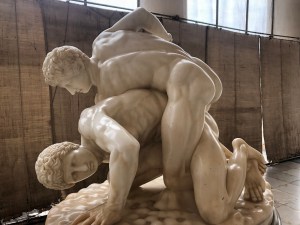
 The wrestle of wrestlers, two apprentice-
   boys, quite grown, lusty, good-natured,
   native-born, out on the vacant lot at sun-
   down after work,
 The coats and caps thrown down, the
   embrace of love and resistance,
 The upper-hold and the under-hold, the hair
   rumpled over and blinding their eyes;
 The march of firemen in their own
   costumes, the play of masculine muscle
   through clean-setting trowsers and waist-
   straps,
 The slow return from the fire, the pause
   when the bell strikes suddenly again, and
   the listening on the alert,
 The natural, perfect, varied attitudes, the
   bent head, the curv'd neck and the
   counting;
 Such-like I love -- I loosen myself, pass
   freely, am at the mother's breast with the
   little child,
 Swim with the swimmers, wrestle with
   wrestlers, march in line with the firemen,
   and pause, listen, count.
I sing the body electric,
 The armies of those I love engirth me
   and I engirth them,
 They will not let me off till I go with them,
   respond to them,
 And discorrupt them, and charge them full
   with the charge of the soul.

Was it doubted that those who corrupt
   their own bodies conceal themselves?
 And if those who defile the living are as bad
   as they who defile the dead?
 And if the body does not do fully
   as much as the soul?
 And if the body were not the soul,
   what is the soul?
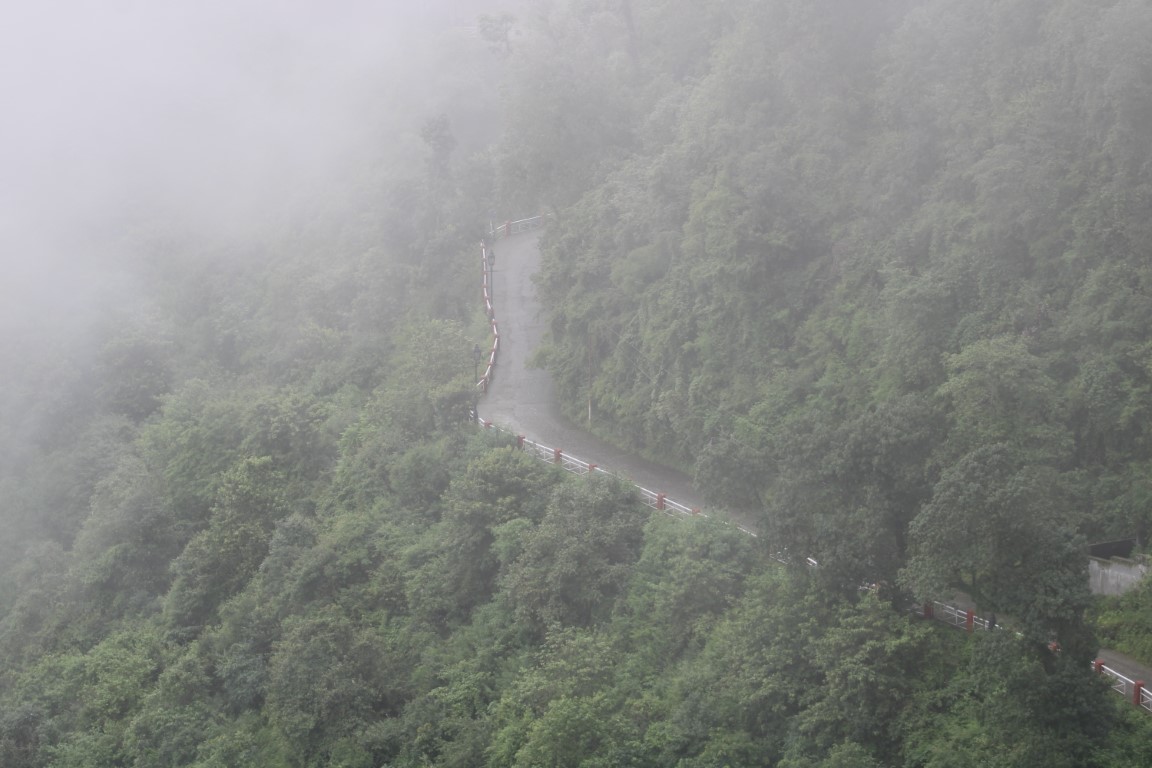
Climbing Taihang Mountain,
  On the green winding way.
  The jade-lined trail in fog,
  Floral scents from the gray.
 Stuck in unflowing time,
  'Til a song sung bright and gay...
  I'm steered back to my past
  With the grace of ghosts at play.
 Skirting roiling waters,
  A Roc soars after prey.
 The Tao is unbounded --
  Round or square as it may.
NOTE: The late Tang Dynasty poet, Sikong Tu (a.k.a. Ssŭ-k‘ung T‘u,) wrote an ars poetica entitled Twenty-Four Styles of Poetry. It presents twenty-four poems that are each in a different tone, reflecting varied concepts from Taoist philosophy and aesthetics. Above is a crude translation of the seventeenth of the twenty-four poems. This poem’s Chinese title is 委曲, and has been translated as: “Grievance” and “In Tortuous Ways.”
Google Books Page
By the author’s admission (and the title, for that matter) this is not so much an overview of Taoist philosophy as a philosophical rendering that attempts to not only be consistent with the Taoist tradition, but also with our present-day understanding of the world. This fact has positive and negative ramifications for readers, and results in a book that will be more useful for the purposes of some readers than others.
The biggest positive is that this interpretation of Taoism is consistent with a modern rationalist worldview. Taoism is a huge system of thought and includes a lot of magical, supernatural, and astrological thinking. In short, a book on Taoist thought could contain a great deal of woo woo, but this one does not. It has not much to say on demons, deities, magic, alchemy (in the narrow, original meaning,) etc., and to the degree these subjects do crop up they do so in a way that is not arcane and doesn’t insist on belief in unsupported ideas. I think this makes this book important, as it fills a niche. Most of the central texts of Taoism were written in times that were different from our own and in which magic and the supernatural were taken for granted. So, if you want a text that draws on major ideas of Taoism but presents them in a way that is consistent with science, you may want to give this book a look.
The biggest negative is that when the book is not explicitly describing the teachings of historical figures, one doesn’t necessarily have a good way of knowing how much Li’s ideas are or aren’t consistent with Taoist tradition. There are extended discussions of ideas such as evolutionary biology and existentialism, and — unless one has a great depth of knowledge of Taoism to begin with — it can be hard to see whether Li’s views on these subjects are in line with Taoist philosophy or whether twists are being made. The most extensively discussed / cross-cutting idea of the book is that of differentiating primary from secondary society and proposing a primacy of primary society in Taoist thought. I can’t say I’ve read much elsewhere that would suggest this was a core idea for Taoists, but the political philosophy of Taoism is not an area with which I’m at all well-acquainted.
I found this book interesting and thought-provoking. I also felt it was much needed to have a scientifically consistent approach to Taoism. If you are looking for such discussion, I’d recommend this book.
Project Gutenberg Site
This is a collection of fourteen humorous essays on a range of topics related to human existence. Besides the titular topic of living a life of idleness, other discussions include: love, poverty, vanity, attire, eating, pets and babies. (The latter two being distinct topics addressed in different chapters, though not with an altogether different attitude.)
Much of the humor holds up well considering this book originally came out almost a hundred and forty years ago. That said, it must be acknowledged that some of the humor and a number of the attitudes have not aged well and will not necessarily be relatable.
If you’re looking for a collection of essays on life that are humorous, if not contemporary, this book is worth looking into.
Men say they know many things;
 But lo! they have taken wings, --
 The arts and sciences,
 And a thousand appliances;
   The wind that blows
   Is all that any body knows.












 Tiger Riding for Beginners