BOOK: “Swami Kripalu’s Ladder of Yoga” by Richard Faulds

Swami Kripalu’s Ladder of YogaSwami Kripalu’s Ladder of Yoga by Richard Faulds
My rating: 4 of 5 stars

Publisher Site – Monkfish

Release Date: April 7, 2026

This book discusses the organizational structure of yoga as described by prominent 20th century yoga guru, Swami Kripalu, an approach that draws on (but distinguishes itself from) the 8-limb (Ashtanga) framework outlined by Patanjali in the Yoga Sutras. Swami Kripalu deemphasized yogic ethics (Yama and Niyama,) and put great emphasis on hierarchy among the elements of yoga — i.e. that one must pass through the lessons of some limbs before you can begin to move up to the next. (This idea is certainly taught in Patanjali’s Sutras, but not with the same emphasis — hence Kripalu’s “ladder,” rather than “limbs” — making clear that these are not independent elements but rather are completely dependent.)

The greatest strength of this book is in distinguishing concepts like dhyana (meditation) from samadhi, distinction of which is often given short shrift with simplistic soundbite-like definitions in books on yoga. The book is not the usual yoga text in that it spends a great deal of time discussing the “higher limbs” of yoga (to resort back to Patanjali’s formulation.) Faulds adds benefit by discussing his own subjective experiences, the lack of access to subjective understanding often gives even students actively training with teachers doubts about their experiences.

I should point out that the book does also spend a good deal of page count (perhaps more space than any other subject) on pranayama (breathwork,) both covering it over several chapters in the book’s midsection and then further in a couple appendices that get into the physiology of breathwork.

One nice feature is that almost all of the chapters end with sections entitled “Be a Discerning Student” and “Applying this Chapter in Practice” to help readers with practical insights into what is by and large a philosophical discussion. There are also several appendices (the most useful one to me was a discussion of the shifting understanding of the term “samadhi” over time and across disciplines.)

If you want to explore what the higher limbs are and how they are distinguished, I’d recommend this book. (As I said, it also deals with Pranayama in some detail, but that will likely offer less new insight for students and teachers of yoga who’ve received an education in [and maintain a practice of] yoga.)

View all my reviews

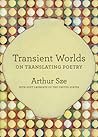
BOOK: Transient Worlds by Arthur Sze

Transient Worlds: On Translating PoetryTransient Worlds: On Translating Poetry by Arthur Sze
My rating: 5 of 5 stars

Publisher Site — Copper Canyon

Release Date: April 14, 2026

Just as people are fond of saying, “the book is always better than the movie,” there is an idea — widely accepted as truism — that goes, “a translation can never be as good as its source poem.” I don’t buy either of those views, but there’s certainly truth to the notion that a poetic translation can never perfectly echo style, tone, sound quality, and meaning at once. Each language is unique, and the more different two languages are the more one has to make decisions about what one will emulate and what one will craft. It’s also true that any translation will represent a drift away from the culture of the original (which is not identical to being worse.) In short, any poetry translation that seeks to be good had better be a work of art unto itself.

The current US Poet Laureate (as of this writing,) Arthur Sze, has written a book to help readers intelligently navigate the troubled waters of poetic translation. Sze certainly has insight, having not only translated Chinese poems himself, but also being Professor Emeritus at the Institute of American Indian Arts, he has multiple cultural lenses with which to view poetry.

This book consists of fifteen chapters exploring poems and poetry excerpts from around the globe — and their translations. The twelve diverse source languages include: Chinese, Navajo, French, Ancient Greek, Hebrew, Danish, and Russian. The original poets include Tao Qian, Guillaume Apollinaire, Homer, Kobayashi Issa, Pablo Neruda, Marina Tsvetaeva, Aime Cesaire, Najwan Darwish, and Mirabai. Many of the chapters include multiple translations, offering the reader a means to see how different translators take to the task. Others offer only a single translation but turn their attention to specific considerations of translation. In one case, there is an interview with the translator. I enjoyed this varied approach to the exploring the topic. It made for a book with zero monotony and many facets.

If you are a poet or a poetry reader who enjoys reading poetry from varied languages or source languages, I’d highly recommend this book.

View all my reviews

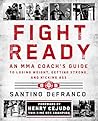
BOOK: “Fight Ready” by Santino DeFranco

Fight Ready: An MMA Coach’s Guide to Losing Weight, Getting Strong, and Kicking AssFight Ready: An MMA Coach’s Guide to Losing Weight, Getting Strong, and Kicking Ass by Santino DeFranco
My rating: 4 of 5 stars

Publisher site –St. Martin’s

Release Date: May 19, 2026

MMA fighter turned coach, Santino DeFranco, offers an insightful and pragmatic overview of the process of getting one’s body shipshape, including: getting sleep, dealing with injuries, strength and conditioning practices, nutrition, and more. The book attempts to be of broad appeal, not just relevant to MMA and other competitive fighters, but to athletes of other sports and non-athletes as well. It was not clear to me that the book achieves said broad appeal. One of the most fascinating and engaging chapters dealt with the process of cutting weight, an activity that applies to few outside weight-graded combative sports. (And an activity which the author, with the pragmatic approach that makes the book so useful, attempts to dissuade general readers from attempting.) The book does discuss the calories-in-and-calories-out basics of nutrition in a more generally relevant manner, as well. And there is certainly wisdom to be gleaned for the non-fighter, but, overall, I don’t know that this would be a good book to send a person toward if they were a typically unathletic person trying to lose a few pounds and be in better shape. (Though I do acknowledge a sort of aspirational motivation that a book might have for such readers, particularly UFC fans.) [And it’s completely out of my wheelhouse to know how generally applicable strength and conditioning approaches are for completely different sports, but I can’t help but have doubts.]

That said, I did come across many thought-provoking tidbits of wisdom in this book. The author is clearly one prone to look to the science and established best practices and to challenge the fad-laden fitness influencers and not dive headlong into the trend du jour. The book uses stories and anecdotes to increase the book’s readability and relatability. Here I’d say the results are mixed, but the aforementioned Tracy Cortez weight cut story is one example of when it is done very well.

If you’re curious about the training life of professional fighters and are looking for a few health and fitness concepts you might apply in your own life, I’d highly recommend this book.

View all my reviews

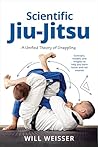
BOOK: “Scientific Jiu-jitsu” by Will Weisser

Scientific Jiu-Jitsu: A Unified Theory of Grappling (Martial Science)Scientific Jiu-Jitsu: A Unified Theory of Grappling by Will Weisser
My rating: 4 of 5 stars

Publisher Site – YMAA Publication Center

Release date: June 2, 2026

This book outlines principles of positioning, alignment, and movement used to gain advantage while grappling. It is not a technique-centric book but rather is a concept-centric one. Weisser does for Brazilian Jiu-jitsu what Jiichi Watanabe and Lindy Avakian did for Judo with their book alternatively titled The Secrets of Judo or The Art and Science of Judo. Watanabe and Avakian focused more on both technique and elementary physics than does Weisser, but there is common ground in ideas of what positions make a body strong and what movements bring vulnerability. The biggest area of divergence between Watanabe’s book and Weisser’s is simply the difference between Judo and Brazilian Jiu-jitsu. Watanabe and Avakian direct the vast majority of their attention to how one gets the opponent to the ground and relatively little on what to do when one gets there, and Weisser’s book is the other way around — i.e. primarily assuming at least one person is already on the ground.

Weisser’s book does assume that the reader has a background in Brazilian Jiu-jitsu, using terms specific to that system without necessarily providing elaboration. I say this just to point it out as (to be fair) I realized that I would have thought nothing of it if it used Japanese Jujutsu / Judo terminology in the same way. (I did have to go to Google at one point to elucidate what turned out to be a Dragonball-Z reference that went right over my head.)

Weisser’s book uses a combination of graphics, including photographs. I found it easier to see the linkage between what the author was describing in the text and what was in the photos in some cases than in others. Often, there was a single photo catching one static situation, and if the grapplers were closely entangled (as grapplers are want to be,) it was not so easy to see — even with different colored uniforms. [Note: I should point out that I was reading an ARC galley, and so that may all be sorted in the final formatting.]

As one who knows little of Brazilian Jiu-jitsu, but with some experience with other grappling systems, I found this book readable and thought-provoking. The statement of ideas is clear, and I’d recommend it for grapplers looking to engage in thinking about first principles of grappling.

View all my reviews

BOOK: “Four Chapters on Freedom” by Patanjali [Commentaries by Satyananda Saraswati]

Four Chapters on Freedom: Commentary on the Yoga Sutras of PatanjaliFour Chapters on Freedom: Commentary on the Yoga Sutras of Patanjali by Satyananda Saraswati
My rating: 5 of 5 stars

Publisher – Yoga Publications Trust

This book holds the Bihar School of Yoga commentaries on The Yoga Sutras of Patanjali. In addition to providing each Sutra in Sanskrit, a Romanized transliteration, a word-by-word literal translation, and a readable free translation into English, the book offers a commentary for each Sutra. The Yoga Sutras of Patanjali consist of just 196 lines of Sanskrit, explaining the nature of yoga and how it is to be practiced. Because the Sutras are so sparse and open to varied interpretations, a commentary is essential and one’s learning experience is only as good as the translation and commentary. There are many English language commentaries on Patanjali’s Sutras available, but I don’t think one can do any better than this one.

In general, I have found the publications put out by the Yoga Publications Trust of the Bihar School to be as useful as they come. Their books are pragmatic, focused, and readable.

This book does, by necessity, use a fair number of Sanskrit terms repeatedly because there are not English words for many of the key concepts and to try to put them into English would be tiresome and confusing. However, there is a glossary at the end of the book (in addition to an index) to help the reader negotiate this Sanskrit terminology. The appendices also include a key to help English language readers with the pronunciation of Sanskrit terms. There are also appendices with the sutras written out in Sanskrit and Romanized transliteration in list form.

This book is well worth reading, whether one has read other commentaries on The Yoga Sutras of Patanjali or not.

View all my reviews

BOOK: “Wildness” by Lydia Willsky-Ciollo

Wildness: Henry David Thoreau and the Making of an American TheologyWildness: Henry David Thoreau and the Making of an American Theology by Lydia Willsky-Ciollo
My rating: 4 of 5 stars

Publisher — University of Notre Dame Press

Release Date: March 1, 2026

Willsky-Ciollo argues in this book that Thoreau built a uniquely American theology with nature at its core, a theology that didn’t just draw on Greco-Roman philosophy and Abrahamic religion (as other schools of thought have) but also on Indian ideas of both the South Asian and Native American varieties. (The book speaks more extensively to the latter.)

For a scholarly work, this book is readable and doesn’t require jargon proficiency or any special academic background. I can’t say I found it compelling to think of Thoreau’s teachings as a theology (rather than a philosophy, or a strain of Transcendentalism.) That said, to someone outside the field, I don’t think that is a particularly interesting question, given that scholarly disciplines are inherently subjectively defined and prone to mutability. What’s more important to me is that I did gain numerous insights from this book, particularly regarding Thoreau’s unfinished final work Wild Fruits (which is discussed in some detail,) and Thoreau’s views on American Indians and their influence on his worldview.

If you’re interested in Thoreau, and looking for some insight that one might not gain from reading his most well-known works, this is a book well worth reading.

View all my reviews

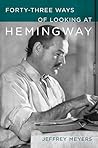
BOOK: “Forty-Three Ways of Looking at Hemingway” by Jeffrey Meyers

Forty-Three Ways of Looking at HemingwayForty-Three Ways of Looking at Hemingway by Jeffrey Meyers
My rating: 5 of 5 stars

Publisher Website – LSU Press

I enjoyed this approach to biography. Instead of telling Hemingway’s life story chronologically or even via some other form of overarching arc, Meyers gives us forty-three chapters that each shine a light on a different facet of Hemingway. In many cases, these facets are Hemingway’s relationships to other people: writers, artists, wives, and other personalities. In other cases, the facets are events or concepts, such as his suicide, war, achievements, etc.

This approach can, on occasion, lead to repetition, but I find repetition that is not overbearing to be useful in taking in key information.

If you are interested in what made Hemingway tick, I’d highly recommend that you read this book.

View all my reviews

BOOK: “Wisecracks” by David Shoemaker

Wisecracks: Humor and Morality in Everyday LifeWisecracks: Humor and Morality in Everyday Life by David Shoemaker
My rating: 4 of 5 stars

Publisher Site — U of Chicago Press

In this book, a Cornell University philosopher considers questions at the intersection of morality and humor, particularly with respect to digs, burns, and other forms of wisecracking humor. Shoemaker’s view is that generally these forms of humor are not morally questionable, but even where they are they can serve a social function. The book reflects in depth upon what might make a joke morally questionable and why it is unreasonable to accept the tautological argument that wisecracks are morally wrong because they poke fun at others. In addition, the book delves into what service wisecracking humor provides as well as investigating how the pros may outweigh the cons.

I suspect most readers will not expect a laugh riot from a book put out by a philosopher, and — in this case — they would be particularly right to not do so. The book repeatedly draws on a few examples, examples which are often of the inside joke variety (i.e. not hilarious to third parties.) But if you’re reading a philosophy book to laugh, you’re in the wrong place. One would also be wrong to think one has a minefield map, showing when, where, and how to safely wisecrack, by the book’s end. The author clearly recognizes the challenge of attempts to clarify the landscape. Whether he thinks he’s succeeded in doing so, I couldn’t say, but the landscape remained messy to my mind, even having completed the book.

I found the book to present some thought-provoking ideas. My interest did wane in the book’s second half as it came to feel a bit more muddled and repetitive, but all-in-all I thought it was a book worth reading — if you’re interested in philosophy, morality, and ethics.


View all my reviews

BOOK: “Yoga Also for the Godless” by Sri M.

Yoga Also for the GodlessYoga Also for the Godless by Sri M.
My rating: 4 of 5 stars

Publisher Site – Penguin India

One common philosophical question regarding yoga is to what degree it is, in itself, religious. This has been argued by various sects from within Yoga, with some seeing Yoga without belief as oxymoronic and others arguing that the metaphysics of Yoga is essentially Samkhya (an atheistic philosophy.) Outsiders to Yoga have also had their say, as with the Roman Catholic Church telling its practitioners that the practice of Yoga is incongruent with that of Catholicism.

This book’s author takes on the question by examining what yoga is according to historic texts, specifically the Yoga Sutras of Patanjali, and then considering whether the practice that is laid out necessitates a belief in a deity, deities, or the supernatural. As one can tell from the title, Sri M (born Mumtaz Ali) argues that belief in divinity is not essential to the practice of Yoga.

Those who’ve read various commentaries on Patanjali’s Yoga Sutras will find this book at best familiar and at worst just another set of Sutra commentaries. Sri M’s book is not just Yoga Sutra commentaries, but that does take up a fair amount of the page space. The early chapters focus more on the thesis question.

If you’re interested in the question of whether Yoga is inherently theistic, this is a fine book to investigate. It’s a quick read and draws heavily on sutras and scriptures (and, thus, is not just the author’s opinion.)

View all my reviews
BOOK: “Lucky Devils” by Kit Chellel

Lucky Devils: The True Story of Three Rebel Gamblers Who Beat the Odds and Changed the GameLucky Devils: The True Story of Three Rebel Gamblers Who Beat the Odds and Changed the Game by Kit Chellel
My rating: 5 of 5 stars

Publisher Site — Simon & Schuster

Release Date: April 14, 2026

This book provides a fascinating look at the field of “advantage gambling” from the 1970’s through the 1990’s / early 2000’s. Advantage gambling is the use of applied mathematics and computing to snatch up part of the advantage in odds that normally accrues to “the house” (i.e. the casino / gambling establishment) to make gambling not so much a sucker’s game. Card counting is a specific variety of this undertaking. This story is largely told through the life stories of three prominent advantage gamblers, Bill Benter, Bill Nelson, and Rob Reitzen. While the book starts with card counting in blackjack, it broadens beyond that — and even beyond the casino — into horse races and online poker.

As one reads about the activities of these gamblers, one also learns about intriguing, related subjects such as the mafia’s hand in Vegas, the development of computing technology (as it applied to gaining advantage,) and even how a younger Trump managed the challenging task of losing money through casino ownership.

If you’re interested in how smart people have tried to beat the house, and the risks that that entails, I’d highly recommend this book. I found the book compelling from start to finish.

View all my reviews