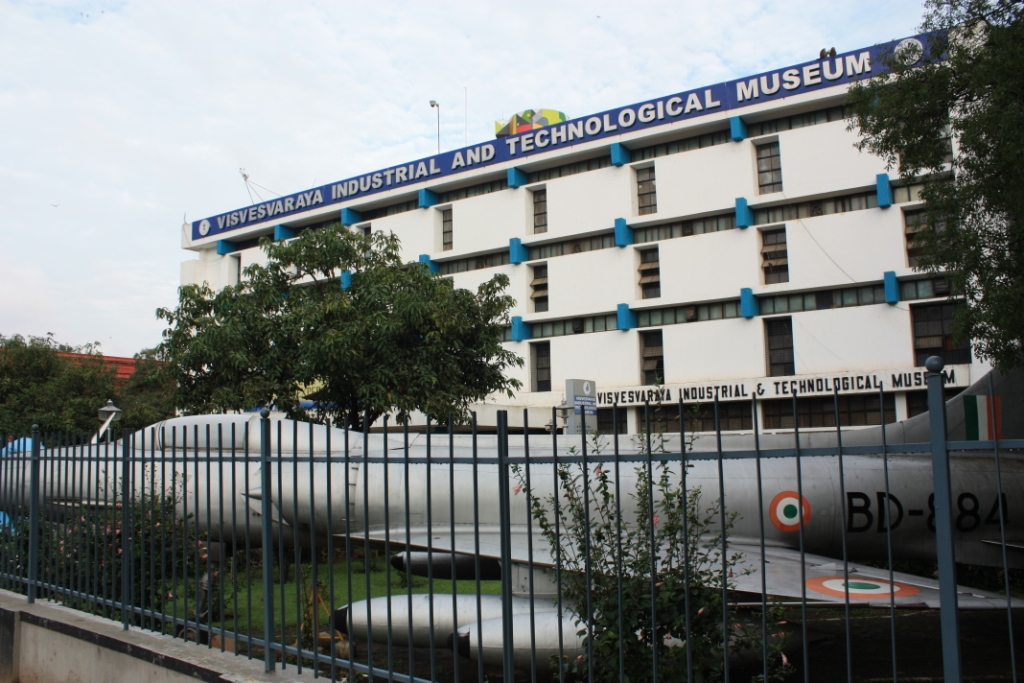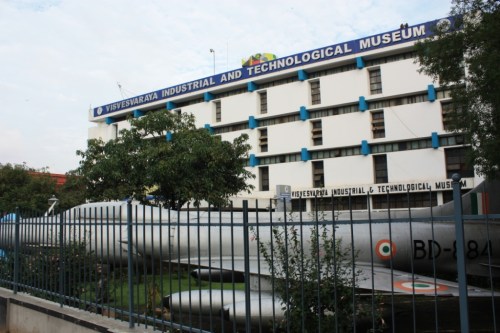
The plane is the HF-24, India’s first indigenous fighter jet (circa 1960’s)
I visited the Visvesvaraya Industrial and Technological Museum last week. I wasn’t sure what to expect. The admission fee is only 30 rupees (less than 50 cents in USD terms.) I ended up being pleasantly surprised. It took me back to childhood visits to Chicago’s Museum of Science and Industry. Granted it’s neither on the scale of the windy city’s museum nor as well-maintained, but it’s largely interactive and has some fascinating–if often retro–displays. It’s great for kids or adults who’d like to revisit the science that they’re forgetting, and to do so in a way that’s entertaining.
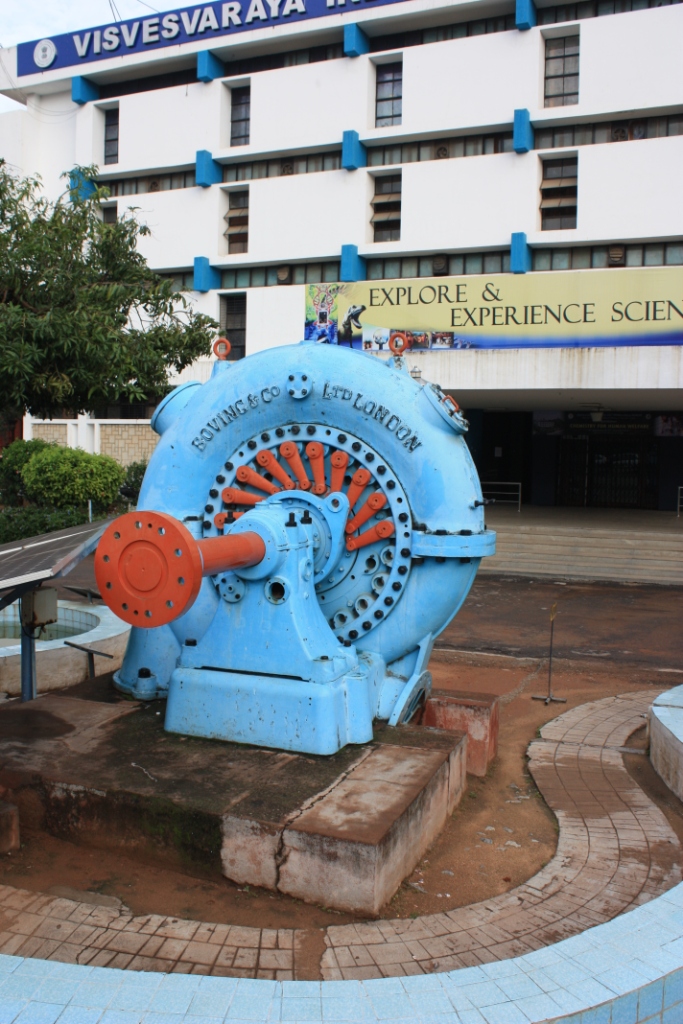
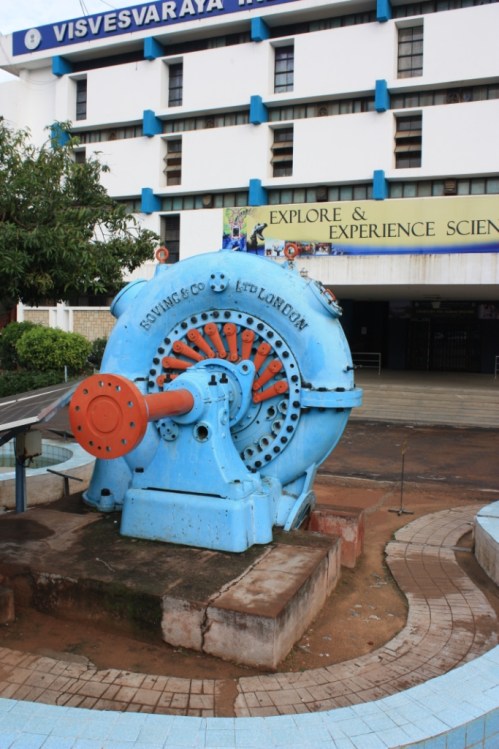
The museum consists of five exhibit halls and a few other stand-alone displays both inside and outside the building. Outside one will see an old locomotive, a copy of India’s first indigenously-built fighter jet, an Archimedes water drill, and a big steam turbine. One’s visit inside, unfortunately, begins inauspiciously with a solitary animatronic T-rex that looks a bit dog-eared.
Also on the ground floor, the first exhibit hall one visits is the Hall of Engines. This covers steam power, gasoline engines, turbines of various forms, as well as displays of human and animal powered technology. There are hand-crankable cut-away scale models that allow one to see how the various engine designs work. There are also cut-aways of some full-sized engines. Overhead there are a series of wire tunnels through which billiard-size balls circulate, having been hand-cranked up into the track by various mechanisms. This, I believe is intended to demonstrate gravity power, which it does in a whimsical Rube Goldberg-esque sort of way. There’s also a video on simple machines that looks like it was initially made for 1950’s school children in America.
There are two exhibit halls on the first floor (that’s the second floor to Americans), one that deals with electricity and another called “Fun with Science” that’s all hands-on exhibits intended to spark the interest of school-aged children. The former covers the basic science of electricity as well as looking at the various generation methods, including nuclear, wind, solar, hydroelectric, and fossil fuels. The latter has interactive exhibits of the kind found in many a science or children’s museum. I would say the exhibits here are largely geared toward middle school and high school students. There is a small exhibit on the top floor that is aimed at young elementary school age students.
The second floor has a biotechnology exhibit hall as well as one that deals with space. The biotech hall covers basic biology, agriculture, and even beer brewing. The space hall discusses the history of space technology and particularly focuses on India’s Chandrayaan-1 moon-orbiting mission. (If you didn’t know that India had orbited the moon and delivered an impactor to the lunar surface, you are in good company. I had no idea either. But this was back in 2008-2009.) Anyway, it was good to see some Indian focus. As I was traveling through the exhibit halls up to this point, it occurred to me that there wasn’t a great deal for the school children passing through this museum to take national pride in. There was a lot of material about discoveries made in places like Germany, America, and Japan, but not a lot of segments on contributions of national scientific heroes as one would expect at such a museum.
The third floor has a full-sized exhibit hall dedicated to electronics and computer technology, and part of one hall that is split between a small “Science for Children” exhibit geared toward young children (pre-school and the younger elementary grades) and a temporary exhibit on chemistry. The chemistry exhibit is the most reading-oriented exhibit, except for a couple of models and a touch screen interactive periodic table, it’s pretty much a poster exhibition. The hall of computers and electronics has many interesting exhibits, such as a cylinder supposedly containing the 42 million transistors that it takes to make up one Pentium 4 processor.
There’s a nice poster exhibit about the 2012 Nobel Prize Winners. I assume this will be updated sometime next month after the new winners have been announced.
All and all, I’d say this museum is a bargain at several times the price.
Share on Facebook, Twitter, Email, etc.

 Night lights by Jozsef Molnar