BOOK: “The Virtues of the Table” by Julian Baggini

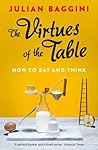
The Virtues of the Table: How to Eat and ThinkThe Virtues of the Table: How to Eat and Think by Julian Baggini
My rating: 4 of 5 stars

Publisher Site – Granta

This book examines the nexus of food and philosophy, from the ethics of butchery to the virtue of authenticity to whether hedonism is a necessary component of eating philosophically. Much of the book challenges or debates conventional wisdoms such as whether local foods are inherently better, whether dining is always and everywhere a social activity (or should be,) and whether organic is always preferable. The book covers a wide variety of topics including: mindfulness, gratitude, skepticism, fasting, willpower, spontaneity, technology, etc.

The book offers many ideas for reflection though sometimes it felt like it rambled on for more than the issue in question necessitated.

Each chapter ends with a discussion of a particular food and its preparation as thought relevant by the author. This is a nice grounding mechanism for discussion that tends otherwise to be cerebral and philosophic.

I’d recommend this book for anyone interested in thinking more about food and its intersection with philosophy of life.

View all my reviews

PROMPT: Pay More Attention

What details of your life could you pay more attention to?

Mental states and somatic & emotional sensations. Sakshi Bhava is good stuff.

PROMPT: Listen

Daily writing prompt
What do you listen to while you work?

I don’t. I could listen to instrumental music while writing or doing other mental work, but I can’t have anything with words / lyrics involved. It’s distracting and can warp my writing.
FIVE WISE LINES [May 2025]

It is a happy talent to know how to play.

Ralph waldo emerson

Just living is not enough… one must have sunshine, freedom, and a little flower.

Hans christian andersen

Don’t abandon kindness, mercy, and sympathy in an emergency.

Qiānzì wén [千字文], Ch. 3

Logic will take you from A to B. Imagination will take you everywhere.

albert Einstein

You must live in the present, launch yourself on every wave, find your eternity in each moment.

Henry david thoreau

PROMPT: Positive Thing

Daily writing prompt
Describe a positive thing a family member has done for you.

Be present.

PROMPT: Positive Change

Daily writing prompt
Describe one positive change you have made in your life.

Daily practice of feeling gratitude. (As opposed to being grateful that one November day a year and wallowing in how horrible everything is the other three-sixty-four.)

PROMPT: Fun… Exercise

Daily writing prompt
What’s the most fun way to exercise?

In the Flow.

Mind Fog [Free Verse]

The fog envelopes me.
I draw vivid pictures
on its white surface.

I don't know how I do it,
But I know why.

It's a craving:
To fill emptiness,
To disallow silence.

The fog's texture is
Subtle, but existent.

Should I not sketch my story
On that white surface,
But rather give it my attention
then I might see that texture,
and then see it clearly,
and - eventually - feel it
as I glide my hand
though space...
Blind and at ease.
FIVE WISE LINES [October 2024]

If any thing is sacred the human body is sacred

walt whitman; Leaves of grass; “I sing the body electric”

Strong in their softness are the sprays of the wisteria creeper;
The pine in its hardness is broken by the weak snow.

Saying of Master Jukyo as Translated by Trevor Leggett in Zen and the Ways

When there is mutual ignorance, confidence indeed is king.

Trevor leggett; Zen and the Ways

Do not see the gate and think it is the house. The house is something which is reached by passing through and going beyond the gate.

YAgyu Munenori’s Art of War (As translated by trevor leggett in Zen and the ways)

Students of the Ways must see clearly that in an untrained man the intellect is like a barrister. It argues clearly and logically, but the aim is not truth, but to reach a predetermined conclusion.

Trevor Leggett; Zen and the Ways

BOOKS: “Zen and the Ways” by Trevor Leggett

Zen and the WaysZen and the Ways by Trevor Leggett
My rating: 5 of 5 stars

Open Library Page

This book is the most densely populated with interesting insights that I’ve read in some time. It’s not new, being first published in 1978, but it takes a variety of approaches to give the reader a better understanding of Zen and the application of Zen mind to martial arts and other activities that found benefit in stillness and clarity. By “the Ways,” Leggett is referring to those arts and activities benefiting from Zen, which include: tea ceremony, flower arranging, painting, poetry writing, and all manner of martial arts. [Often represented by ending “do” in Japanese.] (The latter are dealt with most extensively, but not exclusively.)

The book is arranged in six parts, the first half of which focus mostly upon Zen Buddhism and, particularly, the Kamakura school that found a huge following among warriors and other artists. Those first three chapters take a big to small approach, examining Zen from ever finer levels of detail, starting with an introduction to Zen Buddhism broadly, moving on to the Kamakura developments, and then finally focusing on one particular practice — that of Koans (stories that present riddles which the student can only “solve” in a non-intellectual fashion.)

The second half of the book investigates the ways Zen has been applied to various arts. This is where one sees the varied approaches used to explore the confluence of Zen and artistry. Part Four consists of a series of essays explaining concepts such as ri (universal truth) and ji (formal technique,) ki (vital energy,) and isshin (single-heartedness) / zanshin (lingering awareness.) Part Five consists of historic martial arts scrolls and excerpts, including Yagyu Munenori’s Art of War and Chozan Shisai’s “Tengu’s Guide to the Martial Arts.” The final part consists of stories that illustrate crucial ideas in a readable and memorable fashion.

I was extremely pleased to stumble across a copy of this book in a second-hand bookshop. I’d long ago heard a fascinating story about murders in Edo era Japan of high-level martial artists, all killed in the same manner. They never found the killer, but they figured out how the murders were done easily enough. The killer exploited his knowledge of that school’s techniques to lay a fake that exploited their own technique to create an opening. It’s a cautionary tale that drilling muscle memory is not the end-all be-all of martial arts, and that it can create its own problems. At any rate, I’d never been able to find the source… until now. There is a detailed discussion of it in this book.

For readers interested in how state of mind influences artistic performance, I’d highly recommend this book.

View all my reviews