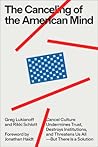
BOOKS: The Canceling of the American Mind by Greg Lukianoff & Rikki Schlott

The Canceling of the American Mind: Cancel Culture Undermines Trust and Threatens Us All―But There Is a SolutionThe Canceling of the American Mind: Cancel Culture Undermines Trust and Threatens Us All―But There Is a Solution by Greg Lukianoff
My rating: 5 of 5 stars

Amazon.in Page

This book presents an in-depth exploration of cancel culture in its many varied manifestations, from both the left and the right of the American political spectrum. The biggest part of the discussion is with respect to the educational system, and particularly higher education. Sadly, this is because the institutions that used to be among the most formidable bulwarks of free speech, expression, and academic freedom have increasingly become untenable to multiple points of view. (The authors point out that there have been more dismissals of faculty members for cancel culture speech and expression issues than there were during the McCarthy era for political stance.)

However, the book doesn’t restrict itself to education, but also investigates cancelations in journalism, publishing, the scientific community, standup comedy, and the medical and psychiatric communities. The authors also present cases of the effect that wokeness and other expression limiting activities are having in these areas. One of the most disturbing revelations to me was the role of wokeness in psychotherapy and the negative effect it may have on people getting the help they need.

The book presents a series of cases in detail to advance the discussion. It also has a couple chapters that examine the tactics that are used to apparently “win” debates by silencing / demoralizing the opposition while avoiding any actual contest of ideas. The authors go through tactics favored by the Right as well as those by the Left. (Though it’s clear that, in a race to the bottom, both sides adopt the approaches of the other side that seem to be effective. e.g. the Left is getting into book banning (historically a Conservative tactic) and the Right is getting into cancelling and shout-downs (usually Progressive tactics.)) I think it was smart to have two authors, one from the left and one from the right, in order to help ensure balance in the project. That said, as the Left has been in the cancel culture vanguard, they come up more often.

Some have called this a sequel to “The Coddling of the American Mind,” with which it shares a co-author, Greg Lukianoff. I don’t know that I’d think of it that way. While it does address some of the same issues as background, psychology and child development are not at the fore in this book (Jonathan Haidt – the other co-author of “Coddling” is a psychologist,) but rather are the legal, cultural, and political issues.  

This is probably the most important book I’ve read this year (and, being late November, it’s likely to retain that status) and I’d highly recommend it for all readers.

View all my reviews

PROMPT: Podcasts

What podcasts are you listening to?

I don’t really, though I do catch YouTube rebroadcasts of Joe Rogan, Lex Fridman, and some standup comics.

PROMPT: Favorite Subject

What was your favorite subject in school?

Depends on the year. In twelfth grade, I remember enjoying Physics the most. In Eleventh, Psychology was the best class I attended. There was a year when I got the most out of an English class that focused on Creative Writing. I guess my most longstanding preference was for classes like Geography and Social Studies, wherein we learned about the world outside our world.

PROMPT: Admired Profession

What profession do you admire most and why?

I most admire Mad Saints / Crazy Sages because it requires great courage to show a path of thwarting convention, and it demonstrates a level of freedom and self-realization unseen, elsewhere.

Furthermore, unlike the other major contenders, there is no bad motive for entering the field. So, if you want to talk on the whole. Many doctors chased pitiful motives like money, prestige, or simply doing what their parents told them to — unquestioningly. Some teachers became teachers based on the June through August dead time or the love of the power to make kids eat their meat by withholding the pudding. But all crazy sages became so because someone needs to point out the world outside the cave, and they had no capacity to do otherwise.

PROMPT: Teachers

What makes a teacher great?

If a student (or students) voluntarily and enthusiastically come to learn from an individual, that individual is a great teacher.

The emphasis is on “to learn” because some people confuse great charisma with great pedagogy, but such people go to the charismatic person to take comfort from being in that person’s presence, not to learn — despite whatever truisms or clever-sounding parallel grammatical structures the charismatic individual might spout.

So, if one would go to an individual seeking knowledge, knowing the experience will be challenging and not merely comforting, one has found a great teacher.

The Most Important Lesson in All of Human Living [DAILY PROMPT]

Describe something you learned in high school.

A Psych teacher told us a story of what he called “a gestalt of expectations.” A man from a city in the East is driving out West, and he passes a gas station – despite being low on fuel. (He’s used to gas stations being everywhere.) Anyhow, he runs out of fuel. He can’t see anything around except desolate desert bisected by a line of asphalt. He decides to walk back to the gas station he passed ten miles back. There is no one traveling on this remote stretch of desert road. As he’s walking in the intense heat, it comes to his mind that the employee at the service station is really going to gouge him on the price of gas and a jerry can. As he walks and walks, skin prickling with the heat, he keeps thinking about how he’s going to get screwed by the gas station attendant and also how he’ll be chided and ridiculed for running out of gas in the middle of the desert. He imagines it in great detail. Finally, bedraggled and with heaving breaths, he arrives at the station. The gas station attendant rushes out to help this poor man, and the man punches the attendant square in the nose (for all the offenses taking place solely in the man’s mind.)

In a broader formulation, I think this is the most important lesson any human can learn. Our personal perception of what we experience is not equal to what it is that we experience (the exterior world.) This is why some people dealt a crappy hand can turn it into a wonderful life, and also why some people who seem to have it all commit suicide in the prime of life.

I could be angered or dismayed that the single most important lesson I learned in secondary school was via off-curriculum ramblings during an elective class, but I choose not to. Instead, I’ve been trying all my life to make that bit of knowledge into wisdom.

BOOK REVIEW: The Power of Podcasting by Siobhan McHugh

The Power of Podcasting: Telling stories through soundThe Power of Podcasting: Telling stories through sound by Siobhan McHugh
My rating: 5 of 5 stars

Amazon.in Page

This book is in part a how-to guide, and in part a history of podcasting’s rise, though a history that tries to look from within rather than from a distance as much as possible. The two major thrusts of the book are story and sound. Of the many varieties of podcasts that exist today, the focus of this book is on ones that are story-centric, be they non-fiction or fiction. [Of course, there’s an argument that all podcasts should employ story to some degree, even if they aren’t of a format that facilitates an overarching story.] McHugh, herself, uses stories and what I’d call meta-stories (i.e. the stories of how various podcast-delivered stories got told) extensively throughout the book.

With respect to sound, there’s a lot of background sound and music that makes the difference between a professional sounding podcast and one that’s not. This is a particularly difficult subject to grasp because – while one often experiences background sound and music drawing one deeper into the story (or – perhaps more accurately – one feels its absence as a vague sense of detachment,) one tends not to be aware of this background audio on a conscious level. Therefore, discussions that point out the thinking about background audio choices can be profoundly eye-opening for a neophyte, such as myself.

When I say that the book has a podcasting how-to aspect, I should emphasize it doesn’t get into the technical aspects (i.e. what kind of mic to buy and how to use it,) but rather it discusses such topics as scripting, interviewing, editing / reorganizing for effect, and starting out. The book also has chapters at the end about increasing diversity in what has been an extremely Caucasian-centric industry as well as offering insight into potential future directions of audio storytelling. Throughout. there are short interviews with individuals with expertise in the industry, and there’s an extensive appendix, listing podcasts and podcasting resources.

If you’re interested in starting a podcast or learning more about podcasting, I’d highly recommend this book.


View all my reviews

BOOK REVIEW: Genius: A Very Short Introduction by Andrew Robinson

Genius: A Very Short IntroductionGenius: A Very Short Introduction by Andrew Robinson
My rating: 4 of 5 stars

Amazon.in Page

This book examines the myths and realities of that state of capability we call genius. It’s not about “geniuses” as individuals who test well on IQ exams, or who are eligible for Mensa membership, but rather about those luminaries who’ve made breakthroughs that changed the course of their discipline. It considers artistic and literary type geniuses (Shakespeare and Picasso) as well as scientific geniuses (e.g. Einstein and Darwin,) as well as discussing the differences (perceived and real) between these groups and the intriguing rarity of crosscutting figures (e.g. Da Vinci.)

The bulk of the book evaluates characteristics that are (rightly or wrongly) commonly associated with genius, including: heredity, education, intelligence, creativity, madness, personality traits, and discipline. Don’t expect clear and straightforward connections. That’s not the author’s fault. There just aren’t any traits unambiguously linked to genius in an uncomplicated way. One might expect education would be an unequivocal boon to genius, but it can be a hindrance to genius in its training of conformity. There may be a disproportionate number of geniuses with mental health issues, but there are even more without them. Hard work maybe a necessary condition, but it’s clearly not a sufficient one.

The book addresses a few other related subjects, beyond the traits associated with geniuses. For example, the degree to which genius can be defined and what it means if we can (or can’t) do so. Few individuals would be unanimously judged geniuses, and to the degree some are, mightn’t that say more about the public’s role in bestowing genius rather than the individual’s earning the designation. There is also discussion about eureka moments versus slow-builds.

This book is thought-provoking and raises intriguing and counter-intuitive debates. If you’re interested in the perception, the reality, and the interplay between the two with regard to genius, check it out.

View all my reviews

Rote Learning [Common Meter]

Words memorized rote are a meal
wholly undigested,
That's why memorization is
utterly detested.

Rote learning is, somehow, bloating
and yet never filling.
One takes it all in by way of 
monotonous drilling,
but while you're still filling your cup
you're already spilling.
You pass your test and purge it all.
It's so unfulfilling. 

If I may, please let me suggest
that here's what you should do:
get the gist, play with it, and find
out what it means to you.

BOOK REVIEW: The Physics of Fun by Carla Mooney

The Physics of FunThe Physics of Fun by Carla Mooney
My rating: 4 of 5 stars

Amazon.in Page

Out: September 15, 2021

This book uses skateboarding, snowboarding, trampolining, music concerts, and video games as a vehicle to teach (middle school-aged) kids some basic physics concepts. I’m not sure why this isn’t the usual textbook approach, teaching lessons via what is of greatest interest to students, but it certainly wasn’t the mode when I was a kid.

While I’m no expert on middle school science curricula, I suspect this book wouldn’t work as a primary classroom text because it doesn’t systematically cover the subject. The chapters on skateboarding, snowboarding, and trampolining explain many terms and concepts of mechanics, but not necessarily everything taught in science class. The penultimate chapter is about waves, both sound and light, and uses the idea of music and laser light shows to elaborate on the topic. The final chapter uses video games as a way to introduce the fundamentals of electricity and circuits.

I think this book is at its best when it is breaking down the physics of tricks in the first few chapters. That’s where it separates itself from the usual dry textbook approach, and any improvement in the book would be seen following that line. Granted, some topics are more amenable than others.

The book has a glossary and each chapter ends with hands on exercises students can do to improve their understanding of the material considered. The graphics are widespread and include cartoons, diagrams, and photos.

If you’re looking for a book to get a child excited about science, give this one a look – particularly if the child is interested in extreme sports.


View all my reviews