Unknown's avatar

About B Gourley

Bernie Gourley is a writer living in Bangalore, India. His poetry collection, Poems of the Introverted Yogi is now available on Amazon. He teaches yoga, with a specialization in pranayama, and holds a RYT500 certification. For most of his adult life, he practiced martial arts, including: Kobudo, Muay Thai, Kalaripayattu, and Taiji. He is a world traveler, having visited more than 40 countries around the globe.

Dragonhead [Tanka]

dragonhead
rises up out of a cloud,
over the city.
how many see the cloud,
but not the dragon?

FIVE WISE LINES [September 2025]

The aim of introduction is to conceal a person’s identity.

George Mikes, How To Be an Alien

From the beginning our philosophers have tried to teach us how to die,
and our poets have taught us that to contemplate death
is to learn to live.

Jonathan weiner, Long for this world

Nothing is harder to see into than people’s natures.

Zhuge liang [a.k.a. Kongming], The WAy of the General

To know how to eat is to know how to live.

Auguste Escoffier

Reality can be beaten with enough imagination.

Mark twain

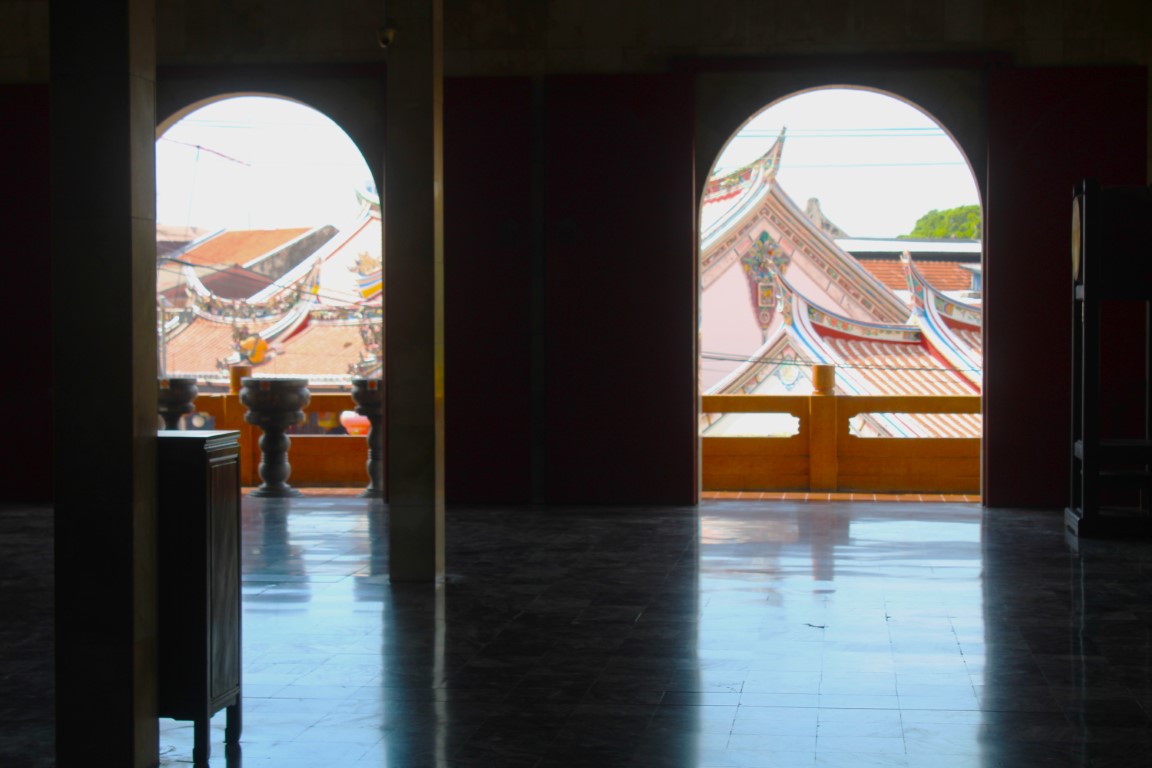
DAILY PHOTO: Scenes from the Temple of Literature [Văn Miếu]

BOOK: Sát Thát by Lê Vân [Illustrated by Nguyễn Bích]

Sát ThátSát Thát by Lê Vân
My rating: 4 of 5 stars

Publisher Site – Kim Dong Books

This illustrated book tells the story of the Vietnamese (Tran Dynasty) victories over the invading Yuan Dynasty (Mongolian-controlled China.) It’s a quick read with only a few lines of text per page, while the bulk of each page is a line-drawn monochrome illustration. The illustrations themselves are sufficiently clear and detailed to allow one to follow the general flow of the story.

I used a translator and don’t know how accurate it was or –more particularly — how true to the original it was, except to say that the translator produced a coherent story that seemed to be consistent with other sources.

This book focuses entirely on the military campaigns and takes a bit of a jingoistic tone. As I understand it, it doesn’t tell the whole tale as many consider the Mongol incursions to have been successful because they exacted a tribute from the Vietnamese (which was their ultimate goal,) despite the Mongols’ lack of military success. That said, it was an impressive set of military victories for the Tran Dynasty, and the Vietnamese have every right to take pride in them.

I discovered this book in the publisher’s bookstore in Hanoi and thought it was a small enough text with sufficiently detailed illustration to give me some insight into the story, even without any real grasp of the language. I did find reading the book to be informative and interesting and would recommend it for readers military history.

View all my reviews

Ripple Chaos [Haiku]

raindrops ripple paddy water; 
wavelets wrap into grain stalks.

Cascade [Haiku]

after the rains,
water cascades in ways
never seen before.

DAILY PHOTO: God’s Eye Mountain, Cao Bằng

BOOK: “The Future of Humanity” by Michio Kaku

The Future of Humanity: Terraforming Mars, Interstellar Travel, Immortality and Our Destiny Beyond EarthThe Future of Humanity: Terraforming Mars, Interstellar Travel, Immortality and Our Destiny Beyond Earth by Michio Kaku
My rating: 4 of 5 stars

Author Booksite

As the title suggests, this is one of the books for which theoretical physicist Michio Kaku dons his futurist cap to speculate about what is to come. Other of his books that might be included in this “series” are: Visions, Physics of the Future, The Future of the Mind, and Physics of the Impossible. This particular book focuses on how humanity will spread beyond the planet (and, perhaps, beyond the universe) to survive the (probably distant, but – also – inevitable) threats to the species. While there are other topics discussed, such as the search for immortality and transhumanism, those topics are often framed as necessities of interstellar expansion.

As one would expect of a physicist, the book is highly focused on the physics of the subject. There is little discussion of the psychological difficulties, nor of biological issues such as the fact that humanity is not so lone wolf as we think, and taking off to other planets and living in space without the Earthly life we are interdependent on would involve challenges we have difficult fathoming. All of the challenges that are usually treated with handwaves in science fiction are also handwaved off here.

The book is fun and interesting reading. It’s probably more insightful of science fiction than of our future, but that doesn’t make it less compelling. The seven years since this book was published have seen a lot of change, and there may be a book on this subject that has more of a finger on the pulse, but I still enjoyed reading it. [The downside of writing about the future, even with a focus on the distant future, is that one risks becoming obsolete rather quickly.]

If you’re interested in how humanity might survive into the future, I’d recommend this book. If you enjoy popular science and / or science fiction, you’ll probably find it intriguing.

View all my reviews

PROMPT: Favorite Word

What’s your favorite word?

“Sword” is “words” with a simple swap where the word leapfrogs its ass, and yet they are unrhymable with each other. That’s a word with some sort of voodoo magic.