"Faith" is a fine invention
For Gentlemen who see!
But Microscopes are prudent
In an Emergency!
Tag Archives: science
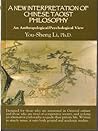
BOOKS: “A New Interpretation of Chinese Taoist Philosophy” by You-Sheng Li
A New Interpretation of Chinese Taoist Philosophy by You-Sheng LiMy rating: 4 of 5 stars
Google Books Page
By the author’s admission (and the title, for that matter) this is not so much an overview of Taoist philosophy as a philosophical rendering that attempts to not only be consistent with the Taoist tradition, but also with our present-day understanding of the world. This fact has positive and negative ramifications for readers, and results in a book that will be more useful for the purposes of some readers than others.
The biggest positive is that this interpretation of Taoism is consistent with a modern rationalist worldview. Taoism is a huge system of thought and includes a lot of magical, supernatural, and astrological thinking. In short, a book on Taoist thought could contain a great deal of woo woo, but this one does not. It has not much to say on demons, deities, magic, alchemy (in the narrow, original meaning,) etc., and to the degree these subjects do crop up they do so in a way that is not arcane and doesn’t insist on belief in unsupported ideas. I think this makes this book important, as it fills a niche. Most of the central texts of Taoism were written in times that were different from our own and in which magic and the supernatural were taken for granted. So, if you want a text that draws on major ideas of Taoism but presents them in a way that is consistent with science, you may want to give this book a look.
The biggest negative is that when the book is not explicitly describing the teachings of historical figures, one doesn’t necessarily have a good way of knowing how much Li’s ideas are or aren’t consistent with Taoist tradition. There are extended discussions of ideas such as evolutionary biology and existentialism, and — unless one has a great depth of knowledge of Taoism to begin with — it can be hard to see whether Li’s views on these subjects are in line with Taoist philosophy or whether twists are being made. The most extensively discussed / cross-cutting idea of the book is that of differentiating primary from secondary society and proposing a primacy of primary society in Taoist thought. I can’t say I’ve read much elsewhere that would suggest this was a core idea for Taoists, but the political philosophy of Taoism is not an area with which I’m at all well-acquainted.
I found this book interesting and thought-provoking. I also felt it was much needed to have a scientifically consistent approach to Taoism. If you are looking for such discussion, I’d recommend this book.
View all my reviews
BOOKS: “Moonwalking with Einstein” by Joshua Foer
Moonwalking with Einstein: The Art and Science of Remembering Everything by Joshua FoerMy rating: 5 of 5 stars
Author’s Book Site
This fascinating work of immersion journalism offers insight into the human memory at its best (and worst,) and throughout the book one follows the author’s experience in preparing for and competing in the American and World Memory Championships. A central theme of the book is how humanity’s attitudes toward (and approach to) memory have changed over time. The tactics that allow competitive mnemonists to perform astounding feats of memorization were well-known in the ancient world and Middle Ages but began becoming less practiced from the dawn of the printing press, becoming almost unheard of by the general population in this, the internet age. Questions such as whether education’s shunning of memorization is, indeed, a sound move are explored. (The mnemonists argue that memorization is done poorly by our educational system, but — if it was done correctly — it would offer tremendous value.)
I found this book to be quite compelling. Foer pulls no punches when presenting individuals who are (or appear to be) charlatans — though in a way that is fair and doesn’t deny things are not always straightforward. (Most of the mnemonists he talks to are clear that they do not have particularly good memories but rather are well-practiced in a set of techniques — e.g. the “memory palace” — that allow even mediocre memories to memorize stacks of cards, chains of random numbers, or even poems at lightening speeds.) Hence the author, with no such background, can learn the skills well enough to be competitive in the US national competition after practicing about a year.
The author speaks to semi-celebrities such as Kim Peek (whom Dustin Hoffman’s character in “Rain Man” is very loosely based upon,) and self-help guru Tony Buzan. But he also interviews a man who has no long-term memory (except from his childhood) and speaks to experts in optimal human performance.
I’d highly recommend this book. It is intensely readable. The stories are riveting and sometimes humorous and the throughline of Foer’s preparation and competition just add icing to the cake.
View all my reviews
“O sweet spontaneous” by E.E. Cummings [w/ Audio]
O sweet spontaneous
earth how often have
the
doting
fingers of
prurient philosophers pinched
and
poked
thee
, has the naughty thumb
of science prodded
thy
beauty how
often have religions taken
thee upon their scraggy knees
squeezing and
buffeting thee that thou mightest conceive
gods
(but
true
to the incomparable
couch of death thy
rhythmic
lover
thou answerest
them only with
spring)
When I Heard the Learn’d Astronomer by Walt Whitman [w/ Audio]
When I heard the learn'd astronomer,
When the proofs, the figures, were ranged in columns before me,
When I was shown the charts and diagrams, to add, divide, and measure them,
When I sitting heard the astronomer where he lectured with much applause in the lecture-room,
How soon unaccountable I became tired and sick,
Till rising and gliding out I wander'd off by myself,
In the mystical moist night-air, and from time to time,
Look'd up in perfect silence at the stars.
BOOKS: The Second Law by Stephen Wolfram
The Second Law: Resolving the Mystery of the Second Law of Thermodynamics by Stephen WolframMy rating: 4 of 5 stars
Amazon.in Page
This book has an intriguing premise but a bizarre organizational scheme. The book offers insight into the Second Law of Thermodynamics couched as the author’s personal journey of discovery. Put simply, the Second Law says that entropy increases, or the coffee cup next to me can fall and break into many pieces but it can’t / won’t reassemble itself, alternatively, I can mix milk into the coffee in the cup, but not unmix the milk out of it. Of course, this simplification is — in fact — a massive oversimplification and there are a number of definitions of entropy and different ideas on the conditions under which its increase holds and why. This is part of what the book investigates.
Let’s start with the book’s intriguing premise. It is that: a.) the Second Law and its implications are not as well (or fully) understood as the scientific consensus suggests, and b.) the key to understanding entropy’s increase may be found in the concept of computational irreducibility. This all ties to Wolfram’s work with cellular automata and the finding that apparent randomness can come about from a simple set of rules that are non-random. In other words, cellular automata could produce a pattern that can only be determined by re-running said simple set of rules — i.e. there would be no way to compute it. As (apparent) randomness plays an important role in the Second Law, Wolfram proposes a connection that has ramifications for critical issues like reversibility. (Remember we can’t unmix the milk out of the coffee [without expending more energy and within the confines of an open system] or so it’s believed.)
When I say the book’s organization is strange, I do so with the assumption that the intended readership includes those who are scientifically literate but not expert in thermodynamics or physics. The first part of this strangeness is that the body of the book concludes with an overview of the development of the Second Law (arguably this is information a non-expert reader might benefit from having up front.) The second element of strangeness is that much of the latter part of the book is just connective tissue between excerpts of other people’s writing on the subject. This increases the page count tremendously and doesn’t serve readability well.
The book does have a good deal of interesting and informative graphics. It also has copies of scholarly papers and relevant chapters from Wolfram’s previous book, “A New Kind of Science” for those who are capable of, and interested in, taking a deeper dive into the science and mathematics under consideration.
I found this book to be thought-provoking if a bit tedious to read in places. If you’re interested in the Second Law, it’s worth reading and may shed new light on the topic.
View all my reviews

PROMPT: Topics
Which topics would you like to be more informed about?
I’d love to know why the fundamental equations and constants that govern the universe appear to be tailor-made to generating life?
I’d love to know whether there is other intelligent life in the universe, and – if not – why not? (And, if so, have they visited, are they visiting, do they intend to visit, and – if none of the above – why not?)
I’d love to know whether there is meaning to life other than moving energy to higher states of entropy in a Sisyphean fashion (and any other meaning that one independently chooses for one’s self?)
But I’m doubtful any of that will be clarified in my lifetime, so I guess I’ll have to stick to more down to earth topics, such as: “Is ‘a good life’ a meaningful statement, and – if yes – how does one go about pursuing one.”
Burning Sensation [Free Verse]
What's this world?
It's energy playing a game,
a game whose goal is to be rid
of an intense burning sensation,
a burning sensation caused by
low-entropy energy sitting
around with nothing else to do
but burn brightly.
We, the wasters of energy, are
a soothing lotion to the universe,
expediting the making high-entropy,
soothing, tepid energy from
all those stars --
i.e. the universe's poison ivy.
DAILY PHOTO: Museum of Science & Industry, Chicago
BOOK REVIEW: Global Catastrophes: A Very Short Introduction by Bill McGuire
Global Catastrophes: A Very Short Introduction by Bill McGuireMy rating: 4 of 5 stars
Amazon.in Page
This book explores a select set climatological, geological, and extraterrestrial impact disasters and their potential planet-wide repercussions. About half of the book deals with climate: global warming and the next ice age. [Those sound like completely unrelated topics, given global climate disruption is largely about a rise in average temperatures (which has been caused by human activities) and the coming ice age is about cooling (which is mostly because of factors outside our control — e.g. our orbital path and axial tilt — but there’s a discussion about how global warming might hasten (rather than stave off) the ice age.]
The other half of the book is about the more dramatic geological and extraterrestrial threats. There’s a chapter (ch.4) about volcanos, earthquakes, and the tsunamis they cause, and the last chapter (ch. 5) is about comet and asteroid impacts.
The book contains a great deal of thought-provoking information. There are two major criticisms to be leveled. First, it leaves some important items undiscussed – e.g. there’s nothing about the solar storms that I’ve heard constitute a planetary risk. (I do understand that technologically induced catastrophes are another book entirely.) Also, there’s little mention of the mitigative activities that are in place and what impact they might have. For example, I know NASA and others have developed technologies to not only monitor but also destroy impactors. (The author mentions monitoring but says nothing of mitigative activities.) I can’t condemn these omissions severely because this is a “very short” guide. The second criticism is potentially more concerning and that is that the tone isn’t the completely objective one we’re used to hearing on scientific subjects. I don’t fault the author for having some angst about climate change or super-volcanoes, but I am left to wonder degree of confirmation bias crept into the selection of research presented. (All “sky is falling” with no discussion of possible mitigative events or best-case scenarios sets my Spidey-sense a tingling.)
This is a fascinating look at catastrophes, though the complete doom and gloom tone of the author made me wonder whether confirmation bias might be at play (or maybe there was a presumption about what people who would read such a guide may want to hear.)
View all my reviews