Kipling called prostitution
The world's oldest profession.
Now, I'm pretty sure that it
Will be the last, as well:
The last professional endeavor --
The last profitable activity --
That humans do better than
Machines.
Whores will be the last holdouts
To shift from being workers
To being Artists of Humanity. . .
Or - maybe - they will be
The first in that, as well.
Tag Archives: arts
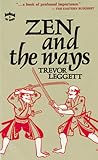
BOOKS: “Zen and the Ways” by Trevor Leggett
Zen and the Ways by Trevor LeggettMy rating: 5 of 5 stars
Open Library Page
This book is the most densely populated with interesting insights that I’ve read in some time. It’s not new, being first published in 1978, but it takes a variety of approaches to give the reader a better understanding of Zen and the application of Zen mind to martial arts and other activities that found benefit in stillness and clarity. By “the Ways,” Leggett is referring to those arts and activities benefiting from Zen, which include: tea ceremony, flower arranging, painting, poetry writing, and all manner of martial arts. [Often represented by ending “do” in Japanese.] (The latter are dealt with most extensively, but not exclusively.)
The book is arranged in six parts, the first half of which focus mostly upon Zen Buddhism and, particularly, the Kamakura school that found a huge following among warriors and other artists. Those first three chapters take a big to small approach, examining Zen from ever finer levels of detail, starting with an introduction to Zen Buddhism broadly, moving on to the Kamakura developments, and then finally focusing on one particular practice — that of Koans (stories that present riddles which the student can only “solve” in a non-intellectual fashion.)
The second half of the book investigates the ways Zen has been applied to various arts. This is where one sees the varied approaches used to explore the confluence of Zen and artistry. Part Four consists of a series of essays explaining concepts such as ri (universal truth) and ji (formal technique,) ki (vital energy,) and isshin (single-heartedness) / zanshin (lingering awareness.) Part Five consists of historic martial arts scrolls and excerpts, including Yagyu Munenori’s Art of War and Chozan Shisai’s “Tengu’s Guide to the Martial Arts.” The final part consists of stories that illustrate crucial ideas in a readable and memorable fashion.
I was extremely pleased to stumble across a copy of this book in a second-hand bookshop. I’d long ago heard a fascinating story about murders in Edo era Japan of high-level martial artists, all killed in the same manner. They never found the killer, but they figured out how the murders were done easily enough. The killer exploited his knowledge of that school’s techniques to lay a fake that exploited their own technique to create an opening. It’s a cautionary tale that drilling muscle memory is not the end-all be-all of martial arts, and that it can create its own problems. At any rate, I’d never been able to find the source… until now. There is a detailed discussion of it in this book.
For readers interested in how state of mind influences artistic performance, I’d highly recommend this book.
View all my reviews
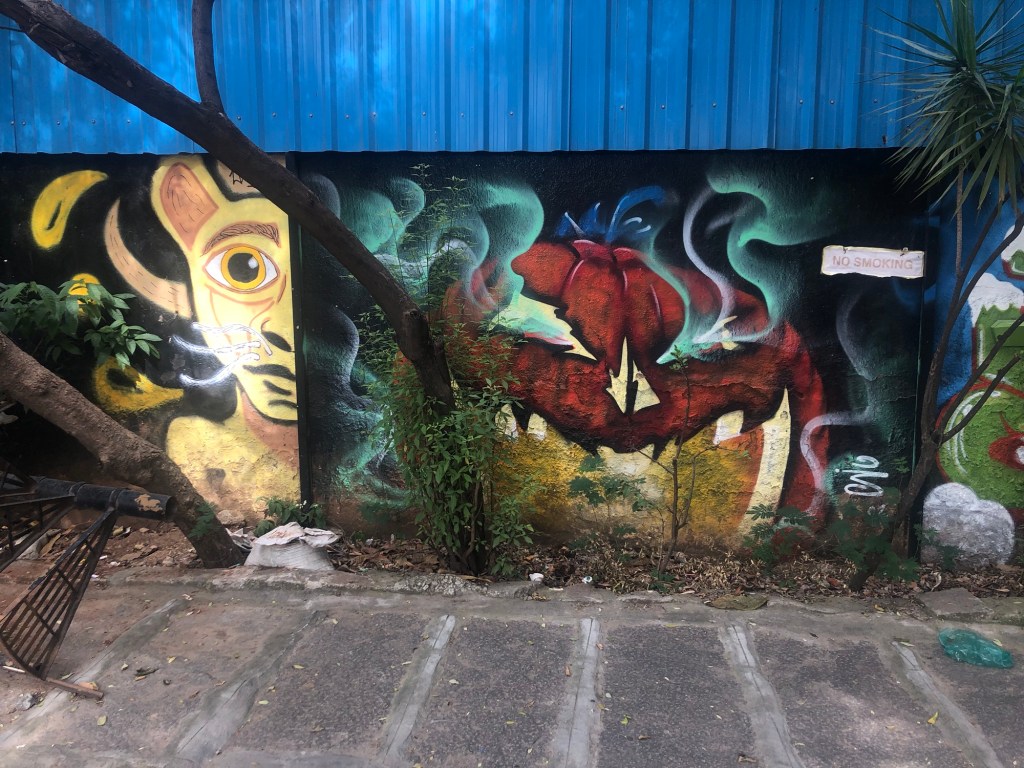
DAILY PHOTO: Bangalore Creative Circus


DAILY PHOTO: Sculptures of Cafesjian Center for the Arts
BOOK REVIEW: The Art of Auditioning, Second Edition by Rob Decina
The Art of Auditioning: Second Edition by Rob DecinaMy rating: 4 of 5 stars
Amazon.in Page
This is a revised edition of a book about how to audition for television shows. The first edition was written in 2004 by a successful casting director (now VP for Casting at CBS) and teacher of casting, and the revision includes industry changes due to technology and the pandemic. For example, it explores the post-COVID shift toward more self-taped auditions and the best practices for them. It also has a few new notes about how the author’s perspective has changed on an issue or two with his new experiences.
This book is niche. Except for a chapter on how to become a casting director, it’s all about preparing actors to audition for a television series. While it might seem that auditioning would be auditioning, apparently television auditioning is quite different from stage auditions and even a little bit different from other on-camera auditioning (e.g. for movies.) To a neophyte, such as myself, the book might be expected to present teachings about acting, but one of the major recurring themes is that acting and auditioning are separate (if related / overlapping) skills and that the latter presents a number of additional considerations. It’s these considerations that are explored in the book – e.g. how to plan and determine your own acting choices (being undirected,) how to behave before and after the audition, how to know what are good or poor investments for a new actor, and how to not be unappealing or ridiculous with your attempts to distinguish yourself.
The book is honest and direct, to the point that the most frequently repeated advice is to not expect to get the job. That’s probably also among the book’s most controversial advice, but the author feels it helps new actors to get out of their heads, to deal with the tons of rejection all of them will face, and to not fall into the bad behaviors that some novice actors think will help to separate him from the pack [while such behaviors often only serve to annoy the casting agent.]
As I said, it’s niche, but if you want to learn how auditioning works or how the sausage is made in the entertainment industry, it’s a quick and well-organized read.
View all my reviews
BOOK REVIEW: The Essential Guide to Being Hungarian Ed. by Istvan Bori
The Essential Guide to Being Hungarian: 50 Facts and Facets of Nationhood by ISTVAN BORI
My rating: 4 of 5 stars
This book is a collection of 50 short essays on various topics (origins, history, arts, sciences, products, and entertainment) as they relate to Hungary and Hungarian-ness. There isn’t a great deal of depth to most of the essays, and so this isn’t the book for someone who is well-acquainted with Hungary and Hungarians and wants a deep level understanding. However, it would be a very useful and easily digested resource for travelers visiting Hungary who want insight into this smallish nation with its very long history. For those familiar with Hungary, this nation has a national character that is quite unique and which is characterized by intelligence, solitariness, and a certain variety of gloominess.
Hungary has had a much larger impact on the world than either its size would suggest, or than most of the world recognizes. Famously, the Manhattan Project, which produced the first atomic bomb, wouldn’t have achieved success in such a rapid timeframe—if at all–if it weren’t for a slate of Hungarian-educated scientists including Edward Teller, Leo Szilard, Eugene Wigner, and Jon Von Neumann. Few of his peers would have disputed the statement that Von Neumann was the smartest person on the planet during his day. Challenging explosives calculations that made the atomic bomb possible are just part of a legacy that also included being the father of game theory–an approach to strategic interactions that is in widespread use in Economics and the social sciences today.
There are some areas in which Hungary has certain niche. For example, while Hungary might not be thought of as an athletics powerhouse, generally speaking, the Hungarians dominate in the sport of water polo and are frequently strong contenders in some swimming events.
This book’s chapters are roughly organized, but not formally grouped, into alike topics. For example, foods, beverages, spices, and desserts are all one after the other. Various history topics are presented together, and the same is true of the arts. Some of the chapters are on much more concrete topics than others. For example, there are chapters on “Fate” and “Soul” up front that are more conceptual than the average chapters. As I indicated, this is a collection of essays by various authors, and that means that there’s not a solitary tone and approach throughout the book. However, there was a single chief editor, and so the chapters aren’t distractingly disparate either.
I believe the book was unfortunately named. “The Essential Guide to Being Hungarian” makes it sound as if this would be a perfect gift for the children of emigrants, i.e. people who’ve visited the country and spent time around Hungarians, but who want to learn more about their native culture. It probably doesn’t give enough depth and new information for such people. For example, the chapters on cuisine talk about pogácsa and gulyas (i.e. goulash), and don’t delve into the exotic, but rather stick with the everyday cuisine with which any visitor to Hungary will already be familiar. On the other hand, tourists and travelers for whom this book might be ideal could be led astray, thinking the book is offering them more depth than they want, need, or can reasonably digest. That being said, there are chapters on niche subjects such as “contemporary writers” or “folk dancing” from which even a veteran visitor to Hungary might pick up something new.
I’d recommend this book–particularly for those who haven’t yet spent a great deal of time in Hungary or who work or interact with Hungarians and want more insight into their nature. Each essay is short and easily digested.
Teachable and Unteachable Lessons
[Note: This is posted in my Jissen Budōka blog as well.]
Miyamoto Musashi, who was undefeated in over 60 duels, claimed that he never had a teacher. Some historians refute this claim. Whether one accepts it or not, the statement astonishes.
Musashi wasn’t talking only about martial arts, but about the many areas in which he was accomplished. Not being a painter or a sculptor, I can’t say how important a teacher is in such domains. But it’s easy enough for me to imagine a successful writer who never took a formal class in writing; someone who read profusely and practiced his (or her) craft relentlessly could do it. (Certainly, one can easily imagine successful writers whose formal education was in some area other than writing because there are so many of them–probably at least as many as those whose education was in writing. Examples include: Vonnegut [Chemistry], Crichton [Medicine], Zane Grey [Dentistry], Ursala LeGuin [Anthropology], and J.K. Rowling [French]. That’s not even to start on the many literary legends who dropped out all together– e.g. Dickens, Faulkner, Twain, H.G. Wells, and Jack London.) This isn’t to say that writing teachers don’t make writing better, but just that there is a path to this skill that doesn’t involve being fed lessons.
However, I struggle to imagine a martial artist achieving so much without a teacher. Boiled down to its most workaday definition, a martial art is a collections of lessons about what works in a combative situation. This is what separates the importance of a teacher in martial arts from that of a discipline like writing. In writing, one has the leisure to make one’s mistakes, learn from them, and self-apply course corrections. Musashi was in life or death duels; he couldn’t learn lessons at such a leisurely pace and in such an iterative fashion.
A martial arts teacher has a number of roles, such as preventing inertia (slacking) from taking hold in the training hall. However, the most fundamental purpose is to pass along the collection of lessons so that a student doesn’t have to learn them all by way of personal experience. Most of us aren’t Miyamoto Musashi; we can’t survive the process of learning all our own lessons.
Needless to say, I am a firm believer in the value of a good teacher. I’ve had several over the years, and I received valuable lessons from all of them–all with different, but no less valid, points of emphasis and flavor.
Having said all that proceeds, there’s much that cannot be taught. Such lessons may be described or discussed, but they cannot be learned except through the initiative of the student. I said that most of us can’t survive the process of learning all one’s own lessons, but I’ve increasingly come to believe that one can’t survive learning none of them either. In the beginning, one must be fed the lessons from a teacher in order grow. However, as the decades pass, one increasingly needs the space to learn one’s own lessons. If one lacks said space, one will stagnate and eventually the wheels will roll off one’s training altogether.
So what are the unteachable lessons? Knowledge can be conveyed, but not everything that a martial artist must learn is knowledge. Confidence cannot be taught. A teacher may explain–or even show–how he or she became confident, but that won’t translate one iota into the student being more confident. This is like a Buddhist monk telling one that “desire is the root of suffering.” One may understand that statement. One may believe the statement. However, one’s suffering won’t decrease because one has the knowledge. One’s suffering will only decrease if one conscientiously does the hard work of reducing one’s desires.
Another area of unteachable lessons are the lessons that the teacher has never learned. Loyalty is a great virtue, and so there may be a tendency to restrict one’s learning to the lessons of one teacher. However, even if one has an outstanding teacher and are practicing a great lineage, blind spots happen. The only way to learn whether there is anything of value obscured in those blind spots is to throw off one’s blinders and have a look for oneself.
What blinders? An excellent and tricky question. It’s like when someone says, “it’s not what you said, but the way you said it.” We all understand that there is some intangible character in language that is commonly understood but not easily seen or defined. In any culture (and a dōjō contains a culture, believe me) there’s always a collection of norms, rules of thumb, ideas, beliefs, mores, credos, etc. that come to be taken so much for granted that they become an invisible filter through which one sees the world. This isn’t an inherently bad thing, and it’s probably necessary to produce sufficient order in a chaotic world in which to learn and grow. Having said that, some of the ideas and beliefs in our cultural filter may be arbitrary, or at least not universal, but yet we don’t necessarily see the potential for error because we are seeing the world through the cultural filter. We take for granted that grass is green, but what if we see it through a yellow filter? Then it’s blue. Right?
BOOK REVIEW: Classic Haiku ed. by Yuzuru Miura
Classic Haiku: A Master’s Selection by Yuzuru Miura
My rating: 5 of 5 stars
Classic Haiku is a collection of 106 poems by masters such as Matsuo Bashō, Kobayashi Issa, and Yosa Buson. It’s logically arranged into five sections: Spring, Summer, Autumn, Winter, and New Year’s Day. While haiku has come to be thought of as any poem in a 5-7-5 syllable arrangement, those familiar with traditional haiku know that there are other requirements that are at least as fundamental as the syllabic arrangement. One of these is that the poem be pure observation devoid of exposition. Another criteria is that it be rooted in nature. A final criteria, historically, has been that the poem indicate the season, if not giving an explicit seasonal word or phrase. This makes the season an optimal organizational unit for the book.
One nice feature of this book is that it includes the English translation, the Japanese romaji version (i.e. the way it would be spoken in Japanese but using roman alphabet characters), and the version using the Japanese system of writing. Granted, for those who aren’t fluent in Japanese, these features might not seem to add much. However, sound can be evocative itself in poetry, and so it can be interesting to read the Japanese for that reason. Furthermore, there are those who argue that 5-7-5 syllables is not the closest facsimile to Japanese haiku for haiku written in English. Because of the average length of syllables, some say that a 2-3-2 accented syllable pattern for English haiku is closer to the original Japanese form. Reading the Japanese, gives one an idea of the sound characteristics of Japanese haiku.
[Furthermore, if one loves a haiku enough to want to get it tattooed in Japanese on one’s body, one can double-check the characters before one gets it done at a Chinatown tattoo parlor only to find that what one really has tattooed on one’s butt is, “Syphilitic nightmare – Ketchup bottle mayhem day – Rides the goat to school”]
Here’s a sampling my favorites:
the raftsman’s straw cape
brocaded with
the storm-strewn cherry blossoms
– Yosa Buson
calm and serene
the sound of cicada
penetrates the rock
– Matsuo Bashō
in summer grasses
are now buried
glorious dreams of ancient warriors
– Matsuo Bashō
oh, cricket
act as grave keeper
after I’m gone
– Kobayashi Issa