Tag Archives: Art
BOOK REVIEW: Zen Art for Meditation by Stewart W. Holmes and Chimyo Horioka
Zen Art for Meditation by Stewart W. HolmesMy rating: 5 of 5 stars
Amazon.in Page
This is a clear and insightful exploration of what puts the Zen in Zen art. Zen Buddhism has long been associated with mind states conducive to peak performance in everything from tea making to swordsmanship. This book examines how Zen philosophy and mindset shows up in paintings and haiku poetry.
Fifteen tenets of Zen are presented, and for each of them two paintings (i.e. sumi-e) and several poems (i.e. haiku or tanka) are shown that have subject matter exemplifying the precept in question. The text points the way to understanding how the art is informed by Zen ideas.
I’ve read other books on the nexus between Zen and art, but this one became my favorite. It is concise, well-organized, and illuminating. There are a number of classes of people for whom I’d highly recommend this book. If you are studying Zen meditation (or peak mental performance more generally,) this book is for you. If you are a poet interested in Japanese forms, this book is for you. If you are an artist or a student of Chinese and Japanese painting styles, this book is for you. And, if you are interested in philosophy, be it Buddhist philosophy or aesthetics, this book is for you.
View all my reviews
BOOK REVIEW: Zen in the Art of Writing by Ray Bradbury
Zen in the Art of Writing by Ray BradburyMy rating: 5 of 5 stars
Amazon.in Page
I rarely re-read books, but I’m glad that I revisited this one. I think I read it more smartly on the second go — more in a way that benefited from Bradbury’s style and message. The book’s nine essays, capped by a small collection of poems, convey lessons on writing, and – specifically – creativity in writing. Bradbury was among my favorite authors because he combined brilliant language with clever stories – i.e. he was creative on both levels. That’s a rarity. There are many excellent storytellers whose language lacks poetry or finesse. And, there are writers who are eloquent and evocative with language, but who either care little for, or have limited gift for, story.
While Bradbury claimed no expertise in Zen and doesn’t hide that he cribbed his title from a popular work by Eugen Herrigel entitled, “Zen in the Art of Archery,” it remains an appropriate title for the book and its eponymous final essay. Throughout the book, one can feel the Zen in Bradbury’s writing. He lets his words and analogies flow without becoming obsessively analytical about them – or at least appearing not to have been. Bradbury uses a lot of short, punchy sentences and a great many poetic applications of figurative language. He practices what he preaches as he both gives lessons and simultaneous demonstrations on how to write. His advice ranges from using single word writing prompts to shake one out of writer’s block, to the very Zen idea of avoiding thought – i.e. letting the words come from the subconscious. Lest one think that there is a conflict in a book on creativity that draws from another book’s title, there’s a recognition that creative writing is never wholly novel.
This book is well worth reading, not just for writers but for other artists and creative types as well. I highly recommend it.
View all my reviews
DAILY PHOTO: Krog Street Art
BOOK REVIEW: The Three-Cornered World by Natsume Sōseki
The Three-Cornered World by Natsume SōsekiMy rating: 5 of 5 stars
Amazon.in Page
This novel was originally entitled Kusamakura or “Grass Pillow,” and it’s the Alan Turney translation that bears the title The Three-Cornered World. Turney drew from a concept that Natsume presents in the book – i.e. that an artist lives in the triangle created by the collapse of a corner called common sense. It’s a poetic and philosophical novel that is very much character-centric. In other words, if you must have an intriguing story, this book is not so much for you. However, if you find ideas and clever use of language appealing, you’ll love it.
The premise is that an artist takes retreat in the mountain countryside, and becomes infatuated with a local woman with a storied past. As the book tells us of the artist’s experience, it discusses aesthetics, the philosophy of art, and the place of emotion in artistic experience. This book is often compared to Bashō’s travelogue (i.e. Narrow Road to the Deep North) as it involves a great deal of elegant imagery and the occasional interspersed poem.
While the book is light on story, I was wowed by the author’s thought process and his use of language. While I’ve never read the original in Japanese, Turney’s translation is beautiful writing in its own right and I suspect it captures the sparse beauty for which Natsume’s work is famed. It is definitely worth reading.
View all my reviews
BOOK REVIEW: Zen Buddhism and Its Relation to Art by Arthur Waley
Zen Buddhism and Its Relation to Art by Arthur WaleyMy rating: 4 of 5 stars
Amazon.in Page
Project Gutenberg (FREE)
This essay reviews the history and key personalities of Zen Buddhism, and then has a quite brief discussion of Zen influenced art. The thin book at its most interesting when it discusses Zen Buddhist teachings by way of the life events and sayings of its historical figures (e.g. Bodhidharma.) It does have some nice straightforward explanations of concepts.
What’s not to like? First, it’s just an essay, so if you’re expecting a full book, you might be displeased. Second, the opening discussion about the sectarian divides of Buddhism is very biased in favor of Mahayana Buddhism and against Theravada. (Of course, if one is reading about a Mahayana sect, e.g. Zen, one probably expects as much.) Finally, the title might lead one to think the book will help one understand the Zen mind’s influence on creativity, but it’s not a great source for that.
If you know what to expect, this little piece has something fine to offer. Waley was a prolific translator and a renowned expert on things Asian (particularly poetry,) and he has an insightful way of communicating difficult concepts.
View all my reviews
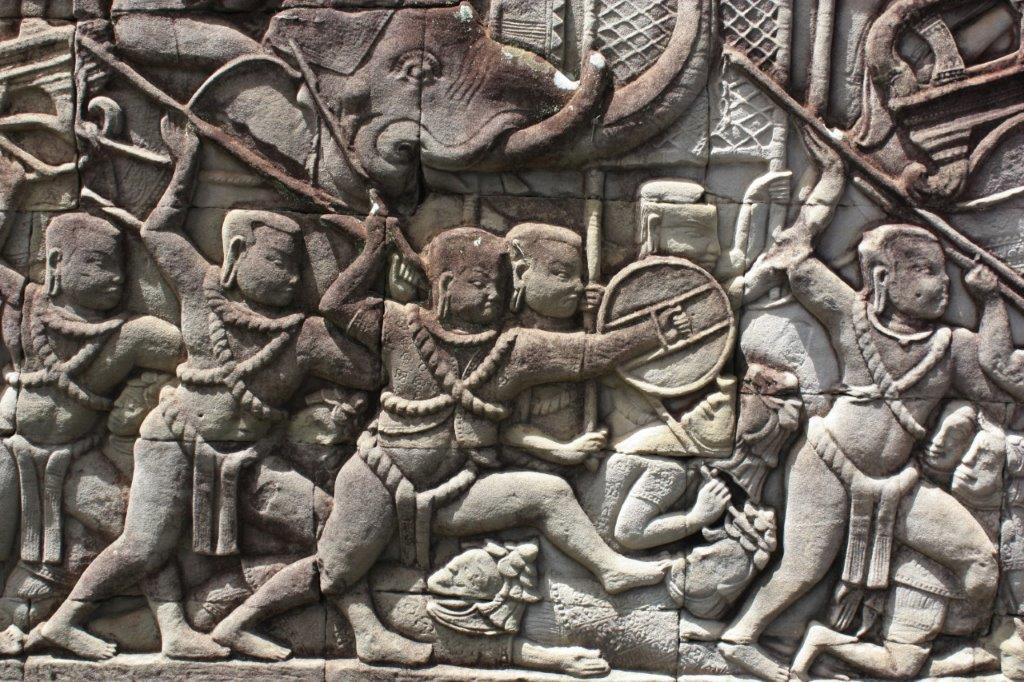
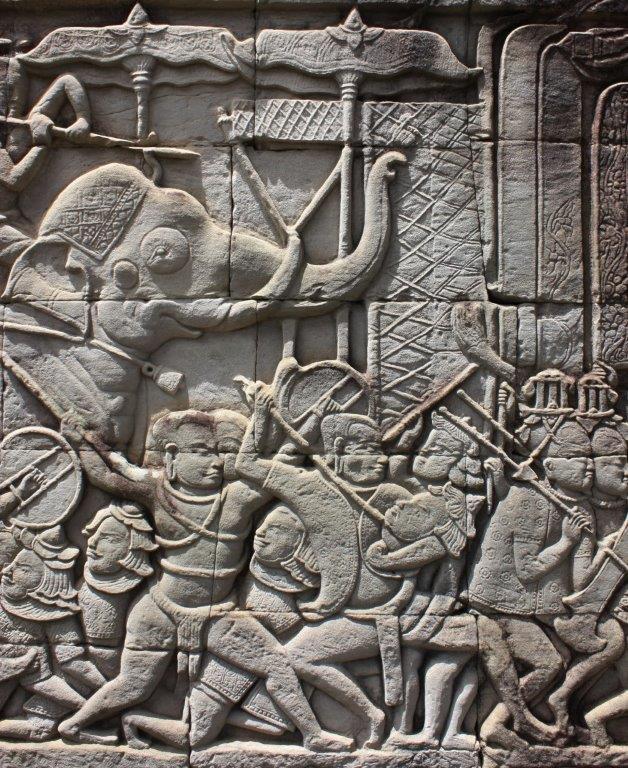
DAILY PHOTO: Battle Bas Relief of the Bayon
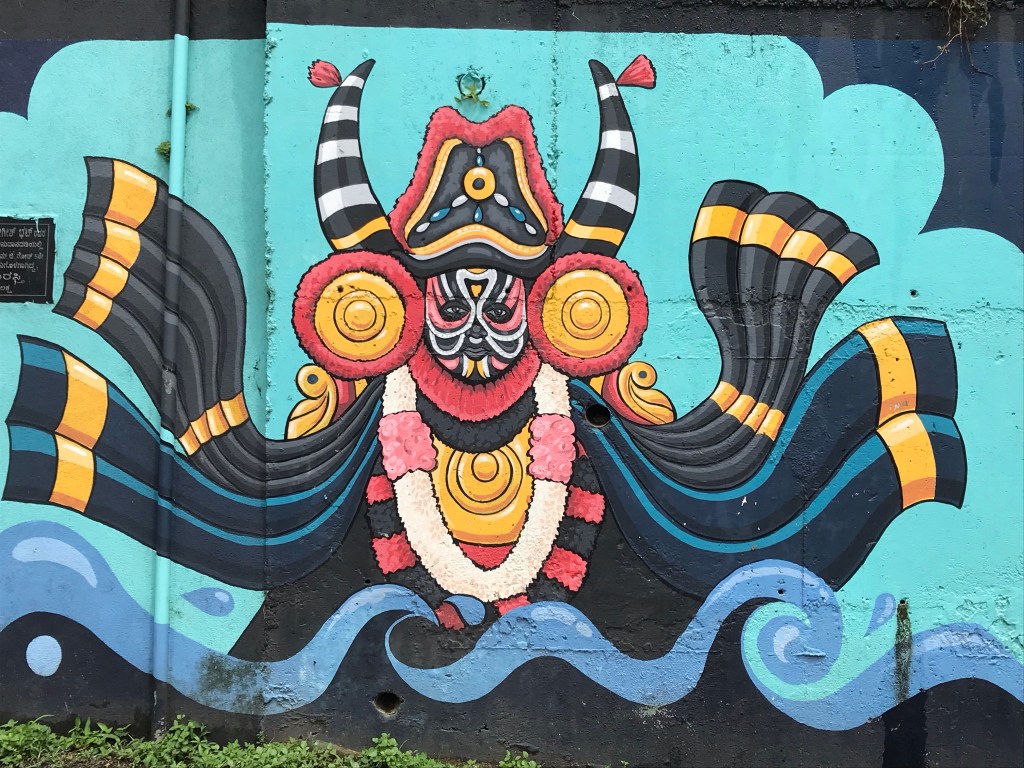
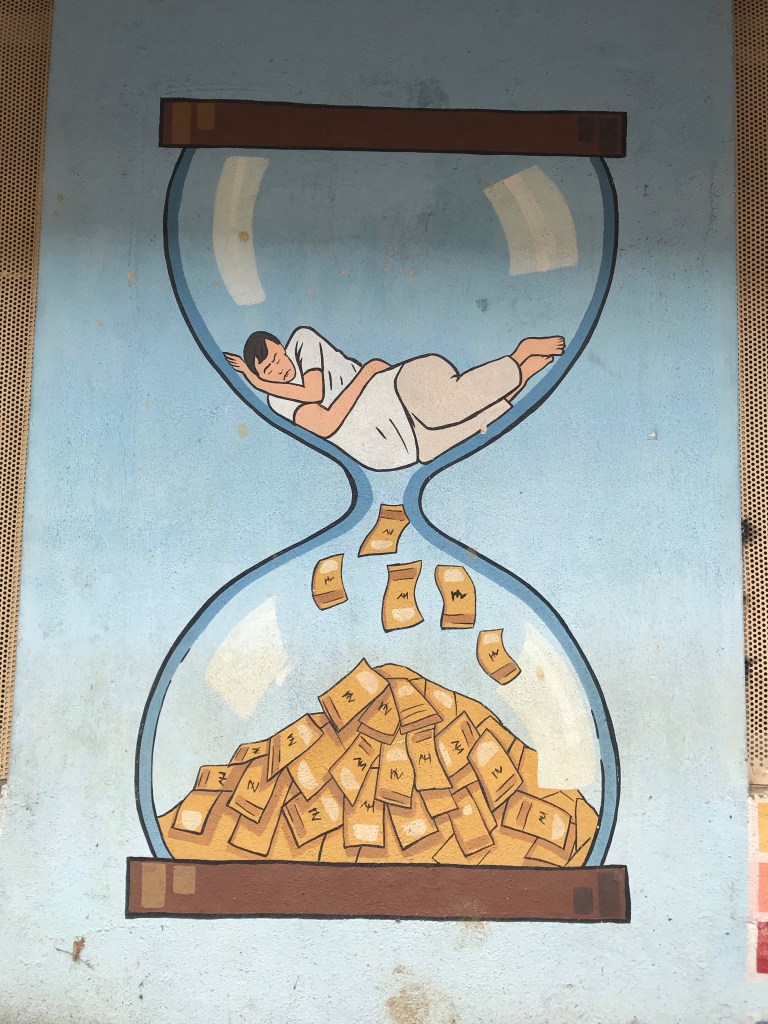
DAILY PHOTO: Mangalore Street Art


BOOK REVIEW: Drawing is for Everyone by Kateri Ewing
Drawing Is for Everyone: Simple Lessons to Make Your Creative Practice a Daily Habit – Explore Infinite Creative Possibilities in Graphite, Colored Pencil, and Ink by Kateri EwingMy rating: 5 of 5 stars
Amazon.in Page
Out: July 20, 2021
True to its title, this book presents an excellent set of lessons for rank amateurs to develop drawing techniques in a way that helps keep their inner critic from being their undoing. It does this by using mostly abstract and still life subjects as a means to convey the technique, such that the early lessons in each section aren’t expected to look like anything recognizable, and there is not the disappointment of off-kilter drawings. [There are some little birdy drawings in the higher numbered lessons, but nothing particularly complicated.]
The book consists 21 lessons evenly divided between three parts: graphite pencil, colored pencil, and ink. Each lesson gives some background information, presents the list of needed supplies, provides step-by-step textual instructions matched with a series of drawings to graphically demonstrate said step, and a section with creative options that show what some of the author’s students produced with the same exercise. This is also a nice feature for those with an intense inner critic, a tendency to compulsively copycat, and / or a conviction that they aren’t capable of drawing. It does this by presenting numerous different ways a project could turn out – all attractive but all very different.
Besides the lessons, there’s a brief introduction to set up the project. And, in addition to the aforementioned drawings, there are numerous graphics, such as photographs of still life subjects and supplies.
I thought this book was smartly arranged and organized. It’s a small book, but presents the dabbler with all they need to start building their skills, plus it’s beautifully presented. If you’re a neophyte looking to get into drawing but worried that you have not talent for it, this is an excellent place to start.
View all my reviews
BOOK REVIEW: Teaching Artfully by Meghan Parker
Teaching Artfully by Meghan Parker
My rating: 5 of 5 stars
Out: May 4, 2021 in India (It may be out already where you live.)
While I’m not an art teacher and this book is clearly directed at art teachers, I took away a number of useful lessons nevertheless. The book is laid out as a comic book, and is meant to extol the virtues of that artform while at the same time conveying knowledge about art, teaching, and the teaching of art.
The book is organized into seven chapters that are loosely themed according to the seven elements of art: line, color, form, texture, shape, space, and value [in the sense of the level of lightness / darkness.] The connection between the artistic characteristic and what is conveyed in its chapter is more readily apparent for some chapters than for others.
Chapter one (Line) both presents how the book came to be and what the intention behind it is, and also has something to say about process. The second chapter is entitled “Color,” and it touches upon issues such as the nature of aesthetics, the value of the notion of embodiment to the artistic endeavor, and the role of imagination. Chapter three is “Form” and it explores how time, space, and story play into conveying knowledge, as well as offering insight into how form influences perception. The next chapter is “Texture, and it has a lot to do with interaction and human relationships as they pertain to the art classroom. “Shape” investigates the issue of boundaries, such as what really differentiates artist from non-artist, the grammar of comics, and the role of the teacher. It also presents a number projects that might be introduced in the classroom or in one’s self-study. “Space” is probably the most literal title as it discusses the classroom space as well as the more figurative space given to students. The final chapter (Value) has a lot to say about frames of reference and the analogy of painting frames to the frames that individuals operate in and see the world through.
There is a Conclusion that provides some summation of ideas, and there are also notes and a page of references. This book shined a spotlight on a few other books that intrigue me, but that would have been completely outside my awareness — given I don’t read much about the visual arts, but I’m increasingly finding it to be a topic of interest.
As I said, even though its outside my bailiwick, I took away some intriguing lessons from this book — particularly about how variations in the elements of art encourage different emotional and psychological responses. There are a few excellent quotes as well. These powerful lessons weren’t in every frame. A fair amount of space is devoted to both platitudes and [hopefully] cathartic rants about the challenge of being a teacher, and particularly a teacher of art.
The book is festively drawn and colored and (as befits a book focusing on the visual arts) I got even more out of how ideas were portrayed visually than how they were discussed textually. The book takes a light and whimsical approach, and is pretty to look at.
If you’re interested in learning more about the visual arts, I’d highly recommend picking this book up.