Ride by Night [Kyōka]

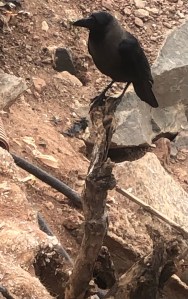
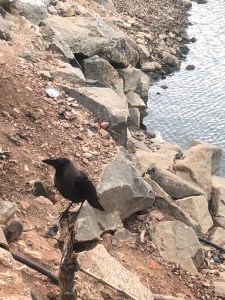
a little bird,
on a bit of driftwood,
speeds downriver
in the dusky, fading light.
doesn’t it know it can fly?

Countless Pieces of Hate [Free Verse]

Countless pieces of hate
Tumble through our days,
Clogging up our Flow --

Tiny bites of thought
Pit us against
Imagined adversaries...

But aren't all adversaries
Imagined adversaries?

Those who act badly against us
Are only adversaries
If we slide them into that
Mental basket.

BOOKS: “Teachings of the Christian Mystics” ed. by Andrew Harvey

Teachings of the Christian Mystics (Shambhala Pocket Library)Teachings of the Christian Mystics by Andrew Harvey
My rating: 5 of 5 stars

Acquired at Blossom Bookhouse

This book gathers a collection of short writings (mostly paragraph to a few page excerpts as well as a few poems) on mystic Christianity from the time of the Gospels through the twentieth century. While the bulk of the pieces are (if not from scriptures) the work of clergymen and / or theologians, there are some by individuals known elsewise (e.g. poets William Blake and Gerard Manley Hopkins.) The book is arranged somewhat, but not perfectly, chronologically — enough that all the Biblical excerpts are lumped together at the beginning to form about the first quarter of the selections. While there are a number of one-off contributors, there are several pieces from each of: Gregory of Nyssa, the Desert Fathers, Saint Symeon the New Theologian, Saint Bernard of Clairvaux, Saint Teresa of Avila, and Eckhart von Hochheim.

One nice feature of this book is that it does include selections from a wide range of sources (Roman Catholic, Orthodox Catholic, and Protestant) over a range of time periods, and from scriptures both canonical and “apocryphal.” So, there are many varied ideas of the mystical experience and the path thereto. The flipside of this fact is that there doesn’t seem to be a lot of cohesiveness to the collection. It isn’t always clear why Harvey (the editor) thought a given excerpt was representative of mystic teachings versus of mainstream Christianity. There is a substantial introduction, but otherwise the selections are left to speak for themselves.

Still, it was a quick read, dense with insights, and I found — particularly some of the scriptural selections — to be among the most profound statements of Christian philosophy that I’ve seen.

View all my reviews

“Wild Nights – Wild Nights!” (269) by Emily Dickinson [w/ Audio]

Wild nights -- Wild nights!
Were I with thee
Wild nights should be
Our luxury!

Futile -- the winds --
To a Heart in port --
Done with the Compass --
Done with the Chart!

Rowing in Eden --
Ah -- the Sea!
Might I but moor - tonight -
In thee!

Ducks Adrift [Haiku]

a pond in summer:
ducks look like wooden toys,
drifting leisurely.

Winter Malaise [Lyric Poem]

One bitter winter afternoon --
Locked under skies so low and gray --
The city slowed in cold cocoon
As what verve remained slid away.

And then the clouds, they broke apart,
And frozen souls began to thaw.
But some needed not the sun's kickstart
To free themselves of winter's maw.

What was their secret? I wish I knew.
To be happy sans the skies of blue.

Psychopomp Shanties [Lyric Poem]

Here comes some sing-song psychopomp,
Shepherding all those stone-cold souls.
He sings stirring songs all day long,
Dragging the Dead over dark shoals.

Sonnet 130 by William Shakespeare [w/ Audio]

My mistress' eyes are nothing like the sun;
Coral is far more red than her lips' red;
If snow be white, why then her breasts are dun;
If hairs be wires, black wires grow on her head.
I have seen roses damasked, red and white,
But no such roses see I in her cheeks;
And in some perfumes there is more delight
Than in the breath that from my mistress reeks.
I love to hear her speak, yet well I know
That music hath a far more pleasing sound;
I grant I never saw a goddess go;
My mistress, when she walks, treads on the ground.
And yet, by heaven, I think my love as rare
As any she belied with false compare.

Poppies [Haiku]

roadside poppies
sway in unison behind
passing autos.

BOOKS: “Best Literary Translations 2024” ed. by Jane Hirschfield, et. al.

Best Literary Translations 2024Best Literary Translations 2024 by Jane Hirshfield
My rating: 5 of 5 stars

Publisher Site

This “best of” annual celebrates the unsung translator. Many of the original works are recent but some are old or even ancient; it is these translations to English that are in all cases recent. Spanish and Arabic translations are well-represented, but with respect to the twenty or so languages included, almost all are the sole representative for that particular source language. Poetry makes up the bulk of the collection (including prose poems,) but there are several pieces of short fiction and a piece of creative nonfiction or two.

Among my favorites were: “Grazing Land” (Greek,) “The Snail’s Spiral” (Spanish,) “The Lion” (Kurdish,) “Deterioration” (Persian,) “Graceless” (Chinese,) “Our Village” (Tigrinya,) and “The Sea Krait” (Tagalog.) But, as one would expect of a carefully curated “best of” collection, there were no stinkers in the batch.

If you enjoy literature in translation, this book is well worth investigating.

View all my reviews