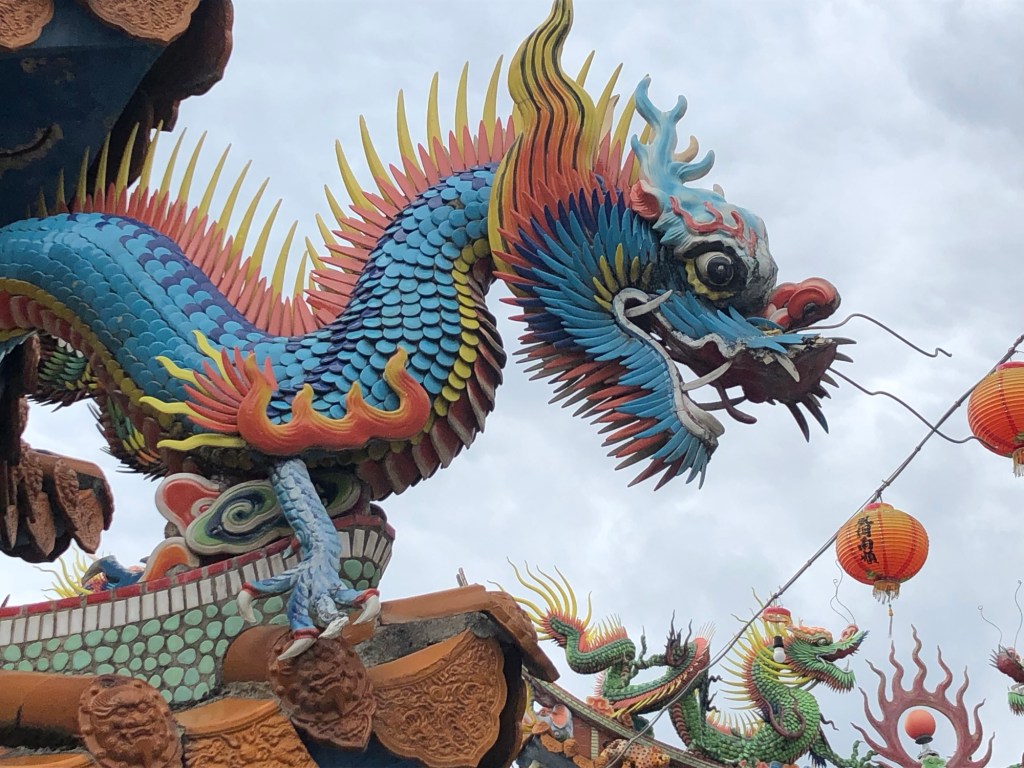
“Fulani Creation Myth” by Anonymous [w/ Audio]

At the beginning there was a huge drop of milk.
Then Doondari came and he created the stone.
Then the stone created iron;
And iron created fire;
And fire created water;
And water created air.
Then Doondari descended the second time.
And he took the five elements
And he shaped them into man.
But man was proud.
Then Doondari created blindness,
and blindness defeated man.
But when blindness became too proud,
Doondari created sleep,
and sleep defeated blindness;
But when sleep became too proud,
Doondari created worry,
and worry defeated sleep;
But when worry became too proud,
Doondari created death,
and death defeated worry.
But then death became too proud,
Doondari descended for the third time,
And he came as Gueno, the eternal one.
And Gueno defeated death.

NOTE: The Fulani (also known as Fula and Fulbe) are a West African herding tribe that live in Mali, Niger, Nigeria, Guinea, and Senegal.
“Leda and the Swan” by William Butler Yeats [w/ Audio]

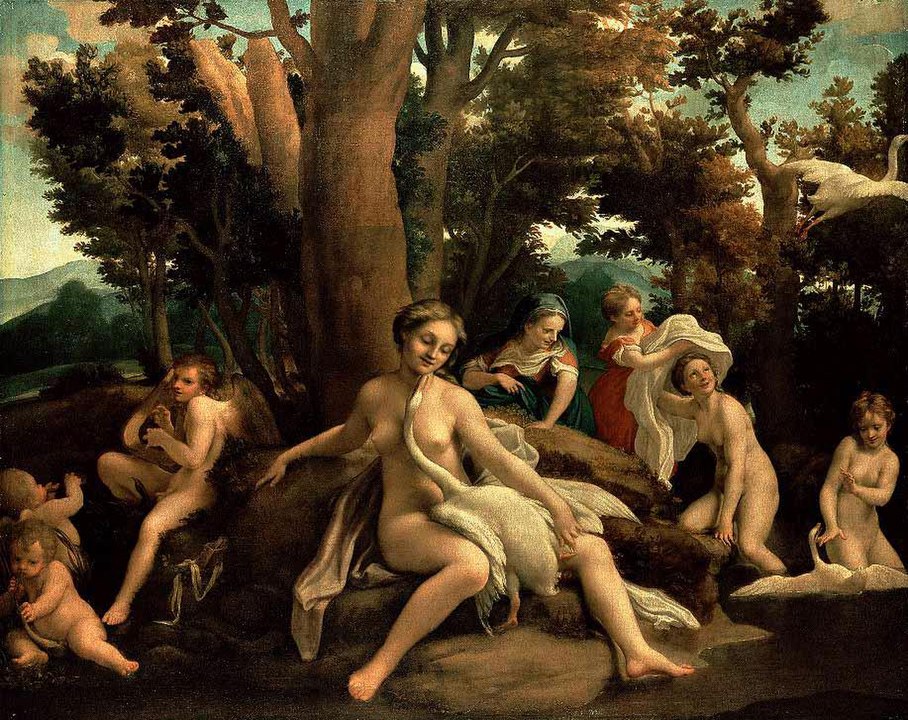
Correggio’s Leda and the Swan (1532)
A sudden blow: the great wings beating still
Above the staggering girl, her thighs caressed
By the dark webs, her nape caught in his bill,
He holds her helpless breast upon his breast.

How can those terrified vague fingers push
The feathered glory from her loosening thighs?
And how can body, laid in that white rush,
But feel the strange heart beating where it lies?

A shudder in the loins engenders there
The broken wall, the burning roof and tower
And Agamemnon dead.
Being so caught up,
So mastered by the brute blood of the air,
Did she put on his knowledge with his power
Before the indifferent beak could let her drop?

BOOKS: “The Sandman, Vol. 3: Dream Country” by Neil Gaiman

The Sandman, Vol. 3: Dream CountryThe Sandman, Vol. 3: Dream Country by Neil Gaiman
My rating: 5 of 5 stars

DC Site

If you love a good story, you really can’t go wrong with Gaiman. This volume consists of four standalone pieces of short fiction set in the Sandman universe.

“Calliope,” like Greek Mythology, envisions an anthropomorphized muse, but takes the idea into a dark and modern twist as said muse is held captive and violated.

“A Dream of a Thousand Cats” imagines dreams do shape the real world and asks what if animals dreamt as big as humans.

“A Midsummer Night’s Dream” is built around the premise that Shakespeare had a patron, none other than Morpheus, a.k.a. Dream, himself.

“Facade” is about a supernatural woman who can only go out in public by taking risky measures to look “normal,” and explores her lonely existence.

All of these stories are clever and compelling, and I’d highly recommend this collection for readers of speculative fiction.

View all my reviews

BOOKS: “Mythos: The Illustrated Edition” by Stephen Fry

Mythos: The Illustrated Edition: The Illustrated Edition (Stephen Fry's Greek Myths)Mythos: The Illustrated Edition: The Illustrated Edition by Stephen Fry
My rating: 5 of 5 stars

Publisher Site

This book offers a humorous telling of many stories from Greek Mythology. One gets the well-known tales such as Prometheus, Sisyphus, and Pandora, but also the myths involving a number of lesser-known characters: god, demi-god, and mortal. As these myths are being told, there is also a substantial amount of nonfiction information presented by footnotes and such — e.g. how later authors (Shakespeare, for example) presented these myths or tales built upon them, how the myths inform popular culture and language to this day, and how Greek and Roman mythology related.

The art is nice, though I can’t say that it added much to the reading experience for me, personally. The art is done in a consistent style throughout and is colorful and visually interesting, though I couldn’t say much else about it in an intelligent fashion. It somewhat reminded me of William Blake’s art and somewhat of Soviet posters.

I enjoyed this book. It is light-hearted and even humorous without detracting from the tone of the myth and is a highly readable way to learn more about Greek Mythology.

View all my reviews

BOOKS: “The Song of Hiawatha” by Henry Wadsworth Longfellow

The Song of HiawathaThe Song of Hiawatha by Henry Wadsworth Longfellow
My rating: 5 of 5 stars

Project Gutenberg edition

This epic poem borrows from American Indian folklore and legend to build a fictional life story for the protagonist, Hiawatha. (There was an actual Hiawatha, but his life story apparently in no way resembles that of Longfellow’s Hiawatha, which is good because the fictional one had to deal with ghosts, tricksters, and deities.) The poem is part hero’s trials, part love story, and part tale of the supernatural, blending real world type tragedy with an otherworldly form.

The choice of trochaic tetrameter makes the poem rhythmically readable, while evoking a drumming sound that contributes to atmospherics.

When the poem came out in the mid-19th century, it faced some controversy. It was claimed that it was a knock off of the Kalevala of Finland. Longfellow’s reply was that he was influenced by that poem’s rhythm (the Kalevala is also trochaic,) but that all the plot events where from his conversations with American Indians and researchers, thereof, (or, presumably his own imagination,) and that any coincidence of events was owing to the broad brushstrokes of them both being heroic tales.

I enjoyed reading this poem and would highly recommend it for poetry readers and lovers of American Literature.


View all my reviews

BOOKS: “Teachings of the Christian Mystics” ed. by Andrew Harvey

Teachings of the Christian Mystics (Shambhala Pocket Library)Teachings of the Christian Mystics by Andrew Harvey
My rating: 5 of 5 stars

Acquired at Blossom Bookhouse

This book gathers a collection of short writings (mostly paragraph to a few page excerpts as well as a few poems) on mystic Christianity from the time of the Gospels through the twentieth century. While the bulk of the pieces are (if not from scriptures) the work of clergymen and / or theologians, there are some by individuals known elsewise (e.g. poets William Blake and Gerard Manley Hopkins.) The book is arranged somewhat, but not perfectly, chronologically — enough that all the Biblical excerpts are lumped together at the beginning to form about the first quarter of the selections. While there are a number of one-off contributors, there are several pieces from each of: Gregory of Nyssa, the Desert Fathers, Saint Symeon the New Theologian, Saint Bernard of Clairvaux, Saint Teresa of Avila, and Eckhart von Hochheim.

One nice feature of this book is that it does include selections from a wide range of sources (Roman Catholic, Orthodox Catholic, and Protestant) over a range of time periods, and from scriptures both canonical and “apocryphal.” So, there are many varied ideas of the mystical experience and the path thereto. The flipside of this fact is that there doesn’t seem to be a lot of cohesiveness to the collection. It isn’t always clear why Harvey (the editor) thought a given excerpt was representative of mystic teachings versus of mainstream Christianity. There is a substantial introduction, but otherwise the selections are left to speak for themselves.

Still, it was a quick read, dense with insights, and I found — particularly some of the scriptural selections — to be among the most profound statements of Christian philosophy that I’ve seen.

View all my reviews

BOOKS: “Pawan” by Sorabh Pant

Pawan: The Flying AccountantPawan: The Flying Accountant by Sorabh Pant
My rating: 4 of 5 stars

Amazon.in Page

On one level, the more superficial level, this is a superhero fantasy featuring a Vanara (a supernatural monkey-man creature from Indian mythology,) on another level it’s a political satire that riffs on the geopolitics and the military-industrial complex of India. It’s cleverer as the latter than the former.

The story has some clunkiness, including the occasional hard to follow description and sloppy story elements (e.g. the deus ex machina.) That said, it’s pop genre fiction and with regards sloppy story elements they’re par for the course in superhero fiction. My point being that the fact that it’s amusing and mostly readable means it hits its target, strained credulity and logical inconsistencies aside.

The humor is of the broadest range with occasional laugh-out-loud hilarity, lots of mildly amusing jokes, and a few groan-worthy lines that go down like a lead-balloon. That’s not a terrible ratio for a novel.

If you want to check out a book featuring an Indian mythology-based superhero, and you don’t mind a lot of jokes directed at political and national security apparatus leadership, this book is worth looking into.

View all my reviews

Guardian Lion [Haiku]

guardian lion
watches the setting sun like
it’s up to no good.

DAILY PHOTO: Thar be Dragons

Witch & Skeleton [Free Verse / Senryū]

Takiyasha the Witch and the Skeleton Spectre; Utagawa Kuniyoshi (1844)
PREMISE:
Princess Takiyasha
 summoned a skeleton to
  kill a samurai.

MORAL?:
"Don't bring swords
 to a giant skeleton-ghost 
  fight!"

CONCLUSION:
Yet, in settled dust,
 the world was less one
  Princess-witch.