BOOK REVIEW: Crow with No Mouth: Ikkyu Translated by Stephen Berg

Crow With No Mouth : Ikkyu : Fifteenth Century Zen MasterCrow With No Mouth : Ikkyu : Fifteenth Century Zen Master by Ikkyu

My rating: 5 of 5 stars

Amazon page

Ikkyū Sōjun was the Howard Stern of Zen masters. Born in 1394, he lived through most of the 15th century. Ikkyū served as a temple’s abbot for less than two weeks before he quit in disgust, vowing to move into a red-light district—apparently he wanted to live among people he found more honest and less hypocritical. The Zen master despised the corruption and snobbery of monastic politics.

Crow with no Mouth is a collection of Ikkyū’s verse, which is largely in the Zen tradition–featuring natural subjects and simple wisdom in a sparse style. Of course, as per my comments in the preceding paragraph, there are a few poems on topics such as cunnilingus and debauchery—so it’s not what one would call a child-friendly collection (unless one enjoys explaining the sexual exploits of a lecherous monk to one’s child.) The more explicit poems may seem like a diversion from the Zen path, but perhaps not. Maybe Ikkyū offered them as a way to train the mind, to observe one’s reaction to shocking commentary as a means of changing one’s way of thinking.

A few of my favorite lines of a more traditional nature include:

-“you can’t make cherry blossoms by tearing off petals to plant; only spring does that”

-“sometimes all I am is dark emptiness; I can’t hide in the sleeves of my own robes”

-“it’s logical: if you’re not going anywhere any road is the right one”

-“the edges of the sword are life and death; no one knows which is which”

-“even in its scabbard my sword sees you”

-“a flower held up twirled between human fingers; a smile barely visible”

-“in war there’s no time to teach or learn Zen; carry a strong stick; bash your attackers”

Here are a few of those jarring lines that I mentioned above:

-“that stone Buddha deserves all the bird shit it gets”

-“all koans just lead you on but not the delicious pussy of the young girls I go down on”

-“ten fussy days running this temple all red tape; look me up if you want o in the bar whorehouse fish market”

-“my dying teacher could not wipe himself; unlike you disciples who use bamboo; I cleaned his lovely ass with my bare hands”

-“don’t hesitate get laid that’s wisdom; sitting around chanting, what crap”

-“who teaches truth? good/bad the wrong way; Crazy Cloud knows the taste of his own shit” [Crazy Cloud was Ikkyū’s name for himself.]

When he left the monastery, Ikkyū shredded the certificate that served as his monastic credential. Some of his students found it, and pieced it back together. That led to the following verse:

-“one of you saved my satori paper I know it piece by piece; you pasted it back together; now watch me burn it once and for all”

Ikkyū’s verse asks us to reevaluate what it means to be sacred or profane. The orthodox view would be that Ikkyū fell from the sacred life of a monk. However, Ikkyū tells us that one can degrade what is important by raising the wrong things to sacred status. Conversely, some of what we believe to be profane is just rooted in habitual and ill-reasoned ways of thinking.

I’d recommend this work for those who love the spare form of Japanese poetry, and who don’t mind a hard jolt to their psyche occasionally.

View all my reviews

The Tongue-Cut Sparrow: A Japanese Folktale

800px-Tree_Sparrow_Japan_Flip[This is a well-known Japanese folk tale. There are many versions and translations of it, but the gist of the story remains the same from one to the next.]

Once upon a time, an old man was married to a shrew. The couple lived in the countryside on the edge of a mountain forest. They had no children, but the man befriended one of the sparrows that resided in the adjacent forest. The old man fed the sparrow, offering whatever he had to the small bird.

Over time, the man and the sparrow grew almost inseparable. However, one day the man had to go into town to buy provisions. It may have been that the man chose that particular day for his errand because his horrid wife was most ill-tempered on laundry days, and that was a laundry day.

While the husband was away, the sparrow came around. Seeing a pile of starch, the sparrow pecked at it. Infuriated, the old woman snatched up the bird in one hand and a scissors in the other, and she snipped part of the bird’s tongue out. Then as she tossed the sparrow free, she said, “Away with you. That’ll teach you to get into my starch.”

The bird flew deep into the mountains.

When the husband returned, he inquired as to whether his wife had seen the bird. The sparrow was usually around the homestead at that time of day.

The hag proudly told the husband of her actions and how she’d punished the insolent bird.

The old man lost no time in trudging out into the forest to try to make sure his friend was alright. He called out to the sparrow, but there was no response. He feared his wife had wounded the bird even more than she’d boasted. Eventually, exhaustion forced the old man to give up his search. He prayed that the little bird would be alright, but he couldn’t keep looking for it.


A couple of years later, the  man was foraging for mushrooms in the forest when he ran into the sparrow. The sparrow invited the man back to his home.

The sparrow offered the man food, refreshments, and even accommodations as they took several days to catch up on the events of each other’s lives. The sparrow now had a family and was doing well.

After a few days of catching up, the old man decided that he must get back, but he promised to come back around to visit occasionally. (The sparrow was reasonably reluctant to visit the man at his home with the vile woman around.) The sparrow family offered the old man a choice of parting gift, they presented two woven baskets. The baskets appeared identical, but one was light and the other was heavy. The old man didn’t feel deserving of a gift, but he took the lighter basket. He had to take one to avoid offending his host, but he didn’t wish to be greedy.

When the man got home, he was berated by the shrew for being away so long. She then interrogated him about the new basket. The man told his wife the entire story, including about how the sparrows offered him two baskets, and how he’d taken the lighter one.

His wife snatched the lid off of the basket and investigated its contents. She found that the reason the basket was so light was that it contained just a few precious jewels and several gold coins. By weight it wasn’t much, but its value was considerable.

The wife thought, Hm. I’ll go visit the sparrows. I’ll make a little apology for snipping at the bird’s tongue, and when they offer me my parting gift, I’ll be smart enough to take the heavy basket. Just imagine the riches it must contain.

The wife tricked her husband into giving her directions, saying she wanted to make a heartfelt apology. She then went to visit the sparrow family. She made a half-hearted apology for injuring the sparrow, claiming she’d only meant to scare him but the scissors had gotten away from her. The meeting was awkward and the sparrows were relieved to have the woman going on her way.

They offered the woman a choice of parting gifts as well. The woman lifted both baskets. Just as her husband had said, one basket was light and the other was heavy. She lugged the heavy basket up on her back, and without even saying her good-byes she sped toward her home as quickly as her legs would carry her. She had fantasies  about what she would do with her new-found wealth.

It wasn’t long before she needed a break because the basket was heavy and her legs weren’t used to such a burden. Standing on the forest trail, the couldn’t resist peaking at her riches.  The woman tugged the lid off and dove her head into the mouth of the basket to see what precious jewels, gold, and silver would greet her. However, what lurched out was an evil ogre, enveloped in a mist of demon spirits.

Clutching her chest, the old woman had a heart attack in the face of the horrific contents of her basket, dying where she had stood.

Tsukahara Bokuden Defeats a Braggart

[Note: There are many versions of this story, and these events have even been attributed to other warriors. The tale was likely passed around orally before it was written down myriad times in myriad different ways (most famously in the Kōyō Gunkan.) The details of the story aren’t important; it’s the overall moral of the story and that remains the same from one version to the next.]

Bokuden Boat

Tsukahara Bokuden listened to the braggart nauseating the ferry passengers with graphic details of his “exploits.” Bokuden would have happily ignored the young samurai, but the cocky youth seemed eager to take offense at the lack of interest in his tales of hacking people to bits and was looking for a fight. The other passengers on the boat were all commoners: an elderly man who was probably a craftsman or a small business merchant, and a mother with her young child.

“Do you doubt me? Do you have the audacity to call me a liar,” The young man said, having not received a suitably enthusiastic response to his stories. And he stood, one hand on his scabbard and the other brushing his sword’s hilt.

Tsukahara Bokuden said, “Easy, young man. No one is calling you a liar. These good people are just not used to such bloody stories.”

The young samurai turned to eye Bokuden, who had appeared to be napping in the back earlier. The braggart asked, “And who are you to challenge me?”

“I didn’t challenge you. I merely explained these people’s lack of enthusiasm for your yarns. But if you must know, I am Tsukahara Bokuden,” he replied, hoping his name might give the bragging samurai pause. Bokuden was well-known, having traversed Japan in musha shugyō (sometimes related to the European “knights errantry,”musha shugyō was a time in a samurai’s life–particularly in times of relative peace–when he traveled the land engaging in matches with individuals from other schools to increase his skill and notoriety–i.e. if he didn’t get killed, which was not uncommon, even when the fight was with wooden swords.)

“I’ve never heard of you. What’s your style?” the cocky samurai asked.

“Mine is the School of No-Sword,” replied Bokuden.

“I’ve never heard of that school, but it sounds weak,” the braggart said.

“I assure you, the technique is quite powerful,” Bokuden said.

“Are you suggesting that you could defeat me with this so-called ‘no sword’ technique?” the braggart said, his hand tightening on his scabbard.

“I said nothing of the sort. I would just like to enjoy the remainder of the ferry ride in peace,” said Bokuden.

“Are you scared to have a match to see who’s style is better?” the cocky youth asked.

“Not in the least, but I see no benefit in it either,” Bokuden replied.

“I’ve had enough of your lip, old man, prepare to defend yourself,” said the young samurai.

Bokuden sighed, “If you insist upon a match, let us at least do so where these good people’s lives will not be in peril. Surely you’ll agree that it would do no great honor to the samurai class if we were to injure or kill innocent bystanders.”

At this the braggart just harrumphed, “Who cares, but I’ll take you on wherever you wish.”

Tsukahara Bokuden said to the oarsman, “Sorry to trouble you, but would you mind diverting to drop us on that outcrop so that we can spare these people the swinging blades.”

The oarsman was readily agreeable. He didn’t want two samurai fighting on his ferryboat any more than Bokuden did.

He rowed them to a stony outcrop that jutted up out of the water. The uneven rocky ground wasn’t ideal for a match, but it would spare the other passengers and would provide a challenge.

When the boat’s bow ground up against the rock, the young samurai jumped out, twisting around in air, and landed on the rock. The braggart held his scabbard and hilt at the ready for a swift draw. The young man was eager to do battle, and it was clear that he was annoyed with Tsukahara Bokuden’s slow movement. The older swordsman took out both of his swords and asked one of the passengers to hold the swords. The oarsman and the passengers were surprised by this disarming behavior, but they’d heard him call his school the “school of no-sword.”

Tsukahara Bokuden then moved up to the boat’s bow as if preparing to move ashore.

“Might I borrow your oar, young man?” Bokuden said to the oarsman. The oarsman nodded and handed Bokuden the long oar with two hands, and with his head bowed. The general assumption was that the older samurai wanted to stabilize the boat against the rock so he could pass ashore smoothly.

Taking the oar, Bokuden drove one end into the outcrop, and grabbed the other pushing the boat away from the rock. The boat glided out from the rock in an accelerating fashion.

Lunging toward the water’s edge, the perplexed braggart called out, “What on earth are you doing, old man?”

To which Bokuden replied, “I’m defeating you with the school of no sword.”

By the time the young samurai could remove his swords and tug away his outer garment, Bokuden had rowed out to deep waters and returned the oar to the oarsman.


BOOK REVIEW: The Memorable Thoughts of Socrates by Xenophon

The Memorable Thoughts of SocratesThe Memorable Thoughts of Socrates by Xenophon

My rating: 4 of 5 stars

Amazon page


Xenophon gives us an alternative to Plato’s accounts of the lessons of Socrates. As you probably know if you are reading this, Socrates left nothing behind by way of written teachings. All we know of the great philosopher’s teachings come from the accounts of his students. Xenophon’s version (Memorabilia of Socrates) is stylistically different from Plato’s dialogues(e.g. Euthyphro, Apology, Crito, and Phaedo), though Socrates’ wisdom and method (questioning) remain consistent.

I enjoyed Plato’s dialogues on the last days of Socrates more than Xenophon’s Memorabilia. This owes to Plato’s narrative approach, which tells us the story of Socrates’ trial, conviction, and execution. Philosophy is more palatable embedded in a story. However, all of these works (Xenophon’s and Plato’s) are short, readable translations, and so it is worth reading all of them to get a broader access to the thoughts of Socrates.

As with Apology, Xenophon conveys Socrates thoughts on piety and corruption of the youth (these were the charges raised against Socrates that resulted in his hemlock sentence.) Socrates maintained that he was pious, but he did think it a weakness to trouble the gods with questions that men should be able to solve for themselves. His emphasis on self-reliance and fortitude is part of why we so respect Socrates. One sees the imprint of Socrates on the school of Stoicism that would come later. In Memorabilia, Socrates openly mocks those men who cannot bear adversity as well as their slaves. (Yes, Socrates wasn’t so infallibly wise as to see the folly of slavery. I no more advocate paleomania [irrational exuberance for old thinkers / ideas] than I do neomania [irrational exuberance for new ideas.] Still, people live in the context of their times, and if one expects a person to be ahead of their time in all aspects, one will be disappointed.)

Socrates discusses governance and politics frequently in this volume. To a large extent, this is by way of trying to convince men that he believed would be good for governance to participate, and convincing those who he believed wouldn’t be effective leaders (e.g. Euthydemus) not to participate. Toward the end of book (part IV) he talks about the various forms of government (e.g. Monarchy, Aristocracy, Plutocracy, Tyranny, and Democracy.) These ideas no doubt informed Plato’s illumination of eight forms of government in The Republic.

What I appreciate most about Socrates was his groundedness and appreciation of the importance of the body. One can read a lot of philosophy without hearing mention of the body (beyond the thought that it might be an illusion created by the program that runs our brain-in-a-vat system.) One gets the idea that proponents of this discipline largely think of the body as a cart that drags around their great, big, lovely brains. Not so with Socrates. In fact, he rebukes philosophers for not taking care of themselves. He mentions the importance of nutrition, exercise, and sleep [this is where he’s ahead of his time.] Also, Socrates recognizes the damage done by having too great an attachment to comfort. (Here one sees an interest point of overlap with Eastern philosophies that derive from yoga–with its niyama of tapas [austerity and self-discipline.] By the way, that isn’t the only correlation between the Eastern and Western mindset we see in Socrates. e.g. At one point, a wealthy man complains about the poor behavior of his servant, to which Socrates asks upon whom this condition should reflect poorly—the master not the servant. Confucius made a similar statement to this one.)

I think this classic is well worth reading. It’s short, readable, and offers a great deal of food for thought. If you don’t have time for multiple accounts of Socrates’ teachings, you might be kept more enthralled by the Platonic dialogues, but surely you can make time for Socrates.

View all my reviews

BOOK REVIEW: The Wit and Wisdom of Master Yoda by Yoda

The Wit and Wisdom of Master Yoda: Master Yoda QuotesThe Wit and Wisdom of Master Yoda: Master Yoda Quotes by Yoda

My rating: 1 of 5 stars

[I normally put a link here to the books I review, but wouldn’t want anyone to accidentally buy this one by mistake.]

This review is the same rant I put in my weekly reading review today. If you saw it there, don’t bother reading onward.

This book was a stinker, and I can’t recommend it for anyone–though its saving grace is that it’s slim and thus only wastes a tiny bit of one’s time. What the author apparently did was to watch a Star Wars movie marathon and pull every Yoda line out and collect them together. This is a sad effort in two ways. First, while Yoda isn’t a lead in the movies (and, therefore, has a limited number of lines), there’s a vast canon of Star Wars books, and it doesn’t look like the author trolled any of them for quotes. Second, some of the lines are neither witty nor wise. Occasionally, Yoda has a line equivalent to, “take a left at the second light,” and the author includes such banal quotes. Furthermore, some of the quotes appear a second time in either reduced or extended form. Beyond all these complaints, the author doesn’t even take the time to put together meaningful front matter to tell the reader something interesting that they don’t already know, and thus doesn’t establish his worth in producing such a book. (Also, he doesn’t seem to know accepted protocol for writing quotes inside quotes–i.e. use of single quotes. Which I guess means he probably didn’t just cut and paste all the quotes because then they would have been grammatically correct.) He also could have at least provided told us which movie each quote was from. It’s a lazy effort. It succeeds spectacularly in being lazy. If you’ve seen the movies (or have basic cable so that you can readily do so by way of one of the frequent Star Wars marathons) you’ll gain nothing from this book.

View all my reviews

The New Acropolis Explorations Course and My Experience Thereof

IMG_1576Last fall I attended a panel talk hosted by the New Acropolis in Bangalore. I’d never heard of the New Acropolis before, and only heard of said event because the head teacher from my yoga teacher training course was among the panelists. I found the environment at the New Acropolis to be friendly and intriguing. The talk took place amid a small library (not necessarily small for an institution of its size) and books always put me in my happy place.


There were brochures out for an upcoming 16-week Explorations Course. “Explorations” is the name for the introductory course that’s taken by non-members to dip their toes into the New Acropolis curriculum, and see if they’d like to continue as members of this school of “philosophy.” (You may be asking, “Hey–wait a minute–why’d he put quote marks around the word philosophy. I’ll get to that in due time.) At  any rate, perusing the brochure, I decided to enroll.


The course consists of 13 lectures given over a 16-week timeline. The reason there are more weeks than lectures is that there are two sessions in which one meets briefly with the instructor one-on-one, and one session that consists of exercises that one does with one’s classmates. (The latter is one of the highlights of the course.) The course is organized into three parts. The first and longest section deals with the idea of “know thyself.” That is, it presents several approaches to developing oneself as an individual. The second section expands the scope, looking at society and the role of individuals in it. The third section is about the “philosophy of history,” (there go those telltale quote marks again) or what they refer to as “evolution,” (really?) which shouldn’t be confused with Darwinian Evolution (which–as near as I can tell–has no status in their system of teachings.)


In my opinion, the transitions from one part to the next represent downshifts in the value of the course. (i.e. The course is at its most beneficial in the first section. That’s also the portion in which it’s presenting ideas that are fairly mainstream among the various philosophical / religious systems it studies.) As the course moves into the second section, one begins to see a few ideas that are either archaic or that depart from rationalism (e.g. the word “magic” gently enters the discussion.) By the time the third section rolls around, ideas that have no relationship to observable reality are being presented as if they were a given.


I was reading Nassim Nicholas Taleb’s book entitled Antifragile the other day and he used the term “neomania.” Neomania–a term that Taleb coined for all I know–means an exuberance for the new for its own sake (as opposed to any objective improvement it represents.) Taking this cue, I will cobble together the term “paleomania”(an exuberance for old ideas for their own sake) to describe one of the main underlying features of the New Acropolis syllabus. One might easily believe that nothing of value has been learned in the past 2000 years and that modern thinkers (not to mention modern science) have nothing worthwhile to lend to the discussion.


This can be seen in the ideas presented from ancient Greece. Let me first say that I’m a big fan of Plato. His words “Be kind, for everyone you meet is fighting a hard battle” is one of my favorite philosophical quotes. However, while I like Plato, the New Acropolis pretty much deifies him. I’m sure they wouldn’t agree with that statement. However, even Plato’s ideas on those subjects about which he was least in a position to write intelligently or authoritatively are presented as if irrefutable. A couple of his most ill-informed ideas are at the forefront of two of the lessons–notably the Platonic hierarchy of forms of government and the ideas he accepted [I don’t know that these are properly attributed to him, but he seems to have believed them] about astrology. (Note: New Acropolis’s teachings about forms of government seems to be one of the biggest causes of ill will toward the organization in Europe. Plato was an elitist on the subject. He distrusted democracy–to be fair they killed his teacher under [a form of] democracy–but believed that if you could just give a philosopher unlimited power he’d do the right thing for everybody–and not just himself. Plato wasn’t a believer of Baron Acton’s “…absolute power corrupts absolutely…” an idea that came later by those with a greater body of exposure to varying forms of government.)


The first couple of lectures I attended didn’t seem in any way untoward or unusual. The first lecture was about knowing oneself, and presented two ancient approaches to this question–i.e. Greek and Indian Vedic. The Greek three-pronged model of soma/psyche/nous, which is translated various ways–but commonly as body, soul, and reason.  The Indian approach was a seven-layered variant that also started with the physical body and moved toward more conceptual elements of being.


Now, it might have occurred to me that both of these approaches take the supernatural as a given, but as they were true representations of the systems in question, I didn’t find it bothersome. This raises a point that I think bears saying, I don’t think that the New Acropolis distorts the teachings that they include in the syllabus, but they do use selectivity to frame the subject. This framing gives the student a limited view philosophy and the various approaches to leading an examined life (as opposed to the unexamined life that Socrates told us was not worth living.)


The second lecture I attended was actually the third lecture–because I was out-of-town for a class on the Bhagavad-Gita–and it dealt with Buddhism. This session was the most orthodox and arguably the least controversial of the lectures. The four noble truths and the eight-fold path were the core of the lesson, and one doesn’t get any more fundamentally Buddhist than that.


However, the fourth lecture, which was ostensibly about Tibetan Buddhism, started me wondering where the course was going. One would expect a lecture on Tibetan Buddhism to refer heavily to the words of lamas, but most of the ideas presented in this lecture were attributed to a woman who I don’t think I’d ever heard of before. Her name was Helena Petrovna Blavatsky. (If you’re saying, “Hey, that name doesn’t sound Tibetan, you are correct.”) It’s not that I don’t think that a 19th century Russian woman is capable of giving informed insight into Tibetan Buddhism. However, one becomes curious when there’s not a single Lama, Rinpoche, monk or nun in the picture. While I’m admittedly a bit of a neophyte on the subject, I’ve been to hear Tibetan monks and nuns before and have visited the local Tibetan meditation center on occasion, so I’m not completely ignorant of that system’s teachings–enough to have an idea what the most fundamental ideas would be.


So, after the Tibetan Buddhism class, my Googling fingers got to work. I just wanted to be sure I wouldn’t be asked to drink any Kool-Aid made Jim Jones style. There wasn’t a lot on the organization besides their various websites, but there were a few negative comments and would-be controversies to be found. I wasn’t too concerned by these comments for a number of reasons. First, the claims were isolated and unverifiable. To elaborate, if a person is either far to the right or far to the left, then the middle seems an extreme way off. Therefore, when a leftist organization calls an organization a “fascist cult” one has to consider the bias of the source of the claim. (Note: the same could be said from the other end of the spectrum, but I stated it that way because that’s essentially what I read in one post.) Nothing I’d seen at New Acropolis would lead me to think they were fascist, or even particularly politically conservative (if anything, I’d guess that individual members would be more likely to be left of center, but it wasn’t really an issue that came up.) Second, most of the negative comments were directed at a couple of the European centers, specifically.


I will say that, despite the fact that I didn’t believe the extreme claims, I can’t say that they weren’t cause for concern. I’ve had a little experience with organizations prone to being embroiled in drama. Even if the organization has many worthwhile attributes and individuals, that inclination to attract drama will inevitably bite a member in the ass. In my experience, one can’t just sit on the sidelines and pretend the drama won’t affect you. If you do, you’ll just be all the more surprised when you feel your ass being bitten.


My web searches confirmed that the New Acropolis was an offshoot of the Theosophical Society. This wasn’t kept a secret. In fact, I believe it was mentioned in the Tibetan Buddhism lesson, and I know it was intimated at various junctures in the course. I was aware of the Theosophical Society, and–in particular–the falling out that Jiddu Krishnmurti had had with them. (A parting of ways that was apparently amicable on Krishnamurti’s side as well as on the side of some from the Theosophical Society’s side–though some Theosophists apparently went dark.) Krishnamurti is among my favorite thinkers, and it was a concern that New Acropolis was an offshoot of an organization whose beliefs were so at odds with his own. I don’t want to deify Krishnamurti (that would be ironic as he was explicit that he didn’t want followers and believed followers were missing the point), but many of his ideas resonated with my own–particularly those on organizations to advance personal or spiritual development (of which he [& I] are quite skeptical.)


Krishnamurti opposed the idea of religions, sects, and paths as means to betterment.  The New Acropolis would likely agree with Krishnamurti’s stance on religion as they’re explicit in their antipathy for the ritualism of religion. However, Krishnamurti went further to oppose entities that proposed that they had a path to guide one to some enlightened state. This is where the New Acropolis would presumably part ways. They seem to believe they have such a path. The aforementioned framing that they do seems to designed to carve out the waypoints so that future courses can work on building the path.


There’s  a common saying that a good education teaches one HOW to think and not WHAT to think. By that definition, I wouldn’t classify the New Acropolis’s approach as a good education, generally speaking. The course is set up for a one way flow of learning. There’s no time for discussion or refutation of the concepts presented in the course. The teacher presents concepts in a lecture format, and there are designated times in which students can ask questions (in many cases outside the class time when peers might have ideas to add or questions  to build off.) Despite the nominal homage to ancient Greece, the New Acropolis pedagogic approach is at odds with the Socratic method by which students are asked questions rather than being presented with answers.


What’s my beef with their use of the term “philosophy?” Depending upon how it’s used, I don’t have a problem with it. When they’re explicitly talking about their particular philosophy, (i.e. New Acropolis’s philosophy) it’s perfectly acceptable. It’s only when one uses the term in a general sense, e.g. as in “school of philosophy,” that students might expect that they’ll learn rational approaches to consider life’s big questions for themselves, rather than learning a specific ideology’s answers to said big questions.


The term “theosophy” would be much more honest and apropos, though I understand their reticence to use that term–given their strained relationship with the Theosophical Society–which has a corner on the market of that term. The fact that the New Acropolis takes the divine or supernatural as a given is hard for me to reconcile with philosophy, which implies an open discussion and refutation of ideas–particularly of those notions for which there is little or no evidence.  I’m not saying that philosophy can’t and shouldn’t consider the question of whether there is a god (or spirits or divinity or whatever term you prefer.)  I’m just saying that taking the existence of such ethereal entities as a given flies in the face of rationality, because the existence of such ethereal entities isn’t rooted in observation or application of logic but in emotion. Faith is the domain of theology (or theosophy, if you prefer), rationality is the domain of philosophy. A lot of the teachings in this course were couched in terms of feelings or the beauty of ideas rather than in rational investigation.


It might seem that I was quite negative about the experience, and that I wouldn’t recommend it for others. That’s not exactly true. There are some individuals that I wouldn’t recommend it for, but others that I might. I did learn a lot during the course, and brought away a number of ideas that I think will be of service to me. For example, we did a throwing stick concentration exercise that was eye-opening (no pun intended), and there were many ideas and stories presented in the course that provided good food for thought. There was only one class /idea that I found not only completely baseless but also potentially dangerous.


(FYI-If you’re wondering what idea that was, it was in the penultimate lecture on astrological cycles (yeah, I know, right?)  The lecture presented both Indian Maha Yugas and Greek zodiac cycles. Guess what? According to both mythical sets of cycles we’re currently in the crappiest of times. [FYI- If there’s anything my education and experience as a social scientist taught me, it’s that notions of determinism applied to the sphere of human behavior are inevitably wrong. The physical world may be clockwork, but the minds of men are a clockwork orange.] Why do I think these conceptions of cycles may be dangerous? Because a lot of damage is done by people who go through life thinking the world is feeding them a steady diet of shit-sandwiches. This is, of course, all perception. Nature–unlike gods and other supernatural mythical creatures–doesn’t draw targets on the backs of individuals, nor weigh them good or evil. However, now you’re going to tell people who already see the world through dung-colored glasses that your [pseudo-]science shows they were born in the worst of times. That–my friends–is not helping make a better world.)


I think those interested in the course should be aware of three things: 1.) a god, gods, the divine, the supernatural, or whatever you wish to call it is taken as a given by the course (you’re not going to see a Nietzschean counterpoint in this school of philosophy); 2.) you aren’t going to get a broad-based exposure to philosophy in that a.) the ideas are all from ancient traditions and b.) the concepts presented are cherry-picked to be consistent with the New Acropolis agenda (which isn’t to imply the agenda is onerous by the standards of sects or religions, but there’s an agenda) ; 3.) you should banish any expectations of engaging in rousing class discussions or dialogues with the teacher because it’s very much a one way street.  If you’re good with those three factors, you may want to give it a try. You might find it’s the right approach for you.

The Science of Wisdom & The Wisdom of Science

Shrine_nearRoppongi_statues

For the purposes of this post, wisdom is neither a collection of trite adages, nor is it an accumulation of arcane or esoteric scripture. Wisdom is:

1.) the ability to quiet the mind

2.) the ability to suppress inclinations to be petty in a healthy way

3.) the ability to override instinct with conscious thought when it’s beneficial to do so

4.) the ability to know when it’s beneficial to do so (see #3)

5.) mastery of (rather than being mastered by) one’s emotions

The objective of these activities is to increase happiness, reduce strife, and exercise better and healthier decision-making.


While these are secular objectives, the pursuit of this form of wisdom has to a large extent become entwined with certain breeds of religion or spiritualism. Mystical religious traditions are the style of spiritualism that are most commonly associated with these pursuits. (Here I use mysticism in its scholarly sense, i.e. traditions that believe in a god or gods and who believe that the space in they can interact with said god is to be found inwardly. This is as opposed to the ill-defined colloquial meaning of mysticism that has a negative connotation and is infused with judgement about hippy-dippiness.) One sees the pursuit of this form of wisdom in yogic philosophy, in most branches of Buddhism, in Taoism, etc.


I’m not sure why this connection should be so entrenched. Why should agnostics and atheists forfeit the pursuit of such forms of personal improvement? Maybe the scientifically-minded think that they are knowledgeable and knowledge is wisdom, and so they think they are already on the path. I can tell you that knowledge isn’t wisdom. I base this on the experience of knowing intellectually brilliant people who couldn’t get along with anyone, who perpetually said the wrong things, and whose personal lives were a wreck. Skeptics and geeks are as subject to strained relationships, stress, and unhappiness as their pious neighbors.


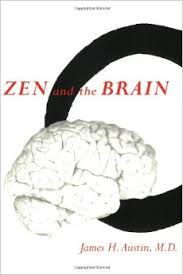
Another possible explanation is that many scientifically-minded people just don’t think that such goals are achievable because the routes to them have too often been couched in supernatural terms.   However, there’s a growing literature on how these objectives can be pursued that is rooted in neuroscience and neuroplasticity, and for which the presence or absence of a deity is irrelevant.  I’ve been reading a book called Zen and the Brain lately that offers an understanding of the effects of meditation that is firmly rooted in the science of the brain. I also recently purchased a book entitled Buddha’s Brain that takes a look at how neuroplasticity allows for a “rewiring” the brain to a healthier state. (Yes, I realize the irony of citing two books that have religious references in their titles in this post. I’d argue that this is how inexorably tangled these pursuits have become with religion. However, both of the scientist/authors of the aforementioned books, James H. Austin and Rick Hanson, have books with more secular titles if you’d prefer.)

BuddhaBrain Zen&Brain


I was once eating in a university cafeteria when I heard a religious man make the argument to a fellow he was trying to “educate” that went like this:  “If there’s not a God, why should I be nice to my wife–why shouldn’t I kick the hell out of my dog?” My first thought was that this man desperately needed therapy. If the only reason he wasn’t being a violent asshole is because he feared the wrath of an invisible, omnipotent entity who–by they way–would have to be showing a complete indifference to what people do to each other in real-time, then he’s an accident waiting to happen. If he either: a.) loses his fear of said deity, or b.) begins to think that the deity is telling him to go another way (since whatever the deity is “telling” him is almost certainly just his mind telling him), then his wife and dog are in great peril.


My second thought was, “this is the cafeteria in an institution for higher learning, how’d this guy get in without at least the rudimentary training in logic to imagine a basis of moral behavior that’s not rooted in the supernatural smiting ability of a deity [who–I might add–sees a helluva lot of smite-worthy activity on a daily basis.]”


If you’re considering an action that seems questionable, you don’t need to ask what Jesus would do? You can start by asking the question: Would my life (or those of my loved ones) be adversely impacted by living in a world in which everybody did what I’m about to do in the manner I intend to do it? (Implied is the idea that, if the action in question involves doing something to someone, you would be subject to being on the receiving end of same action sooner or later.)   If the answer is “yes,” don’t do it. If the answer is “no” there still may be reasons not to do the activity that have to do with what is good for you personally. (We’ll get into that a little further down.)


I realize that the above standard isn’t perfect, but it’s far less subject to user error than WWJD and it explains why the fellow from above shouldn’t beat his wife or his dog unless he likes rigorous and regular beatings himself. Some people might say that they don’t think they or their loved one’s would be adversely in the slightest if everyone went about walking around naked. Others might believe that they would be stressed out (or overstimulated) in such a world. However, the above approach has already gotten us to the fringe of questionable activity. Yes, some people might be traumatized if their neighbors walked around in the nude. But I suspect if everybody did it (as per the question) it would become not weird (definitely not harmful) in short order. There are those people who are so fragile that they can’t sleep knowing that a couple engaging in intercourse in privacy of a room three doors down are probably not using a missionary-approved posture. Said people need the kind of wisdom I’m talking about more than any because part of it is accepting that there may be more in heaven and earth than is dreamt of in their philosophy. Now that we know how to kill stray asteroids, if humanity ever dies out it will be at the hands of people who can’t bear anyone living by rules not those that they took for themselves.


At any rate, I think there are two reasons why the above approach is difficult for homo religiosis (religious human.) First, there are many activities that homo religiosis wants to see universally abolished because their religion considers forbidden, but which don’t adversely impact others. (e.g. Jains are pretty easy-come-easy-go, but imagine you were told you’d have to forgo onions because of that religion’s moral belief that no food should come from a plant that’s killed by harvesting. [FYI: Let me laugh now at the religious people who say “but there’s nothing crazy like that in my religion?” That just means you are so untraveled and uneducated that you can’t fathom how completely wacky some of your “moral” beliefs / practices are. e.g. How about eating salmon on Fridays as a sacrifice in lieu of eating a hamburger? That’s just nutty on all sorts of levels.])


Second, many believers really do believe that they have a special place in god’s heart and, therefore, aren’t subject to the same limitations as those poor, god unloved people. The idea that said person shouldn’t commit rape because they wouldn’t like it if someone else raped them or their sister or their mother is non-sense, because their god would never let someone else get away with shit like that with them. (Yes, there are people who’ve lived sheltered enough lives to believe that god punishes others but–at most–“tries” them.)


Most of us must accept that when it comes to being a person, we are the same as all the other people. While one may be stronger, faster, smarter, or in some dimension more talented than others, this doesn’t endow one with a different set of rights and responsibilities. On a genetic level there are no chosen people.


Earlier I mentioned that the “if everyone else did it” standard might leave one on the horns of a dilemma as to how to behave or what decision to make. Here’s where we’ve got to use our brains because the hard and fast rules go out the window. Evolution has programmed us with some guidelines that were beneficial given the constraints of the world our ancestors lived in. However, this programming of pleasure and pain may or may not be great advice given the ways in which humans have changed our own world.


Let me give some examples. Our nervous system suggests we eat foods that are sweet and fatty. We crave chocolate and bacon, and pleasure centers in the brain light up when we consume these foods. In our hunter / gatherer existence, this was excellent guidance because a.) these foods were relatively rare, b.) these foods had dense caloric content, c.) sweet foods are less likely to be poison, and d.) we worked our asses off in physical labor (i.e. high caloric demands.) However, today these high caloric foods are mass-produced, we require almost no caloric expenditure to obtain them (or to do most anything else in our cubicle-dwelling work lives), and in some cases people are literally (I don’t use “literally” lightly) killing themselves with such foods.  So part of the wisdom I’m talking about is developing the capacity to exercise conscious control over decisions about whether to eat such foods, how much of such foods to consume, and what activities to do to counter act the flood of empty calories. Our biology is a harsh mistress, and it can require intense efforts to keep such impulses under control.


We are also programmed with love, a trait which has served us well over all. I know some of you are cringing about the idea of “evolutionarily programmed love”–so unromantic. It’s simple. Those who could build connections with others disproportionately survived to pass their genes on. This further fed into our species’ rise because, while we think of ourselves as the planet’s dominant species, we produce the most vulnerable 1 year olds (or 8 year olds for that matter) of any species on the planet. A human three-year-old is good for two things–learning and food. It takes a lot of love to make sure its the former and not the latter. An extremely intense experience of love is essential to our species’ ability to not just wander off and let our pain-in-the-ass children get eaten. This gives us plenty of time to teach kids more than just how to elude a saber-tooth tiger. We have time to teach kids language, social niceties, and trigonometry.


We can, therefore, use our gigantic brains to noodle out whether a given action is best for us,  in addition to whether it does no harm to those around us. The complexity of our brains allows us to rewrite our rule book in unprecedented ways. Some of the religious “morality” that seems vacuous (e.g. don’t eat shellfish, but feel free to own as many people as you can afford) probably had a logic in that time (e.g. people were getting sick from eating shellfish because they didn’t yet know how to prepare it.) The problem is that one has to be ready to jettison obsolete advice, and that’s hard to do once it’s entrenched as dogma. This is where being Homo sapiens, the thinking human, comes into play.


10 Easy Pieces of Fitness Wisdom: and Why “Fitness Secrets” are Bullshit

A few weeks ago I did a post entitled, 10 Easy Pieces of Wisdom: and Why “Secret Wisdom” is Bullshit. That article’s premise was that understanding what one needs to do to be wise is simple, but the process of doing it is inescapably arduous–often to the point of seeming Sisyphean. (For those who aren’t brushed up on their Greek Mythology, Sisyphus was the guy who was punished by having to roll a rock up to the top of the hill only to let it roll back down, and the repeating the process ad infinitum.) I’m not saying that it’s a Sisyphean task, just that it can feel that way and one has to press forward through that feeling.


This post has the same premise, but applied to fitness. Fitness and wisdom have more in common than you might first think–they are both about improvement of the self. Unfortunately, the commonality that’s relevant here is that both invite crowds who will try to convince you they have an end-run around hard work. One of my past martial arts teachers, who was also in law enforcement, said that “cons only work on people with larceny in their hearts.” So it is that the con-men that are trying to sell “enhanced formula supplements” or “a 15 minute per week workout” can only sell to the people who want something for nothing. (Clue: what you get for nothing is nothing worth having.)


Without further ado, here are the 10 easy pieces:


1.) Know Thyself. This is a two-parter:

First, don’t let your ego write checks your body can’t cash. Some students want to jet right into the most advanced exercises. That’s like a third grader taking trigonometry; it’s ultimately less than productive. These are the individuals who tear ligaments, and who you don’t see again for six months–if ever. For virtually everyone, advanced exercises–be it a muscle-up or a yogasana like Urdhva Dhanurasana (A wheel pose, chakrasana, that is entered from a standing back bend)–require a lot of time spent in capacity building via fundamental exercises.


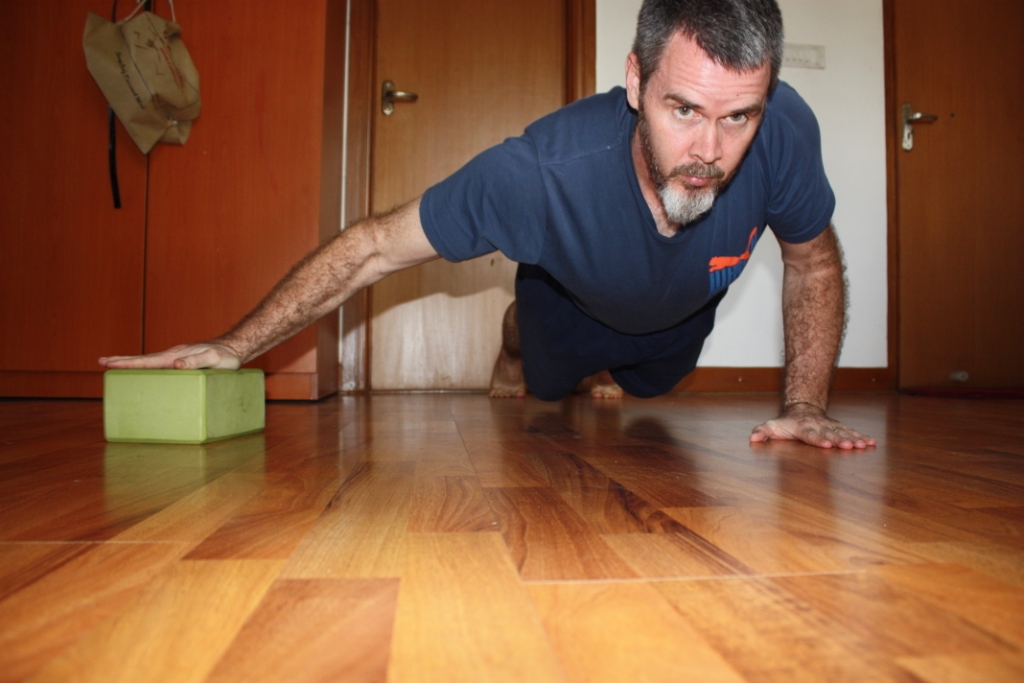
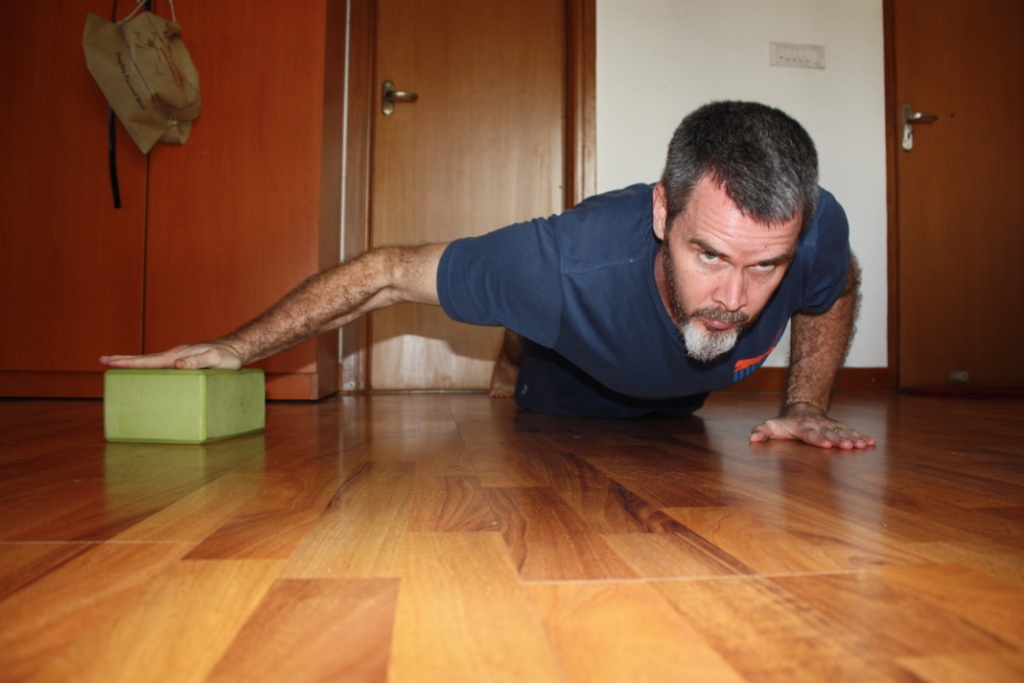
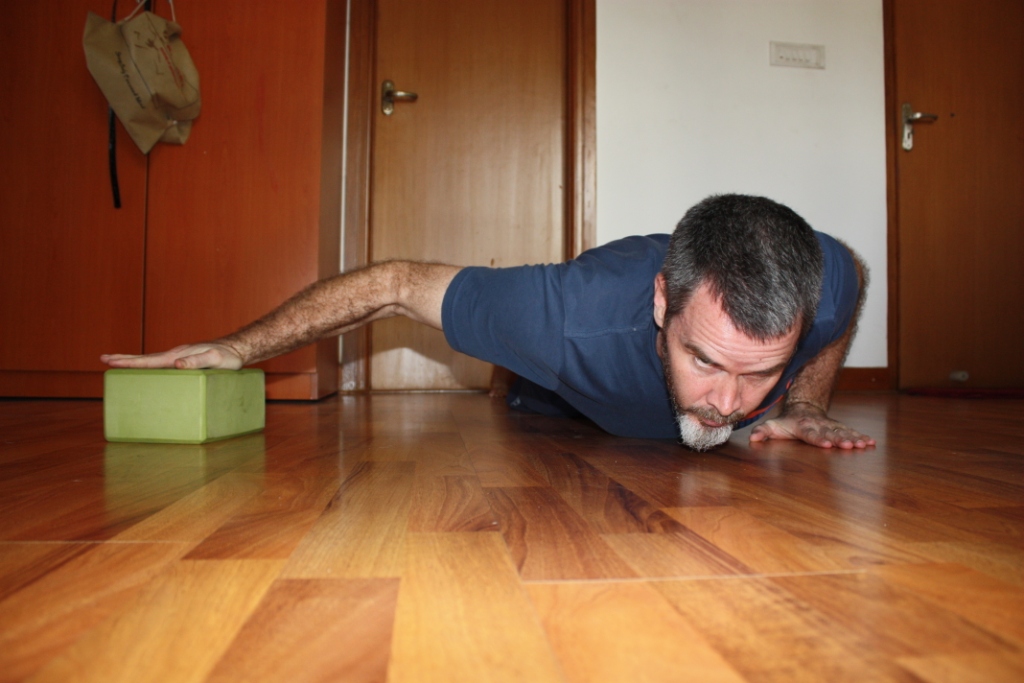
I’ll give an example, I saw someone on television yesterday doing the most horrendous single-armed push up. The only thing that kept this individual from damaging himself is that his range of motion was so tiny (he may have still injured himself.) His problem is that he heard that single-arm push-ups were cool, and he wanted to get straight to it. In reality, one needs to build into that exercise starting from a good solid standard push up, and then doing preppers (preparatory exercises) that gradually shift the load onto one arm. But maintaining form as well as one can. For example, putting one hand on a block off to the side, and gradually shifting it out to arm’s length.

IMG_3217 IMG_3218 IMG_3219


Second, on the other hand, don’t half-ass everything because you mistake discomfort for agony. This confusion cause people to greatly underestimate their capabilities. While you may think your teacher or trainer is a Sadist (only rarely are they are, really), the fact is that they are trying to give you one of the greatest gifts you can ever receive, which is the realization that you are capable of far more than you think you are–if you’re willing to gut it out through the challenging parts.


2.) Diet is the 800 pound gorilla of cutting weight. The simplified mathematics of this that adding exercise (while critically important to fitness) only marginally adds to the calories burned part of the equation. (Believe it or not one burns a lot of one’s calories just through baseline activities–breathing, walking, sleeping, etc.) However, when you cut caloric intake that’s all reduction from the intake side of the equation. However….


3.) Don’t make your goal weight loss, but rather to have a healthy and more functional body. Weight loss tends to be about external validation. That is, one wants to appear more attractive to someone else (or everybody else.) That’s a sucker’s game. People won’t necessarily notice–depending upon how often they see you and how self-absorbed they are. If you shed pounds at a healthy rate, people around you all the time don’t necessarily notice a day-to-day change.


On the other hand, as one starts feeling healthier and develops movement capacity beyond your previous capability, that can’t be taken away by anyone.


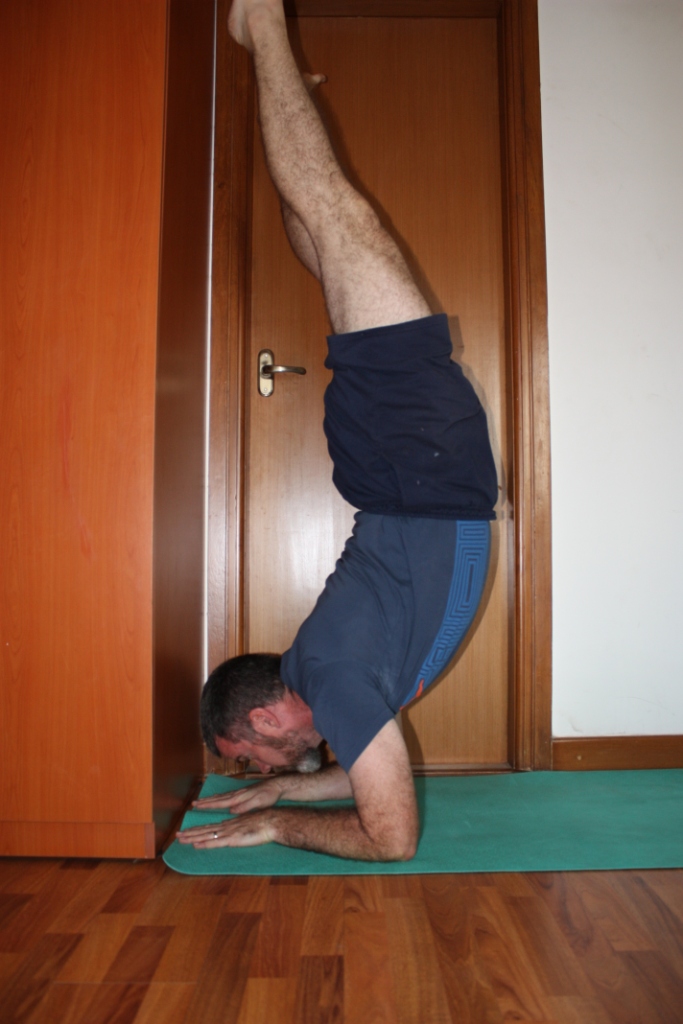
4.) When your body has been properly prepared through fundamentals, advanced maneuvers practically fall into place. I was taught a scorpion prepper  just a couple of weeks ago, and was surprised to find it was much easier than expected. I still have a lot of work to do to take it to the full pose. For example, I’m still using a wall so I don’t over-rotate in the arched back position,  but I bring my heels off the wall once I’m up. Next I’ll do away with the wall. Then it will be time to start bending my knees. My point is that  work on back stretches, core strengthening, and headstands made it relatively easy to get into the first stage.

IMG_3225


5.) Reveling in small victories can kill progress. The handstand provides a classic example. In the beginning, one starts kicking up against a wall. Even this can be a challenge in the beginning. However, as soon as it becomes doable, one should start gradually taking the training wheels off. This may begin as cautiously as pulling one leg away from the wall at a time. Then do away with the wall altogether. Then the suffering begins anew as one sheds the kick up in favor of a more controlled manner of ascent into the handstand.


6.) Don’t be quantitative.  A journalist once asked Muhammad Ali how many sit-ups he did in his training regimen. Ali said, “I have no idea. I don’t start counting until they start hurting.”

I’ve heard guys pleased with themselves because they do “sets of 100 push-ups.” This is often impressive only until you see the person actually do the exercise, and then–more often than not–you notice that they haven’t actually done one push-up. Rather, they’ve done a whole lot of mild elbow bends from a roughly plank-like position. It’s better to do 10 push-ups with a full-range of motion and controlled ascent and descent than to fool yourself with weak form.


7.) Don’t mindlessly workout. Shun the distraction of headphones, television, or cellphones . If you find working out to be so mind-numbingly boring that you need a distraction, you should re-evaluate the nature of your workouts. You should be “listening” to your body throughout the process. If your goal is to have a greater command over your body and its movement, e.g. you are a martial artist, dancer, yogi, etc., then this is particularly important.


First of all, with respect to boredom, boredom is the product of a weak mind. So you might consider working the mind out as well. Secondly, if you are truly bored, you should be upping your game.


While this may be one of my least popular points in this post, if you don’t believe me, ask Al Kavadlo.


8.) Rest is part of the process. It’s not stepping away from the process. As your body rests, your mind should be alert and taking stock of the effect of the practice on your body. Rest breaks aren’t zone out time. Also, part of having a healthy body is building a healthy parasympathic nervous system and immune system. Your body requires rest to heal, and it can heal and fight off infections tremendously effectively if you provide the right conditions.


9.) Exercises that consist of the motions you will need for your particular life are the most important.  The term “functional fitness” is ubiquitous these days, but I first read this advice in Bruce Lee’s Tao of Jeet Kune DoLee said that actions like punching, kicking, and grappling practice should make up the core of a martial artist’s workout. That doesn’t mean one should do away with general fitness activities. (Lee certainly didn’t.) Martial arts provide a prime example of an activity that requires a well-rounded form of fitness. That is, one needs core strength, good range of motion, cardiovascular endurance, and extremity strength and speed.


10.) Don’t agonize over failures. Move onward and, carefully, upward. If you aren’t (safely) failing to achieve an occasional goal, then you need to kick your way out of that box of comfort zone you’re trapped in.


10 Easy Pieces of Wisdom: and, Why “Secret Wisdom” is Bullshit

IMG_0438

Having lived in India–land of sages–for over a year now, one may wonder whether enlightenment has taken hold. Let me share some of the nuggets I’ve gleaned. This isn’t what I found chiseled on walls in Sanskrit. It’s what living and thinking in the modern world have wrought.


1.) Anger is just fear in a red dress.

It’s all just frustration / unease / discontent with one’s limited domain of control.

On a related note, I read a relevant quote from Irmgard Schloegl recently: “Look at getting mad from this perspective. If you had but five more minutes to live, and it would still be worth getting mad over, then by all means do so.”


2.) Secret paths to wisdom are bullshit–the theory is simple the practice is arduous.

It all boils down to living in the moment more, being aware of your mind, and exercising your will.

First, you start becoming aware that you were recently a jackass.

Next, you begin to realize you’re in the process of being a jackass.

Then realize that you’re about to be a jackass–but you can’t help yourself and end up with jackass’s remorse.

Finally, you begin to preempt your inner jackass.

The latter is wisdom, and it’s not for lazy people who like shortcuts.


3.) There’s no ratchet effect on wisdom–no one-way trip to enlightenment or nirvana.

Either you accept that life is a glorious lifelong struggle to be the best version of yourself, or you wallow in a sty of mediocrity.


4.) The words “just a…”–as Catholic nuns say of masturbation–result in immediate blindness.

There’s nothing that will blind you to the deepest beauty of a person, place, or animal faster than saying it’s “just a…”


5.) Stop thinking of the body as an “empty vessel.”

It results in your treating it like a rental car. You aren’t a bar of gold being hauled around in a manure spreader. You were endowed with a Rolls Royce with on-board access to a Cray super-computer, and you risk turning into a Yugo with an abacus when you fail to keep it tuned and quietly revel in its magnificence.


6.) If a teacher is happy that his students  almost reach his level, he’s part of a dying tradition.

In a growth tradition, some students will surpass their teachers, and that’s only likely if the teacher wants it to be that way.


7.)  Be a scalable hero.

Human beings are terrified by their smallness, impermanence, and ultimate insignificance. In geologic time, everybody is an inconsequential blip. You can’t get around this, but you can pick a scale of time and space in which you matter. That space is here, and that time is now. In the here and now, you can be a giant–figuratively, of course. Here and now you can’t be everybody’s hero, but you can be somebody’s.


8.) Start your pursuit of virtue by doing no harm.

Begin being virtuous by capturing the advantage in those quiet moments that need nothing but a lack of interference or insinuation. Then go on to active expressions of virtue.


9.) Vicarious living ain’t living.

Don’t sit around watching others live life.


10.) Don’t count yourself free if your impulses overwhelm your conscious mind.

People worry a lot about the control that external forces and authorities exercise over their ability to act, but often spend far too little time on whether they’re working towards liberating themselves from raw impulse, habit, and reactionary living. Epictetus used to piss high society types off by asking them whether they thought they were truly free.

If you’ve been following the science of free will, you’ll know that the current prevailing thought lands against the notion of free will. This is because brain imaging has made it possible to see how decisions are biochemically made before the mind consciously ruminates and “makes a decision.” However, the verdict is still out. The question isn’t whether we ever fail to exercise conscious free will. Of course, there are many times we fail to, maybe even most times. The whole point of emotions is to help us make decisions without adequate information to make rationally optimized decision. However, the question is whether we can learn to exercise free will. Scientist long ago verified that some yogis and monks can exercise conscious control over autonomic bodily functions (e.g. controlling heart rate from a static position.)


There it is: wisdom for the modern age stuffed in a nutshell of bullet points.


BOOK REVIEW: The Voice of the Silence by Helena Petrovna Blavatsky

The Voice of the Silence: Being Extracts from The Book of the Golden PreceptsThe Voice of the Silence: Being Extracts from The Book of the Golden Precepts by Helena Petrovna Blavatsky

My rating: 3 of 5 stars

Amazon page

According to Helena Blavatsky, the three “fragments” that make up The Voice of the Silence are her translations of three tracts from The Book of Golden Precepts, of which there are 90 and she had memorized 39. The Book of Golden Precepts is said to include both Buddhist and pre-Buddhists views on spirituality.

Blavatsky was one of the founding members of the Theosophical Society, an organization that proposed and advanced a certain brand of mysticism. Mystic traditions are those which believe that one must look inward to find the divine, i.e. to know god. The Theosophical approach isn’t without controversy. Blavatsky’s allusion to a secret path to wisdom and the suggestion that most of the world isn’t ready for the high level teachings sits in contradiction to a Siddhartha Buddha who was transparent. Buddhists have been known to claim that in as much as an idea is a teaching of the Buddha, it wasn’t secret, and in as much as a teaching was secret, it wasn’t the work of the Buddha. But there is disagreement. Some believe that what Blavatsky is presenting is high level Mahayana Buddhism, but others think that it’s a hodge-podge of Kabbala, esoteric Buddhism, and yogic teachings.

The first “fragment” is also titled “The Voice of the Silence.” This section suggests that there are three stages to one’s journey: ignorance, learning, and wisdom. It states that one must take care to not to be distracted from the path by sensual inclinations or by desire. The path described mirrors the advanced stages of Patanjali’s eight-limbs. In other words, she discusses a progression from pratyahara (not explicitly named, but described as the withdrawal of sensory input), dharana (concentration), dhyana (meditation), and Samadhi (liberation.)

The second part is entitled “The Two Paths.” Liberation and renunciation are the two paths in question. The central topic of this chapter is Karma, and the questions of action versus inaction that are also discussed in the Bhagavad-Gita.

The third part is “The Seven Portals.” These seven doors through which one must pass on the way to wisdom are essentially the same as the six paramita of Buddhism with an additional one, Virag, inserted between the third and fourth spot. The portals are Dana (generosity), Shila (a.k.a. Sila, or virtue), Kshanti (patience / perseverance), Virag (illusion conquered), Virya (energy), Dhyana (contemplation), and Prajna (wisdom).

A nice feature is a “glossary” at the end of each of the fragment that explains some of the terminology and concepts. While this is called a glossary, it’s not one in the usual sense, i.e. it’s not in alphabetical order and is not exclusively definitions. It would better be described as chapter notes. The idea is to convey the information that a lay reader may need, but which the author / translator doesn’t want to muddle the text with.

I think this book is worth a read. It’s short, and for a work written in the 19th century it’s quite readable—that doesn’t mean that the message is always clearly conveyed—whether on purpose or accident.

Note: While I read this on Kindle for a nominal price, it’s available on the web free of charge (see here.)

View all my reviews