“The Wind Shifts” by Wallace Stevens [w/ Audio]

This is how the wind shifts:
Like the thoughts of an old human,
Who still thinks eagerly
And despairingly.
The wind shifts like this:
Like a human without illusions,
Who still feels irrational things within her.
The wind shifts like this:
Like humans approaching proudly,
Like humans approaching angrily.
This is how the wind shifts:
Like a human, heavy and heavy,
Who does not care.

“In a Station of the Metro” by Ezra Pound [w/ Audio]

The apparition of these faces in a crowd;
Petals on a wet, black bough.

BOOKS: “Literary Theory: A Very Short Introduction” by Jonathan Culler

Literary Theory: A Very Short IntroductionLiterary Theory: A Very Short Introduction by Jonathan D. Culler

My rating: 4 of 5 stars

Publisher site – OUP

This brief guide tries to bring some clarity to the question of what literary theory is, a question which is a great deal more convoluted that it is in science (or even the social sciences) where the scientific method shapes our understanding of the term. Often when one hears about literary theory it’s in the context of Marxists, Feminists, or Psychoanalysts, and one might be forgiven for wondering whether those scholars don’t have a discipline of their own (not to mention how much can a Marxist – for example – illuminate The Little Prince or the poetry of Li Bai.)

I thought the book was well-arranged to shed as much light on the topic as possible. Of its nine chapters, the first two explore competing ideas of what constitutes “theory” and “literature,” respectively. There is a chapter (Ch.3) that distinguishes the field from the overlapping discipline of cultural studies. The remaining six chapters cover topical components of the field, including: language / meaning, rhetoric / poetics, story, performative language, identity, ethics, and aesthetics.

This book does a good job of offering some clarity and has a sense of humor as it does so (notably through satirical cartoons that illustrate the book.) If you’re looking for a layman’s guide to the subject, this one is readable and insightful.

View all my reviews

“Nightfall on the Tisza River” by Géza Gárdonyi [w/ Audio]

Up comes the Moon on the river,
Trees and grass quietly quiver.
Near Szeged a wooded island,
Od fishing barque, tied to the land.

By the moonlight, on this barque, old,
Sat a fisherman I am told,
Played a tune as well as he might,
Played it well, well into the night.

On the Tisza, velvet darkness,
Starry sky, the stars numberless,
Spread a shroud studded with diamonds
Radiating starry light fronds.

May have been this very spot, hark!
Right under this rickety barque,
In the very depths of the deep
An ancient king's sleeping his sleep.

His coffin is gold and silver,
Of iron is made its cover.
Up the river is glistening,
Down the ancient king, listening.

Translation by Frank Veszely in: Hungarian Poetry: One Thousand Years. 2023. Friesen Press: Altona, MB, Canada.

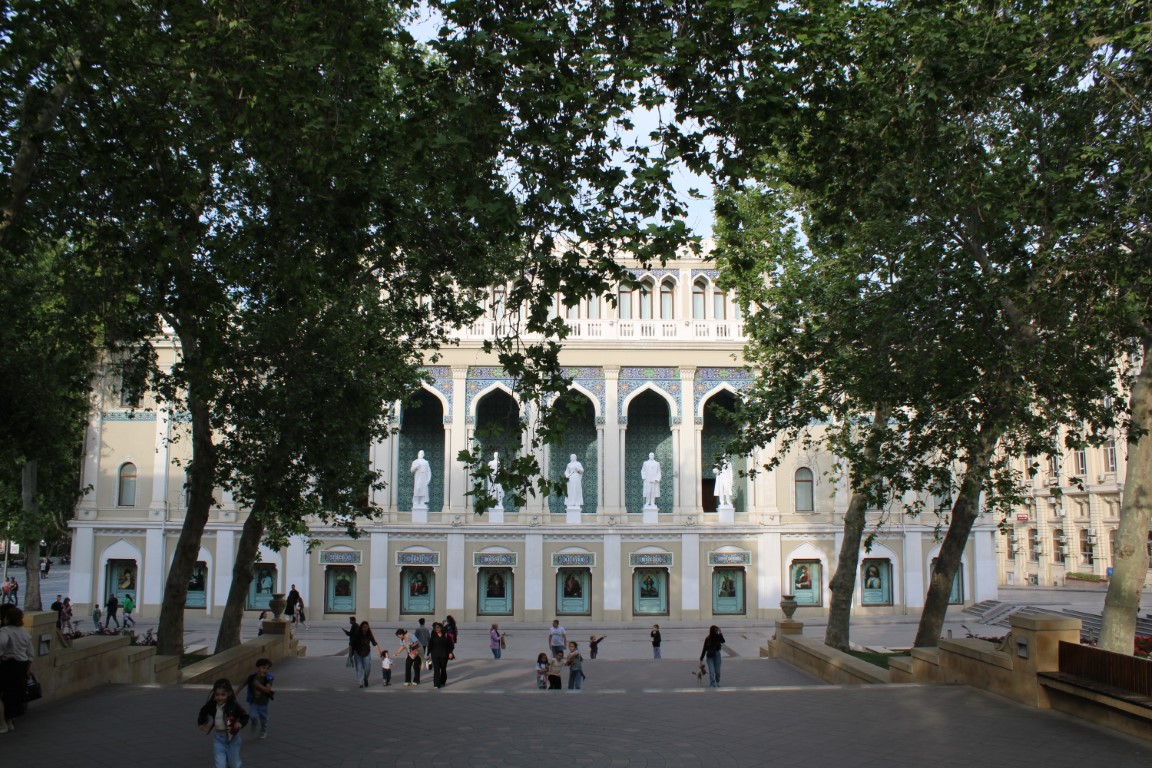
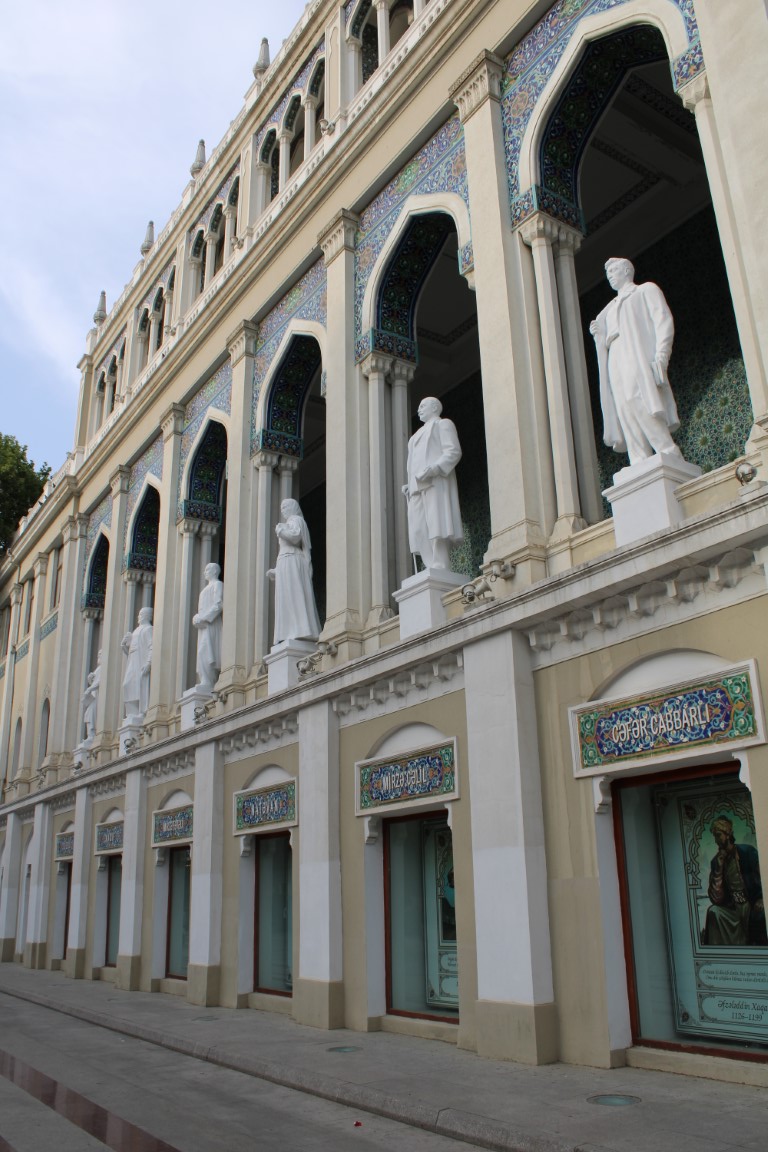
DAILY PHOTO: Nizami Museum of Azerbaijani Literature

BOOKS: “Pygmalion” by George Bernard Shaw

PygmalionPygmalion by George Bernard Shaw
My rating: 5 of 5 stars

Available on Project Gutenberg

Pygmalion is a play about class and human connection, and is probably the best-known work of George Bernard Shaw, having been adapted into a popular movie entitled My Fair Lady.

Henry Higgins, an expert on accents and dialects, bets his friend, Col. Pickering, that he can train a poor Cockney flower girl (Eliza Doolittle) to pass as a duchess at a soiree with genteel elites. Higgins is educated and of upper-crust upbringing but is neither refined nor does he have much in the way of people skills. Pickering is a personable and mannerly gentleman. Eliza is on a journey of transformation and her interaction with the two men offers insight into how those of different classes view dignity. (Besides examining class differences, some insight into how men and women differently view human interactions is generated.)

Beginning the last act (Act V,) it felt like the earlier acts hadn’t done the work required of them to motivate the last act behavior / discussions, but — I must admit — that feeling went away by the time the dialogue was complete. (Also, I give benefit of the doubt to the fact that good acting may have conveyed inklings to an audience that couldn’t be garnered from reading dialogue and stage directions.)

There was an Afterword that sketched out what happens in the lives of the characters after the events of the play. I didn’t care for it. There is a certain level of ambiguity in the ending, and I was good with that. I understand that many readers / viewers are not, however. (If you watched Christopher Nolan’s Inception and the spinning top ending drove you batty, you’d probably appreciate this Afterword. I believe the movie (My Fair Lady) tweaks the ending to make it more definitive.)

At any rate, this is a witty and evocative play and is well worth reading (or seeing.)

View all my reviews

“Ox” by Ikkyū [w/ Audio]

Among other creatures this is what I was.
Abilities depend on the realm;
realm also depends on abilities.
At birth I forgot completely by which path
I came.
I don't know, these years, which school
of monk I am.

Translation by Kazuaki Tanahashi and David Schneider in Essential Zen. 1994. HarperSanFrancisco.

“I’ll be the tree…” by Sándor Petőfi [w/ Audio]

I'll be the tree, if you'll be its flower;
I'll be the flower, if you'll be the dew;
I'll be the dew, if you'll be the sunshine
That glistens as it unites we two.

If you, My Love, should become the Heavens,
I'd be reborn as a star on high.
Even if you turned into Hell, itself,
I'd be damned, and I'd gladly fry.

The Original Poem in Hungarian:

Fa leszek, ha fának vagy virága.
Ha harmat vagy: én virág leszek.
Harmat leszek, ha te napsugár vagy...
Csak, hogy lényink egyesüljenek.

Ha, leányka, te vagy a mennyország:
Akkor én csillagá változom.
Ha, leányka, te vagy a pokol: (hogy
Egyesüljünk) én elkárhozom.

“The Secret Sits” by Robert Frost [w/ Audio]

We dance round in a ring and suppose,
But the Secret sits in the middle and knows.

“The Voice of the Ancient Bard” by William Blake [w/ Audio]

Youth of delight, come hither,
And see the opening morn,
Image of truth new born.
Doubt is fled, & clouds of reason,
Dark disputes & artful teazing.
Folly is an endless maze,
Tangled roots perplex her ways.
How many have fallen there!
They stumble all night over bones
of the dead,
And feel they know not what
but care,
And wish to lead others,
when they should be led.