BOOK: “Understanding Eastern Philosophy” by Ray Billington

Understanding Eastern PhilosophyUnderstanding Eastern Philosophy by Ray Billington
My rating: 4 of 5 stars

Publisher Site — Taylor & Francis

This book does a solid job for one that bites off so much in a single go. Eastern Philosophy is a large subject, and to try to outline the major premises of its varied systems and also compare them to Western / Abrahamic notions (when Western schools are sometimes no more different from Eastern schools than each side is within,) and to do so in under two-hundred pages is a daunting undertaking.

For the most part, I felt the book did a fine job of meeting its objective. A fair amount of selection and simplification is required. I will say the part describing karmic doctrine didn’t seem consistent with what I was taught and seems more in line with the early Western scholars who started writing about Eastern Philosophy but could not help but couch the subject in a Western / Abrahamic frame because it was what they knew and was invisible to them. I say this as one who is no big fan of Karmic philosophy, though for another reason (one which is also mentioned in this book.) I’ve always been told that the central idea is to do selfless acts in order to escape the karmic cycle. Billington, like others before him, states it as do “good deeds” and then he puts forth the critique that this won’t help because doing good for one’s own benefit is fraught with peril. My understanding from Sanskrit scholars is: first, Hindu philosophers were aware of this paradox from the beginning and that’s why the emphasis has always been on “selfless” acts; second, the Abrahamic bifurcation of all actions into good and evil is not so much a thing in Hindu thinking (most actions are inherently neither.) I should point out that there is a lot of internal conflict within these philosophies (e.g. differences between Buddhist and Hindu thoughts on Karma) and that Billington does elsewhere reflect on the differences between Eastern and Western thinking about good and evil.

The first two-thirds of the book is organized by schools of thought (beginning with the Indian ones and working toward Chinese / East Asian schools) and the last third deals with a series of fundamental philosophical questions.

If you want a quick outline of Eastern philosophical ideas, this book gives a good look at them, particularly if one is interested in a comparison to Western ideas. The book also spends a fair amount of time in discussion of what a religion is and how one differs from a philosophy.

View all my reviews

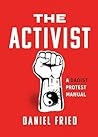
BOOKS: “The Activist” by Daniel Fried

The Activist: A Daoist Protest ManualThe Activist: A Daoist Protest Manual by Daniel Fried
My rating: 4 of 5 stars

Publisher Page — Prometheus Books/

Release date: March 3, 2026

Taoist philosophy has been applied to many a subject over the centuries, from war to business to governance to relationships, but this is the first time I’ve seen it applied to activism in a substantive way. The book caught my eye because I’ve long recognized the central truth behind Fried’s work, which is that the tactics and mindsets of protesters often does them no favors and may even ensure failure (if one presumes the objective to be to change behavior and attitudes on a given topic into line with the protesters’ stance.) The problem is that protesters are often angry and combative, characteristics which may keep the choir (preaching to itself) warm and feeling self-righteous, but which seldom brings in new converts from among the undecided [let alone from the opposing side.] And if you didn’t need converts to your side, you wouldn’t have to protest in the first place. Given this tendency, Taoism could be argued to be an ideal source of strategy. Taoism proposes going with the grain, not leading with a fight, and avoiding useless activity.

This book provides interesting food-for-thought about how protesters might have more impact by adopting fewer belligerent and self-serving tactics. Unfortunately, the book also has stretches of stream-of-consciousness writing that — while perhaps consistent with the Taoist love of spontaneity — can be a bit of a strain on the reader’s ability to follow. This mostly takes place in the latter chapters.

I found this book to be intriguing. I can’t say that I came away from it having answered the question of whether Taoist philosophy is reconcilable with activism on a practical level. Taoism asks one to let the natural unfold, while protest movements want to guide a society in a particular direction (notably one by definition at odds which that which has fallen into place organically.) It’s not for lack of discussion that I haven’t reached a conclusion, but rather that questions remain for me on the pragmatic level (rather than the level of theory.) That said, I found the book well worth reading, despite a few points of low readability.

View all my reviews

Immortal’s Limerick

There once was a wise Daoist Immortal,
Asked the secret to long life, he'd chortle:
"If you can stand masses
Who behave like asses
You're enlightened --
but better off mortal."

BOOKS: “Taoism: An Essential Guide” by Eva Wong

Taoism: An Essential GuideTaoism: An Essential Guide by Eva Wong
My rating: 4 of 5 stars

Publisher Site

This book offers the reader clarity about the scope of Taoism, a daunting challenge given Taoism’s long history and how it overlaps with other schools of philosophy as well as with Traditional Chinese Religion, more broadly. The book is divided into three parts: history, specialties (magic, divination, ceremony, inward training, and karma yoga,) and practices (meditation, somatic practices [e.g. qi gong and taijiquan,] and rituals and ceremonies.) The history section covers a period from pre-Taoist shamanic practices of 5,000 years ago, practices that would inform early Taoism, to a period during which Taoism became entwined with Buddhism and Confucianism. The specialties and practices sections attempt to give the reader a broad overview while avoiding discussion of “how-to.”

I found this book to be informative and interesting. It did feel more effectively geared toward someone with an interest in Taoism as religion rather than Taoism as a philosophy. The discussion does sometimes get into the weeds on issues like ceremonies and talismans (again, not in a how-to fashion, but with some arcane detail nevertheless,) but — at the same time — besides some discussion of the teachings of the Tao Te Jing and some exploration of Taoist metaphysics in the Divinational Taoism chapter, there’s not a lot of insight into Taoism as philosophy. That said, it does end each chapter with a “Further Reading” section that can point readers interested in a specific topic elsewhere.

If you’ve ever been overwhelmed at one of those bright and complicated Chinese temples and would like some insight into what Taoists do and how it’s different (or not different) from what Confucianists, Traditional Chinese Religion practitioners, and Zen Buddhists do, this is a good book to check out. If you’re solely interested in Taoism as a school of philosophy or otherwise have a specific focus such as qi gong and breathwork practices, you can probably find books that are better tailored to your needs.

View all my reviews

“Strong” [Poetry Style #8] by Sikong Tu [w/ Audio]

Walk with a mind that's clear and unburdened, 
With life force that flares -n- flows like rainbows,
Traversing the witch's gorge through the mountains --
Among the floating clouds and blowing winds.
Drink up the spiritual; dine on the real;
Let them ever build up in your body.
Emulate the health and might of the gods,
Preserve your energy through harmony.
Be one with Heaven, be one with the Earth.
See in yourself divine transformations.
Know all this to the utmost -- be all this,
And hold on to it 'til the bitter end.

NOTE: The late Tang Dynasty poet, Sikong Tu (a.k.a. Ssŭ-k‘ung T‘u,) wrote an ars poetica entitled Twenty-Four Styles of Poetry. It presents twenty-four poems that are each in a different tone, reflecting varied concepts from Taoist philosophy and aesthetics. Above is a translation of the eighth of the twenty-four poems.

“On Laozi” by Bai Juyi [w/ Audio]

"The ignorant speak, while the wise keep silent."
I read the words of Laozi.
But if Laozi knew the Way,
Why did he write those five thousand characters?

BOOK REVIEW: The Te of Piglet by Benjamin Hoff

The Te of PigletThe Te of Piglet by Benjamin Hoff
My rating: 3 of 5 stars

Amazon.in page


Once in a while, one runs across a book that is much beloved by the general public, and one can’t figure out why. For me, this is one of those books, (as is its predecessor, “The Tao of Pooh.”) I certainly get the appeal of such a book, in principle. A book that clarifies and simplifies a subject as complex as philosophy using straightforward, down-to-earth, and well-known children’s stories like those from A.A. Milne’s “Pooh” book series is a brilliant idea, and is the kind of book I’d generally enjoy reading. [I’m a big believer in Einstein’s notion that, “If you can’t explain it to a six-year-old, you don’t understand it yourself.”] Maybe that’s why I gave this book a rare second-chance. I’d listened to the audiobook from the library many years back, and didn’t much care for it at the time. However, the idea of the book was so appealing that I picked up a copy at a used bookstore recently, figuring that I’ve certainly changed my mind on many things over the years. Unfortunately, my opinion of this book has not improved. It’s a stellar book idea that, in my view, was poorly executed.

Before I get into what I found objectionable about this book, it’s worth noting that when the book is at its best it delivers some beautiful lessons on Taoist thought in a humorous and lighthearted way, illustrating these lessons through a mix of Pooh character interactions and quotes and tales from Lao Tzu, Zhuangzi, and other Taoist sources. When is the book at its best? When there is an interaction between two streams of voice: Taoist sage and Pooh-universe kid’s characters. Perhaps surprisingly, those two voices work well together – harmoniously and effectively.

So, what, you may ask, is my problem. It is the frequent interjection of a third voice, one that I will call “angry ideologue.” This angry ideologue is not at all in harmony with the other two voices, and –in fact — frequently detracts from the lessons by violating them outright. A prime example of this can be seen with respect to the fifth chapter’s (i.e. “The Eeyore Effect”) lesson against belittling others to make oneself feel bigger. A great lesson, except that Hoff is so quick to behave in conflict with it. A minor, but unfortunately not atypical, example can be seen in the previous chapter in which Hoff proves unable of extolling the virtues of Taiji and Pa Kua Chang (two Chinese martial arts) with the need denigrate a couple of Japanese martial arts (judo and aikido) in the process.

The most widespread example of his failure to do as he says, however, involves Hoff’s attacks against Confucianism. To be fair, there is a long history of Taoist and Confucianists badmouthing each other, but this need to tear down others to feel better about oneself is not consistent with the ideas that are explicitly expressed in the book. Hoff greatly oversimplifies Confucianist arguments, and while it’s certainly alright to simplify for the purposes of such a book, one can employ simplification as a weapon — cherry-picking ideas and statements out of context to make the other side look inept and illogical. Hoff violently swerves between the book that is advertised into political diatribes that often employ gratuitous attacks. To be fair, these digressions are probably not so dominant in the book as I make them sound, but the effect is multiplied by the distraction created – particularly when there is a sequence in which Hoff shares some Pooh wisdom to be kind, tolerant, or humble and he follows this by being none-of-the-above in his vilification of those with differing views.

While there are obviously many who would disagree with me, I’d recommend one look elsewhere to better understand the tenets of Taoism. There are certainly books that are more balanced and which will teach one more about Taoist thinking (as opposed to how to cherry-pick and twist Taoist ideas so that they seem to support a particular political stance.)

That said, one advantage of this book (and its predecessor) is that it is designed to speak to a wide age-range, and while books like Puett’s “The Path” and Slingerhand’s “Trying Not to Try” are better books for learning about Taoism but yet are very readable for a non-scholarly reader, they are not necessarily kid-friendly. I can’t say that I know any good kid-oriented books on Taoism (though some may well exist,) but I tend to believe that kids are more likely to pick up bad habits of thinking about people with different points of view and about interacting with others through this book then they are to learn good habits of mind. [Although, if one skips over the diatribes, it might serve quite well. And if one doesn’t skip them, one will still be preparing your child to participate in what passes for political discourse in the modern era.]

View all my reviews

Wu Wei Haiku

don’t debate dolts
they’ll remain half-wits
after you’re spent

flex in wind
and rebound in calm
all in time

glide to dive
the hawk’s fearsome show?
gravity’s work

wise farmers
wait to do watering
eyes to clouds

mute traders
get extra carrots
for silence

BOOK REVIEW: The Way of Chuang Tzu by Thomas Merton

The Way of Chuang TzuThe Way of Chuang Tzu by Thomas Merton

My rating: 5 of 5 stars

Amazon page

The Way of Chuang Tzu is Thomas Merton’s take on Chuang Tzu’s lessons of Taoism. One might ask why a person should learn about Taoism from a Trappist monk any more than one would learn the teachings of St. Francis of Assisi from a Zen monk. Maybe you should and maybe you shouldn’t, but I think Merton did a remarkable job in putting this book together and that there’s a lot to be learned from it. Some may find a fresh fusion in Merton’s approach to Chuang Tzu.

What I like most about this version of Chuang Tzu’s teachings is that Merton doesn’t foul it up with a bunch of analysis. Because the lessons are short and—admittedly, in some cases—arcane, there’s a temptation to write in a bunch of explanation and analysis—both to hit a page quota and to prove how smart the translator is. Ironically, some don’t seem to see the irony of rambling on in explication of Taoism—a philosophy that advocates simplicity and rebukes the wordy for their arrogance. Merton doesn’t fall into this trap. He offers a few pages of introduction as context for the reader, and then moves straight into 62 lessons of Chuang Tzu.

I’d say the introduction is useful, particularly for individuals without a great deal of background in Taoism. In it, Merton gives insight into potentially confusing topics like wu-wei (actionlessness), the yin/yang dichotomy, and the divergence of Taoists from Confucian scholars on the four-fold Ju philosophy of virtue. However, the intro can also be skipped if you do know a about Chinese philosophy, and don’t care to read a commentary on Taoism inflected with Trappist worldview. (Taoists may want to skip the intro if they’re prone to becoming infuriated by an outsider proposing that their life philosophy took a wrong turn along the way. Merton suggests that one shouldn’t confuse Chuang Tzu’s Taoism with what the system has become, the implication being that it was a sound philosophy and became voodoo hokum in modern times.) Merton does inevitably project some of his own worldview as a Christian monk into Chuang Tzu’s teachings. Some might find this to make for a refreshing commentary on it, and others may find it a bit off the mark on occasion.

Merton’s poetic background serves him well here as many of the lessons are in poetic form—partially or totally. Translating poetry is one of the most difficult linguistic tasks imaginable. Merton has the added challenge of never having read the original. He doesn’t read any Chinese languages. He did, however, consult four different translations in three different languages (English, French, and German.) This, of course, means that besides Merton being in the text, there’s a further seepage of Western framing into these Eastern teachings. I’ll leave it to the reader to decide whether this is a good or bad thing, and arguments could be made either way.

One of the strengths of Chuang Tzu’s lessons is his use of the narrative form. That is, the Taoist sage liked to use stories to impart his wisdom, like the wheelwright who insults the Emperor but then ends up teaching him a valued lesson. One of my favorites is the story about the Prince of Chu sending out high-ranking emissaries to appoint Chuang Tzu to a ministerial post. Chuang Tzu explains why he is turning down the offer by way of an allegory about a turtle.

Chuang Tzu also uses dialogue to get his point across in a way that is easy to follow and clear. A prime example of this is the discussion between Chuang Tzu and Hui Tzu about the happiness of fishes, which has an almost Socratic ring to it. The combination of story and dialogue makes Chuang Tzu’s lessons sometimes easier to follow than the Tao Te Ching of Lao Tzu. Lao Tzu tends to be more arcane by way of his use of short, declarative statements that are more vague and abstract (that could be a good thing, but given vast loss of cultural context it might be confusing as well.)

I’d recommend this book for anyone interested in Taoism. I enjoyed the Merton’s sparse approach, and think that he does a good job conveying Chuang Tzu’s lessons.

View all my reviews