Satori [Free Verse]

It was a moment 
 of silent spaciousness.

In the midst of a fight,
 there was no enemy --
  just the effortless
   dance of the thing.

That moment 
 expanded to the infinite,
  & snapped back 
   to one tick after the tock.

Since then, 
 no catastrophe has felt 
  too great for a smile.

BOOK REVIEW: Singing and Dancing Are the Voice of the Law by Busshō Lahn

Singing and Dancing Are the Voice of the Law: A Commentary on Hakuin's “Song of Zazen”Singing and Dancing Are the Voice of the Law: A Commentary on Hakuin’s “Song of Zazen” by Bussho Lahn
My rating: 5 of 5 stars

Amazon.in Page

Release Date: December 20, 2022 [In India, may be out in your area.]

This book consists of a collection of essays inspired by the poem, “Song of Zazen,” written by the 18th century Zen master, Hakuin. Hakuin’s poem is brief (about forty lines,) and the essays composed by a present-day Zen priest (Lahn) offer commentary on a stanza-by-stanza basis. The book is divided into fourteen chapters, though the final chapter isn’t a stanza commentary.

I enjoyed reading this book and learned a great deal from it. The book benefits from the fact that the author is not rigidly sectarian. Therefore, the book is not doctrinaire, which warms the reader to the teachings. It’s also useful because it allowed the author to freely draw examples and quotes from a variety of sources, some of which may be more familiar or relatable to neophyte readers.

The last chapter offers a discussion of the fundamentals of zazen (seated meditation) as well as some other ancillary information that may be useful to readers new to Zen Buddhism, its practices, and its sutras. If you’re interested in Zen Buddhist meditation and philosophy, you may want to give it a look.


View all my reviews

In the Temple [Free Verse]

i enter an empty temple. 

it’s not silent.

footfalls resonate
&
floorboards creak.

but flickering flames
&
sleepy-eyed Buddhas
are quiet enough

in an hour,
the monks will filter in
with great punctuality:
monks, young and old.
(i would say, “and ages in-between,”
but they all seem young or old.)

there will be chanting,
and the din of finger cymbals
and deep-toned drums.

and i will leave
for the solace
of the world
outside the temple.

Slack Flags [Haiku]

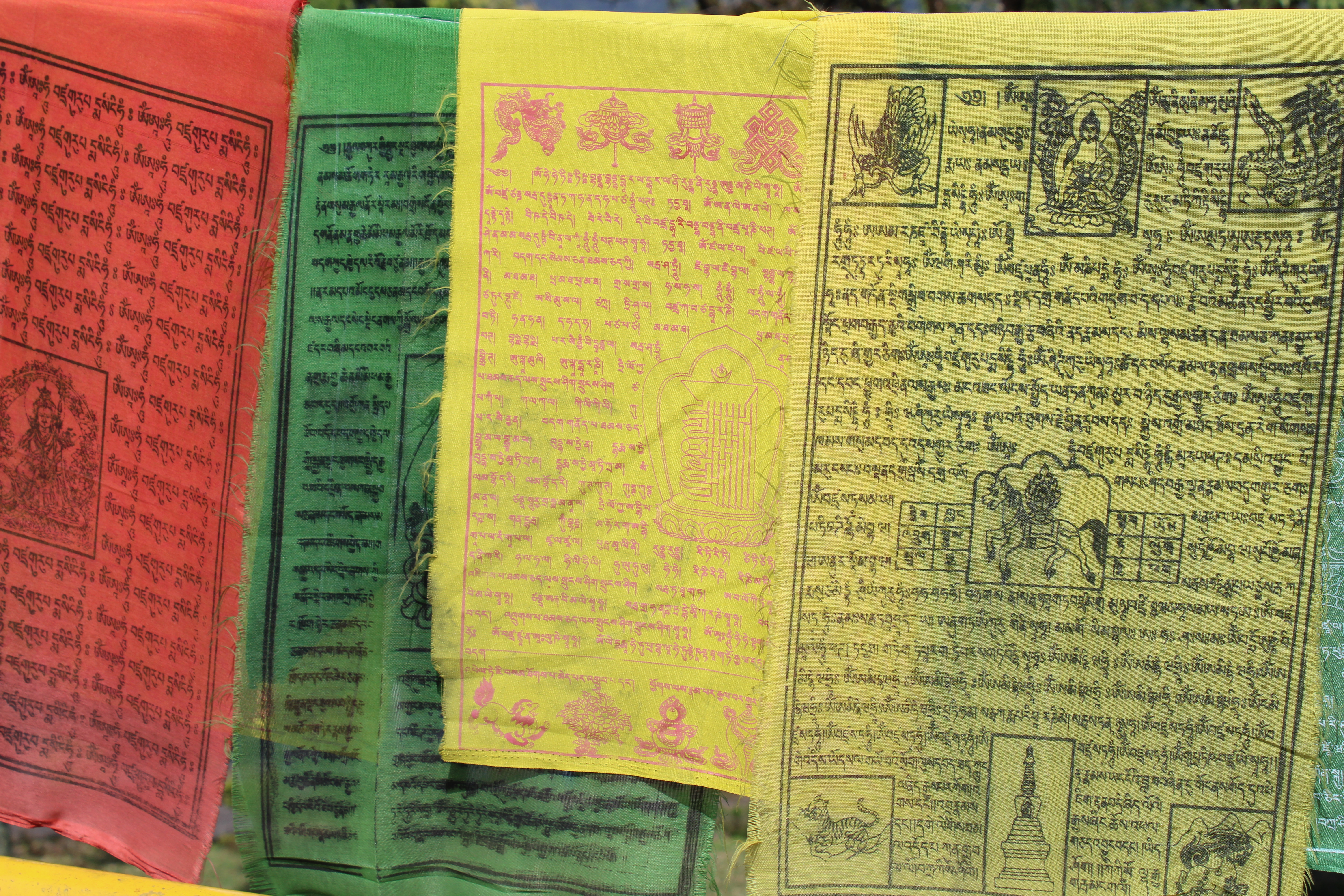
prayer flags hang still.
i hear them go silent
as i sit - eyes closed

After the Quake [Haiku]

post-quake scaffolds,
on the ancient temples,
teach impermanence

BOOK REVIEW: Buddhist Ethics: A Very Short Introduction by Damien Keown

Buddhist Ethics: A Very Short IntroductionBuddhist Ethics: A Very Short Introduction by Damien Keown
My rating: 5 of 5 stars

Amazon.in Page

Most people, if they know anything about Buddhist ethics, have heard of the Eightfold Path (right + view, intention, speech, action, livelihood, effort, mindfulness, and concentration.) However, just knowing that can lead to the impression that Buddhist ethics are blurry and that it’s all a matter of doing as one pleases within one’s personal interpretation of rightness. This concise guide offers an overview of the Buddhist ethics and morality, focusing on issues of global and modern interest (as opposed to those issues only of interest in places where Buddhism is practiced or at the time in which Buddha was teaching – i.e. issues like abortion, vegetarianism, war, suicide, and cloning and not subjects like caste, traditional family roles, etc.)

The first two chapters present a broad overview, and the rest focus on particular ethical issues. I found the second chapter beneficial; it asks how Buddhist ethics fit in the categorization scheme employed by Western Philosophy. I considered it useful even though the answer was that Buddhist ethics aren’t neatly contained by this way of thinking, but rather can be seen as a mix of multiple approaches. (e.g. Buddhism has sets of precepts – ala deontology, has a karmic doctrine that is arguably consequentialist, and, also, has elements similar to the virtue ethics of ancient Greece.)

Chapters three through eight investigate specific issues: animal rights and environmental ethics (ch. 3,) sexuality and gender (ch. 4,) war and violence (ch. 5,) abortion (ch. 6,) suicide / euthanasia (ch. 7,) and upcoming technologies that will change what it means to be alive and conscious (i.e. cloning, artificial intelligence, cryogenics, and CRISPR.) As with chapter two, there’s often no tidy answer. For one thing, the author tries to contend with what is common across various sects, and this is often reflected in the laws of countries, laws which are only partially informed by Buddhist philosophy. Also, it’s not like the Buddha had anything to say on many of these issues, which either weren’t issues (e.g. cloning) or were considered radically differently (e.g. gender.) Still, one does get an idea of how these questions relate to ideas such as karma and dharma, and how contemporary Buddhist thinkers might begin to consider them.

One will note that there are ethical territories that aren’t addressed (e.g. justice / punishment, ethics of governance, business ethics, etc.,) but a brief guide needs filters, and this one chose to focus heavily on modern, individual ethical questions of broad international interest.

If you’re looking to better understand Buddhist ethics, this book is worth reading.


View all my reviews

BOOK REVIEW: Dropping Ashes on the Buddha by Seung Sahn

Dropping Ashes on the Buddha: The Teachings of Zen Master Seung SahnDropping Ashes on the Buddha: The Teachings of Zen Master Seung Sahn by Seung Sahn
My rating: 4 of 5 stars

Amazon.in Page

This book’s one-hundred brief chapters mostly consist of interactions between the Korean Zen Buddhist teacher, Seung Sahn, and students of his. However, there are also some old Zen stories, and a few odds and ends: such as the transcript of a completely unproductive “dialogue” between Seung Sahn and a Hindu yogi. Some of the student-teacher interactions are epistolary, but others are face-to-face “dharma combat” or Q&A sessions (which also, ultimately, became dharma combat — given Seung Sahn’s teaching methods.) Dharma combat is a dialogue that resembles Socratic dialogue except that the goal isn’t to use logic and sound reasoning to persuade another, but rather to demonstrate a lack of attachment and proclivity to overintellectualize. It involves a lot of seemingly nonsensical answers and occasional shouting and slapping / hitting. It sounds unproductive, but the objective is to break established cognitive modes and to induce epiphany, rather than to build a rational argument.

It’s a thought provoking and informative book, if a bit repetitive. Most of the conversation revolves around less than a dozen ko-an [kong-an in Korean,] which are questions or statements that’re intended to provoke a kind of realization rather than to produce a straightforward / rational answer. It’s not a problem that there’s repetition, as these aren’t straightforward ways of thinking, and oftentimes it takes many varied looks at a ko-an to grasp what’s being conveyed. That said, I felt this book could’ve used some editing to streamline the dialogue a bit to make it feel a bit less punitively redundant.

If you’re interested in ko-an and dharma combat, this is a great book to look into. However, if you’re familiar with many of the popular ko-an and Zen stories, it may feel a bit redundant.


View all my reviews

Buddha Wisdom [Haiku]

in the temple yard,
i read the Buddha's words,
and feel their wisdom

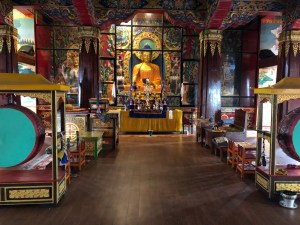
DAILY PHOTO: Ravangla Gompa, Sikkim

Taken in Ravangla in May of 2022

BOOK REVIEW: Awakening the Sleeping Buddha by The 12th Tai Situpa [Pema Donyo Nyinche]

Awakening the Sleeping BuddhaAwakening the Sleeping Buddha by Pema Donyo Nyinche
My rating: 5 of 5 stars

Amazon.in Page

This is a concise overview of Buddhism from the Kagyu Vajrayana [Tibetan] Buddhist perspective. It’s a straightforward, just-the-facts look at the fundamental teachings of Buddhism, and doesn’t plumb the depths of the subject, but rather offers a readable broad-brush view. And yet the author managed to state ideas in such a way as to provoke thought and offer insight.

The book is divided into eight chapters, each of which takes on a major concept from Mahayana Buddhism: Buddha nature, bodhichitta (compassion,) reincarnation / karma, emptiness, Tantric science, transformation, Enlightenment, and Mahamudra (the core meditation of the Kagyu lineage.) The organization is informed by what concepts one needs to learn to move through greater levels of refinement towards Enlightenment, with the final chapter examining Buddhist teachings as presented in the Kagyu line.

I value books on Buddhist philosophy and psychology that keep things simple and don’t overly religify the topic. This book does a good job of it, and that says something when considering the great complexity and esoteric nature of Tibetan schools of Buddhism. If you’re looking for an introductory text on Buddhism from the Vajrayana perspective, this is an excellent book to read.


View all my reviews