BOOK REVIEW: Head in the Game by Brandon Sneed

Head in the Game: The Mental Engineering of the World's Greatest AthletesHead in the Game: The Mental Engineering of the World’s Greatest Athletes by Brandon Sneed
My rating: 5 of 5 stars

Amazon page


There are many factors that influence whether an athlete can reach an elite level. Physical factors such as VO2 max (maximum oxygen consumption) and musculature have long been at the fore in the minds of coaches and trainers, but they’ve never told the full story. There are athletes who have the muscles, lungs, and general physiology to dominate their sports who fall apart under pressure. One also sees the occasional athlete who is consistently good even though he seems puny by comparison to his peers. It used to be that mental performance was considered an endowed X-factor–you either had it or you didn’t. Coaches didn’t know how to coach for issues of the mind and often exacerbated problems with old school attitudes and approaches.

We’ve now entered a new era in which a bevy of techniques and technologies are being exploited to strengthen the mind and improve psychological deficiencies, just as gyms have always been used to build the body and combat physical deficiencies. These range from techniques of meditation and visualization that have been known to yogis and Buddhists for centuries to advanced technologies that have only become available in recent decades and which are constantly improving and being made obsolete. Sneed examines the gamut of these approaches as they are applied to improving performance in sports: from the meditative or therapeutic to the electronic or pharmacological. One no longer need give up on athletes who are great at their best, but who get the yips at the worst possible times. The performance of mediocre athletes can be improved and that of the best can be made more consistent.

Sneed has a unique qualification to write this book. He counts himself among the athletes who couldn’t reach his potential because of inconsistency rooted in psychological challenges. His willingness to be forthright about his own problems makes the book more engaging. His own stories are thrown into the mix with those of athletes from football, basketball, soccer, baseball, adventure sports, and mixed martial arts (MMA.)

The book’s 19 chapters are divided among four parts. The first part lays the groundwork, helping the reader understand the rudiments of how the brain works, doesn’t work, or works too hard for a competitor’s own good. A central theme is that the ability to analyze and train through the lens of neuroscience has removed some of the stigma that has always been attached to psychological issues in sports (not to mention the days when they were written off as weakness.) Much of the six chapters of Part I deal with assessment of the athlete’s baseline mental performance. The last chapter (Ch. 6) covers a range of topics that have been around a long time as they’ve been reevaluated through modern scientific research. These include religion, faith, superstition, meditation, visualization, and the immortal question of whether sex is good or bad for athletic performance.

The second part consists of five chapters taking on one fundamental truth: mind and body are not two disparate and independent entities. This section starts at the most logical point: breath. Practitioners of yoga (i.e. pranayama) and chi gong have known for centuries that breath can be used to influence one’s emotional state and level of mental clarity. Sneed evaluates the technology that is being used to help athletes master the same age-old lessons. Having laid the groundwork through breath, the section advances into biofeedback technology. There are two chapters in the book that deal with pharmacological approaches. One is in this section and it deals with legal (at least in some locales) substances such as caffeine, alcohol, nicotine, nootropics (alleged mind enhancing drugs), and marijuana. (The other is in the final part and it deals with hallucinogens.) There are also a couple of chapters on technologies used to produce or enhance desired mental states.

For most readers, the third part will be seen as the heart of the book. Having considered how to evaluate an athlete’s mental performance (Part I) and how to influence mind states by way of the body (Part II), this part explores the range of technologies that are used to exercise the mind in a manner analogous to working out the body. These technologies focus on a range of areas including improving the nervous system’s ability to take in information, process that information, and respond appropriately. Much of this part focuses on video games; albeit video games using state of the art virtual reality and which are customized to improvement of athletic performance. Some of the games are used to train general cognitive performance (e.g. Ch. 13) but others are specifically tailored to the game in question (i.e. Ch. 14.) Just as simulators are used in aviation, part of the advantage of these games is the ability to put players in progressively more challenging conditions.

The last part of the book was the most interesting to me, personally. [It’s also the part of the book that will be the most relevant and readable a few years down the road because it’s not as modern technology-centric as most of the book—especially Part III–is.] It’s entitled “The Spirit” and it explores X-factors to performance, but sans the assumption that these are endowments, but rather under the assumption they are trainable. The part has an important introduction that presents the research about how “soft” factors like gratitude play into outlook and performance. Then there are the Part’s three chapters. The first describes an experiment involving taking elite athletes into physically arduous conditions of the kind normally experienced by military special operations forces in survival training. The second tells the story of MMA fighter Kyle Kingsbury’s use of hallucinogenic substances (most intriguingly, ayahuasca, a powerful drug long used by Peruvian shamans.) Finally, the last chapter deals with sensory deprivation—a technology some will associate with the movie “Altered States” but which many athletes swear by.

The book has an extensive section on notations and sources organized by chapter. There are no graphics.

I enjoyed this book and found it to be informative. There are a number of books that explore the techniques and technologies of optimal mental performance, but this one develops a niche by focusing on the realm of sports and some of the technologies that are only available with the kind of deep-pockets seen in professional sports. The book is heavily weighted toward the technology part of the equation, which is both good and bad. If you’re reading it now (2017), it’s great because you’re getting an up-to-date discussion of the subject from the perspective of entities that are awash in money for tech. The downside is that this book won’t age well, at least not as well as it would if there was more emphasis on approaches that aren’t based on cutting-edge technology.

I’d recommend this book if you are interested in optimal human performance, and if you have an interest in sports, all the better.

View all my reviews

BOOK REVIEW: Monkey: A Folk Novel of China by Wu Cheng’en

Monkey: A Folk Novel of ChinaMonkey: A Folk Novel of China by Wu Cheng’en
My rating: 4 of 5 stars

Amazon page


If you’re familiar with any Chinese folklore, it’s probably this story. But you probably know it as “Journey to the West.” It’s not only been released in numerous editions as a novel, it’s also been adapted for film, stage play, and I’m sure there must be a video game of it out there.

If you’re thinking, “Chinese folklore? Sounds boring.” Think again. This is a superhero story. Monkey, also known as the Monkey-King and “Great Sage Equal to Heaven,” is an immortal who has all manner of supernatural powers. He can fly. He can make copies of himself. He can transform himself—either disguising himself as another being or appearing as an inanimate object. He has an iron truncheon that can be the size of a sewing needle or a mile long and which is indestructible. Wielding said staff, he can defeat armies or deities.

In fact, the flaw in this story isn’t a lack of adventure or thrill. On the contrary, it’s one adventure after the next. If anything, the flaw is “Superman Syndrome.” That’s what I call it when the hero is so ridiculously overpowered that even when he’s fighting gods, dragons, or whole armies there’s still no doubt about the outcome.

Of course, the Monkey does eventually meet his match in the form of the Buddha. The Buddha defeats Monkey not in combat, but in a bet. That event shifts the direction of the story. In the early chapters, Monkey is goes about heaven and earth arrogantly wreaking havoc. He’s not altogether detestable. He does have his redeeming traits, but he’s insufferably arrogant and mischievous. After he’s imprisoned following his run-in with the Buddha, a monk is assigned to go to India to bring back scriptures (hence, a “journey to the west”) to China. Monkey is assigned to be the monk’s guardian and along with two others that they pick up along the way (Pigsy and Sandy) the monk is escorted on his journey. The party faces one challenge after the next, and the trip is long and arduous. Some of the challenges require brute force but in many cases they are battles of wits. So while Monkey may be overpowered, he does experience personal growth over the course of the story.

The story is told over 30 chapters, each set up with a cliffhanger. I enjoyed this translation by Arthur Waley. It is end-noted, which is useful given the historic and cultural nuances that may not be clear to readers.

It should be noted that this is unambiguously a Buddhist tale. There is a bias against Taoists and other non-Buddhist religions evident throughout the story. It’s not just the fact that the Buddha easily defeats Monkey when no other deity or group of deities can, there’s a steady stream of anti-Taoist sentiment. So, Taoists and Chinese Folk Religion practitioners be warned, I guess.

I would recommend this book for fiction readers, particularly if you have an interest in the superhero genre or Chinese literature.

View all my reviews

BOOK REVIEW: Modern British Poetry ed. by Louis Untermeyer

Modern British PoetryModern British Poetry by Louis Untermeyer
My rating: 4 of 5 stars

Amazon page (not the same edition)


This is an anthology of 183 poems written by 77 British authors. Given the title, “Modern British Poetry,” the first thing that should be stated is that the original work came out around 1920, and so the bulk of these poems are from the 19th century. That may fit perfectly with your classification of modern poetry, but if you’re looking for present-day poets, this isn’t the book you’re after.

However, the good news is that you might still find some unexpected treasures. Often collections of public domain poetry like this gather poems that are ubiquitous and which are probably already on the shelves of most poetry readers in various collections and anthologies. But of the almost 80 poets included, only a handful will be household names for a general reader—particularly if you aren’t from the UK and thus didn’t get exposed to the more obscure British poets. Of course, there are a number who have stood the test of time: Thomas Hardy, Robert Louis Stevenson, Oscar Wilde, A.E. Housman, William Butler Yeats, Rudyard Kipling, G.K. Chesterton, Alfred Noyes, D.H. Lawrence, Edith Sitwell, and Robert Graves spring to mind. Furthermore, the poems chosen aren’t a straightforward “greatest hits” list. (e.g. “If” isn’t among the four Rudyard Kipling entries.)

As one might expect of a 230 page anthology that contains 183 poems (plus author bios and the occasional footnote), the poems selected are brief. In a few cases, excerpts from longer works are included, but for the most part these are poems that fit comfortably on a single page. This is great for someone trying to get a feel for the various poets and for those who enjoy more compact works over epic poems—which, if we’re being honest, is most of us.

The anthologist, Louis Untermeyer, includes brief bios for each of the poets in front of their entries in the anthology. Generally, each included poet has between one and four poems. While the poems are organized by poet, the poets seem to be organized chronologically (at least as near as I can tell; it begins with Thomas Hardy [1840 – 1928] and ends with Robert Graves [1895 – 1985.])

I read a Kindle version of this work and found it to be far better organized than most of these public domain compilations. It not only had an index that would take one to individual poems or poet bios, but it also contained a hyperlinked index. Unfortunately, I obtained the book some time ago and I couldn’t find the same edition when I looked for it while doing the review. Most of the Kindle editions now seem to bundle Untermeyer’s “Modern American Poetry” with his “Modern British Poetry” but the edition I had was just the British poets.

I recommend this book for poetry readers. In addition to having some exemplary short form poetry from both well-known and forgotten poets, it happens to contain the first poem I ever memorized in it—a powerful little poem by John McCrae entitled “In Flanders Fields” (if you don’t know it, read it; it’s war poetry at its finest.)

View all my reviews

BOOK REVIEW: Narconomics by Tom Wainwright

Narconomics: How to Run a Drug CartelNarconomics: How to Run a Drug Cartel by Tom Wainwright
My rating: 5 of 5 stars

Amazon page


“Narconomics” is about how drug cartels are taking pages from the playbooks of big businesses like Walmart and Coca-cola. In cases like diversifying into new markets or deciding to collude with a competitor, this might not seem surprising. However, it may come as a shock to find out about the franchising and CSR (corporate social responsibility) practices of drug cartels. Other than being outside access to the justice system, and thus resorting to violence to achieve what contracts, mediators, and courts would do for other businesses, the drug business it turns out is very much a business.


Along the way a secondary story emerges that is just as interesting and even more important. It’s the story of how the drug war makes no sense from the standpoint of economic logic. Destroying fields in South America only makes for poorer farmers because their monopsonistic (i.e. single buyer) market pushes the cost of lost crops back onto them. And because raw product is such a tiny portion of retail price, their destruction has almost no effect on prices at the user end. Furthermore, as more US and European states legalize marijuana, it seems that this will have more of an effect at putting cartels out of business and ending their reign of violence than all the arms shipments and foreign aid for drug enforcement ever had.


The book consists of ten chapters, each of which addresses an area of business practices that have been taken up by the drug cartels. Chapter one is about supply chains, and in the case of cocaine there is a rather long one. The raw product is grown in South America and must be infiltrated into the US—usually through Mexico. (For a while there was a prominent Caribbean route, but it was shut down—at least for a while.) This is where we learn about how the cartels adapt to eradicated crops, as well as how the product is marked up at various stages of the operation.


Chapter 2 is about the decision to compete versus collude. We mostly read about the competition, because in a lawless market competition equals violence. However, over time cartels have been increasingly willing to agree on distribution of territory. Although, there are also clever means to compete unique to criminal enterprises, such as engaging in violence in someone else’s territory to cause the police to crack down there—thus making it harder for said opposition.


Chapter 3 is about human resources, and the different approaches used to handle problems in this domain. In the movies, a drug cartel employee who fouled up always gets a bullet to the brain, but it seems that this isn’t always the case—though it certainly happens. Different countries and regions have differing labor mobility. In some cases, there is no labor mobility. (i.e. if one has a gang’s symbols tattooed all over one’s body, one can’t interview with a rival gang and Aetna sure as hell isn’t going to hire you.)


Chapter 4 is about public relations and giving to the public. One doesn’t think about drug lords engaging in CSR, but in some cases they may be more consistent with it than mainstream businesses. The cartels face an ongoing risk of people informing on them, and at least some of those people can do so without their identities becoming known. Violence is often used to solve problems in this domain, but it can’t do it all. That’s why drug lords build churches and schools, and often become beloved in the process.


Chapter 5 explores “offshoring” in the drug world. This may seem strange, but drug cartels, too, chase low-cost labor. But it’s not just about lowering costs, it’s also about finding a suitable regulatory environment—which in the cartel’s case means a slack one. An interesting point is made that all the statistics on doing business are still relevant to the drug business, but often in reverse. That is, if Toyota is putting in a plant, it wants a place with low corruption, but if the Sinaloa want to put in a facility–the easier the bribery the better.


Chapter 6 describes how franchising has come to be applied to drug cartels—famously the Zetas. The franchiser provides such goods as better weaponry in exchange for a cut of profits. Of course, there’s always a difference in incentives between franchisers and franchisees when it comes to delimiting territory, and this doesn’t always work out as well for drug dealers as it does for McDonald’s franchisees.


While the bulk of the book focuses on cocaine and marijuana, Chapter 7 is different in that most of it deals with the wave of synthetic drugs that has popped up. The topic is innovating around regulation, and so it’s certainly apropos to look at these drugs. If you’re not familiar, there are many synthetic drugs that are usually sold as potpourri or the like. Once they’re outlawed, the formula is tweaked a little. In a way, these “legal highs” may be the most dangerous because no one knows what effect they’ll have when they put the out on the street.


In chapter 8 we learn that the drug world hasn’t missed the online retail phenomena. Using special web browsers, individuals are able to make transactions that are not so difficult to trace. In an intriguing twist, the online market may foster more trust and higher quality product than the conventional street corner seller ever did.


Chapter 9 examines how drug traffickers diversify—most notably into human trafficking. Exploiting their knowledge of how to get things across the border, they become “coyotes.”


The last chapter investigates the effect of legalization, and it focuses heavily upon the effects that Denver’s legalizing marijuana has had in Denver, in the rest of the country, and on the cartels. Wainwright paints a balanced picture that shows that not everything is perfect with legalization. E.g. he presents a couple of cases of people who ingested pot-laced food products intended for several servings, and did crazy stuff. However, the bottom line is that legalization (and the regulation and taxation that comes with it) seems to be the way to go if you want to really hurt the cartels and stem the tide of violence, as well as to reduce the number of people showing up at the ER having ingested some substance of unknown chemical composition.


There is an extensive conclusion, about the length of one of the chapters that delves into the many ways our approach to eliminating drug use is ill-advised and dangerous. This connects together a number of the key points made throughout the chapter.


I found this book fascinating. Wainwright does some excellent investigative reporting—at no minor risk to life and limb. If you’re interested in issues of business and economics, you’ll love this book. If you’re not into business and economics, you’ll find this book to be an intriguing and palatable way to take on those subjects.

View all my reviews

5 Books to Introduce You to Your Subconscious

In a world free of frontiers, the subconscious mind is the final frontier.


Below are a few books that I found useful. The hyperlinks forward to my review on GoodReads or the book’s GoodReads page.


Also, I’ve included three honorable mention books that I haven’t yet reviewed, but which seem both relevant and intriguing.


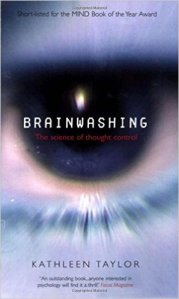
5.) Brainwashing by Kathleen Taylor: What makes some minds more malleable than others and how are minds bent to a given purpose? In learning the answers, one discovers that the bases of our beliefs are often more deep-seated than one might believe.

brainwashing_taylor


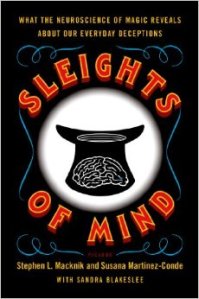
4.) Sleights of Mind by Macknik & Martinez-Conde: Magicians and mentalists are notoriously skilled at exploiting the chinks in the armor of  our minds.

sleights_of_mind


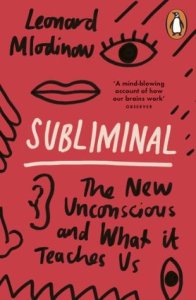
3.) Subliminal by Leonard Mlodinow: Physicist and pop science writer, Leonard Mlodinow, explores the many ways in which our behavior is more influenced from the back of the house than we feel to be the case.

subliminal


2.) The Tibetan Yogas of Dream and Sleep by Tenzin Wangyal Rinpoche: This is my nod to the fact that the Western scientific community isn’t the only entity that has something useful to say on this subject. Tibetan Buddhists have a long tradition (arguably predating Buddhism and into the Bon-era) of dream yoga (lucid dreaming) and our dreams offer the greatest portal to the subconscious.

tibetanyogas


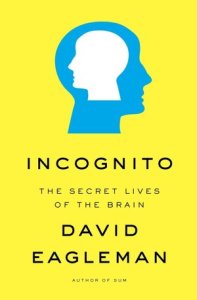
1.) Incognito by David Eagleman: Eagleman tells us that our conscious mind represents the tip of the mental iceberg, and he explores the many ways in which we are subject to the vagaries of what exists below the surface.

incognito_eagleman


Here are a few others.


The Man Who Wasn’t There by Anil Ananthaswamy: I just finished this book. In it, the author investigates whether there really is  such a thing as the self by studying a number of diseases and phenomena of the mind that look like negations of self. (e.g. Cotard’s Syndrome in which people insist they are dead, depersonalization disorder in which life seems a dream in a literal rather than poetic sense, out-of-body-experiences in which there is a hallucination that one is outside one’s body, etc.)


The Attention Merchants  by Tim Wu: I haven’t read this one yet, but it’s said to be good and is about how our programming is exploited to keep us clicking. If you’ve ever wondered why you can’t seem to just drop social media even when it seems like a phenomenal waste of time–why it exerts such a strong pull–this book delves into what proclivities of the mind have been seized upon.


Reality is Broken by Jane McGonigal: I’m about 1/3rd of the way through this one. It has some overlap with the Wu book. In it, McGonigal asks why games have so much appeal–even to the extent of becoming addictive. As with why we keep clicking, the answer has a lot more to do with the primitive parts of our mind than the high tech subject matter might suggest.

BOOK REVIEW: The Geography of Bliss by Eric Weiner

The Geography of Bliss: One Grump's Search for the Happiest Places in the WorldThe Geography of Bliss: One Grump’s Search for the Happiest Places in the World by Eric Weiner
My rating: 5 of 5 stars

Amazon page


This book combines travel writing with pop science discussion of what makes people happy (or unhappy.) Weiner travels to ten countries in pursuit of happiness, and reflects upon the cultural components of bliss.

Some of the countries, like Switzerland and Iceland, rank among the world’s happiest in international surveys. Some of the countries, such as Qatar and America, have every reason to be happy, but aren’t necessarily as blissful as the rest of the world would expect. Some of them, like India and Thailand, have good reason to be unhappy, and yet they manage to be global exemplars of happiness [at least within certain domains.]

Then there are a few nations that have unique relationships to happiness. Bhutan has a national policy on happiness [plus it’s a Buddhist country, and Buddhism probably offers the most skillful explanation of what it takes to be happy of any world religion.] Moldova provides a counterweight as it’s one of the least happy countries in the world. Weiner visits the Netherlands in part because one of the biggest academic centers studying happiness is located in Rotterdam, but it also offers an opportunity to study whether the country’s unbridled hedonism (drugs and prostitution are legal) correlates to happiness. That leaves Great Britain, a country known for wearing the same happy face as its sad, terrified, and enraged faces.

I’ve been to half of the countries on Weiner’s itinerary, and—of the others—I’ve been to countries that share some—though not all—of the cultural constituents of happiness. (e.g. I haven’t been to Qatar, but I’ve been to the UAE. I haven’t been to Moldova, but I’ve seen somewhat less grim Eastern European states. I haven’t been to Switzerland or Iceland but I’ve been to cold countries in Western Europe. I haven’t been to Bhutan, but I’ve been in areas where Tibetan Buddhism was the dominant cultural feature.) This allowed me to compare my experiences with the author’s, as well as to learn about some of the cultural proclivities that I didn’t understand during my travels. And I did find a lot of common ground with the author, as well as learned a lot.

I found this book to be interesting, readable, and funny. Weiner has a wacky sense of humor that contributes to the light-hearted tone of the book—perfect for the subject. That said, some people may be offended because the author doesn’t pull punches in the effort to build a punchline, and this sometimes comes off as mocking cultures. However, in all cases—even that of Moldova—Weiner does try to show the silver lining within each culture.

The paperback edition I read had no graphics or ancillary matter. There are no citations or referred works (except in text), and the chapters are presented as journalistic essays. The chapters largely stand alone, and so one could read just particular countries of interest. He does refer back to events that happened in earlier chapter or research that related to another country’s cultural proclivities, but not often. The first chapter, on the Netherlands, would be a good one to read first because he describes many of the scientific findings on happiness in that one.

I would recommend this book for anyone interested in what makes some places happier (or sadder) than others.

View all my reviews

BOOK REVIEW: Maps and Legends by Michael Chabon

Maps and Legends: Reading and Writing Along the BorderlandsMaps and Legends: Reading and Writing Along the Borderlands by Michael Chabon
My rating: 5 of 5 stars

Amazon page


This book consists of 17 essays about reading and writing. As the book’s title–also the title of the second essay–suggests, there’s an analogy drawn between story and a map, but—more importantly– Chabon proposes that the literary domain is a realm with frontiers and hinterlands. The central theme is that there is room for great discoveries if we stray from the center of the map were all is clear and well-defined. Literary fiction is the center. The hinterlands include a range of genres and approaches to story-telling that are often maligned as low-brow—e.g. fan fiction and comic books.


The book could be split into two parts, though the aforementioned theme cuts across all essays. The first 11 essays offer insight into maligned genres and their merits, but the next five shift gears into autobiographical telling of Chabon’s transformation into a writer. (The last essay, not present in some editions, could be seen as an epilogue to the entire work.) I’ll list the essays and give a hint about what each is about:


-“Trickster in a Suit of Lights”: This essay invites us to reconsider the connection between entertainment and literature, and in particular with respect to the modern short story.


-“Maps and Legends”: Here Chabon reflects upon the nature of a map and its analogy to the domain of fiction.


-“Fan Fictions: On Sherlock Holmes”: Fan fiction is maligned, and not entirely without reason. Even when it achieves great popularity, it’s often bad (e.g. “Fifty Shades…”) However, Chabon correctly suggests that we consider fan fiction too narrowly, including only that which reinforces our notions. He offers a great example of a character, Sherlock Holmes, who launched a thousand fan fictions, some of which are masterpieces in their own right.


-“Ragnarok Boy”: Mythology often seems tired and cliché, but there are reasons such stories survive across ages. Chabon explores what it is in Norse mythology that makes it an ongoing font of inspiration for writers.


-“On Daemons & Dust”: For a while, YA was the only genre with rising sales–much to the chagrin of those who felt this might herald the rise of a real world idiocracy. In this essay, Chabon describes what it is about Philip Pullman’s “His Dark Materials” series of fantasy books that pulls readers in—including the appeal of dark elements in stories.


-“Kids Stuff”: In this essay, Chabon considers the comic book and its evolution from kids’ stuff to a vast domain meant to appeal to a broad readership.


-“The Killer Hook”: This essay continues Chabon’s look at comic books, but through a specific example: “American Flagg!” a dystopian sci-fi comic book. Chabon proposes that “American Flagg!” spawned a new approach to comic book art and tone.


-“Dark Adventure”: This is about Cormac McCarthy’s “The Road.” Some topics are revisited, such as the appeal of dark and dystopian content. [For those unfamiliar, “The Road” is the story of a father and son wandering through a post-apocalyptic wasteland in search of some sort of stable community. McCarthy is the master of sparse prose, eschewing dialogue tags and maintaining a minimalist approach to his craft.


-“The Other James”: Here Chabon discusses the ghost story, using M.R. James’ story “Oh, Whistle, and I’ll Come to You, My Lad” as an exemplar.


-“The Landsman of the Lost”: Chabon discusses the comic strip work of Ben Katchor.


-“Thoughts on the Death of Will Eisner”: Eisner was a popular cartoonist, associated with such comic books as, “The Spirit.”


-“My Back Pages”: Here the book ventures into autobiographical territory as Chabon talks about his first dalliances with writing a novel.


-“Diving into the Wreck”: This continues Chabon’s telling of how he came to be a writer, and his early troubles in structuring a novel.


-“The Recipe for Life”: Here Chabon tells us about his introduction to Golems, a concept that would play an important role in one of his most influential works—an in the rest of the book. You’ll note the connection between fantastical devices and the telling of story that carries over from the first part.


-“Imaginary Homelands”: Chabon describes the role that is played by culture in forming a writer’s experience—both the culture one is living in and the cultural heritage that we each carry with us wherever we may roam.


-“Golems I Have Known”: This is one of the longer pieces and it presents the climax of Chabon’s tale of his transformation into a novelist. Golems as fictitious creatures built to facilitate certain truths are a central feature around which Chabon’s story is told.


-“Secret Skin”: [Note: This essay didn’t appear in the initial version of the book, and so your edition might not have it.] This essay invites the reader to reconsider the role that costumes and secret identities play for superheroes and how that need resonates with readers. In the process, this last essay sums up the reason why fantastical elements are so powerful in fiction.


There are only few graphics in the book, i.e. comic panels. Other than that there’s not much by way of ancillary matter, though there are recommended readings (oddly) interspersed within the index—rather than being a separate section.


I’d recommend this book for readers and writers. The essays are well-crafted and thought-provoking.

View all my reviews

5 Novels in Translation That You Should Read

Reading translated novels is a good way to gain insight into the culture and history of a country in a way that is both entertaining and that exposes the deep nuances of national character. I’ve selected works that both highlight aspects of culture and / or history and that are pleasant reading–some are humorous and others are adventures, but none are drudgery.  (Includes two Nobel Prize winners and one guy who gets nominated every year only to have the prize handed to folk-rock musicians or the like.)

[The hyperlinks go to my review of said book in GoodReads.]


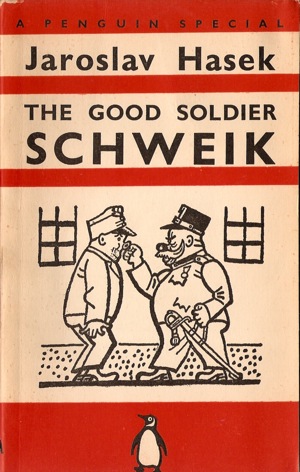
1.) The Good Soldier Švejk by Jaroslav Hašek (Czech): The lead character in this farcical comedy is a bumbling, but likable, idiot who is drawn into military service. The book highlights the fact that in times of war the greatest acts of idiocy are not perpetrated by greatest idiots.

goodsoldiersvejk_en


2.) After Dark  by Haruki Murakami (Japan): One can’t go wrong with Murakami. I almost picked Norwegian Wood, which is more a work of realist literary fiction, but this novel about what happens when the trains stop running in Tokyo may shed a little more light on Japan. (anti-pun not intended.)

afterdark_murakami


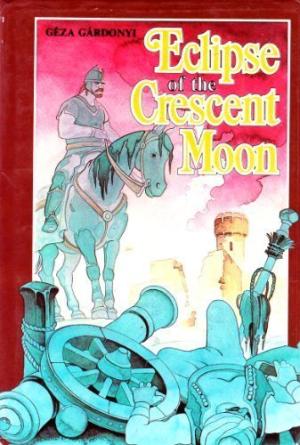
3.) Eclipse of the Crescent Moon by Géza Gárdonyi (Hungary): The story of how a small Hungarian castle village held out against a siege by the Ottoman juggernaut.

eclipseofthecrescentmoon_gardonyi


4.) Death in the Andes by Mario Vargas Llosa (Peru): When three men disappear from a small mining village in the Andes, the Army sends a Corporal and his deputy to investigate.

death-in-the-andes_llosa


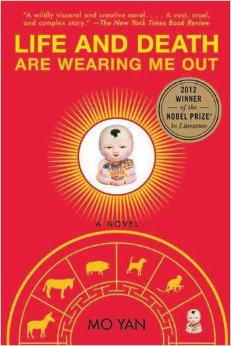
5.) Life and Death are Wearing Me Out by Mo Yan (China): A wealthy land owner is executed during the Communist revolution and must live out several lives as various animals in the service of the family of his [former] beloved hired-hand. The books shows the generational change between when China first became Communist through the reform period that led to a more market-friendly approach.

lifedeath_moyan

5 Works of Fiction That Teach Life Lessons

Every novel or short story has lessons to teach. After all, stories are nothing more than problems resolved. Sometimes fiction teaches one how to do it right, and in other instances how to do it wrong–but there’s always a lesson.

But some works of fiction teach more than others (and more effectively.) It’s a great challenge to merge entertaining and thought-provoking story lines into one piece. Below are five books that I found both illuminating and engrossing.

[The hyperlinks in the titles go to my book review.]


1.) Ishmael by Daniel Quinn: Ishmael asks one to reevaluate what one thinks one knows about the world based on a lifetime of viewing it through the lenses of culture and anthropocentrism.

ishmael_quinn


2.) The Journeys of Socrates by Dan Millman: The “Socrates” in question is Millman’s [probably fictional and / or composite] teacher from the “Peaceful Warrior” books–not the Greek philosopher. This book shows us how a person whose life has been scarred by tragedy can attain peace of mind.

journeyofsocrates


3.) The Little Prince by  Antoine de Saint-Exupéry: The Little Prince teaches one to reevaluate what one thinks is important, and encourages one to see the world through a more child-like lens.

littleprince

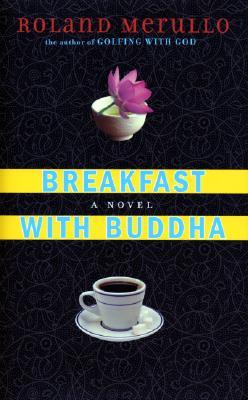
4.) Breakfast with Buddha by Roland Merullo: How can the average Joe reshape the way he [or she] views life so as to live a happier one?


breakfastwithbuddha


5.) Veronika Decides to Die by  Paulo Coelho: A young woman who attempts suicide is told by her doctor that she damaged her heart and has only five days to live.

veronika


Happy reading.


BOOK REVIEW: Hindu Myths by A.L. Dallapiccola

Hindu MythsHindu Myths by Anna L. Dallapiccola
My rating: 3 of 5 stars

Amazon page


Having moved to India, we picked up this book to try to wrap our heads around the vast Hindu pantheon and the myriad myths involving them. There are a huge number of tomes on the subject of Hindu mythology, but far fewer concise commentaries that look useful. We were always on the lookout for a book that would offer a sort of “Hindu Mythology for Dummies” –the quick down-low, if you will.

I can’t say that this book clarified the topic. However, I’m not sure any book could. Hindu mythology is a subject of enormous scope, while being defiant against reducibility. I was about to compare it to the challenge of writing a concise book for neophytes on quantum mechanics, but then I realized that such a book could probably be done much more effectively. For as strange as the world behaves at a subatomic scale, there’s a means to order the story and to simplify it in a way that leaves intact the gist. Along with dry descriptions of ordinary sounding events, one reads stories like that of the deity that popped out of another’s belly-button on giant lotus flower. That’s when the myths become hard to imagine–if one hasn’t been hitting the psilocybin.

That said, I did learn some interesting elements of myth from reading Dallapiccola’s book, and I think it has as effective an organizational scheme as one can hope for. After an Introduction that exposes the reader to Vedas, Puranas, and the Hindu trilogy (Vishnu, Shiva, and Brahma), there are three chapters that revolve around creation, preservation, and destruction. [For those unfamiliar, those three deities map to those processes—Brahma the creator, Vishnu the preserver, and Shiva the destroyer.]

After those three, there are another three chapters. Chapter four deals with myths about delusion, and in addition to describing Vishnu’s role in delusion (maya) it tells a couple of tales (the story of Madhu and Kaitabha, and the story of King Harishchandra.) Chapter 4 discusses the topic of grace and describes the birth of the Ganga, tells the tale of Arjuna and the Hunter, the story of Vishnu and Prahlada, and then offers a bit of insight into Shaiva saints, temple myths, and animal devotion. The last chapter is a brief overview of Hindu Mythology in modern times—especially its inclusion in popular culture.

There is a map (i.e. an India map showing major cities and crucial historical sites) and many pictures throughout the book. The pictures include photos of sculptures as well as reproductions of paintings that are of the deities and key mythical events. As far as ancillary features go, there is a half-page “Further Reading” section and the book is indexed.

This book is only 80 pages, and offers a quick overview. Whether it hits the most crucial material, I can’t rightly say. As I mentioned, there are some interesting tidbits in the book. I’d recommend it for someone looking for a quick overview. However, one should note that there are books that are more oriented toward story and less toward a scholarly level of precision in language that may be more useful for one—depending upon one’s needs.

View all my reviews