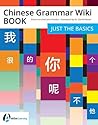
BOOKS: “Chinese Grammar Wiki BOOK: Just the Basics” ed. by John Pasden

Chinese Grammar Wiki BOOK: Just the BasicsChinese Grammar Wiki BOOK: Just the Basics by John Pasden
My rating: 5 of 5 stars

Publisher Website

This is the first in a series of books that present the rules and structure of grammar for Mandarin Chinese along with examples. As the subtitle suggests, it covers only the rudiments of sentence structure as well as the most elementary ways of expressing existence, possession, location, number, and a few other basic grammatic functions, as well as teaching the reader how to count and express time and date.

The examples are all presented in characters, pinyin [w/ tone markers,] and the English translation. The explanations are straightforward, and the examples offer basic and useful sentences and phrases.

I found this book to be beneficial, and have obtained the next volume, which expands upon the basics. The book presents a simple and painless approach to Chinese grammar. I’d recommend this book for any fellow neophytes just learning Chinese.

View all my reviews

BOOKS: “Fluent Forever” by Gabriel Wyner

Fluent Forever: How to Learn Any Language Fast and Never Forget ItFluent Forever: How to Learn Any Language Fast and Never Forget It by Gabriel Wyner
My rating: 5 of 5 stars

Publisher’s Website

This is one of the most useful books I’ve read in some time. Wyner proposes a method to learn a new language that both removes some of the drudgery while improving retention. Anticipating the skepticism that I would have myself at this point: no, it is not one of those books that makes ridiculous and unfounded claims such as that you can learn a language entirely in your sleep or that you can develop native fluency in seven days. Instead, Wyner’s method is based on sound scientific ideas.

So, what does this method consist of? A few of the key points are: first, one doesn’t skip straight to basic conversational phrases as many books and courses do, but rather places great emphasis on learning how to hear and say the sounds of the target language. This phase is often given short shrift, presumably assuming that this skill will be picked up automatically in the process, but Wyner’s argument is that not being able to hear what’s correct or not great slows progress in the long run. Second, memorization tasks use the “spaced repetition system” (SRS) method whereby you increase the time between exposure to new knowledge as you learn it until it is firmly entrenched in one’s mind. Third, one seeks to build a more visceral connection to the new vocabulary and phrases, and this makes learning more fun while improving retention. This is principally done by making flash cards that tell a story relevant to one’s personal experience (and / or which uses subject matter such as sex [which tends to produce more indelibility of memories.])

Beyond the method presented by the book, one is also presented with a great number of resources that can be helpful. Some of these resources are a part of the author’s own website, but many are external resources (from Anki [an app that allows one to build flashcards and study them on a SRS schedule] to courses of the State Department’s Foreign Service Institute.)

I’ve started to learn Mandarin and have begun employing a number of ideas from this book. I would highly recommend the book for anyone who is interested in learning another language, no matter what said language might be. (This is a book of “how to” learn, not “what to” learn.)

View all my reviews

BOOKS: “Chinese Folktales for Language Learners” by Vivian Ling and Peng Wang

Chinese Folktales for Language Learners: Famous Folk Stories in Chinese and English (Free online Audio Recordings)Chinese Folktales for Language Learners: Famous Folk Stories in Chinese and English by Vivian Ling
My rating: 5 of 5 stars

Publisher Website

As the title suggests, this is a collection of fifteen Chinese folktales presented bilingually in a manner optimized to language learners. To clarify the “optimized for language learners” comment, these stories are paced differently than they would be if the central objective was to entertain. That old writerly chestnut of “show don’t tell” is often violated and the stories are kept short and sweet in a way that can feel like they sprint through critical moments. This is not criticism. I think it is the best way to give individuals learning Mandarin (or presumably Mandarin speakers learning English) a user-friendly book that doesn’t feature dense blocks of text and overly complicated language. (Note: it’s also not bad for those who just want the quick and dirty version of these tales.)

Each of the stories includes a section with some background information on the history and cultural elements behind the stories (stories which display a range of realism and are from distant times,) a list of terms and phrases in English and Chinese, and a brief set of questions to help the reader develop deeper insight into the stories. These ancillary features are all quite useful to the student of language.

As stories, some of these folktales are more compelling than others. A number of them are dry, but what they lack in intrigue they make up for in insight into the history and culture of China. And some of the stories, e.g. “Judge Bao Takes on the Emperor’s Son-in-Law,” are fascinating.

I’d highly recommend this book for those who are trying to learn Mandarin, but it would also serve those who wish to learn some Chinese folklore in a condensed and readable format.

View all my reviews

BOOKS: “Improv Wisdom” by Patricia Ryan Madson

Improv Wisdom: Don't Prepare, Just Show UpImprov Wisdom: Don’t Prepare, Just Show Up by Patricia Ryan Madson
My rating: 4 of 5 stars

Publisher’s Website

One might expect this to be a book about how to perform improvisational comedy, but it’s better described as a philosophy of life that employs lessons from improv. There are books that take a much more tailored approach to building an improv act. This one, rather, broadens its target demographic from those interested in theater and comedy to everybody. It discusses applying lessons such as default to positivity (the famous “Yes, and…” of improv) both on and beyond the stage.

Each of the thirteen chapters is built around a maxim that might be heard in an improv theater or troupe. The crux of the matter is building the confidence and sense of freedom to be able to behave spontaneously in an environment that’s stressful and somewhat chaotic. Most of the lessons approach an aspect of the problem of surrender and free response action, though there are broader lessons such as the benefits of gratitude and helpfulness. While I call the book’s content a philosophy of life, the author doesn’t spend a lot of time drilling down into established philosophies, with the exception of Buddhism — specifically of the Zen variety. As one might imagine, Zen — with its emphasis on non-attachment and avoidance of overthinking — has a substantial overlap with the approach to living that Madson is proposing.

“Improv Wisdom” is set up as a self-help book, featuring not only lesson-based organization but also offering a few exercises in each chapter.

This is a quick read and might prove to be of great benefit to those who have never thought much about the challenges and lessons of improv. The book can’t be said to be groundbreaking in terms of the lessons it presents, but its focus on what improv elucidates about these lessons is interesting and unique.

View all my reviews

BOOK: “Toleration and Other Essays” by Voltaire

A Treatise on Toleration and Other Essays (Great Minds Series)A Treatise on Toleration and Other Essays by Voltaire
My rating: 5 of 5 stars

Project Gutenberg — Free Access

This collection gathers together eight essays and a poem. The theme that interconnects these works is a petition to avoid petty tribalism and irrationality / superstition in the practice of one’s religion. The titular essay, “On Toleration,” sets the collection’s tone, beginning with its detailing of the murder of Jean Calas on religious grounds and its exploration of many more acts of savagery attributable to sectarian forces in alliance with authoritarian governments. The poem, “Poem on the Lisbon Disaster,” echoes the central idea of “Candide” — i.e. the idea that we live in the best of all possible worlds is patently false.

As one would expect of Voltaire, there is plenty of humor and satire throughout these pieces. The arguments are also generally well supported by facts. It is clear that Voltaire possessed a great deal of the knowledge of his day. That said, the reader may well find some factual errors. Most notably, Voltaire tends to attribute a kind of enlightened utopian vision to cultures with which he was likely largely unfamiliar as he builds a case against many within the culture with which he is familiar. This isn’t to say that there isn’t some truth to Eastern traditions being historically more tolerant of other sects than the Abrahamic religions, but the degree to which he extends these idyllic views of those outside of Europe (and the details, thereof) don’t always seem to comport with the historic record.

While some may be inclined to dismiss this book as a collection of anti-religion writings, it is really not anti-belief at all. (Though he does poke holes in many a Biblical myth, so too does he actually provide a deist argument in favor of the existence of a god or gods in the book’s final essay.) Instead, the collection is anti-intolerance, anti-superstition, and anti-authoritarianism. I’d highly recommend this book for all readers. Whatever flaws it may contain are outweighed by the great importance of its message and the cleverness with which Voltaire conveys said message.

View all my reviews

BOOKS: “Christianity: A Very Short Introduction” by Linda Woodhead

Christianity: A Very Short IntroductionChristianity: A Very Short Introduction by Linda Woodhead
My rating: 5 of 5 stars

Publisher’s Page OUP

The central idea of this book is that (despite all the complexity of schisms, sects, and subsects) the various entities that call themselves Christian can be put into one of three categories: church, biblical, or mystical. These groups reflect where the adherents see the ultimate source of authority. Church Christians, exemplified by Roman Catholics, view the hierarchy of clergy as the ultimate authority. Biblical Christians, e.g. Baptists, see the Bible as the highest authority. Finally, mystics see the individual’s relationship with (or connection to or oneness with) God to be what matters.

Bookending elaboration upon those three forms of Christianity, there is an opening that discusses early development of the Christian religion and the dividing lines that characterized it (e.g. whether Jesus was man, god, or a bit of both,) and there is a closing chapter about modern Christianity that explores various modern movements, such as: liberal Christianity, Evangelicalism, Fundamentalism, and charismatic Christianity.

If you’re interested in understanding the various permutations of Christianity (past and present,) and how they developed and differentiated themselves, this is a fine introduction to the subject.

View all my reviews

BOOKS: “Teachings of the Christian Mystics” ed. by Andrew Harvey

Teachings of the Christian Mystics (Shambhala Pocket Library)Teachings of the Christian Mystics by Andrew Harvey
My rating: 5 of 5 stars

Acquired at Blossom Bookhouse

This book gathers a collection of short writings (mostly paragraph to a few page excerpts as well as a few poems) on mystic Christianity from the time of the Gospels through the twentieth century. While the bulk of the pieces are (if not from scriptures) the work of clergymen and / or theologians, there are some by individuals known elsewise (e.g. poets William Blake and Gerard Manley Hopkins.) The book is arranged somewhat, but not perfectly, chronologically — enough that all the Biblical excerpts are lumped together at the beginning to form about the first quarter of the selections. While there are a number of one-off contributors, there are several pieces from each of: Gregory of Nyssa, the Desert Fathers, Saint Symeon the New Theologian, Saint Bernard of Clairvaux, Saint Teresa of Avila, and Eckhart von Hochheim.

One nice feature of this book is that it does include selections from a wide range of sources (Roman Catholic, Orthodox Catholic, and Protestant) over a range of time periods, and from scriptures both canonical and “apocryphal.” So, there are many varied ideas of the mystical experience and the path thereto. The flipside of this fact is that there doesn’t seem to be a lot of cohesiveness to the collection. It isn’t always clear why Harvey (the editor) thought a given excerpt was representative of mystic teachings versus of mainstream Christianity. There is a substantial introduction, but otherwise the selections are left to speak for themselves.

Still, it was a quick read, dense with insights, and I found — particularly some of the scriptural selections — to be among the most profound statements of Christian philosophy that I’ve seen.

View all my reviews

BOOKS: “Forensic Psychology: A Very Short Introduction” by David Canter

Forensic Psychology: A Very Short IntroductionForensic Psychology: A Very Short Introduction by David Canter
My rating: 4 of 5 stars

Publisher site

This book discusses the many roles that psychologists play in the criminal justice system: e.g. as expert witnesses, as consultants to police and prosecutors, and as therapists to prisoners. The big takeaway is that forensic psychology is much messier than we have been led to believe. In the 1980’s, a wave of pop psych books suggested that a clever psychologist could build a detailed profile that would tell the authorities all they needed to know to winnow a suspect pool down to one. Fascination with this Neo-Sherlock Holmesian notion resulted in it spilling over into popular culture, most famously in the excellent movie, “The Silence of the Lambs.” The only problem is that it’s largely BS. Humans are too complex and varied for such easy policing to be achieved.

The book begins with an examination of how criminals are made, and this – too – is largely a disputation of the overly simplified single-source arguments: nature, nurture, etc. Instead, the suggestion is that it is a range of factors and their interactions that lead one down the road to crime, and that said factors can be very circumstantial. The rest of the book explores the specific roles that psychologists play in criminal justice and their limitations, therein.

I found this book to be interesting and an eye-opener.

View all my reviews

BOOKS: “Best Literary Translations 2024” ed. by Jane Hirschfield, et. al.

Best Literary Translations 2024Best Literary Translations 2024 by Jane Hirshfield
My rating: 5 of 5 stars

Publisher Site

This “best of” annual celebrates the unsung translator. Many of the original works are recent but some are old or even ancient; it is these translations to English that are in all cases recent. Spanish and Arabic translations are well-represented, but with respect to the twenty or so languages included, almost all are the sole representative for that particular source language. Poetry makes up the bulk of the collection (including prose poems,) but there are several pieces of short fiction and a piece of creative nonfiction or two.

Among my favorites were: “Grazing Land” (Greek,) “The Snail’s Spiral” (Spanish,) “The Lion” (Kurdish,) “Deterioration” (Persian,) “Graceless” (Chinese,) “Our Village” (Tigrinya,) and “The Sea Krait” (Tagalog.) But, as one would expect of a carefully curated “best of” collection, there were no stinkers in the batch.

If you enjoy literature in translation, this book is well worth investigating.

View all my reviews

BOOKS: “The Pass of the Persecuted” by Guram Odisharia

The Pass of the PersecutedThe Pass of the Persecuted by Guram Odisharia
My rating: 5 of 5 stars

Prospero’s Books

I picked up this book at Prospero’s Books in Tbilisi as part of my continuing effort to consume literature from every place I visit. It’s one of those books that’s small in page count (less than 100pp.) but massive in emotional impact. It tells of the author’s flight from Abkhazia (a contested region between Georgia and Russia on the Black Sea) on foot over a high mountain pass in the early 1990’s. It shines a harsh light on the refugee experience (though I don’t know that the term “refugee” is technically correct as Odisharia was both leaving from and going to a country to which he was a citizen.)

Besides being a visceral story of hardship, this thin book is weighty with powerful language, and it offers some vivid philosophical insights — e.g. “Miserable is the country where a bullet is valued more than a kind word, where hatred means more than love.” or “Mountains are like great love. Great love makes a kind man kinder, and a wicked man more wicked, a niggardly man more niggardly, a greedy man greedier, a cowardly man more cowardly, a naive man more naive…”

I found this book to be well worth reading.

View all my reviews