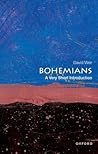
BOOKS: Bohemians: A Very Short Introduction by David Weir

Bohemians: A Very Short Introduction (VERY SHORT INTRODUCTIONS)Bohemians: A Very Short Introduction by David Weir
My rating: 5 of 5 stars

Amazon.in Page

This book examines the brief life of the Bohemian artistic lifestyle, exploring how it came about, what it looked like in its heyday, what led to its demise, and by what / whom it was replaced (e.g. the Beats.) It is an intriguing examination of the subject. I will say, there were points that I felt the book had become lost in the weeds, but at other points I found it fascinating. I concluded that my own calculus was to find it interesting when it discussed the lives and works of artists who are still deemed to have relevance and influence today (e.g. Baudelaire, Picasso, and Whitman,) and not so much when it was elaborating on artists and works that have fallen into obscurity among the general populace (e.g. Henry Murger’s Scenes of Bohemian Life.) So, that may be more a reflection on me than on the book.

The author touches upon the fictional influences that inspired Bohemianism, the places where the lifestyle thrived (e.g. Paris and New York,) the philosophy and – particularly – the political philosophy of the Bohemians (e.g. often Anarchists or – at least – anti-government.) One of the topics that most interested me is how the successor artistic communities differed from the Bohemians.

If you’re interested in who the Bohemians were and how they differ from other artistic communities (before and after,) this book is well worth the brief read required.

View all my reviews

BOOKS: How to Talk Dirty and Influence People by Lenny Bruce

How to Talk Dirty and influence peopleHow to Talk Dirty and influence people by Lenny Bruce
My rating: 5 of 5 stars

Amazon.in Page

This is the autobiography of the comedic legend, Lenny Bruce. The first half (or so) of the book discusses Bruce’s life before standup comedy. This includes time as a sailor (US Navy) during the Second World War, as a sailor in the merchant marine, as a farmhand, and brief stint as a grifter. The second half takes place while Bruce is a working comedian but focuses heavily on his legal troubles including multiple Obscenity trials and one for Narcotics.

Being the work of a comedian, it’s no surprise that this book is funny — frequently of the laugh-out-loud variety. However, it may come as more of a surprise how interesting it is as the account of a man’s life. Besides some interesting stories, such as: how Bruce got discharged from the Navy, how he acquired priest’s uniforms to conduct a con, his experiences getting high with a Turkish sailor as a merchant marine, and the ins and outs of his marriage to a stripper, one gains some insight into Bruce’s philosophy and why he insisted on being maximally edgy, even at the cost of blackballed by clubs. The book holds up surprisingly well, considering it was first published in the early / mid-1960’s.

If you’re interested in outlandish people, standup comedy, or free speech, this book is well worth reading, and will not disappoint. (If you liked “The Marvelous Mrs. Maisel,” it’ll definitely be up your alley.)

View all my reviews

The Anchor Book of Chinese Poetry ed. Tony Barnstone & Chou Ping

The Anchor Book of Chinese Poetry: From Ancient to Contemporary, The Full 3000-Year TraditionThe Anchor Book of Chinese Poetry: From Ancient to Contemporary, The Full 3000-Year Tradition by Tony Barnstone
My rating: 5 of 5 stars

Amazon.in Page

This poetry translation anthology presents examples from some of the earliest known Chinese poetry to authors who are still alive and composing. It’s arranged by dynastic period (up until the modern era,) and, within dynasties, by poet. Most of the poets merit only a poem or two, but some of the major poets are allotted many pages of poems. Of course, how much poetry per poet is included isn’t just a function of how prolific or popular the poet was, but also how much extant poetry remains — i.e. how much survived. Each dynastic section begins with an overview of the time and poetic trends, and there is bio blurb for each poet.

There is quite a bit of variation in the book beyond that of the changing nature of Chinese poetry. The translations are also by varied translators, including not only the book’s editors but also individuals from the past, such as Arthur Waley. I wouldn’t say there is any bad translation in the book, but some translators capture the feel, e.g. the relative sparseness, of Chinese better, and others show their English poetic educations more obviously.

All in all, I enjoyed this selection of poems immensely, and learned a lot about Chinese history as well as of the country’s changing poetic tradition. I gained new insight to some of my favorites (e.g. Li Bai, Han Shan, etc.) and gained new favorites I’d never heard of before. I’d highly recommend this book for readers of poetry in translation.

View all my reviews

BOOKS: The Crescent Moon by Rabindranath Tagore

The Crescent Moon : Poems and Stories [Paperback] [Jan 01, 2017] Rabindranath TagoreThe Crescent Moon : Poems and Stories [Paperback] [Jan 01, 2017] Rabindranath Tagore by Rabindranath Tagore
My rating: 5 of 5 stars

Available free at Project Gutenberg

Amazon.in Page

This is a collection of forty poems that are all connected by the theme of childhood. Many are in the voice of a child, but others are in a parent’s voice as he contemplates the nature of youth and how life has changed — or simply as he looks upon a sleeping infant. Some are brief stories or vignettes and others are scenes or philosophical reflections. Among the more well-known inclusions are: “Playthings,” “Paper Boats,” “The Gift,” and “My Song.”

This is Tagore at his most playful, but it retains his usual clever musing.

View all my reviews

BOOKS: The Batman Who Laughs by Scott Snyder

The Batman Who LaughsThe Batman Who Laughs by Scott Snyder
My rating: 5 of 5 stars

Amazon.in Page

This volume plays on the spookiness of buffoonery that has made the Joker not only one the most well-known and effective villains of Batman’s rogues’ gallery but in all of comic books. However, while the Joker does play a role in this book, he’s not the villain. Instead, the book employs the popular comic book scenario of having the villain be a version of the hero, a version without moral compunctions or constraints. In this case, the central villain is a demented and mutated version of Batman with Jokeresque qualities, assisted by a Batman who is a bit more malevolent and vengeful, one who goes by the moniker Grim Knight.

How are there multiple versions of Batman? The multiverse, of course. That makes this a sci-fi heavy Batman story. If you like your Batman of the Matt Reeves / Robert Pattinson variety — i.e. in a plausible world, with fully human enemies, and with no freaky supernatural happenings, then this one may not be for you. That said, I don’t think the sci-fi elements detracted from the story, and they did allow for some compelling story elements. Snyder, wisely, avoids a problem that can readily plague sci-fi intense Batman stories, which is reference to (or cameos of) the god-tier DC heroes. (An occurrence that always begs the question, why wouldn’t Superman use his god-like powers to fix this debacle before heading to lunch.)

I enjoyed this story. I especially enjoyed that it wrapped up the narrative arc in a tidy package. It is often the case that comic book volumes end with a speedbump on the way to the next volume. This story felt like the central issue was resolved, while still leaving potential for future stories. I should point out that, with flashbacks and multiple Batmen, it does require one’s full attention while reading, lest one get lost between backstory and the present.

I’d highly recommend this volume for comic book readers.

View all my reviews

BOOKS: The Importance of Being Earnest by Oscar Wilde

The Importance of Being EarnestThe Importance of Being Earnest by Oscar Wilde
My rating: 5 of 5 stars

Amazon.in Page

This play is an amusing cautionary tale on the dangers of “Bunburying” and / or leading a double life. “Bunburying,” a term coined by Wilde in this play, is the act of concocting meetings with a fictitious friend to get out of tedious familial (and other social) obligations. Don’t want to go to Aunt Bessie’s potluck? Tell her that your friend with a plausibly absurd name (e.g. Bunbury) has ruptured a disc in his back and desperately needs your assistance. Bunburying is the specialty of one of the two bachelor characters this story is built around, a man named Algernon. The other, Jack, goes by the name Ernest when he is in London, and has to invent the story that he has a brother when his town and country dichotomy of personalities starts to be seen through by those other than Algernon.

This humorous tale revolves around both Algernon and Jack finding desirable fiancés while being tangled in the web of their own duplicity. Much of the humor comes from the interactions of Algernon and Jack, two men who are quite alike, though Jack thinks himself more respectable. Algernon is more at ease with his own scamp-like nature and plays a role similar to that played by Lord Henry in Wilde’s novel, The Picture of Dorian Gray. That is, Algernon offers many a quotable line that at least has the appearance of wisdom — if, often, a kind of nihilistic wisdom.

This play is definitely worth reading.

View all my reviews

BOOKS: The Half Known Life by Pico Iyer

The Half Known Life: In Search of ParadiseThe Half Known Life: In Search of Paradise by Pico Iyer
My rating: 5 of 5 stars

Amazon.in Page

The subtitle to this collection of travel essays might suggest Iyer intends to write about the most idyllic places on Earth. In a way, he does, but he’s also revealing the conundrum of “paradise” by showing the reader places that have been called “paradises,” but which are also some of the furthest places from serenity imaginable. I wouldn’t say that the author is revealing the concept of paradise to be an illusion, but rather that he’s showing that there is an inextricable tangle of dark and light in any earthly paradise. I think the idea is best expressed in a quote from the book, “A true paradise has meaning only after one has outgrown all notions of perfection and taken the measure of the fallen world.” [FYI: the main title is from a quote from Moby Dick.]

From my experience with some of the places that Iyer covers (e.g. Kashmir, Sri Lanka, Varanasi, etc.) I can glimpse the substance that started him digging. It isn’t just that these places are superficially paradisaical (though Kashmir and parts of Sri Lanka are definitely scenically idyllic,) but there is some other (deeper) quality by which these places feel fantastical. Of course, the examples that I mentioned (as well as others: e.g. Jerusalem) are simultaneously examples of the antithesis of paradise. These are troubled places with histories of violence and dysfunction. I even learned that Bali (which doesn’t have its own chapter but is discussed) has barbarity in its own history, and it seems as likely a candidate for true paradise as any.

I enjoyed reading this book. I must admit that part of my fascination with it derived from the fact that I’d tread much of the same ground that Iyer covers. I’d highly recommend the book for readers of travel writing.

View all my reviews

Reviewer Limerick

There once was a prolific reviewer
 who reviewed everything from shipyards to sewers.
   With great dispassion,
     he reviewed an assassin,
  and wished he'd written one review fewer. 

Grave Reviews [Free Verse]

I click on Google Maps;
 a pin highlights for a cemetery,
  and, here, I stumble upon 
   graveyard reviews.

These reviews intrigue me because
 it seems to me that if one is capable 
  of writing a cemetery review,
    then one is unqualified.

And, if one is qualified to comment
 on the caliber of an eternal resting place,
  then one is unlikely to be capable of 
   posting a review.

I read one of the one-star reviews
 and see that the reviewer's principal complaint
 is an overabundance of "pocong."

"What is a 'Pocong?'" you may ask.
 It is a Javanese ghost that takes up
  occupancy in death shrouds.

Why is there a Javanese ghost
 infestation in a cemetery 4000 kilometers
  from Java, and -- as near as I can tell --
   with zero Javanese occupants?

The review does not say,
 but I love that someone panned 
  a cemetery based on the presence 
   of foreign ghosts

[and not because it is simultaneously
 phasmophobic and xenophobic.]

But because it shows an unbridled commitment 
 to one's imagination that is usually 
  only seen among children. 

BOOKS: Wonderful Wonderful Times by Elfriede Jelinek

Wonderful, Wonderful TimesWonderful, Wonderful Times by Elfriede Jelinek
My rating: 5 of 5 stars

Amazon.in Page

If I said this book was A Clockwork Orange meets A Midsummer Night’s Dream it would be in some ways deceptive but in other ways, accurate. The book has none of the otherworldliness of those other stories and, instead, is set in a realistic 1950’s Vienna. Furthermore, those comparisons might confuse readers into not realizing this book is unambiguously a tragedy.

The book is set around four kids (Rainer, Anna, Hans, and Sophie) who like to beat up and rob adults, usually using a kind of catfishing scheme where they trick a middle-aged man into thinking he is about to have a getting lucky with Lolita moment before the other three gang up on the man in a moment of shock and awe. Here lies the “Clockwork Orange” comparison: youths enamored of violence as a means to combat the boredom and meaninglessness of their lives — possibly while passing on the abuse they receive in their own lives.

The “Midsummer Night’s Dream” part comes in with the book’s love geometry. Like that Shakespearean play, there are two boys and two girls and both boys are in love with the same girl (Sophie,) leaving the other girl (Anna) in a sad unrequited territory.

The book won’t be everyone’s cup of tea, and not only because it deals heavily in sex and violence. There are a couple factors that make the book feel strange. First of all, it is written in present tense. Secondly, it spends a lot of time in the minds of the characters and relatively little time with the action. Thirdly, the pacing of the conclusion and resolution of the book is abrupt and might feel forced — like the author was 245 pages in when the publisher told her that she had 250 pages, maximum, and that she’d better be wrapping it up. I didn’t find any of these factors to be problematic, but I can see how they would rub some readers the wrong way.

If the premise intrigues, you should definitely read this book – particularly if the previous paragraph’s warning didn’t turn you off.

View all my reviews