BOOK: “Kindred Spirits” by Edward C. Sellner

Kindred Spirits: Thomas Merton, Jack Kerouac, and ZenKindred Spirits: Thomas Merton, Jack Kerouac, and Zen by Edward C. Sellner
My rating: 5 of 5 stars

Publisher Site — Monkfish Books

Release Date: July 28,2026

This book intertwines the biographies of two prominent 2oth century American authors, Beat novelist Jack Kerouac and Trappist monk Thomas Merton. Besides the two writers’ general interest in Eastern philosophy and mysticism and the fact that they had broadly overlapping lifespans, I wouldn’t have placed them in the same basket (despite having read works by each and found both writers’ works enjoyable – though in distinct ways.) However, Sellner dives down into other points of commonality — e.g. Columbia University educated, lifelong Catholics, love of drink, ladies’ men (at some point, at least,) desire for a hermetic existence, etc. Of course, another important commonality was dying young, Kerouac at 47 and Merton at 53.

This book is a fascinating look at two authors who forever changed American perception of Zen Buddhism and Eastern philosophy more generally, though who did it through the lens of Catholicism. At its heart, however, it’s the tale of the struggles of two men to find something, something elusive yet for which they each felt a strong compulsion, something which even successes only left them hungering for more.

If you’re interested in the lives of writers, this book is an excellent read and I’d highly recommend it. Regardless of what you might feel about the connective tissue between them, both of these writers had an interesting life.

View all my reviews

DAILY PHOTO: Holy Lords Transfiguration Convent, Tbilisi

Image

Photograph of a chapel at the Holy Lords Transfiguration Convent in Tbilisi, Georgia --  Queen Darejani Palace.

DAILY PHOTO: Holy Trinity Cathedral, Tbilisi

Image

Photograph of Holy Trinity Cathedral in Tbilisi, Georgia taken from the hills across the river.

Condemned [Free Verse]

Condemnation placard
Stapled to the church door
With the commanding tone
Of Luther’s notice.

The Condemned has stately bones
But its skin and viscera
Are in shambles.

Sun pierces stained glass,
Bathing dirty surfaces
With bright color,
But the dust and rat shit
Remain to create a
Miasma within.

One day a wrecking ball
Will make good on the
Condemnation.

DAILY PHOTO: First Congregational Church, Atlanta

DAILY PHOTO: St. Mark United Methodist Church, Atlanta

BOOK: “Love Thy Stranger” by Bart D. Ehrman

Love Thy Stranger: How the Teachings of Jesus Transformed the Moral Conscience of the WestLove Thy Stranger: How the Teachings of Jesus Transformed the Moral Conscience of the West by Bart D. Ehrman
My rating: 4 of 5 stars

Publisher Site – Simon & Schuster

Release Date: March 24, 2026

In this book, Ehrman argues that the development of Christianity started a sea change in the Western world’s approach to charity, altruism, and forgiveness. The idea is that both Greco-Roman philosophies and Judaism (Christianity’s religious precursor) were more tribal. Those systems clearly presented arguments for being charitable and kind, but in the context of those closest to you — your family and immediate neighbors — i.e. your ingroup. However, Ehrman proposes that those systems did not suggest any obligation to be charitable or kind to those who were strangers to one.

This is an intriguing book and provides many thought-provoking ideas and lessons from scripture, philosophy, and history. Ehrman definitely makes a case, but I don’t know that it is as strong as it might seem. In short, I think he did a great job of collecting stories and teachings that supported his point but showed less willingness to consider stories that might refute his thesis. I did appreciate how often Ehrman acknowledged contradictory views even when they conflicted with his own — often (appropriately) in footnotes. That said, I can’t recall seeing anything about the story of the Syrophoenician woman, a tale that seems to negate the book’s argument. In that story, a woman (of Syrophoenician origin) comes seeking Jesus’s help and is at first rebuked and turned away. Jesus says, “It is not fair to take the children’s food and throw it to the dogs.” Suggesting he neither sees her as the same species nor worthy of assistance. While it is true that Jesus does eventually assist her after she demeans herself (“Even dogs eat the children’s crumbs,) it’s still indication that he was far from advocating one behave lovingly toward all.

The book begins by dealing with broader questions, such as whether altruism actually exists (i.e. has existed) anywhere (i.e. are kind actions always self-serving?) and what the existing thinking was on the subject in Western philosophy and Abrahamic religion in Jesus’s day. I thought these first few chapters were quite beneficial for setting the stage before jumping into the building of the book’s central argument.

For those interested in what Jesus taught and what became of his teachings after his death, I’d recommend this book, or even for anyone interested in the changing shape of Western morality and ethics over time. I think the author conveys many interesting ideas in a readable and approachable way.

View all my reviews

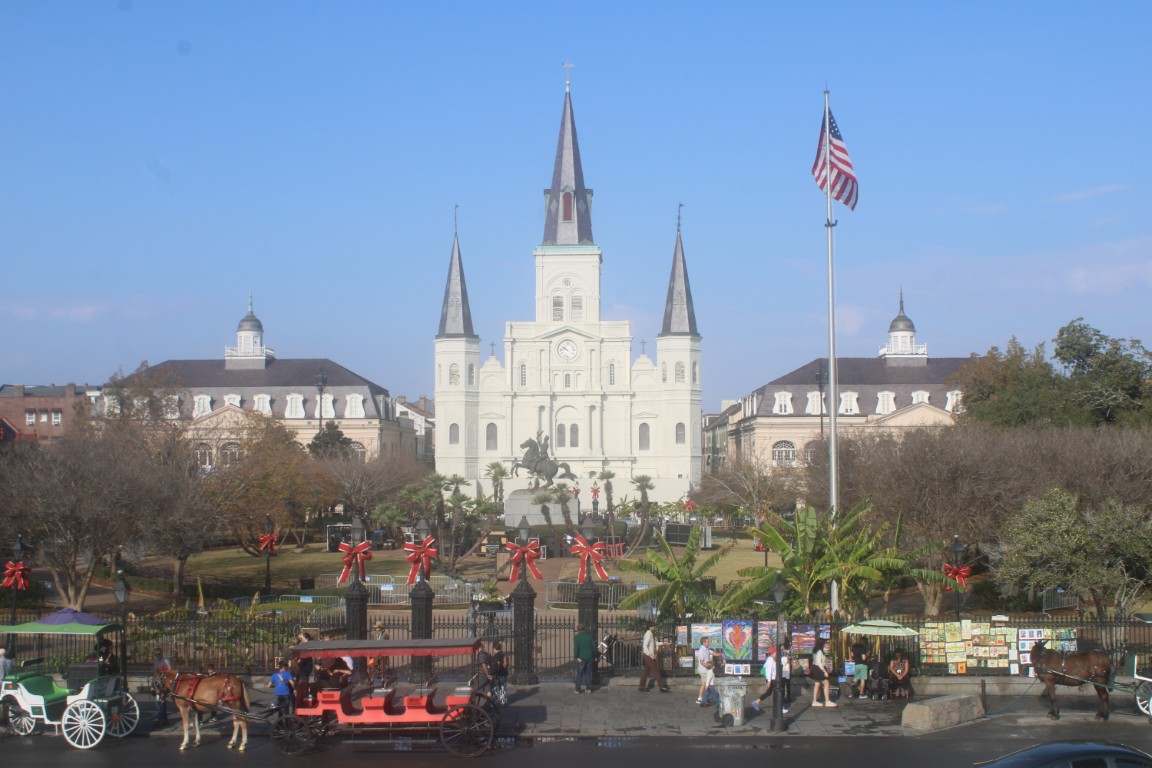
DAILY PHOTO: St. Louis Cathedral by Day

Image

Photograph of St. Louis Cathedral in New Orleans taken from Washington Artillery Park across Jackson Square.

FIVE WISE LINES [December 2025]

William Blake painting of Urizen praying to the world he created, an illustration from "Song of Los."
William Blake:
Urizen prays to the world he created (1795)
Song of Los

I must create a system
or be enslaved by another man’s…

william blake; Jerusalem: The emanation of the great albion

Saying Yoga exists to make one more flexible
is like saying that it exists to wring farts out of one’s body,
both will happen — neither is the primary objective.

Me

He that is without sin among you,
let him first cast a stone at her…

JESUS; John 8:7

The best government is that which governs least.

Henry david thoreau, Civil Disobedience

Gods always behave like the people who make them…

zora neale hurston; Tell my horse

DAILY PHOTO: First Evangelical Presbyterian Church, Roanoke