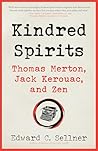
BOOK: “Kindred Spirits” by Edward C. Sellner

Kindred Spirits: Thomas Merton, Jack Kerouac, and ZenKindred Spirits: Thomas Merton, Jack Kerouac, and Zen by Edward C. Sellner
My rating: 5 of 5 stars

Publisher Site — Monkfish Books

Release Date: July 28,2026

This book intertwines the biographies of two prominent 2oth century American authors, Beat novelist Jack Kerouac and Trappist monk Thomas Merton. Besides the two writers’ general interest in Eastern philosophy and mysticism and the fact that they had broadly overlapping lifespans, I wouldn’t have placed them in the same basket (despite having read works by each and found both writers’ works enjoyable – though in distinct ways.) However, Sellner dives down into other points of commonality — e.g. Columbia University educated, lifelong Catholics, love of drink, ladies’ men (at some point, at least,) desire for a hermetic existence, etc. Of course, another important commonality was dying young, Kerouac at 47 and Merton at 53.

This book is a fascinating look at two authors who forever changed American perception of Zen Buddhism and Eastern philosophy more generally, though who did it through the lens of Catholicism. At its heart, however, it’s the tale of the struggles of two men to find something, something elusive yet for which they each felt a strong compulsion, something which even successes only left them hungering for more.

If you’re interested in the lives of writers, this book is an excellent read and I’d highly recommend it. Regardless of what you might feel about the connective tissue between them, both of these writers had an interesting life.

View all my reviews

Rickety Gibberish [Free Verse]

A long time ago,
 I listened to the audiobook of
    Kerouac's "On the Road."

In that format, 
   I became aware of how often
     Kerouac used the word
       "rickety." 

Almost as aware as I became
   of how often Twain uses
      the N-word in Huck Finn
      when I unwisely listened to 
      that audiobook while driving
      through downtown Atlanta
      with my windows rolled down. 

I'm now reading Hunter Thompson's
   "Kingdom of Fear," and I've become
      aware that Thompson had a love
      of the word "gibberish" almost on par
      with Kerouac's love of "rickety."

And I think about how much beautiful
   rickety gibberish I've read from those
      authors, and what a fine 
      thing it is if one can write 
      rickety gibberish that stands up 
      under its own weight. 

BOOK REVIEW: Naked Lunch [the Restored Text] by William S. Burroughs

Naked Lunch: The Restored TextNaked Lunch: The Restored Text by William S. Burroughs
My rating: 4 of 5 stars

Amazon.in page

This isn’t a novel so much as a series of heroin-fueled fever dreams. While that makes it sound incoherent and unreadable, there’s a great deal of visceral imagery and clever language in it. What there’s not is a thread that carries the reader through a series of events constituting a coherent narrative arc. The book reads like dystopian fiction, but that’s merely Beat-style lingo and heroin addict worldview applied to a combination of Burrough’s world and the surreal mind-space of the addict on a fix.

As is also true of Joyce’s “Ulysses,” if you’re a reader who needs a coherent story and the avoidance of experimental language, you probably won’t like this book. Furthermore, readers who’re uncomfortable with pornographic imagery will also find the book objectionable. However, if you enjoy books that are prose poem-like in their use of language and if you don’t mind the disjointed strangeness necessary to convey the addict’s mental experience, then you’ll probably get a kick out of this book. It’s worth recognizing that what makes the book a challenging read is simultaneously what makes it such a masterpiece of the drug-addled experience. If it were more lucid, it’d be tepid and purposeless.

This is the restored text edition. This is one of the few cases in which I’d recommend reading all the backmatter. It includes some “outtakes” from the earliest drafts, but (more usefully) some essays by Burroughs that offer important insights. When one finishes this book, there’s a tendency to think, “What was that? What did I just read?” The appendices help one understand the book better. Here we read Burrough’s claim that he had no recollection of composing the original draft, and a later statement in which he clarifies that his earlier statement was an exaggeration – that he did have some memories of it.

I found this book to be an engrossing read. As I say, while it’s bizarre, outlandish, and frequently pornographic, it also lends insight into a state of mind that most of us – fortunately – will never experience.

View all my reviews