THAILAND LIMERICK

There was a wise pot seller in Thailand
whose customers always claimed to be scammed.
You see, he sold metal pots –
Ganja varietals, not –
but he truly had the strongest pot in the land.

BOOK: “Hell’s Angels” by Hunter S. Thompson

Hell's AngelsHell’s Angels by Hunter S. Thompson
My rating: 5 of 5 stars

Publisher Site – Penguin

This, the first published book of Hunter S. Thompson, is said to be from his pre-Gonzo period, but it bears many of the hallmarks Thompson would later be famous for: inventive colorful language, immersion in scenes of debauchery, and insight into the American cultural landscape.

The book is part exposé of the Hell’s Angels motorcycle gang, an organization shrouded in a reputation that was as much myth as reality and whose tightknit inner circle made obtaining an accurate picture a challenge. It would take someone as fearless / crazy as Thompson to get close enough to learn about the gang and then to tell enough truth to make at least some of the members unhappy.

The book also takes the temperature of America and reports on what ails the country. One might think this would not be worth reading, given that its insight of America is from the late sixties (it came out in ’67.) However, as I read the penultimate chapter, I was surprised to find how much of what was being said could be seen as prophetic. Thompson wrote about the Angels not as a romantic throwback to wild west outlaws (as many saw them,) but as a class of people who were ill-equipped to make a living in an ever more technologically advanced America, leaving them with little money and loads of resentment. He wrote of them as “prototypes,” and his description connects up to the latest model. It was at that point that I started seeing Thompson not only as a brilliant creative writer, but — perhaps — as a prophet.

I’d highly recommend this book for anyone curious about the Hell’s Angels or American outlaws, more generally.

View all my reviews

BOOKS: “Smoke and Ashes” by Amitav Ghosh

Smoke and Ashes: A Writer's Journey through Opium's Hidden HistoriesSmoke and Ashes: A Writer’s Journey through Opium’s Hidden Histories by Amitav Ghosh

My rating: 5 of 5 stars

Amazon.in Page

Release Date: February 15, 2024 [NOTE: for this edition; the book is already out in some markets in some additions.]

Ghosh has written a fascinating exploration of the profound global consequences of that pretty red flower, the opium poppy. I find the events surrounding the Opium Wars to be among the most incredible stories humanity has written. It is mind-blowing that a substance could be so utterly addictive as to spur wars and global social and economic upheavals. That substance is, of course, tea. Ah, you thought I was going to say opium (or its relative, heroin,) didn’t you? But while opium is fantastically addictive, its addicts were by-and-large in peaceful stupors in (or on) their clouds during the time in question. It is the uppity Earl Grey addict who was draining Britain’s treasury of precious metals, and — as addicts do in their impoverished desperation — turned to dealing drugs.

There have been many books written on this subject, but Ghosh carves himself a niche. First, while accounts often focus tightly upon the central adversarial relationship of Britain versus China, Ghosh examines at leisure the roles of two lesser discussed players — India (not only as a subject of Great Britain but also as an autonomous actor) and America. The importance of India’s involvement, from being a major producer and processor of opium to sourcing the sepoys who actually fought the Opium Wars, has been largely ignored, and Ghosh helps to clear up distortions in the historical record. Second, the book investigates questions around America’s opioid crisis and what history can tell us about its drivers. In particular, what does the China’s explosion of addiction tell us about what might have spurred America’s crisis?

This is a readable and compelling nonfiction exploration of the influence of opium from a writer who has produced novels (e.g. the “Sea of Poppies” trilogy) set around these historical events.

I’d highly recommend this book for individuals interested in the influence of Opium, particularly if one is curious about how history relates to the recent crises and what role Indians and Americans played in events.

View all my reviews

Phantasm Avenue [Free Verse]

Bleary-eyed drunks
 stagger down the street;
Eyes drawn to
 orbs of color,
Looking up,
 the lanterns become
  planets.
Spinning spheres of
 vertiginousness
  that send tipsy chappies
   face first into terra firma.
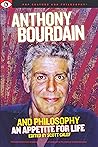
BOOKS: “Anthony Bourdain and Philosophy” ed. by Scott Calef

Anthony Bourdain and PhilosophyAnthony Bourdain and Philosophy by Calef Scott
My rating: 5 of 5 stars

Amazon.in Page

Release Date: December 26, 2023

These pop philosophy books that examine philosophical ideas through the lens of a particular pop culture personality or entity have become, well, popular. It’s not hard to see why; it’s an easy way to take your medicine, your medicine being to learn philosophical concepts. And, let’s face it, scholarly philosophical books are often nigh unreadable, being laden with jargon and having a tendency to get so lost in the minutiae of razor fine points that they display no relevance to the human experience. I am not immune to the appeal of such books, though when I see a book like “Miranda Sings and Philosophy” I figure I can take a hard pass. But this one caught my eye because Anthony Bourdain did live a life shaped by his own particular philosophy, and an intriguing one at that.

Like most of these books, this is a collection of essays written by different authors. As such, the quality and relevance of the included chapters does vary somewhat.

The book is divided into four parts. The first part looks at the subject of the work for which Bourdain was best known — i.e. at the intersection of food and travel. In these four chapters, authors explore the aesthetics of food and questions like: Do “expert” views on food matter? What is disgusting? And what role does culture play in the culinary experience?

The second part is entitled, “life,” and these five chapters look at Bourdain, the man. That is, they shift away from his work, and look at Bourdain as a martial arts student, a storyteller, and -generally – as a person. These chapters also offer insight into his epistemological perspective — i.e. how he viewed (and engaged in) the pursuit of truth, as well as touching upon his philosophical views more broadly.

The third part takes another turn to examine Bourdain’s addiction and his death by suicide. The chapters present broader philosophical frameworks on suicide and freedom, as a means to put Bourdain’s experience in perspective.

The final part is really kind of a grab-bag of subjects that don’t fit neatly into the other sections. Probably not coincidentally, this is where most of the book’s rough spots are located. It sometimes seems that Bourdain’s philosophy is not so much the subject anymore, and some authors convey their ideas more clearly and effectively than others. This is not, by any means, to say that any of the chapters are completely stinkers, nor to say that all of the chapters are defective. Chapter 13 [which, BTW, I think could have found a spot in Part II] does an interesting job in clarifying Bourdain’s approach to ethics, no easy task as it can seem like an odd mix of spiteful nihilistic impulses and compassionate humility (and it certainly evolved over time.) But even Chapters 14 and 15, which are not only the least flattering discussions of Bourdain but also the most didactic, have something to offer. The first lays out the scandal involving Bourdain’s girlfriend who was a MeToo leader but who also paid off a young actor who accused her of statutory rape, a pay-off made by Bourdain and which seems to be a factor in his suicide. Chapter 15 offers examples of what the author believed Bourdain did right and wrong in discussing the historical context of the places he visited that had been colonized. Ch. 16 was a discussion of the ethics of engaging in luxuriant fine dining in a world with starving people. I thought this chapter would stay the course set by the previous two, but it did shift back into academic objectivity by producing a more complete discussion of competing viewpoints. The penultimate chapter goes more niche than the others, but is a fascinating look at the ethics of AI generated voicework for the “Roadrunner” documentary — i.e. using AI to make it sound like Bourdain said things that he wrote in emails or books but never said [at least not into a recording device.] The last chapter involves climate change and episodes Bourdain did in Madagascar and Bhutan. This was both one of the longer chapters and definitely the most muddled. It remains unclear to me exactly what the author was trying to say, exactly. It’s perfectly readable, and yet unclear.

All in all, I enjoyed this book (as much as one can “enjoy” a book that is about a deceased beloved figure,) and thought it offered some excellent food for thought.

View all my reviews

Be Drunken by Charles Baudelaire [w/ Audio]

Be always drunken. Nothing else matters: that is the only question. If you would not feel the horrible burden of Time weighing on your shoulders and crushing you to the earth, be drunken continually.

Drunken with what? With wine, with poetry, or with virtue, as you will. But be drunken.

And if sometimes, on the stairs of a palace, or on the green side of a ditch, or in the dreary solitude of your own room, you should awaken and the drunkenness be half or wholly slipped away from you, ask of the wind, or of the wave, or of the star, or of the bird, or of the clock, or whatever flies, or sighs, or rocks, or sings, or speaks, ask what hour it is; and the wind, wave, star, bird, clock will answer you: “It is the hour to be drunken! Be drunken, if you would not be martyred slaves of Time, be drunken continually! With wine, with poetry, or with virtue, as you will.”

NOTE: This is the Arthur Symons translation from the 1913 Elkin Mathews edition of Baudelaire’s Poems in Prose. Available via Project Gutenberg at: https://www.gutenberg.org/cache/epub/50489/pg50489-images.html#XI

Green Fairy [Free Verse]

Bohemians
   gathered around 
   the absinthe bottles,
  the light hitting 
   the bottles shone
   a radioactive shade
   of green.

That green light
   threw blotches
  against walls &
 floors & people &
  anything else there
  was to illuminate.

The more they drank,
 the less green the mottling --
  not because the empty glass 
   was clear, &
 didn't refract, or spray green,
   but because the splotches
  turned every color --
   every color there is --
  and the colors danced
   around the increasingly 
  amorphous surfaces.

 Until, at last,
  everyone was asleep,
 and visions of Green Fairies
  danced in their dreams. 
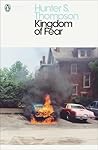
BOOKS: Kingdom of Fear by Hunter S. Thompson

Kingdom of Fear: Loathsome Secrets of a Star-crossed Child in the Final Days of the American CenturyKingdom of Fear: Loathsome Secrets of a Star-crossed Child in the Final Days of the American Century by Hunter S Thompson
My rating: 5 of 5 stars

Amazon.in Page

Kingdom of Fear is part memoir and part commentary on the state of America at the turn of the millennium. As a memoir, it explores Thompson’s bid for Sheriff, his arrest and judicial proceedings for drug and explosives charges that resulted from a “he said / she said” accusation that did not warrant charges in and of itself, a wild and wooly road-trip through Nevada, and Thompson’s position at the center of an investigation of a “threat” on the life of actor, Jack Nicholson.

As a commentary on the decline of America it discusses the battle for Grenada, a trip to Cuba, 9-11 and its aftermath, and the book revisits the ’68 Democratic Convention. It’s all written in Thompson’s drug-fueled Gonzo style, making it incredibly entertaining to read even as the hard walls between fact and fiction seem to dissolve. While the factualness might be at times in question, there is always a kind of truth that can only be received from those who’ve tossed off the shackles of societal convention and are willing to tell it as it is — even the embarrassing bits (especially the embarrassing bits.)

It’s not for those who take life and authority figures too seriously, but otherwise it’s a tremendously compelling and sometimes hilarious in its depiction of pre- and post-Y2K America.

View all my reviews

BOOK REVIEW: Project MK-Ultra Vol. 2 by Brandon Beckner, et. al.

Project MK-Ultra Vol. 2: Sex, Drugs, and the CIAProject MK-Ultra Vol. 2: Sex, Drugs, and the CIA by Brandon Beckner
My rating: 5 of 5 stars

Amazon.in Page

Release Date: November 15, 2022

Get Speechify to make any book an audiobook

Volume Two continues the story of CIA’s crazy “experimentation” with LSD, ultimately leading to the fall of the MK-Ultra program. The story is built around strange but true events, but there is a fictionalized element, particularly with respect to the investigative journalist (Seymour Phillips) whose presence in the story is used as a mechanism to tie together events that may or may not have had much overlap in terms of common personnel. That is to say, fiction isn’t just used to make the story more intriguing (a tale this strange hardly needs much help in that department,) but to both fill in knowledge gaps (famously, most of the MK-Ultra files were destroyed) and to make a throughline connecting somewhat disparate events. The focus is on events surrounding Ronald Stark as well as the widening spillover of LSD from CIA programs into the civilian space – e.g. the birth of Ken Kesey’s Merry Pranksters.

The art in this book is amazing. Of course, much of it has to capture the sensory bizarrerie of psychedelic experiences, and it does that creatively. However, even the “sober” panels are colorful and present a captivating world. There’s a full-page depiction of Chinatown that blew my mind.

If you’re interested in a story built around the CIA’s dalliances with LSD, and the subsequent spillover into the civilian world, I’d highly recommend the two volumes of this book.

View all my reviews

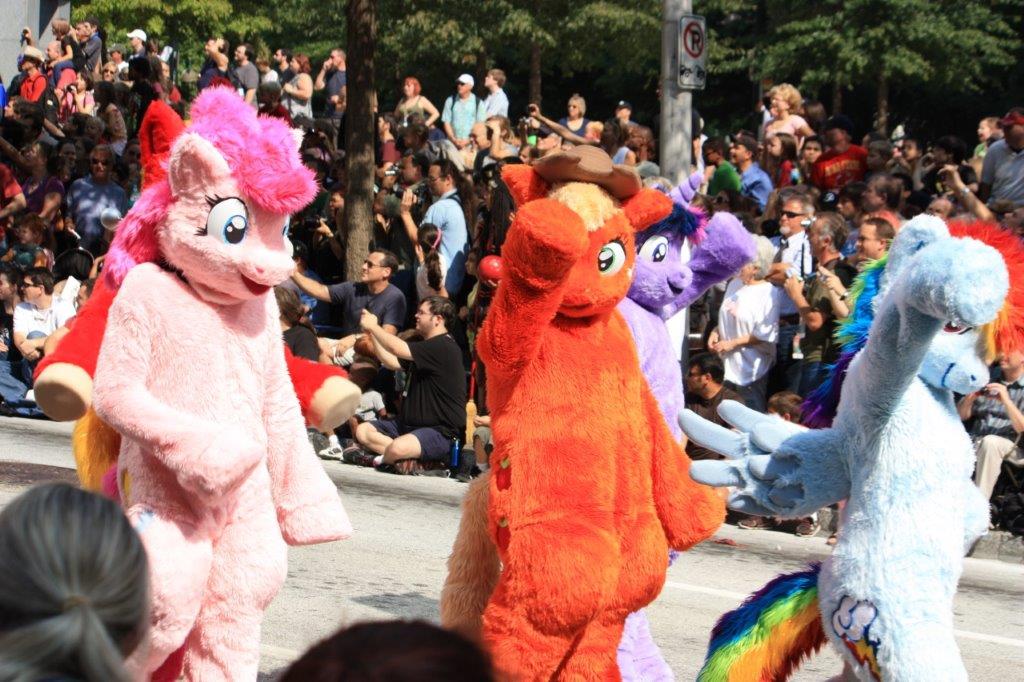
Psychedelic Parade [Limerick]

An old man got caught up by a parade.
Street after street, he was barred by blockade.
But he didn't lose poise
'til walking plush toys
convinced him LSD was being covertly sprayed.
