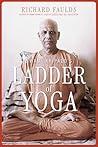
BOOK: “Swami Kripalu’s Ladder of Yoga” by Richard Faulds

Swami Kripalu’s Ladder of YogaSwami Kripalu’s Ladder of Yoga by Richard Faulds
My rating: 4 of 5 stars

Publisher Site – Monkfish

Release Date: April 7, 2026

This book discusses the organizational structure of yoga as described by prominent 20th century yoga guru, Swami Kripalu, an approach that draws on (but distinguishes itself from) the 8-limb (Ashtanga) framework outlined by Patanjali in the Yoga Sutras. Swami Kripalu deemphasized yogic ethics (Yama and Niyama,) and put great emphasis on hierarchy among the elements of yoga — i.e. that one must pass through the lessons of some limbs before you can begin to move up to the next. (This idea is certainly taught in Patanjali’s Sutras, but not with the same emphasis — hence Kripalu’s “ladder,” rather than “limbs” — making clear that these are not independent elements but rather are completely dependent.)

The greatest strength of this book is in distinguishing concepts like dhyana (meditation) from samadhi, distinction of which is often given short shrift with simplistic soundbite-like definitions in books on yoga. The book is not the usual yoga text in that it spends a great deal of time discussing the “higher limbs” of yoga (to resort back to Patanjali’s formulation.) Faulds adds benefit by discussing his own subjective experiences, the lack of access to subjective understanding often gives even students actively training with teachers doubts about their experiences.

I should point out that the book does also spend a good deal of page count (perhaps more space than any other subject) on pranayama (breathwork,) both covering it over several chapters in the book’s midsection and then further in a couple appendices that get into the physiology of breathwork.

One nice feature is that almost all of the chapters end with sections entitled “Be a Discerning Student” and “Applying this Chapter in Practice” to help readers with practical insights into what is by and large a philosophical discussion. There are also several appendices (the most useful one to me was a discussion of the shifting understanding of the term “samadhi” over time and across disciplines.)

If you want to explore what the higher limbs are and how they are distinguished, I’d recommend this book. (As I said, it also deals with Pranayama in some detail, but that will likely offer less new insight for students and teachers of yoga who’ve received an education in [and maintain a practice of] yoga.)

View all my reviews

PROMPT: Negative Feelings

Daily writing prompt
What strategies do you use to cope with negative feelings?

Sakshi Bhavan, the dispassionate witness, giving feelings one’s full attention without allowing rumination that compounds the effect.

Not technically a strategy, but I think it’s on point.

BOOK: “Four Chapters on Freedom” by Patanjali [Commentaries by Satyananda Saraswati]

Four Chapters on Freedom: Commentary on the Yoga Sutras of PatanjaliFour Chapters on Freedom: Commentary on the Yoga Sutras of Patanjali by Satyananda Saraswati
My rating: 5 of 5 stars

Publisher – Yoga Publications Trust

This book holds the Bihar School of Yoga commentaries on The Yoga Sutras of Patanjali. In addition to providing each Sutra in Sanskrit, a Romanized transliteration, a word-by-word literal translation, and a readable free translation into English, the book offers a commentary for each Sutra. The Yoga Sutras of Patanjali consist of just 196 lines of Sanskrit, explaining the nature of yoga and how it is to be practiced. Because the Sutras are so sparse and open to varied interpretations, a commentary is essential and one’s learning experience is only as good as the translation and commentary. There are many English language commentaries on Patanjali’s Sutras available, but I don’t think one can do any better than this one.

In general, I have found the publications put out by the Yoga Publications Trust of the Bihar School to be as useful as they come. Their books are pragmatic, focused, and readable.

This book does, by necessity, use a fair number of Sanskrit terms repeatedly because there are not English words for many of the key concepts and to try to put them into English would be tiresome and confusing. However, there is a glossary at the end of the book (in addition to an index) to help the reader negotiate this Sanskrit terminology. The appendices also include a key to help English language readers with the pronunciation of Sanskrit terms. There are also appendices with the sutras written out in Sanskrit and Romanized transliteration in list form.

This book is well worth reading, whether one has read other commentaries on The Yoga Sutras of Patanjali or not.

View all my reviews

BOOK: “Yoga Also for the Godless” by Sri M.

Yoga Also for the GodlessYoga Also for the Godless by Sri M.
My rating: 4 of 5 stars

Publisher Site – Penguin India

One common philosophical question regarding yoga is to what degree it is, in itself, religious. This has been argued by various sects from within Yoga, with some seeing Yoga without belief as oxymoronic and others arguing that the metaphysics of Yoga is essentially Samkhya (an atheistic philosophy.) Outsiders to Yoga have also had their say, as with the Roman Catholic Church telling its practitioners that the practice of Yoga is incongruent with that of Catholicism.

This book’s author takes on the question by examining what yoga is according to historic texts, specifically the Yoga Sutras of Patanjali, and then considering whether the practice that is laid out necessitates a belief in a deity, deities, or the supernatural. As one can tell from the title, Sri M (born Mumtaz Ali) argues that belief in divinity is not essential to the practice of Yoga.

Those who’ve read various commentaries on Patanjali’s Yoga Sutras will find this book at best familiar and at worst just another set of Sutra commentaries. Sri M’s book is not just Yoga Sutra commentaries, but that does take up a fair amount of the page space. The early chapters focus more on the thesis question.

If you’re interested in the question of whether Yoga is inherently theistic, this is a fine book to investigate. It’s a quick read and draws heavily on sutras and scriptures (and, thus, is not just the author’s opinion.)

View all my reviews

PROMPT: Physical Activities or Exercises

Daily writing prompt
What are your favorite physical activities or exercises?

I never met a one I didn’t like.

PROMPT: Change

Daily writing prompt
What is one thing you would change about yourself?

I think about this in yogic terms. In the niyama of yoga there are two guiding ideas that – at first – seem contradictory. Santosha is contentment. Tapas is discipline. So, on one hand, Patanjali was suggesting one needs to accept what one is (santosha,) but, on the other hand, he was suggesting that one needs to keep the fire of self-development burning (tapas.) [Note: I realize there are different readings of these two concepts, these are the versions that have resonated with me.]

These two ideas did seem at odds until I realized that they answer different questions. Contentment is the answer to “Am I enough?” Tapas is the answer to “Can I be better?”

Long story short, I see wishes such as the desire to be six inches taller or to be a celebrity as a waste of time and mental energy. However, I see the need to be a healthier and more equanimous version of myself as an ever-present driver.

FIVE WISE LINES [December 2025]

William Blake painting of Urizen praying to the world he created, an illustration from "Song of Los."
William Blake:
Urizen prays to the world he created (1795)
Song of Los

I must create a system
or be enslaved by another man’s…

william blake; Jerusalem: The emanation of the great albion

Saying Yoga exists to make one more flexible
is like saying that it exists to wring farts out of one’s body,
both will happen — neither is the primary objective.

Me

He that is without sin among you,
let him first cast a stone at her…

JESUS; John 8:7

The best government is that which governs least.

Henry david thoreau, Civil Disobedience

Gods always behave like the people who make them…

zora neale hurston; Tell my horse

PROMPT: Everyone Should Know

Daily writing prompt
What’s something you believe everyone should know.

While any individual’s ability to substantially change the world is minimal, one’s ability to change how one experiences the world is vast. Cultivate the dispassionate witness. #Sakshi Bhava

Also, how to swim, change a tire, and juggle while riding a unicycle.

PROMPT: Physical Exercise

What is your favorite form of physical exercise?

I’m a big fan of them all. I like to move it, move it.

Each in its time.

Though the less special equipment I need access to, the better. I’m a firm believer that one needs only the body and mind to keep a fit body. It’s all a matter of how, how often, how intensely, and how safely one moves one’s body. Gadgety fitness can become too fetishist, and not build integration of the body as much as is ideal.

PROMPT: Pay More Attention

What details of your life could you pay more attention to?

Mental states and somatic & emotional sensations. Sakshi Bhava is good stuff.