PROMPT: Writing

Daily writing prompt
What do you enjoy most about writing?

EPIPHANIES.

But, if you think about it, writing is miraculous. In the scheme of gifts that nature grants, it is way out beyond left field. Encoding ideas and images in simple characters in a way that can evoke emotional or cognitive responses in readers is kind of a superpower. (As is reading.)

PROMPT: All

Daily writing prompt
What does “having it all” mean to you? Is it attainable?

Health, food, air, water, love, and thought… that about covers it.

Sure, why not?

PROMPT: Superstitious

Daily writing prompt
Are you superstitious?

No. I’ve trained myself to recognize factors, such as selection bias, that contribute to superstitions. And I try to hold all beliefs only so tightly as they can be shaken away by better understanding, particularly beliefs that aren’t strongly supported by experience and reason.

PROMPT: Lose Track of Time

Daily writing prompt
Which activities make you lose track of time?

Reading, thinking, and learning.

Mind Storm [Free Verse]

A loose shard of thought
Flips and twists about in
My brain,
Poking sensitive tissue,
And sending firestorms
Riffling through my circuitry.
I can't really say I feel each
Prickle or pierce, but they
Do make me wince, sometimes.

The Emotional Beast [Free Verse]

We laud our rational side

- The Thinking Man -

But we're emotional beasts
to the core.

To use that old
[and disparately applied]
chestnut:

Of emotions, 
better master
than servant.

Poetry is a conduit
to emotional savvy.

That's part of the reason
Plato urged poetic restraint;

he found the emotional
inferior to the rational,
and thought most youngsters 
couldn't behave responsibly
in the face of poetry's 
emotional power.

It's also where Aristotle
found virtue in poetry,
its ability to induce 
catharsis.

Could they both 
be right?

POEM: Wisdom of the Leaf

The mind is architect of a slum town of grief.
Silent words, yet ceaseless calling.
I envy the simple way of a falling leaf.
No grasping, nor fear of falling.
 
If a thought could twist on the wind for its brief life —
not frantically seeking hold.
We would not live these dear lives strafed by strife.
We’d not find our dreams bought and sold,
or feel untimely turning old —
vigor sapped by a false form of cold.

And life would be all we had to live.

POEM: Thinking

I think,
but without Descartes’ insistence that I am.

In fact, the more I think, the less confident I am about knowing what “being” means.

I think — without knowing,
and recognize the hazard of that condition.
It’s what got Socrates killed.

A smart person who claims to know may raise hackles,
but is dismissed as arrogant.

It’s the smart person who admits he doesn’t know…
[let’s hope I’m not wrongly classed among them]
… that’s the one who arouses murderous intent.

For what hope exists for priests, professors, or politicians —
or any of the many oracles of our age —
when the most astute confess that uncertainty is inescapable?

What airy sands are our castles built upon?

And, yet, I think.

POEM: The Vampire Rule

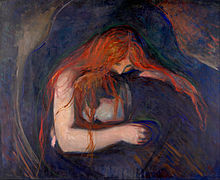
Edvard Munch; “Vampire”

They say a Vampire can’t enter your house unless you invite them inside.

I don’t know whether it’s true, on account of I don’t know if Vampires are a thing.

But I recognize a rule that is good and true when I hear one.

I always hear this or that person complaining about how such-and-such is,

“…living in my head, rent free.”

Well, who invited them?

POEM: Nullius in Verba

nulliusinverba1

Said Socrates, “Oh, those poor bastards, for they think they know.

“I may be an ignorant slut, but I know I know not.”

[I paraphrase.]

My point, if I have one, is that “know” is an overused word.

Stinking up the discourse, like a bloated, floating pig turd.

[Remember Jim Carey, in the movie “Liar, Liar”]

“I object, Your Honor”… “Because, it’s devastating to my case.”

It’s a refrain seldom stated, but oft implied.

It works quite well, if you only talk to one side.

Fault us not for we’re wired to be certain.

If the cave wall shadow might be a tiger,

you don’t wait to see whether it’s a mouse.

That said, we’ve evolved these huge honking brains.

Our prefrontal cortexes might withstand the strain–

of asking:

How do I know this?

What if I’m wrong?

Might my mind deceive?

Facts: cherry-picked or  strong?