PROMPT: Teacher

What makes a teacher great?

If students choose the teacher, that is an excellent first indicator. In the typical top-down selection of teachers, it is easy to produce an abundance of shitty teachers. Of course, there is still the danger of charismatic bullshitters and easy people-pleasers, problems ever-present. But among students (as opposed to followers) they usually reveal themselves in time.

“A learned man came to me once” by Stephen Crane [w/ Audio]

A learned man came to me once.
He said, "I know the way, -- come."
And I was overjoyed at this.
Together we hastened.
Soon, too soon, were we
Where my eyes were useless,
And I knew not the ways of my feet.
I clung to the hand of my friend;
But at last he cried, "I am lost."

PROMPT: Alternative Career Paths

What alternative career paths have you considered or are interested in?

1.) Teaching English as a Second / Other / Foreign Language

2.) Grand Emperor of the Spiral Arm

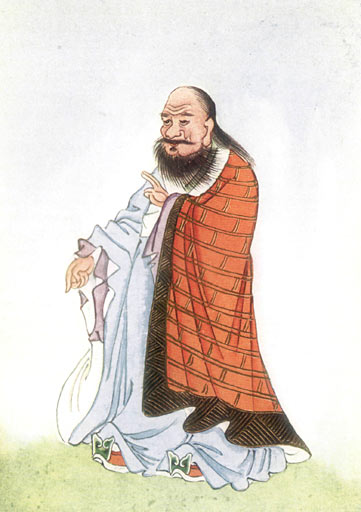
“On Laozi” by Bai Juyi [w/ Audio]

"The ignorant speak, while the wise keep silent."
I read the words of Laozi.
But if Laozi knew the Way,
Why did he write those five thousand characters?

BOOK: Caged by Brandon Dean Lamson

Caged: A Teacher's Journey Through Rikers, or How I Beheaded the MinotaurCaged: A Teacher’s Journey Through Rikers, or How I Beheaded the Minotaur by Brandon Dean Lamson
My rating: 5 of 5 stars

Amazon.in Page

In Caged, Brandon Dean Lamson tells the story of his time teaching inmates on Rikers Island, finding himself in conflict both with students and with the guards. There is definitely a unique culture to the world of incarceration. I found myself thinking about the Stanford Prison Experiments in which ordinary people were randomly assigned to play either inmate or guard. The subjects’ behavior changed during the short period of the experiment, guards becoming more domineering and sadistic and inmates becoming more scheming and duplicitous than these people were in their regular lives. One sees evidence of this strange power dynamic and the resulting unusual behavior throughout the book. Lamson and the other teachers and staff involved with the school often saw the guards as vicious fascists, but – at the same time — they couldn’t trust the prisoners because learning was never an inmate’s top priority but rather was a combination of survival and maintenance of status.

As interesting as the story inside the wire is, it’s equally fascinating to learn what happens with Lamson outside his workday. The author is forthright about changes in his own psychology as he developed a need to work out his own violent tendencies as well as uncharacteristic sexual behavior. Lamson describes time spent in a boxing gym and S&M dungeon in service of these changes.

The book also offers some insight into what teaching methods worked or didn’t. Some of this pedagogical insight might be exclusively applicable to jails and prisons, but some would likely be of use to regular teachers, particularly in dealing with troubled or challenging kids. Lamson is also forthright about his own teaching missteps and failures, while offering the reader insight to what he learned from those teachers who seemed to be unusually effective.

I found this to be a fascinating book. It’s well-written and thought-provoking. I’d highly recommend it for readers of nonfiction.


View all my reviews

PROMPT: Teachers

What makes a teacher great?

If a student (or students) voluntarily and enthusiastically come to learn from an individual, that individual is a great teacher.

The emphasis is on “to learn” because some people confuse great charisma with great pedagogy, but such people go to the charismatic person to take comfort from being in that person’s presence, not to learn — despite whatever truisms or clever-sounding parallel grammatical structures the charismatic individual might spout.

So, if one would go to an individual seeking knowledge, knowing the experience will be challenging and not merely comforting, one has found a great teacher.

BOOK REVIEW: Teaching Artfully by Meghan Parker

Teaching ArtfullyTeaching Artfully by Meghan Parker
My rating: 5 of 5 stars

Amazon.in page

Out: May 4, 2021 in India (It may be out already where you live.)


While I’m not an art teacher and this book is clearly directed at art teachers, I took away a number of useful lessons nevertheless. The book is laid out as a comic book, and is meant to extol the virtues of that artform while at the same time conveying knowledge about art, teaching, and the teaching of art.

The book is organized into seven chapters that are loosely themed according to the seven elements of art: line, color, form, texture, shape, space, and value [in the sense of the level of lightness / darkness.] The connection between the artistic characteristic and what is conveyed in its chapter is more readily apparent for some chapters than for others.

Chapter one (Line) both presents how the book came to be and what the intention behind it is, and also has something to say about process. The second chapter is entitled “Color,” and it touches upon issues such as the nature of aesthetics, the value of the notion of embodiment to the artistic endeavor, and the role of imagination. Chapter three is “Form” and it explores how time, space, and story play into conveying knowledge, as well as offering insight into how form influences perception. The next chapter is “Texture, and it has a lot to do with interaction and human relationships as they pertain to the art classroom. “Shape” investigates the issue of boundaries, such as what really differentiates artist from non-artist, the grammar of comics, and the role of the teacher. It also presents a number projects that might be introduced in the classroom or in one’s self-study. “Space” is probably the most literal title as it discusses the classroom space as well as the more figurative space given to students. The final chapter (Value) has a lot to say about frames of reference and the analogy of painting frames to the frames that individuals operate in and see the world through.

There is a Conclusion that provides some summation of ideas, and there are also notes and a page of references. This book shined a spotlight on a few other books that intrigue me, but that would have been completely outside my awareness — given I don’t read much about the visual arts, but I’m increasingly finding it to be a topic of interest.

As I said, even though its outside my bailiwick, I took away some intriguing lessons from this book — particularly about how variations in the elements of art encourage different emotional and psychological responses. There are a few excellent quotes as well. These powerful lessons weren’t in every frame. A fair amount of space is devoted to both platitudes and [hopefully] cathartic rants about the challenge of being a teacher, and particularly a teacher of art.

The book is festively drawn and colored and (as befits a book focusing on the visual arts) I got even more out of how ideas were portrayed visually than how they were discussed textually. The book takes a light and whimsical approach, and is pretty to look at.

If you’re interested in learning more about the visual arts, I’d highly recommend picking this book up.

View all my reviews

BOOK REVIEW: Up the Down Staircase by Bel Kaufman

Up the Down StaircaseUp the Down Staircase by Bel Kaufman
My rating: 5 of 5 stars

Amazon page


This is a humorous novel about a rookie teacher’s first year in a New York City public school with all the frustrations and victories that experience entails. It’s an epistolary novel – meaning it’s conveyed through a series of documents. Some of the humor is of a “kids say the darndest things” nature – though these are high school students, so the humor isn’t so much born of naiveté as it is a combination of teenage snarkiness and a maddening ignorance of concepts that students should have grasped by that age (i.e. laugh so you don’t cry style humor.) The humor from kids is largely conveyed by students’ comments in the teacher’s comment box as well as via homework assignments.

There’s a second kind of humor in the form of bureaucratic absurdism. Bureaucratic wrangling and lack of resources cause most of the protagonist’s frustrations. This humor is largely conveyed through memos – some school-wide and some specifically to the protagonist, Sylvia Barrett. Barrett also commiserates with her co-workers, and we see some of her frustration playing out through the post-it note equivalent of water-cooler conversations.

The epistolary form offers a challenging format for both character development and story presentation. However, the novel is strong on character development. It achieves this in large part by mixing long-form letters to a close friend with the short memos and comment box entries. The reader gets to see events unfold and responses by way of different documents. The longer letters give us some depth of feeling. There is even a point where Barrett is being swamped by correspondence and we hear nothing back from her, and in this we can feel the degree to which she is overwhelmed.

The book isn’t story-centric. However, there is a narrative arc that revolves around the question of whether Barrett will stay on at the public high school or move on to teach at a liberal arts college. She is torn because she feels she can do good at the public high school and that would be satisfying, but at the same time she is bureaucratically frustrated and demoralized by perceived failures. There are dramatic events here and there to elevate the tension from the run-of-the-mill school events, but not so much that the book ever moves away from feeling like the real experience of a rookie teacher.

The book uses drawings here and there, usually presented as student doodles, to add to the humor.

I enjoyed this book, finding it to be both humorous and illuminating. I would highly recommend it for those interested in the challenges of secondary education or who can appreciate the [bittersweet] humor of it.

View all my reviews

5 Lessons One Learns Teaching Kids Yoga

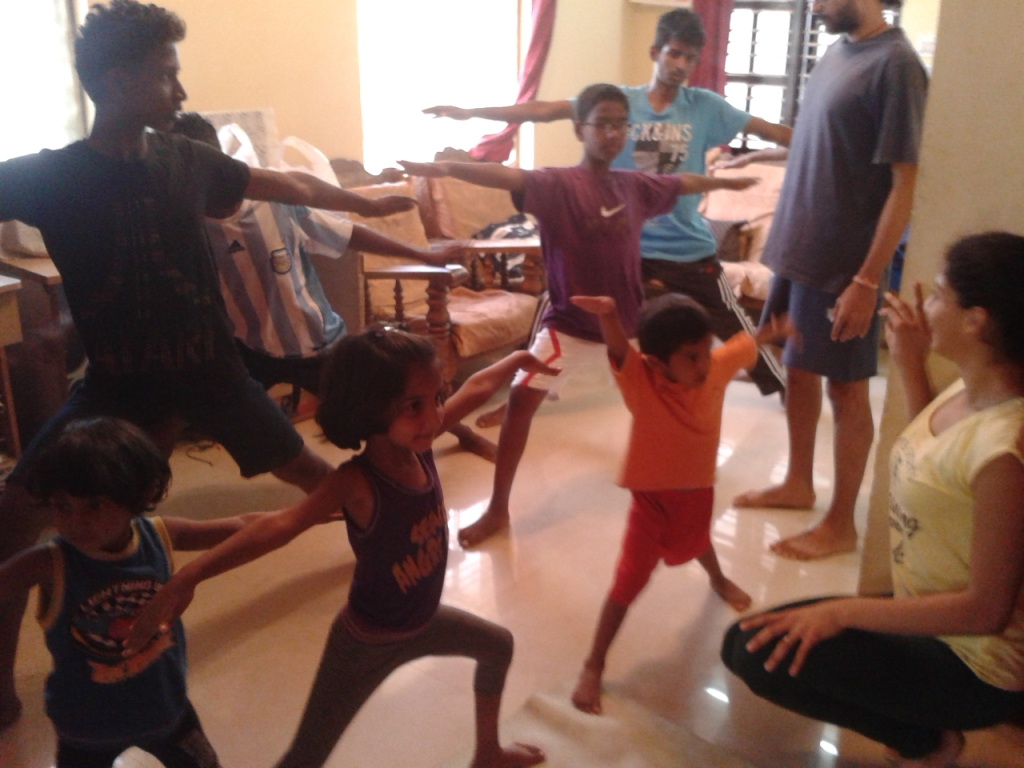
During the last half of April, I taught a kid’s camp at a1000 yoga‘s Kormangala studio. Below are some ideas about my experience.

Playful Scorpion

The Playful Scorpion

1.) Kids can’t down shift from 4th to 1st like adults. This was once a major point of frustration for me in teaching kids. When you ask kids to settle down after an activity they were really excited about, there’ll be a lag. There’s a temptation to see this unresponsiveness as a lack of respect, but it probably isn’t. (Which isn’t to say that the kiddies never attempt to test the waters.) The fact is that adults don’t get so amped up, and so it’s not so difficult for them settle down. Instead of getting frustrated with the kids, maybe one should feel sorry for the adults.


2.) Kids need a more advanced class, but not because they’re more advanced. Attention to detail isn’t a child’s strong suit. They have difficulty focusing on the finer points of alignment and breath–unless they’ve found a fun challenge in the pose. During the camp, we played with vrschikasana (scorpion pose) during the first few days. That’s not something I would do with adults. Kids get in the zone and, therefore, they don’t tense up and injure themselves so easily.


3.) Kids are natural flow hackers. If you don’t know what “flow” is, I’d recommend Mihaly Csikszentmihalyi’s book Flow, Steven Kotler’s The Rise of Superman, or Marer / Buzady / Vecsey’s Missing Link Discovered. (Depending upon your point of interest: psychology, athletics, or business, respectively.)  However, in a nutshell, flow is the state of mind in which we perform at our best because of a combination of concentration and the quieting of one’s inner critic. One of the keys to catching the flow is finding a challenge of the appropriate level. The challenge should be just beyond one’s current capability. If it’s too easy, one gets bored. If it’s too difficult, one gets frustrated. Children instinctively seek out the Goldilocks’s zone in challenges.

I noticed this when we were playing a game in which each kid had to cross the floor walking only on wooden yoga blocks. This helps with balance, which tends to be a weakness among kids. Every time all the kids have finished crossing, a block or two is removed. So, the game gets harder the longer it goes on. The position of the remaining blocks can be adjusted, and, after a while, the kids wanted to adjust the blocks themselves because I was making it too easy. In other words, they wanted to make gaps that they would have to stretch to their utmost to succeed.


4.) Don’t assume that kids experience fear the same way you do. I suspect there may be some readers who will say, “that guy had kids doing scorpion on their second day of yoga, he must be a complete lunatic.” But, adults superimpose their fears on children. Kids’ excitement more easily overcomes their anxieties. In my last post on yoga, I referred to a FaceBook meme that I saw recently that said, “A child who falls down 50 times learning to walk, never says, ‘I don’t think this is for me.'” Somewhere along the line, people become mortified of failure or the risk of a bruise, but it’s not in childhood.

Have you ever seen a child fall down and start to get up–everything apparently fine–until he or she sees the gasp from mom (or another adult,) and then the child bursts into tears? If you’re the adult in the aforementioned scenario, let me suggest that teaching kids physical activities isn’t yet for you–at least not until you can manage your own anxiety a bit better. That’s not to say that there’s anything wrong with such people, but a teacher’s job is to show the child a world of possibilities and not to infect them with his or her own limitations.


5.) Finding the balance between inner child and outer adult can be a challenge, but is necessary. My working theory is that kids don’t trust an adult whose inner child doesn’t show through at least a little bit. Kid’s yoga is typically taught differently from the adult version. When teaching adults, one doesn’t practice alongside the students, but that’s the norm in teaching kids. (Kids can mimic better than they can follow complex verbal instructions.) The kids enjoy having the teacher participate, but one must also ensure that it remains clear who is the teacher. Otherwise, kids may be confused. When you’ve been participating in practice, playing games, and letting the children have some say in what they do (which is also a sound practice to some degree) they may gradually start to forget about your role as authority figure.

9 Lessons Learned During Children’s Yoga Teacher Training

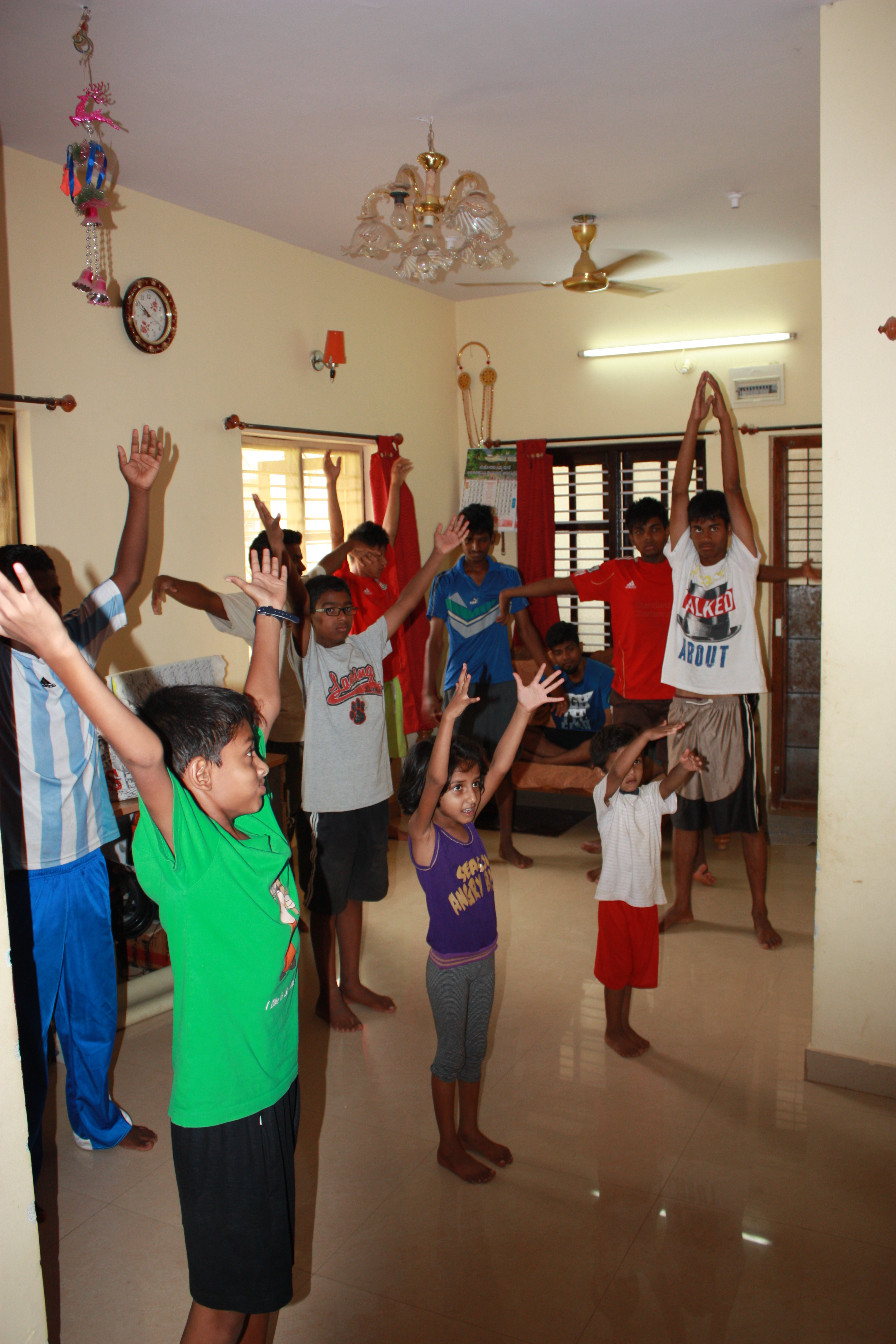
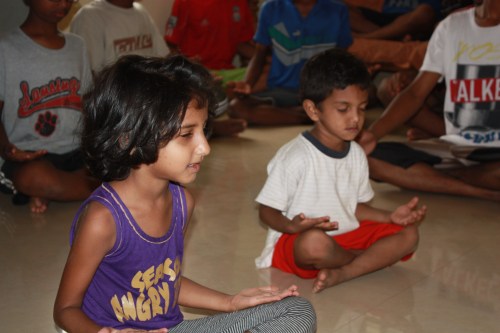
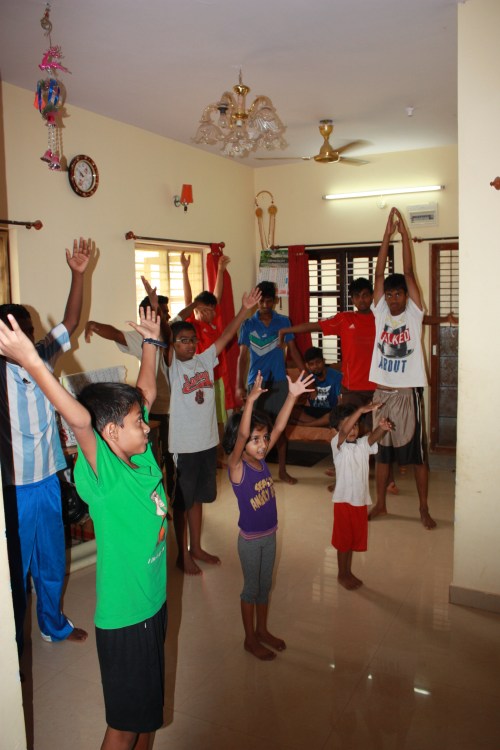
I recently finished the course requirements for Registered Children’s Yoga Teacher (RCYT) training at a1000 Yoga in Bangalore. (As of this writing, I still have a kid-specific teaching requirement to meet before I can add this to my Yoga Alliance certification portfolio.)  When I did my seva (charitable teaching) requirement for RYT-200 at an orphanage, I discovered that teaching kids was a different monster. That’s what led me to take up this specialization, and I thought I’d share some of what I learned.

IMG_1580

1. Eight is [soon] enough:  The traditional age for introducing children to a practice of yoga is eight. This doesn’t mean that kids aren’t taught postures (asana) or other yogic techniques earlier, but for younger kids it’s typically done as play. Traditionally, surya namaskara (sun salutation), nadi shodhana (alternate nostril breathing), and Gayatri mantra (a particular chant) serve as the core of the child’s practice.

Why eight? It has to do with a number of physical and mental development factors including lung development, the state of the pineal gland, and the arrival of abstract reasoning capacity.
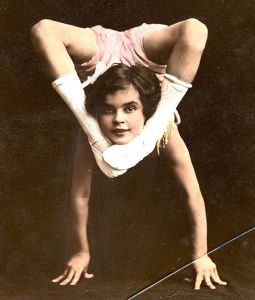
Kids_contortionism2.) There are no youth-related contraindicated postures: I expected to spend a fair amount of the course learning what postures one shouldn’t teach children and why. However, instead we were told that kids could be exposed to any Hatha yoga postures.

Of course, this is predicated on: a.) the fact that one is dealing with a child eight and up; b.) one recognizes that the strengths and weaknesses of children will need to be taken into account and modifications or capacity building may be necessary in some cases. (For example, the flexibility of kids may allow them to achieve postures that few adults can, but at the same time their lack of strength and balance may be limiting factors for some postures.); c.) obviously, one needs to take into account that kids may have contraindicated conditions that aren’t age-related but are due to their particular physical condition.

It should also be noted that children are typically not taught breath retention (khumbaka) as part of their (breath exercise) practice. So it’s not true to say that there are no contraindicated practices.

3.) In stillness, your results may vary: One of the nice things about a yoga practice for kids is that it acknowledges that most kids, by nature, don’t want to be still. As opposed to mainstream education, which attempts to force stillness upon them, yoga offers a mixture of activity and stillness. However, it was interesting to see the range of abilities to remain motionless during yoganidra (“yoga sleep,” i.e. a hypnogogic state) practice. There is, of course, an age component to this. That is, young kids have a harder time staying still than older kids. However, that isn’t all there is to it. A few of the older kids couldn’t stay still in savasana (corpse pose) for five seconds, but a few of the young seemed able to be still for as long as required–not necessarily awake, but still.

the exception

the exception

4.) Balance isn’t in a child’s wheelhouse:  I knew that strength was ill-developed in prepubescent children, but I didn’t realize how challenging kids would find even simple balance postures. They’re a little like drunks in this regard.

Obviously, kids tend to be freakishly bendy, and so it’s not a surprise that most of them could learn to do chakrasana (wheel pose, i.e. a full back bridge) from a standing position in short order. In fact, the challenge for those who had one was more likely to be confidence with not falling on one’s head than with a lack of back-bending flexibility.

The moral of the story is that one must recognize that children are a little like senior citizens in this one domain. That is, consideration must be given to the risk that they will fall down during balancing poses. Unlike seniors, they don’t have too far to fall, and they’ll heal lickety-split if they do, but–still–they’ll fall like a drunken sailor.

5.) Teaching kids’ partner yoga requires a different approach:  The usual advice is that one should teach kids from “inside the circle.” That is, one shouldn’t set oneself off at the head of a class like one would usually do with an adult class. One sits with with the kids and does the class with them. (You probably won’t be doing 6 classes a day that way.)

I had the opportunity to teach a pairs yoga class and found that an entirely different approach was needed. First let me say that pairs (partner) yoga is a great approach for teaching kids. Many kids will enjoy the interaction, and they can learn about teamwork and (in some cases) take advantage of the stabilization of additional limbs / grounded surface area. However, because it requires so much attention to be focused on the partner, it’s best not to teach it from inside the circle. One won’t necessarily be able to see what one’s students are doing, and that can be dangerous.

6.) There’s a yoga for special needs children: Among our guest speakers, we had a yoga teacher from Prafull Oorja, which is an organization that teaches special needs children using yoga, dance, and various other methods. These approaches are used to increase bodily awareness, which is a common problem across many different afflictions. We learned about the range of challenges faced by such children and how the usual approach is varied to adapt to their needs.


The course included information about several non-yogic methods that could be used to complement yoga practice to achieve the objectives of a yoga course. I write this by way of explanation as to why the last few lessons seem to have little to do with yoga.


7.) Stories must be physical, animated, and repetitive for small kids:  These features serve to help adjust to the child’s limited vocabulary, while helping them to build vocabulary. We had a speaker from Kathalaya (House of Stories) who offered a great deal of insight into story-telling for kids.

Lest one think that story-telling is just filler in the yoga context, I’ve been learning a great deal about how our minds need stories, and am inclined to believe that one’s insight into the mind will be limited if one doesn’t understand story and why stories appeal to our minds. I recommend the book Wired for Story by Lisa Cron.

8.) Games used in theater can go hand-in-hand with yoga practice:  I was completely new to the idea of theater games before this course, but we had someone teach us a number of these games, and the logic behind building our own. Games which aren’t too cerebral can go help build some of the same skills that are sought in a course of yoga. Such games include practices that help develop one’s voice and physical expressiveness. These games can also help bring some kids out of their shells so that they are more ready to actively participate in a yoga class.

9.) We need mental hygiene as much as dental hygiene: This actually comes from a quote by Sir Bat Khalsa, a Harvard Neurologist who studies the effects of yoga. When I was doing research for my final presentation, I ran across said quote, which goes:

“There’s no preventive maintenance. We know how to prevent cavities. But we don’t teach children how to be resilient, how to cope with stress on a daily basis… We’ve done dental hygiene but not mental hygiene.”
IMG_1582