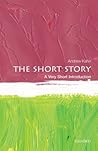
BOOK: “The Short Story: A Very Short Introduction” by Andrew Kahn

The Short Story: A Very Short Introduction (Very Short Introductions)The Short Story: A Very Short Introduction by Andrew Kahn
My rating: 4 of 5 stars

Publisher Site – OUP

This guide provides an overview of the short story, particularly literary short stories (though it’s not without mention of genre fiction.) The book is well organized and offers some fascinating food for thought, particularly regarding the psychology of character and the distinctions between short stories and novels. (The former are not to be thought of as pared down versions of the latter.)

I will say that, for a concise introduction, the book does occasionally get into the weeds on specific issues, potentially losing the non-specialist reader who this series is ostensibly geared toward.

I found the book’s organization to be logical and productive to its task. After an introduction that explores the advent and history of the short story, most of the chapters deal with structural or compositional aspects of story, including: openings, voice, setting, plot, irony / reversal, and endings. One chapter (Ch. 6) stands out as a bit different in that it zooms in on Chekhov and his influence on the short story as we’ve come to know it. While this could be said to demonstrate the author’s tendency to zoom in the specificity more than is usual for such a guide, I did find the chapter interesting and enlightening.

If one is interested in the short story (as a reader, writer, or both) one will find this guide worth one’s attention.

View all my reviews

PROMPT: Screentime

How do you manage screen time for yourself?

Many ways, really: e.g. Go for a walk or otherwise move. Forget it exists. When the WiFi goes down, take it as a sign from the universe. Juggle. Do something productive.

PROMPT: Hobby or Pastime

Daily writing prompt
What is your favorite hobby or pastime?

I don’t collect favorites. I like reading, hiking, writing, swimming, playing, exercise, traveling, cooking… each in its due time for its due time.

PROMPT: Relax

Daily writing prompt
How do you relax?

I usually don’t find it too difficult. I find reading and free writing conducive to relaxation. In cases in which I’m wound up, I move and / or exercise intensely. If I ever need to achieve relaxation expeditiously, I use Visama Vritti Pranayama or PMR (progressive muscle relaxation.)

PROMPT: Blog – Change

Daily writing prompt
What change, big or small, would you like your blog to make in the world?

If I’m being entirely honest, everything that’s come out of this enterprise has been of selfish motive — even those activities that seem like they have broader purpose. For example, I started book reviewing because: a.) I found it disheartening how many books I read that I had virtually no recollection of a couple years down the line, and b.) because, while I felt I knew good writing when I read it, I couldn’t really say what it was that made it good or bad without taking a more analytical look into the matter. (And I was pretty sure good writing wouldn’t come to me osmotically — merely by reading good writing — if I didn’t understand why it was good writing.)

I started recording classic poems to get a better sense of the sound quality of well-crafted poetry (and to become more comfortable with the sound of my own voice.)

I guess the honest answer is that I hope to be smarter and more capable as a result of the practice. It is continuing education, a fostering of the Beginner’s Mind.

PROMPT: Lose Track of Time

Daily writing prompt
Which activities make you lose track of time?

Reading, thinking, and learning.

BOOKS: “Hōjōki” by Kamo no Chōmei; Trans. by Matthew Stavros

Hojoki: A Buddhist Reflection on Solitude: Imperfection and Transcendence - Bilingual English and Japanese Texts with Free Online Audio RecordingsHojoki: A Buddhist Reflection on Solitude: Imperfection and Transcendence – Bilingual English and Japanese Texts with Free Online Audio Recordings by Kamo no Chōmei
My rating: 5 of 5 stars

Amazon.in Page

Release Date: May 7, 2024 [for Tuttle’s bilingual edition]

This is the Japanese Walden, except that it was written several hundred years before Thoreau’s essay and was predominantly philosophically informed by Buddhism rather than Transcendentalism. (Though those philosophical systems do agree on a number of points, most relevantly that materialism is not a sound route to happiness.) Like Walden, Hōjōki is an autobiographical promotion of the hermitic lifestyle. Both works sing the virtues of life in a simple, rustic cabin in a natural setting, a life of minimalism and subsistence living.

There are many translations of this work available, and so I’ll spend the remainder of this review on what differentiates this edition from the two others that I’ve read. First and foremost, the other versions I’m familiar with were presented as prose essays. This edition is presented in verse, which I understand to be the form that the original Japanese work employed. I should say that in some places the work comes across as poetic in the conventional sense, though in others it seems like a versified essay.

Secondly, this edition has a few handy ancillary features. One is that it is bilingual. Romanized Japanese allows the reader to experience the sound quality of the original. This edition also has graphics in the form of maps, artwork, and photographs. Some of the graphics support or expand upon the information delivery while others seem to be more a matter of creating atmospherics. Also, there are explanatory endnotes that help readers unacquainted with Kamakura Period Japan to understand some of the book’s references that might otherwise remain unclear.

I enjoyed and benefited from reading this edition, even having read others. If you are looking for insight into the ascetic life, I’d highly recommend it.

View all my reviews

PROMPT: Books

Bloganuary writing prompt
What books do you want to read?

I’d love to read all the good ones, but even with my voracious approach to reading I barely make a dent.

Here’s the top of the list of books I’m excited about right at the moment, by category:

Travel lit related to an impending trip to the Caucasus region: “A Man Was Going Down the Road” by Otar Chiladze; “Ali and Nino” by Kurban Said; “The Burning Tigris” by Peter Balakian; and “Kvachi” by Mikheil Javakhishvili.

Related to a Chinese literature (in translation) kick that I’m on: “The Romance of the Three Kingdoms” Luo Guanzhong; “Strange Tales from a Chinese Studio” by Pu Songling; “In the Thick Woods a Deer Is Seen at Times” and “A Pair of Swallows Fly” [The latter two are bilingual poetry translations of works from the Tang Dynasty and the Book of Poetry, respectively.]

Books and editions coming out this year: “Judo Unleashed” by Neil Ohlenkamp; a new verse translation of Kamo no Chomei’s “Hojoki” translated by Matthew Stavros; “Nuclear War” by Annie Jacobsen; and a new translation of Natsumi Soseki’s “Kokoro.”

Related to things I’m working on presently: “Thinking, Fast and Slow” Daniel Kahneman; “Blink” by Malcolm Gladwell; “Gut Feelings” by Gerd Gigerenzer; and “The Meaning of Travel” by Emily Thomas.

Long overdue: “Metamorphoses” by Ovid; “The Decameron” by Giovanni Boccaccio, and I should probably finish Joyce’s “Ulysses”

Odds and Ends: “Rental Person Who Does Nothing” by Shoji Morimoto; “Is This Anything?” by Jerry Seinfeld; “Sick in the Head” by Judd Apatow.

Are you sorry you asked yet?

PROMPT: Fun

Bloganuary writing prompt
List five things you do for fun.

1.) Read; 2.) Move; 3.) Juggle; 4.) Hike; 5.) Breathe