BOOKS: “A Man Was Going Down the Road” by Otar Chiladze

A Man Was Going Down the RoadA Man Was Going Down the Road by Otar Chiladze
My rating: 5 of 5 stars

Publisher Site

This is the English translation of a novel considered to be one of the most important literary works of Georgia (i.e. the country, not the state) in the twentieth century. The multigenerational tale adapts from Greek Mythology, most notably the story of Jason and the Golden Fleece and Daedalus and Icarus (the former taking place early in the book and the latter towards the end.)

Given its pacing, multigenerational sprawl, and the rambling ordinary life interactions between big events, this book isn’t of the highest readability, but that has its benefits. Supposedly, the author was taking digs at the Soviets and their invasions and operations in Georgia, but – apparently – the Soviet censors never made the connection due to the abstruse nature of the story. Otherwise, we might not have this book to read, today.

Regardless of my comments about readability, the book does have a number of positive things going for it. I found the translation to have some beautiful stretches of language. There was an opening paragraph of one of the latter chapters that floored me. Also, it’s not all soap opera, the more intensely plot-driven bits are compelling, most notably the Golden Fleece story.

I’d highly recommend this book for readers who don’t mind the challenge of literary fiction pacing and everyday minutiae.

View all my reviews

“Lethe” by Walter de la Mare [w/ Audio]

Only the Blessed of Lethe's dews
May stoop to drink. And yet,
Were their Elysium mine to lose,
Could I, sans all repining, choose
Life's sorrows to forget?

“Ultima Thule: Dedication to G. W. G.” by Henry Wadsworth Longfellow [w/ Audio]

With favoring winds, o'er sunlit seas,
We sailed for the Hesperides,
The land where golden apples grow;
But that, ah! that was long ago.

How far, since then, the ocean streams
Have swept us from that land of dreams,
That land of fiction and of truth,
The lost Atlantis of our youth!

Whither, ah, whither? Are not these
The tempest-haunted Orcades,
Where sea-gulls scream, and breakers roar,
And wreck and sea-weed line the shore?

Ultima Thule! Utmost Isle!
Here in thy harbors for a while
We lower our sails; a while we rest
From the unending, endless quest.

“To Helen” by Edgar Allan Poe [w/ Audio]

Helen, thy beauty is to me
Like those Nicéan barks of yore,
That gently, o'er a perfumed sea,
The weary, way-worn wanderer bore
To his own native shore.

On desperate seas long wont to roam,
Thy hyacinth hair, thy classic face,
Thy Naiad airs have brought me home
To the glory that was Greece,
And the grandeur that was Rome.

Lo! in yon brilliant window-niche
How statue-like I see thee stand,
The agate lamp within thy hand!
Ah, Psyche, from the regions which
Are Holy-Land!

“Leda and the Swan” by William Butler Yeats [w/ Audio]

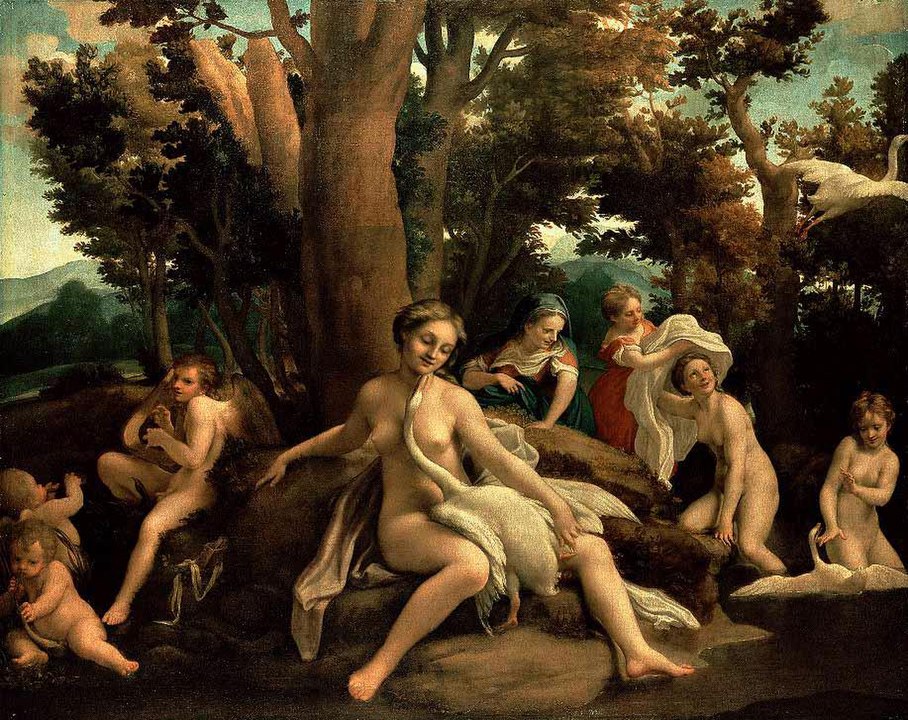
Correggio’s Leda and the Swan (1532)
A sudden blow: the great wings beating still
Above the staggering girl, her thighs caressed
By the dark webs, her nape caught in his bill,
He holds her helpless breast upon his breast.

How can those terrified vague fingers push
The feathered glory from her loosening thighs?
And how can body, laid in that white rush,
But feel the strange heart beating where it lies?

A shudder in the loins engenders there
The broken wall, the burning roof and tower
And Agamemnon dead.
Being so caught up,
So mastered by the brute blood of the air,
Did she put on his knowledge with his power
Before the indifferent beak could let her drop?

BOOKS: “Mythos: The Illustrated Edition” by Stephen Fry

Mythos: The Illustrated Edition: The Illustrated Edition (Stephen Fry's Greek Myths)Mythos: The Illustrated Edition: The Illustrated Edition by Stephen Fry
My rating: 5 of 5 stars

Publisher Site

This book offers a humorous telling of many stories from Greek Mythology. One gets the well-known tales such as Prometheus, Sisyphus, and Pandora, but also the myths involving a number of lesser-known characters: god, demi-god, and mortal. As these myths are being told, there is also a substantial amount of nonfiction information presented by footnotes and such — e.g. how later authors (Shakespeare, for example) presented these myths or tales built upon them, how the myths inform popular culture and language to this day, and how Greek and Roman mythology related.

The art is nice, though I can’t say that it added much to the reading experience for me, personally. The art is done in a consistent style throughout and is colorful and visually interesting, though I couldn’t say much else about it in an intelligent fashion. It somewhat reminded me of William Blake’s art and somewhat of Soviet posters.

I enjoyed this book. It is light-hearted and even humorous without detracting from the tone of the myth and is a highly readable way to learn more about Greek Mythology.

View all my reviews

BOOK REVIEW: The Translations of Seamus Heaney by various [Trans. by Seamus Heaney / Ed. by Marco Sonzogi]

The Translations of Seamus HeaneyThe Translations of Seamus Heaney by Seamus Heaney
My rating: 5 of 5 stars

Amazon.in Page

Release Date: March 21, 2023 [for the reviewed edition]

I’d read Heaney’s approachable yet linguistically elegant translation of Beowulf long ago, and was excited to see this collection of his translations coming out. The one hundred pieces gathered make for a diverse work, from single stanza poems to epic narratives and timed from Ancient Greece through modernity. The pieces include works from well-known poets such as Baudelaire, Cavafy, Dante, Brodsky, Horace, Sophocles, Ovid, Pushkin, Rilke, and Virgil. But most readers will find new loves among the many poets who aren’t as well-known in the English-reading world, including Irish and Old English poets. I was floored by the pieces by Ana Blandiana, a prolific Romanian poet who’s a household name in Bucharest, though not so well-known beyond.

I’d highly recommend this anthology for poetry readers. Besides gorgeous and clever use of language, the power of story wasn’t lost on Heaney and his tellings of Antigone (titled herein as “The Burial at Thebes,) Beowulf, Philoctetes (titled “The Cure at Troy,”) and others are gripping and well-told.


View all my reviews

BOOK REVIEW: Classical Mythology: A Very Short Introduction by Helen Morales

Classical Mythology: A Very Short IntroductionClassical Mythology: A Very Short Introduction by Helen Morales
My rating: 5 of 5 stars

Amazon.in Page

Get Speechify to make any book an audiobook

This book examines the mythology of ancient Greece and Rome, reflects upon how these myths have come to be understood and used in the modern world, and proposes how these understandings may represent partial or incorrect views – in some cases. This approach can be seen from the book’s opening chapter, which investigates how Europa (a figure primarily known for being raped by Zeus) came to be namesake of the continent where classical mythology developed. In later chapters, there’s an exploration of how partial or erroneous understandings of Classical Mythology have been applied to psychoanalysis (ch. 5,) sexuality (ch. 6,) and New Age practices such as astrology and goddess worship (ch. 7.)

I learned a great deal from this book. I particularly enjoyed the discussion about what might have been if Freud had picked a different mythological figure to fixate on, other than Oedipus. How the famed psychiatrist might have extracted lessons that better stood the test of time than those that came about in reality.

While there’s not a great deal of room in a book such as this to explore the full scope of classical myths, the author does use a variety of myths – often well-known stories that don’t require a great deal of backstory – to make the book interesting and thought-provoking.

If you’re looking for a book on Classical Mythology, particularly one that discusses how it (for good or ill) appears in today’s world, I’d highly recommend this brief guide.

View all my reviews
Victory Mythologized [Free Verse]

victory in the palm of the hand
(specifically, 
the winged, laurel-bearing Nike --
goddess who personifies victory)

it's a bit on the nose
as is the bent front leg
as if standing on the chest 
of a vanquished foe

as is the looming,
nothing says victory
like looming
(unless you're a weaver) 

but victory is never so 
unambiguously glorious
as it's mythologized

Helen of Troy [Limerick]

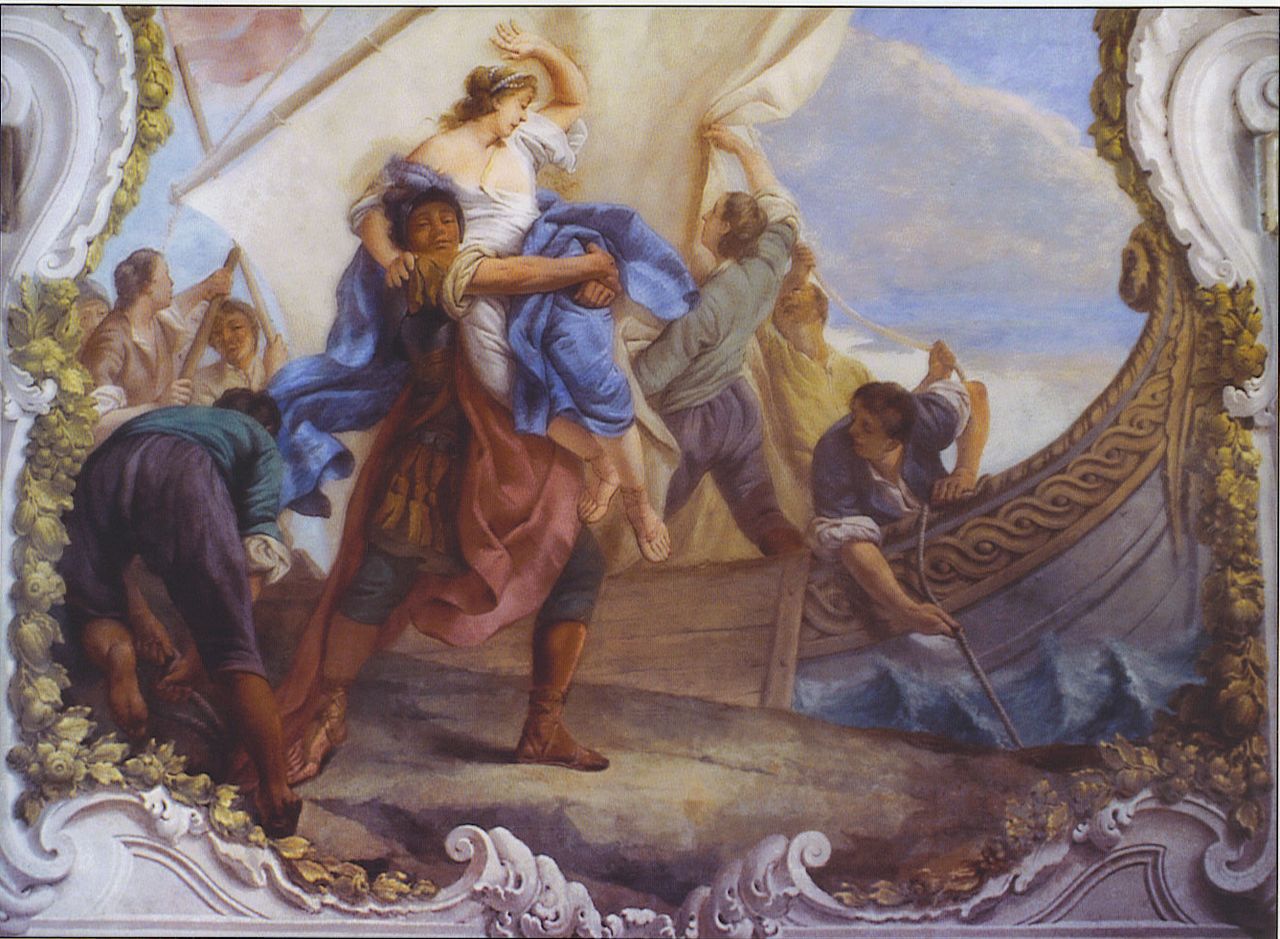
Abduction of Helen; (mid-18th cent. Venice)
There was pretty lady named Helen
whose beauty had all the boys yellin'.
No arrows from Cupid;
her glance made 'em stupid.
But did her face split a thousand melons?