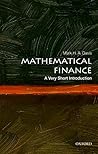
BOOK: “Mathematical Finance: A Very Short Introduction” by Mark H. A. Davis

Mathematical Finance: A Very Short Introduction (Very Short Introductions)Mathematical Finance: A Very Short Introduction by Mark H.A. Davis
My rating: 4 of 5 stars

Publisher Site – OUP

This is Oxford University Press’s Very Short Introduction to the field of the “Quants,” individuals who apply mathematics to questions of how to value financial assets and assess risks. The book begins by laying out how banking and financial markets work, then discusses how interest rates are determined, and then explores the quantification of various risks faced by lenders. The book finishes by discussing how the 2008 financial crisis impacted the field and how it operates in the wake of that event. (The 2008 crisis was described in an intriguing fashion in the book and movie The Big Short. It basically resulted from deceptive grading of mortgage-backed securities such that investors who thought they had the ultimate default-proof asset in fact had assets that not only could collapse, but — in fact — were bound to.)

Even though this book is a concise introduction, it shouldn’t be confused for a simple guide. It is not only mathematically intense but also jargon dense. It’s not a complete waste for someone without any advanced mathematics and / or economics / finance background to read, but there will be large patches that will likely be lost on one. (And if you’re not at all used to reading scholarly writing, it may be excessively daunting.)

If you want a quick guide to the field of quantitative finance, and you have an understanding of the mathematical notation used in calculus and statistics, I’d recommend this book. If you are interested in the topic but aren’t at all mathematical, you might start elsewhere (the aforementioned, The Big Short, might be a good place.)

View all my reviews

PROMPT: Live Anywhere

Daily writing prompt
If you could live anywhere in the world, where would it be?

Someplace inexpensive, with beaches and hikeable hilly / mountainous terrain within a reasonable distance, and where beer prices are not disproportionately high vis-a-vis the general cost of living. FYI — I call the latter the “stick-up-the-bum” index because if beer prices are relatively high, it usually means they are heavily sin-taxed (it’s not an expensive product to make,) and so disproportionately high beer prices suggest the society is trying to micromanage personal behavior. I may or may not want a beer (I’ll want one,) but I prefer to live in a society with a live-and-let-live mentality. Candidates exist in Southeast Asia, Latin America, and the Central Asia / Caucus region.

PROMPT: Personal Item

Daily writing prompt
Name the most expensive personal item you’ve ever purchased (not your home or car).

I think it was a sword, back in the days when swordsmanship was among the subjects i studied. But I can say, with some measure of pride, that I really don’t know for sure because I don’t really put much value in owning things and have become ever less interested in possessing more stuff.

When you’re a traveler, they’re all just anchors, and not goods.

Anything expensive I buy better be absolutely essential, have multiple uses, or —ideally— both.

PROMPT: Podcasts

Daily writing prompt
What podcasts are you listening to?

I don’t properly listen to any, but I watch clips and segments from many on YouTube — mostly those of comedians, but some of a popular science or current events / international affairs / macroeconomic nature.

PROMPT: Brands

Daily writing prompt
What brands do you associate with?

Unless and until they cut me a check, I have no “association” with any brand.

I believe loyalty to friend, family, and nation can all be great virtues, but loyalty to a corporation is just silly. (They certainly won’t be loyal to you when it conflicts with what is best for the profit margin.)

ZAMBIA LIMERICK

PROMPT: Excited

Daily writing prompt
What are you most excited about for the future?

I think humanity has a golden age coming. Unfortunately, a.) as John Maynard Keynes pointed out, “In the long run, we are all dead.” Accordingly, I don’t expect I’ll live to see that great age. And, b.) said great age is likely to come on the backend of a tragic period whose reach and devastation will make the Second World War seem like a puny and short-lived regional skirmish by comparison. [I also think there’s a good chance I’ll miss the worst of this, but there’s no accounting for the rapidity at which it might move (and the process has begun.)]

The root of this combination of relative near-term pessimism and long-run optimism is the observation that we are experiencing a technological revolution that there is no reason to believe won’t end in machines that are both smarter and more capable than we, and we have no plan for what to do in that scenario. We have no conception of what an economy looks like in which machines do everything faster, more cheaply, and more efficiently than human labor. I wouldn’t be so pessimistic if our institutions and legal frameworks were trending better and better, but — in fact — after years of spreading rule of law and democracy, we are starting to see global shrinkage and a rise of a strange populist authoritarianism that I can only imagine being catastrophic under the stress test that is to come.

Why the long-term optimism? Nothing lasts forever, and tough times breed tough and capable people. [Whereas comfort addiction is a major factor in our near-term predicament.] I think the Golden Age will be humans learning not to be defined by production / consumption but by developing the human body and mind to its utmost capacity.

A lot of people are worried about population collapse. I am not so worried about that. I think that: a.) humanity could use some thinning; b.) we do fine with long time scale threats. As pressures rise, the adjustments start and — perhaps with some growing pains — we’ll get where we need to be. The AI / Machine Learning revolution concerns me because I suspect it will happen too quickly to steer the ship (like being in an aircraft carrier as a tsunami comes, there’s no agility to navigate out of the way and no speed to outrun it, you just have to take the damage and try to recover.)

You were probably looking for an answer like flying cars, but I gave up on those long ago.

The End of the World as We Know It [Free Verse]

Humans have been hunters,
gatherers,
farmers,
machines,
thinkers,
and creators,

And have no idea what we'll next be.

I think that people will next be
-- simply --
Human Beings,
Full-time Human Beings --
More Human,
More Being...

And many will fail spectacularly.

PROMPT: Harmony

Daily writing prompt
What could you let go of, for the sake of harmony?
My wonkish need to analyze the train wreck that is our present state of governance and social discourse.

PROMPT: First Thing

Daily writing prompt
Jot down the first thing that comes to your mind.

We’re all screwed. Embrace the chaos or head for the hills.

There is a class of problems that brute force solutions, even when they nudge the needle in the desired direction, always end in devastation.

One can’t drive an aircraft carrier like a jet-ski and expect anything other than a bunch of drowned sailors and destroyed planes.

[Guess who’s been reading the news.]