BOOKS: “The Cultural Revolution: A Very Short Introduction” by Richard Curt Kraus

The Cultural Revolution: A Very Short IntroductionThe Cultural Revolution: A Very Short Introduction by Richard Curt Kraus
My rating: 4 of 5 stars

Publisher Site – OUP

The decade-long Cultural Revolution in China is generally looked upon as a bleak time and place to be alive. This brief guide reflects on the political, economic, and cultural dimensions of Mao’s attempt to root out capitalist and middle-class influence from Chinese society. The book also reflects upon other events in China during the period (e.g. detente) and how they related to the Cultural Revolution. It also explores how China came out of the Cultural Revolution.

The author makes efforts to be diplomatic and evenhanded about the event. Some readers will find this beneficial to their purposes and may even see the occasional glimmer of a bright side to a dismal period in human history. However, one should not expect to gain any visceral insight into the sadness and chaos of the era. While there was discussion of not only the end of the Cultural Revolution but what China’s continued path looked like, it didn’t get much into whether there was a long shadow to the revolution and what that shadow might look like.

I found the book informative though there were dimensions into which I would have liked to gain more insight (e.g. it doesn’t go much into the influence on religion, nor on more peripheral arts,) but that’s the challenge of such a concise guide. Also, the author is of a political science background, and this informs what elements are given more or less discussion.

View all my reviews

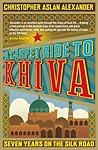
BOOKS: “A Carpet Ride to Khiva” by Christopher Aslan Alexander

A Carpet Ride to Khiva: Seven Years on the Silk RoadA Carpet Ride to Khiva: Seven Years on the Silk Road by Chris Aslan
My rating: 5 of 5 stars

Publisher Site – ICON Books

“Travel-centric memoir” is how I’d classify this book, but it’s one of those books that isn’t easily categorized. The author cleverly interweaves explorations of Uzbek history and culture with his own story of living in the Uzbek city of Khiva for seven years as an NGO worker and traditional crafts entrepreneur. The side voyages into history and culture not only support the readers’ contextual understanding of the author’s story but also make for a fascinating journey of understanding of the locale. Uzbekistan has had many lives, from beating heart of the Silk Road to forgotten backwater of the Soviet Union, and these many lives have shaped what Uzbekistan is, and what it’s becoming.

I should point out that Uzbekistan has apparently made a hard shift since the days described in this book (late 90’s early 2000’s, i.e. fairly early in the wake of independence from the Soviet Union.) I mention this to avoid discouraging travelers through discussion of the author’s experiences. [I, myself, am planning a trip in the near future.] I’m sure that Uzbekistan continues to have deep-seated problems, but it seems to be making great efforts to be tourist-friendly these days. Which is not to say that the individuals were ever unfriendly to travelers. The author describes an Uzbek people who are warm-hearted, welcoming, and helpful. But when the author was there it was also on the list of the biggest human rights violators, corruption was ubiquitous, and tourism was almost non-existent. In fact, the penultimate chapter of the book describes the author’s experience of a visa denied, ping-ponged deportations, and a life sharply diverted by corruption.

The final chapter is intensely compelling and describes the author’s (late 2000’s) visit to Afghanistan to help apply the lessons he learned in Uzbekistan to building a rug weaving operation in that war-torn country (allowing women to make some money, an activity disallowed by the Taliban before and since.)

This is a fascinating book, and I’d highly recommend it for travelers and those interested this lesser-known part of the world. Even the descriptions of silk production, rug weaving, and natural dyes (topics that I expected wouldn’t resonate with me) were interesting and engaging.

View all my reviews

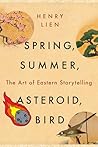
BOOK: “Spring, Summer, Asteroid, Bird” by Henry Lien

Spring, Summer, Asteroid, Bird: The Art of Eastern StorytellingSpring, Summer, Asteroid, Bird: The Art of Eastern Storytelling by Henry Lien
My rating: 4 of 5 stars

Publisher Site

I enjoyed, and was stimulated in thought, by the first half of this book, as well as by sections of the latter half, especially in the fourth chapter. (It’s arranged into four chapters, echoing the book’s central idea of a unique four-act approach to storytelling prevalent in Eastern societies. I’ll get to why I was not so fond of Ch. 3 later.) The book employs exemplary works of literature, film, and even video games to support the claim that there’s not just one approach to sound story crafting — but, rather, that Eastern societies developed distinct modes of storytelling reflecting their values and worldview. (A note on the use of the word “Eastern”: while the book draws heavily on East Asian sources, it tries to make a broader case suggesting not only South Asia but also the Middle East [i.e. everyplace not big-W “Western”] fit this mold. The book might have made a stronger case sticking to East Asia, as – for example – it might be argued that Arabia / Persia of the time of One Thousand and One Nights, being Abrahamic, was closer to Europe than East Asia in values and worldview. To be fair, the author does argue that some parts of that book are believed to have come from farther East (India and, possibly, beyond.))

The book proposes that there are two (arguably three) styles of story construction that are distinctly Eastern. The first is a four-act structure that is far from just a rejiggering of the three and five act forms with which English Literature students will be familiar. Incidentally, the book’s rather unusual title maps to the elements of this four-act structure. The second involves circular and nested story structure. I don’t know that the author succeeds in (or even seeks to) convince the reader that this is a uniquely Eastern approach, but -rather – makes an argument as to why it is prominent in Eastern storytelling.

The author picked an excellent set of works to illustrate his points. Generally, the works are both well-known and well-received among diverse audiences. The films he employs as cases include Parasite, Everything Everywhere All at Once, and Rashomon (the latter also being a literary work.) Lien uses one of my favorite Haruki Murakami novels Hard-Boiled Wonderland and the End of the World as a critical example. I was not at all familiar with the video games he describes (beyond name,) but – given that I’d at least heard of them – I assume they are pretty popular (though I can’t speak to whether they have any discernable stories and will have to take that on faith.) [I’m not sure whether One Thousand and One Nights was a good choice for Eastern literature, though it is an excellent choice as of nested structure.]

As for why I didn’t care for the book’s third part. I should point out that is the most philosophical (and the least explicitly concerned with story) part of the book, and it aims to show how values and worldview vary across cultures such that there are differences in story structure and crafting between different parts of the world. That could be a laudable objective and germane to the book’s point and it’s not why I found this section to be muddled and ineffective. The problem is that the chapter oversimplifies the issue in a way that seems to undercut a broader central argument (that Eastern modes of storytelling are underrepresented outside of the East.) Instead of suggesting that people experience conflicts along continuums (e.g. individual to group identity) and that Easterners tend come to different conclusions than Westerners do based on differing values and cultural perspectives, it engages in an elaboration of the distinctions that seems to suggest there’s some unbridgeable gulf of understanding between cultures (and, quite frankly, kind of feels like it’s shifted from making the aforementioned point to just being a thinly veiled critique of Western culture — which is fine, but probably belongs in a different book — or maybe a manifesto.) But if there were no basis for stories to resonate across this gulf, then not only wouldn’t Parasite and Everything Everywhere All at Once have killed it at both the Oscars and American box office, there’d be no reason for artists to attempt to branch out and tells stories across tribal lines. Without establishing a basis for story resonance, it’s ridiculous to argue that Hollywood should use Eastern modes of storytelling and Eastern worldviews to a greater extent. (A profit pursuing entity is always going to seek the largest possible customer base.) I’m not attempting to negate the argument that there are different approaches to storytelling among different peoples nor that more diversity of approaches shouldn’t be seen across cultures. I’m saying that this chapter doesn’t well support the argument for greater representation of Eastern modes of storytelling outside of Eastern outlets (publishers, film studios, etc.) because it spends so much time arguing the cultural differences that it doesn’t indicate how cross-cultural story resonance is possible.

Overall, I found this to be an interesting and thought-provoking read, though it was – for me – a bit muddled in the middle.

View all my reviews

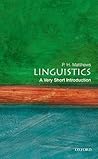
BOOKS: “Linguistics: A Very Short Introduction” by P.H. Matthews

Linguistics: A Very Short IntroductionLinguistics: A Very Short Introduction by P.H. Matthews
My rating: 4 of 5 stars

Publisher Site – OUP

This book offers an overview of the territory studied by the discipline of linguistics, from general topics such as what a language is and what distinguishes human language through more technical and scientific subjects such as the nature of vocal sound and the role of the brain in language.

It introduced me to some interesting ideas that I hadn’t previously given much thought, such as: the importance of redundancy in language, the idea that a word can’t necessarily be thought of as simply a label put on a pre-existing notion or thing, the question of whether language developed once or multiple times (independently,) how languages are learned, and how speaking influences thinking and vice versa.

Until the penultimate chapter (Ch. 8 – “Sounds”) I felt the book was doing a fine job of sticking to the basics, being interesting but not obscure. The “Sounds” chapter seemed to get more into the weeds than the rest (but, I’ll concede, it may have been part my relative interest in the topic, your results may vary.)

The book, like others in the series, has a few monochrome graphics as well as a “Further Reading” section.

If one is looking for a broad introduction to linguistics, I’d recommend this as a fine place to start.

View all my reviews

BOOKS: “Buddha Jumps Over the Wall” by Ying Chang Compestine

Buddha Jumps over the Wall, and Other Curiously Named Classic Chinese Dishes: A Graphic Cookbook—26 Recipes & StoriesBuddha Jumps over the Wall, and Other Curiously Named Classic Chinese Dishes: A Graphic Cookbook—26 Recipes & Stories by Ying Chang Compestine
My rating: 5 of 5 stars

Publisher’s Site – Chronicle Books

Cookbooks don’t get more interesting than this. As the title suggests, the author selected dishes that have colorful names (and often histories or folklore to match) and presents lessons in culinary history as well as teaching the reader how to make each dish. The graphic novel format conveys these stories compactly and with a bit of added liveliness. The graphic novel approach is also used to “demonstrate” the preparation process — in lieu of photographs.

In addition to the twenty-six recipes (5 appetizers, 16 main course, and 5 desserts,) the book has five appendices and some front matter to both help readers who are entirely new to Chinese cooking as well as those who’d like a bit more depth of culinary cultural insight. (I should point out that the book looks at Chinese food broadly, including items like Chop Suey and Fortune Cookies that developed outside of China, and either don’t exist within China or have subsequently been introduced from foreign lands.)

If you are interested in learning to cook Chinese food, or are interested in Chinese culinary history and culture, I’d highly recommend this book.

View all my reviews

BOOKS: “The Story of Malacca” by Allein G. Moore

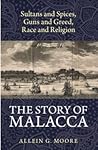
Sultans and Spices, Guns and Greed, Race and Religion: The Story of MalaccaSultans and Spices, Guns and Greed, Race and Religion: The Story of Malacca by Allein G. Moore

My rating: 4 of 5 stars

Publisher Website

With an upcoming trip to Malacca (a.k.a. Melaka) planned, I decided it would be good to learn something about the city of Malacca besides that it shares a name with the pirate-infested strait that it sits beside. Fortunately, given the tremendous historical import of this town, there were at least a few English-language resources available. I settled on this history and was pleased with my choice. [It’s definitely the most up-to-date work in English that I found.]

The book covers the history of Malacca from its earliest human occupants through to the COVID pandemic [during which it was published.] (Actually, the last chapter is a wishful forecast of what the author hopes for the near-term future of Malacca (i.e. over the next decade or so.)) The core chapters are chronologically oriented and sorted by the ruler of the day (of which Malacca had an impressive sequence: Indian, Chinese, Portuguese, Dutch, British, Japanese, British (again,) and then Independence and a Malay-led government of its own.) Interspersed with these chronological chapters are a few topical ones, beside the aforementioned chapter about the future, these include chapters on the mythology of the city and one of biographical sketches of prominent historical figures.

I found this book to be educational and full of fascinating tidbits. While I appreciated that it brings the reader up to date, the last couple chapters do sometimes veer from “just-the-facts” description of events into a combination city planning rant / wish-list (Pollyanna, in places) regarding the state of the city and its future. I did like that the book touched upon cultural dimensions, from language to martial arts, in addition to a telling of historical events. The book is well worth reading for travelers and / or history buffs.

View all my reviews

The Beauty of the Ancient [Free Verse]

There's something beloved about
an ancient place.

Entropy increases.
Nature devours.
Nothing lasts forever.

Nothing of man can be built of stone
sturdy enough or steel resistant
enough to become ancient
by mere persistence.

It must be loved.
Someone must clean the grass
from the cracks, must scrub
moss & mold, must replace
pieces that slough off...
(& must do it all with tender
craftsmanship.)

I suspect anything ancient
that's higher than my knee
is a Theseus's ship:
rebuilt stone by stone through the ages
until only a wafting idea of the place
remains ancient.

BOOK: “Twenty-Nine Goodbyes” by Timothy Billings

Twenty-Nine Goodbyes: An Introduction to Chinese PoetryTwenty-Nine Goodbyes: An Introduction to Chinese Poetry by Timothy Billings
My rating: 5 of 5 stars

Publisher website

The premise of this book is simple, Billings presents twenty-nine different translations of a famous farewell poem by the Tang Dynasty poetic genius, Li Bai, and compares, contrasts, and critiques them in detail. The included translations weren’t all crafted in the English language, but English translations (of the translations) are presented as needed. There are translations from French, Spanish, Japanese, and even modern Mandarin Chinese — among others.

Despite how that may sound, it is a tremendously readable book. Billings writes with engaging prose, employs humor (especially when critiquing his own contribution in the final chapter,) and uses complicated jargon only when necessary and with comprehensible explanations.

Still, it does take a certain level of passion to read because one is repeatedly examining the same poem, and one has to have an interest in the minutiae of said poem and – more importantly — an interest in the broader lessons conveyed about translation. If whether a color is translated as green or blue (or what symbolic object tumbles on the ground, or what sound a horse makes) doesn’t seem change the emotional experience of the poem for you, then you’ll probably have a hard time getting into this book. That said, the ability to take a longitudinal view –seeing same points in a given poem through the lens of different poets and translators cross time and cultures, does offer insight that one would be unlikely to get from reading any of the twenty-nine translations in isolation as part of a single translator’s collection of translations.

The most useful thing the book did for me was to increase my understanding of the nature of translation and its tradeoffs, as well as to elucidate how easy it is to miss the mark when one is translating from a perspective so different in time and worldview.

I’d highly recommend this book for anyone interested in Tang Dynasty poetry, translation, and the interface of culture and language.

View all my reviews

Blindspot [Free Verse]

A culture is a vehicle
we use to move
through
this world.

And like all vehicles -
be it truck or bus -
it
has blindspots.

Everyone in a given
vehicle has the same
blindspots...

That's why we travel.

BOOKS: “36 Ways of Writing a Vietnamese Poem” by Nam Le

36 Ways of Writing a Vietnamese Poem36 Ways of Writing a Vietnamese Poem by Nam Le
My rating: 4 of 5 stars

Amazon.in Page

Release Date: March 5, 2024

This is a clever collection of poems, lighthearted in places but raw and incensed in others. (A pacing that I appreciate in poetry collections.) The collection draws heavily on the author’s experience being of Vietnamese ethnicity while growing up in the West. It touches upon the tragedies lived by his elders, but, more so, how his life (and perception of him) has been shaped by war and the diaspora it caused. The collection playfully engages with language and cultural concepts in a way that is interesting and – at times – scintillating.

My main gripe with this collection would be its occasional swerves into the domain of huge, rare, and super-specialized terminology. I enjoy being sent to the dictionary as much as the next person, but in a poetry collection – where evoking emotion is the name of the game – I find it takes me out of the experience.

I enjoyed reading this collection and would recommend it for poetry readers.

View all my reviews