BOOKS: “The Story of Malacca” by Allein G. Moore

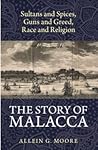
Sultans and Spices, Guns and Greed, Race and Religion: The Story of MalaccaSultans and Spices, Guns and Greed, Race and Religion: The Story of Malacca by Allein G. Moore
My rating: 4 of 5 stars

Publisher Website

With an upcoming trip to Malacca (a.k.a. Melaka) planned, I decided it would be good to learn something about the city of Malacca besides that it shares a name with the pirate-infested strait that it sits beside. Fortunately, given the tremendous historical import of this town, there were at least a few English-language resources available. I settled on this history and was pleased with my choice. [It’s definitely the most up-to-date work in English that I found.]

The book covers the history of Malacca from its earliest human occupants through to the COVID pandemic [during which it was published.] (Actually, the last chapter is a wishful forecast of what the author hopes for the near-term future of Malacca (i.e. over the next decade or so.)) The core chapters are chronologically oriented and sorted by the ruler of the day (of which Malacca had an impressive sequence: Indian, Chinese, Portuguese, Dutch, British, Japanese, British (again,) and then Independence and a Malay-led government of its own.) Interspersed with these chronological chapters are a few topical ones, beside the aforementioned chapter about the future, these include chapters on the mythology of the city and one of biographical sketches of prominent historical figures.

I found this book to be educational and full of fascinating tidbits. While I appreciated that it brings the reader up to date, the last couple chapters do sometimes veer from “just-the-facts” description of events into a combination city planning rant / wish-list (Pollyanna, in places) regarding the state of the city and its future. I did like that the book touched upon cultural dimensions, from language to martial arts, in addition to a telling of historical events. The book is well worth reading for travelers and / or history buffs.

View all my reviews

The Beauty of the Ancient [Free Verse]

There's something beloved about
an ancient place.

Entropy increases.
Nature devours.
Nothing lasts forever.

Nothing of man can be built of stone
sturdy enough or steel resistant
enough to become ancient
by mere persistence.

It must be loved.
Someone must clean the grass
from the cracks, must scrub
moss & mold, must replace
pieces that slough off...
(& must do it all with tender
craftsmanship.)

I suspect anything ancient
that's higher than my knee
is a Theseus's ship:
rebuilt stone by stone through the ages
until only a wafting idea of the place
remains ancient.

BOOK: “Twenty-Nine Goodbyes” by Timothy Billings

Twenty-Nine Goodbyes: An Introduction to Chinese PoetryTwenty-Nine Goodbyes: An Introduction to Chinese Poetry by Timothy Billings
My rating: 5 of 5 stars

Publisher website

The premise of this book is simple, Billings presents twenty-nine different translations of a famous farewell poem by the Tang Dynasty poetic genius, Li Bai, and compares, contrasts, and critiques them in detail. The included translations weren’t all crafted in the English language, but English translations (of the translations) are presented as needed. There are translations from French, Spanish, Japanese, and even modern Mandarin Chinese — among others.

Despite how that may sound, it is a tremendously readable book. Billings writes with engaging prose, employs humor (especially when critiquing his own contribution in the final chapter,) and uses complicated jargon only when necessary and with comprehensible explanations.

Still, it does take a certain level of passion to read because one is repeatedly examining the same poem, and one has to have an interest in the minutiae of said poem and – more importantly — an interest in the broader lessons conveyed about translation. If whether a color is translated as green or blue (or what symbolic object tumbles on the ground, or what sound a horse makes) doesn’t seem change the emotional experience of the poem for you, then you’ll probably have a hard time getting into this book. That said, the ability to take a longitudinal view –seeing same points in a given poem through the lens of different poets and translators cross time and cultures, does offer insight that one would be unlikely to get from reading any of the twenty-nine translations in isolation as part of a single translator’s collection of translations.

The most useful thing the book did for me was to increase my understanding of the nature of translation and its tradeoffs, as well as to elucidate how easy it is to miss the mark when one is translating from a perspective so different in time and worldview.

I’d highly recommend this book for anyone interested in Tang Dynasty poetry, translation, and the interface of culture and language.

View all my reviews

Blindspot [Free Verse]

A culture is a vehicle
we use to move
through
this world.

And like all vehicles -
be it truck or bus -
it
has blindspots.

Everyone in a given
vehicle has the same
blindspots...

That's why we travel.

BOOKS: “36 Ways of Writing a Vietnamese Poem” by Nam Le

36 Ways of Writing a Vietnamese Poem36 Ways of Writing a Vietnamese Poem by Nam Le
My rating: 4 of 5 stars

Amazon.in Page

Release Date: March 5, 2024

This is a clever collection of poems, lighthearted in places but raw and incensed in others. (A pacing that I appreciate in poetry collections.) The collection draws heavily on the author’s experience being of Vietnamese ethnicity while growing up in the West. It touches upon the tragedies lived by his elders, but, more so, how his life (and perception of him) has been shaped by war and the diaspora it caused. The collection playfully engages with language and cultural concepts in a way that is interesting and – at times – scintillating.

My main gripe with this collection would be its occasional swerves into the domain of huge, rare, and super-specialized terminology. I enjoy being sent to the dictionary as much as the next person, but in a poetry collection – where evoking emotion is the name of the game – I find it takes me out of the experience.

I enjoyed reading this collection and would recommend it for poetry readers.

View all my reviews

BOOKS: In Praise of Shadows by Jun’ichirō Tanizaki

In Praise of ShadowsIn Praise of Shadows by Jun’ichirō Tanizaki
My rating: 5 of 5 stars

Amazon.in Page

Tanizaki’s essay on Japanese aesthetics doesn’t just show the reader the simple, rustic, and weathered traits of Japanese beauty, it fully submerges them in an otherworldly place ruled by different principles of seeing. So enamored with this pre-modern Japanese aesthetic was Tanizaki that we are convinced he would give up all present-day conveniences to see the world this way (but, alas, he recognizes the impossibility of maintaining a household or business in today’s world that way.)

While the book is principally a tour of this Japanese shadow world, moving from architecture to toilets to lacquerware to Noh plays to skin tones to hotels (with other stops along the way,) it is also a critique of modernity, and particularly a modernity shaped by the West by virtue of Western countries building a lead in a number of key technologies. The most crucial of these technologies, and the one Tanizaki most decries, is electric lighting, which does away with the artistic beauty that derives from the interplay of varied toned shadows (and occasionally a little bit of light.) [I should say, he’s not bashing the Western technology or ways, but rather how poorly they work with maintaining Japanese aesthetic ways.]

I’d highly recommend this book for all readers. If you’re interested in aesthetics, art, architecture, culture, or “things Japanese,” then all the more so, but I can’t remember the last time description pulled me into a book as hard as this one. The essay can be a bit rambling and shifts from euphoria to rant and back, rapidly, but that is part of its magic.

View all my reviews

Rivers of the Dead [Free Verse]

So many cultures
make their dead
cross a river.

The Greeks' Styx.
The Hindus' Vaitarna.
The Norse Gjȍll.
The Gnostic's Hiṭpon.
The Japanese Sanzu-no-Kawa.
The Mesopotamians' Hubur.
Taoists cross Naihe Bridge --
over what (I'm not sure,
but) is probably a river.

No rest for the dead?
It seems kind of rude.

BOOK REVIEW: Identity: A Very Short Introduction by Florian Coulmas

Identity: A Very Short IntroductionIdentity: A Very Short Introduction by Florian Coulmas
My rating: 5 of 5 stars

Amazon.in Page

This book explores the slippery metaphysical concept of identity — not only as it’s presented in philosophy, but also in psychology, law, politics, anthropology, and literature. It begins with individual identity and expands outward to encompass gender, political, socio-economic, and linguistic identities. The aforementioned slipperiness of identity stems from the fact that we all have an intuitive grasp of identity that could be leading us astray. It tends to make us believe that aspects of identity are inherent features of the universe, when – in fact – they may be arbitrary designations – in which case, a given criterion or classification of identity may be chopped up in different ways than a given culture happened to glom onto.

I learned a great deal from this Introduction, and feel it was well organized and presented. How we see various dimensions of group identity (as well as how we weight them) has a lot to do with our social tensions and strife, and the issues around identity are worth dissecting — despite the fact that it might seem like a dry academic topic at first blush.

If you’re interested in learning more about identity, selfhood, and how various group identities feature in an individual’s overall identity, this book is worth investigating.


View all my reviews

BOOK REVIEW: Social and Cultural Anthropology [VSI] by John Monaghan & Peter Just

Social and Cultural Anthropology: A Very Short IntroductionSocial and Cultural Anthropology: A Very Short Introduction by John Monaghan
My rating: 5 of 5 stars

Amazon.in Page

Get Speechify to make any book an audiobook

This was one of the most interesting “Very Short Introduction” books — of the many titles in the series that I’ve read. The authors use stories and examples to convey the basics of the subject in way that’s not mind-numbingly dry (i.e. the scholarly norm) – in fact, there’s a fair amount of humor laced throughout the book.

Most of the examples come from the two tribes that these two authors study – i.e. one in Mexico and the other in Indonesia. However, those two groups provide a rich arena of interesting anecdotes, and the authors do use social groups outside their research focus when necessary.

In addition to learning about the nature of ethnographic fieldwork and what anthropologists do, there’s an exploration of culture, the various ways in which people are socially organized (i.e. kinship, castes, societies, etc.,) and how different societies view religious belief, economic activity, and selfhood.

If you’re starting from zero and are seeking an introduction to anthropology, I’d highly recommend this one.

View all my reviews

BOOK REVIEW: Introducing Cultural Studies: A Graphic Guide by Ziauddin Sardar

Introducing Cultural Studies: A Graphic GuideIntroducing Cultural Studies: A Graphic Guide by Ziauddin Sardar
My rating: 4 of 5 stars

Amazon.in Page

Get Speechify to make any book an audiobook

Culture is a deep and fascinating topic, but a dirty little secret of academia is that there are two words used to signal subjects and courses for the not-so-bright kids: one is “Studies” and the other is “for.” (As in “Math FOR Economists,” a course that I once took that was – I’m sure of it – greatly dumbed down from what Math majors learned. “Economics FOR Business Majors” is a more widely known example; it’s Economics for people who are afraid of equations and who can’t figure out which way is up on a supply and demand curve.) So, I wasn’t sure what to expect from a guide to “Cultural Studies,” as opposed to a book about, say, Cultural Anthropology, which I believe is the big-boy pants version of the discipline under discussion.

The author is forthright that cultural studies is a bit amorphous and that it struggles to find its place amid the established disciplines that touch upon culture from varying perspectives (i.e. psychology, philosophy, anthropology, etc.) The book begins before there was a “Cultural Studies,” per se, discussing competing definitions of culture and related precursor disciplines, e.g. semiotics. It then describes the evolution of the subject and its varied points of focus and ideas across its major epicenters: Europe, North America, Australia, and South Asia. It investigates colonization and its influence on indigenous cultures, and it looks at how a range of concepts intersect with culture, including: science, technology, race, gender, sexuality, and media. It concludes by reflecting on globalization and the discontents who wish to end or replace this homogenizing force.

I did learn quite a few new things from this book, and if you’re looking to understand culture as a landscape of academic study, it’s worth having a look at it.


View all my reviews