PROMPT: Drink

What is your favorite drink?

If amount consumed is any indication, that would have to be water – with coffee as a second runner up. And the rest of the pack is a muddled mess in which no one stands out, judging from the fact that the aforementioned are the only beverages that I drink on a daily basis. (Gin or beer are at most once a week beverages and average less than that, if this was meant to imply alcoholic drinks.)

Certainly, water is the only one that I: a.) can’t do without, and b.) could live a comfortable and healthy life drinking exclusively.

World Writ Minimalist [Kyōka]

sunrise paints the haze
the color of campfire flames,
and nothing looks real,
but rather like a painting
by an artist, skilled & lazy.

Pleasant Valley [Lyric Poem]

In the narrow valley
Traversed by a cool stream,
Life is but a pleasant,
And ever shady, dream.

Feet within the waters,
But mind up in the sky,
Nothing can upend one,
Nor kill what cannot die.

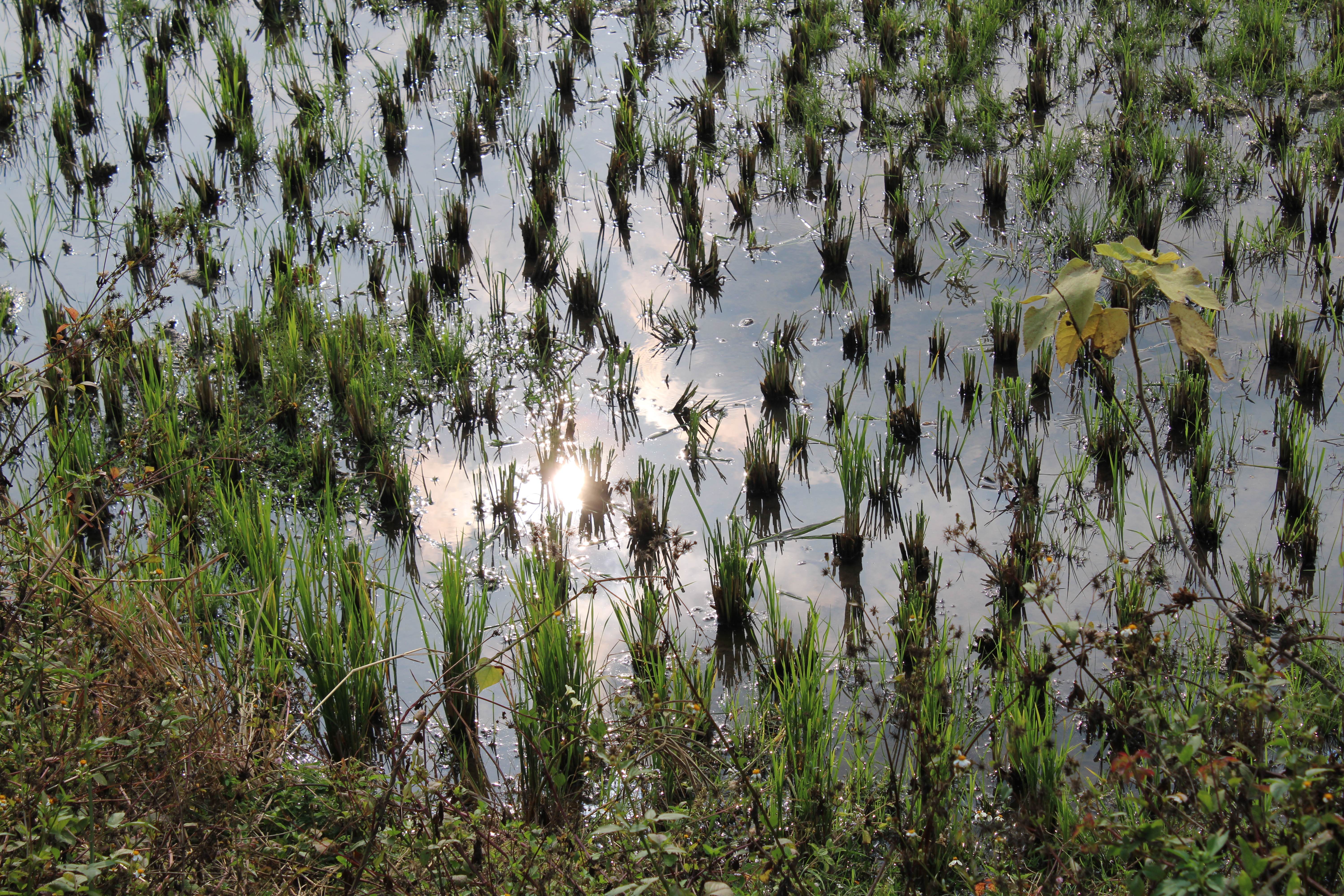
DAILY PHOTO: More Scenes from Santichon Village, Thailand

“Treading on Grass” by He Zhu [w/ Audio]

On winding pool with willows dim,
At narrow strait the lovebirds swim.
Green duckweeds float,
Barring the lotus-picking boat.
Nor butterflies nor bees
Love fragrance from the withered trees.
When her red petals fall apart,
The lotus bloom 's bitter at heart.

The setting sun greets rising tide,
The floating clouds bring rain.
The swaying lotus seems to confide,
Her sorrow to the poet in vain.

Then she would not be wed to vernal breeze.
What could she do now autumn drives away wild geese?

Translation: Xu Yuanchong [translator]. 2021. Deep, Deep the Courtyard. [庭院深深.] Cite Publishing: Kuala Lumpur, p.226.

Graveyard Trees [Haiku]

graveyard trees
turn crimson in the Fall, but
hold leaves stubbornly.

DAILY PHOTO: Wat Phra Kru, Chiang Mai

Image

BOOKS: “Nuclear War” by Annie Jacobsen

Nuclear War: A ScenarioNuclear War: A Scenario by Annie Jacobsen
My rating: 5 of 5 stars

Amazon.in Page

Release Date: March 28, 2024

Annie Jacobsen’s new book is fascinating and — quite frankly — horrifying from cover to cover. The book presents a hypothetical minute by minute unfolding of events that culminate in full-scale nuclear war and the end of the world as we know it. A four-hundred-page book that breaks down the events of an hour may sound like a recipe for tedium, like Joyce’s seven-hundred-plus page elaboration of the events of a single day in “Ulysses.” But, it is anything but. There is so much to explore amid the concepts like “the nuclear football” and MAD (Mutually Assured Destruction,) and EMP’s (Electromagnetic Pulse weapons.) There is also so much to go wrong, and much that is virtually certainly go wrong.

That last sentence might suggest that the book takes an excessively pessimistic view to create drama. Sadly, it does not need to. The ultra-fast timeline of nuclear calculus does the work of ensuring that many things will go terrifyingly and irreparably wrong. Decision makers have a short window to make decisions, and “use-’em-or-lose-’em” thinking plays a major role in decision making. (i.e. One can’t count on delaying a decision about a counter response because one’s delivery infrastructure — notably, the human bit of it — will likely be destroyed if one absorbs the first strike.) There is also the fact that — counter to all the abort buttons seen in the movies — once missiles are launched, there is no way to stop them. [A bit of “Dr. Strangelove” writ into the system.] At many of the points at which it may seem that Jacobsen is being pessimistic for effect, she explains the basis for her pessimism: from historical events like the failure of the nuclear hotline to commentary by experts.

Lest one think that nuclear warfare is a threat of the past, and that it’s a solved problem, Jacobsen’s scenario reminds us that it’s not just a matter of NATO v the Warsaw Pact (i.e. America v the USSR in the common conception) anymore. She does this by using North Korea as the instigator. We don’t ever learn the Kims’ theoretical motivation, but all one really needs to know to make one nervous is that the DPRK has been quite happy playing the role of pariah, engaging in a number of activities in violation of international law and norms, as well as that Kim Jong Un might just believe some of the ridiculous things his yes-men tell him. (Not to mention the famines and other destabilizing conditions that could lead some other inside actor or group of actors to take unanticipated actions.) The truly disturbing part is to see how easily a strike by the DPRK could draw Russia or possibly China into the nuclear exchange. [Russia because it’s in the path between the US and the DPRK, and China because it could suffer massive casualties from strikes on North Korean facilities near the border that send radiation to sizable Chinese population centers.]

This book is a must-read for anyone who thinks nuclear weapons are the problem of a bygone era.

View all my reviews

“A Shropshire Lad XXXVI” by A. E. Housman [w/ Audio]

White in the moon the long road lies,
The moon stands blank above;
White in the moon the long road lies
That leads me from my love.

Still hangs the hedge without a gust,
Still, still the shadows stay:
My feet upon the moonlit dust
Pursue the ceaseless way.

The world is round, so travellers tell,
And straight though reach the track,
Trudge on, trudge on, 'twill all be well,
The way will guide one back.

But ere the circle homeward hies,
Far, far must it remove:
White in the moon the long road lies
That leads me from my love.

NOTE: This poem is sometimes titled by its first line or an abbreviated form, thereof. So, it’s sometimes called: “White in the Moon the Long Road Lies.”

PROMPT: Shoes

Daily writing prompt
Tell us about your favorite pair of shoes, and where they’ve taken you.

Well, they were Timberland hiking boots, a pair that was comfortable and had served me well on a number of hikes in various parts of the world. Then, on the Goechala Pass Trek in Sikkim, I learned that they were only held together by some planned-obsolescent glue.

I had to hike six days with one of the soles strapped to my foot for one of the boots, and five days for the other. Yes, after so many miles of hiking in various environments, they fell apart within one day of each other. I guess the glue has a finite number of puddle steps in it, and I hit that number one day earlier with one boot than the other. That’s when I realized there’s nothing special about a shoe. It’s just a bunch of the lowest cost materials stuck together in the lowest cost assembly method and designed so you’ll have to buy a new pair every few months to years, depending upon the type of shoe, its use, and its price point. If there were a monopoly on shoe production, no pair would last more than a week. It’s only competition that allows for some halfway decent pairs to exist. I’m happy with any shoe that protects my feet, and — once it doesn’t — it’s dead to me.