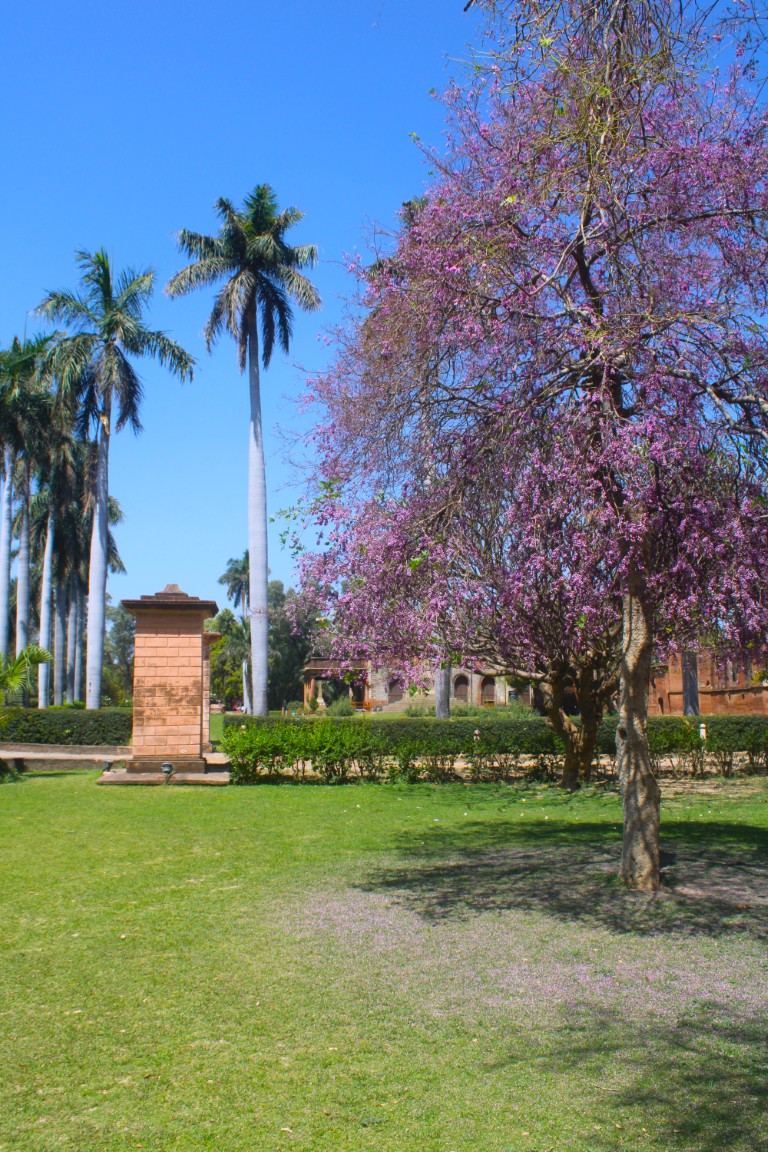
ring of blossoms
 around the tree trunk:
  still, as shadows creep.

ring of blossoms
around the tree trunk:
still, as shadows creep.
I like to see it lap the Miles --
   And lick the Valleys up --
 And stop to feed itself at Tanks --
   And then - prodigious step

Around a Pile of Mountains --
   And supercilious peer
 In Shanties -- by the sides of Roads --
   And then a Quarry pare

To fit its sides
      And crawl between
   Complaining all the while
 In horrid -- hooting stanza --
   Then chase itself down Hill --

And neigh like Boanerges --
   Then - prompter than a Star
 Stop - docile and omnipotent
   At it's own stable door --
That’s a tough one because while I see value in communities, I’m also concerned that there is a rising trend toward tribalism and nationalism that will not be good for anyone — not to mention a shift toward virtual communities where anonymity and disconnect lead to people to act as though they were raised by hyenas. (I do know that, in reality, that’s an insult to the marvelous hyena, but I think it makes a sort of point for the non-hyena expert.)
I’ve been amazed at how India manages to have an intense sense of community in such a vastly super-tribal environment. (I’m using “supertribe” in Desmond Morris’s sense — i.e. a community which is too big for everyone to know everyone else, and which has a group dynamic that reflects that fact.) But it’s not as though there isn’t a dark side to this intensity of community — patriarchy, sectarian conflict, disempowered societal segments, etc.
America, by comparison seems to be experiencing a dearth of true community, which is driving people toward virtual “communities,” and in virtual communities people seem to fall into the shittiest versions of themselves. Not to mention the lack of community’s contribution to what I’ve heard called a “mental health crisis.”
I guess my preferences would be that community be: 1.) real and not virtual. 2.) that it exploit the advantages of diverse membership instead of wallowing in homogeneity and group think. 3.) that it doesn’t create overclasses and underclasses. And that, 4.) Community norms minimally negate individual freedoms.
That said, I’m not at all sure that the above criteria can be reconciled. Maybe the tradeoffs are too strong. Maybe – in our super-tribal world – the closest-knit society will always be the most xenophobic [fearful / disliking of outsiders,] and maybe tolerance and egalitarianism will always be accompanied by societal degradation. I have observed a strong inclination for people to think of compassion as a zero-sum game.
As I said, a tough one.

heron & reflection drift apart
 until one of them vanishes.
 George Bernard Shaw: A Very Short Introduction by Christopher Wixson
Once there came a man
   Who said:
 "Range me all men of the world in rows."
 And instantly
 There was a terrific clamor among the
   people
 Against being ranged in rows.
 There was a loud quarrel, world-wide.
 It endured for ages;
 And blood was shed
 By those who would not stand in rows,
 And by those who pined to stand in rows.
 Eventually, the man went to death, weeping.
 And those who stayed in the bloody scuffle
 Knew not the great simplicity.
How have you adapted to the changes brought on by the Covid-19 pandemic?
When someone unfamiliar enters my vicinity, I shout STRANGER DANGER! and form a cross of my outstretched index fingers that I point in their general direction.
But seriously, it’s just a vague memory at this point.





 Tiger Riding for Beginners