
FIVE WISE LINES [October 2024]

If any thing is sacred the human body is sacred

walt whitman; Leaves of grass; “I sing the body electric”

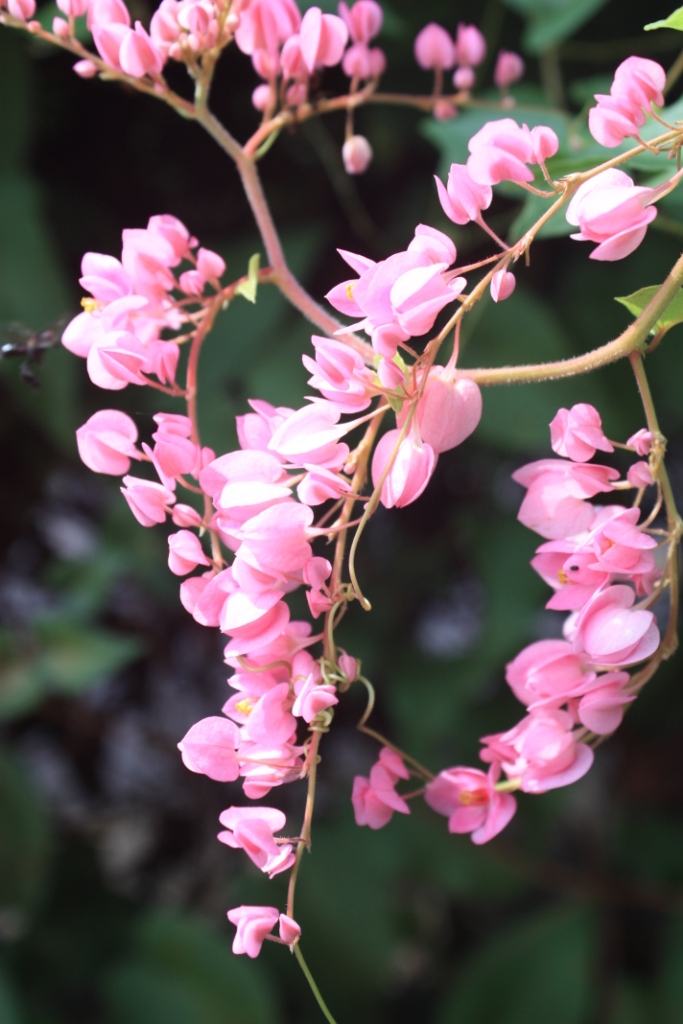
Strong in their softness are the sprays of the wisteria creeper;
The pine in its hardness is broken by the weak snow.

Saying of Master Jukyo as Translated by Trevor Leggett in Zen and the Ways

When there is mutual ignorance, confidence indeed is king.

Trevor leggett; Zen and the Ways

Do not see the gate and think it is the house. The house is something which is reached by passing through and going beyond the gate.

YAgyu Munenori’s Art of War (As translated by trevor leggett in Zen and the ways)

Students of the Ways must see clearly that in an untrained man the intellect is like a barrister. It argues clearly and logically, but the aim is not truth, but to reach a predetermined conclusion.

Trevor Leggett; Zen and the Ways
“Broadminded” [Poetry Style #23 (旷达)] by Sikong Tu [w/ Audio]

One may live a century --
Short span though it may be:
Joys are bitterly brief
And sorrows are many.
You may take a wine jug
On your wisteria rounds:
See flowers grow to the eves
As sparse rains wet the grounds.
And when the wine is gone,
One strolls with cane and croons.
We become wizened with age;
South Mount, fair through countless moons.

NOTE: The late Tang Dynasty poet, Sikong Tu (a.k.a. Ssŭ-k‘ung T‘u,) wrote an ars poetica entitled Twenty-Four Styles of Poetry (二十四诗品.) It presents twenty-four poems that are each in a different tone, reflecting varied concepts from Taoist philosophy and aesthetics. Above is a crude translation of the twenty-third of the twenty-four poems. This poem’s Chinese title is 旷达, which has been translated as: “Illumed” [Giles,] “Big-hearted and Expansive [Barnstone and Ping,] “Expansive,” and “Open-minded.”

BOOKS: “Handbooks for Daoist Practice: Scriptural Statutes of Lord Lao” by Louis Komjathy [and Lord Lao]

Handbooks for Daoist Practice: Scriptural Statutes of Lord LaoHandbooks for Daoist Practice: Scriptural Statutes of Lord Lao by Louis Komjathy
My rating: 5 of 5 stars

Author Site

This paper presents exposition on, and translation of, an important Taoist work. Like many collections of sutras and other epigrams of wisdom, the “Scriptural Statutes of Lord Lao” are only a couple pages of sayings. To be more specific, they consist of nine practices (九行) and twenty-seven moral precepts. The bulk of the twenty-five-ish pages of this work are a scholarly background on the nine practices and twenty-seven precepts, plus back matter including references and the original (Chinese) “statutes.”

I read this because the nine practices seem like a concise statement of what it means to be Taoist (a topic that can be tremendously complicated given the varied sects, beliefs, and practices that all fall under the heading of “Taoist” — some religious, some philosophical, and some mystical.) Those nine practices are: non-action (which is much more complicated than just sitting on one’s bum,) softness, guarding the feminine, namelessness, stillness, adeptness, desirelessness, contentment, and knowing how and when to yield. The text offers some insight into where these practices come from (e.g. the points in the Dao De Jing that reverence them,) but the scope of the work is far to limited to gain a deep understanding of them (for that one will have to go elsewhere.)

I found reading this short work to be quite beneficial and insightful, despite its thin profile. I’m glad it includes the original text as well as provides citations, as therein much of its value lies.

View all my reviews

“Sad” [Poetry Style #19 (悲慨)] by Sikong Tu [w/ Audio]

Strong winds ripple water;
Forest trees are laid low...
A bitter urge to die --
One can't come; one can't go.
Ten decades flow, stream-like;
Riches are cold, gray ash.
Life 's a death procession --
Unless you're adept and brash,
And can take up the sword
To hasten the anguish...
No rustling dry leaves, or
Leaky roof as you languish.

NOTE: The late Tang Dynasty poet, Sikong Tu (a.k.a. Ssŭ-k‘ung T‘u,) wrote an ars poetica entitled Twenty-Four Styles of Poetry. It presents twenty-four poems that are each in a different tone, reflecting varied concepts from Taoist philosophy and aesthetics. Above is a crude translation of the nineteenth of the twenty-four poems. This poem’s Chinese title is 悲慨, and it has been translated as: “Despondent,” and “Sorrowful.”

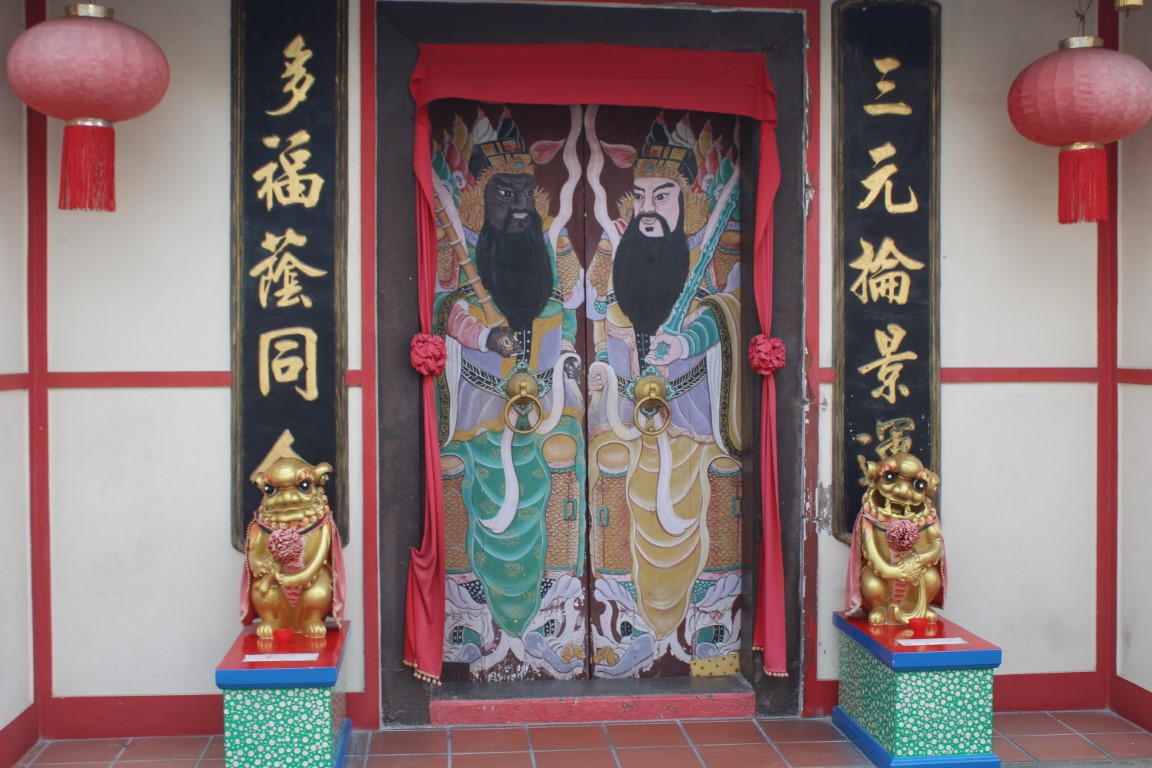
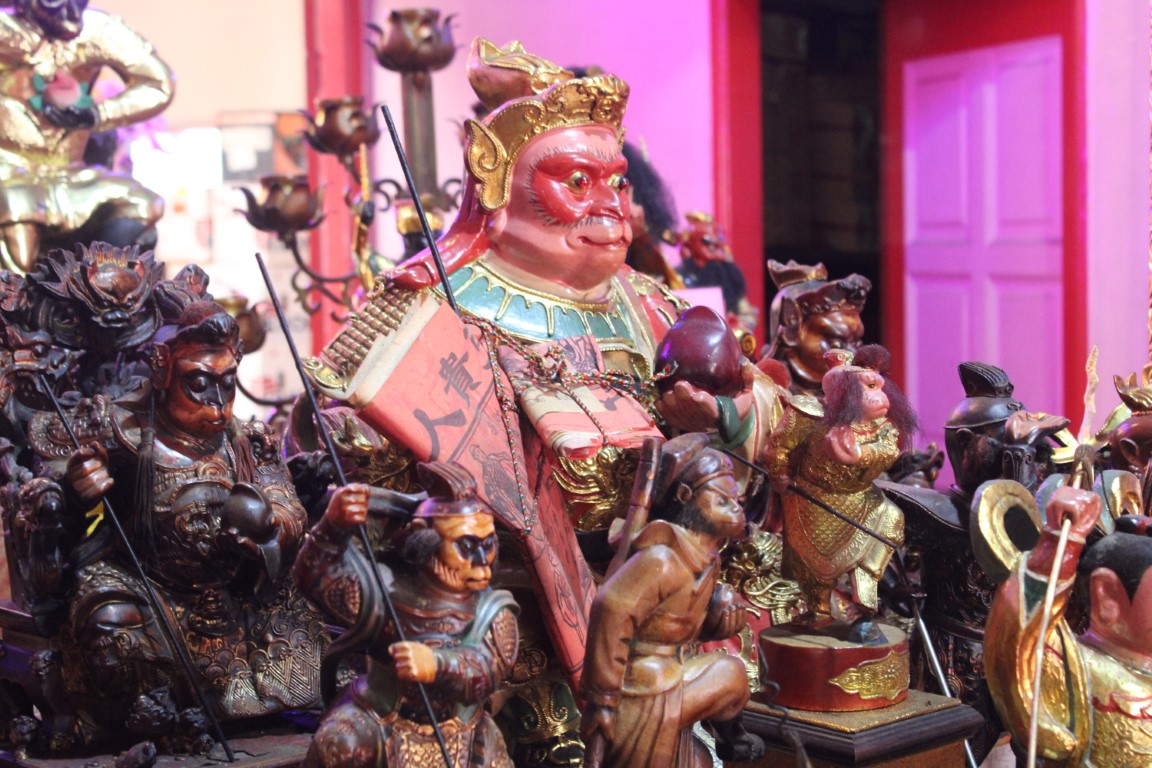
DAILY PHOTO: Warrior Figures Inside a Taoist Temple, Kaohsiung

“Tortuous” [Poetry Style #17 (委曲)] by Sikong Tu [w/ Audio]

Climbing Taihang Mountain,
On the green winding way.
The jade-lined trail in fog,
Floral scents from the gray.
Stuck in unflowing time,
'Til a song sung bright and gay...
I'm steered back to my past
With the grace of ghosts at play.
Skirting roiling waters,
A Roc soars after prey.
The Tao is unbounded --
Round or square as it may.

NOTE: The late Tang Dynasty poet, Sikong Tu (a.k.a. Ssŭ-k‘ung T‘u,) wrote an ars poetica entitled Twenty-Four Styles of Poetry. It presents twenty-four poems that are each in a different tone, reflecting varied concepts from Taoist philosophy and aesthetics. Above is a crude translation of the seventeenth of the twenty-four poems. This poem’s Chinese title is 委曲, and has been translated as: “Grievance” and “In Tortuous Ways.”

“Sparse” [Poetry Style #15 (疏野)] by Sikong Tu [w/ Audio]

Ah, make nature your home;
Be true and be unchained.
Enrichment by control
Can never be sustained.
Build your hut in the pines:
Toss your hat and read verse.
Know the dawn from the dusk,
But not time -- cradle to hearse.
If your life suits you well
Why must you strive and strain?
If you're unbound as sky,
This style you have attained.

NOTE: The late Tang Dynasty poet, Sikong Tu (a.k.a. Ssŭ-k‘ung T‘u,) wrote an ars poetica entitled Twenty-Four Styles of Poetry. It presents twenty-four poems that are each in a different tone, reflecting varied concepts from Taoist philosophy and aesthetics. Above is a crude translation of the fifteenth of the twenty-four poems. This poem’s Chinese title is 疏野 and it has been translated as “Seclusion” [Giles,] “The Carefree and Wild Style” [Barnstone / Ping,] as well as, “Unrestricted,” “Seclusion,” and “Sparse Wilderness.”

BOOKS: “A New Interpretation of Chinese Taoist Philosophy” by You-Sheng Li

A New Interpretation of Chinese Taoist PhilosophyA New Interpretation of Chinese Taoist Philosophy by You-Sheng Li
My rating: 4 of 5 stars

Google Books Page

By the author’s admission (and the title, for that matter) this is not so much an overview of Taoist philosophy as a philosophical rendering that attempts to not only be consistent with the Taoist tradition, but also with our present-day understanding of the world. This fact has positive and negative ramifications for readers, and results in a book that will be more useful for the purposes of some readers than others.

The biggest positive is that this interpretation of Taoism is consistent with a modern rationalist worldview. Taoism is a huge system of thought and includes a lot of magical, supernatural, and astrological thinking. In short, a book on Taoist thought could contain a great deal of woo woo, but this one does not. It has not much to say on demons, deities, magic, alchemy (in the narrow, original meaning,) etc., and to the degree these subjects do crop up they do so in a way that is not arcane and doesn’t insist on belief in unsupported ideas. I think this makes this book important, as it fills a niche. Most of the central texts of Taoism were written in times that were different from our own and in which magic and the supernatural were taken for granted. So, if you want a text that draws on major ideas of Taoism but presents them in a way that is consistent with science, you may want to give this book a look.

The biggest negative is that when the book is not explicitly describing the teachings of historical figures, one doesn’t necessarily have a good way of knowing how much Li’s ideas are or aren’t consistent with Taoist tradition. There are extended discussions of ideas such as evolutionary biology and existentialism, and — unless one has a great depth of knowledge of Taoism to begin with — it can be hard to see whether Li’s views on these subjects are in line with Taoist philosophy or whether twists are being made. The most extensively discussed / cross-cutting idea of the book is that of differentiating primary from secondary society and proposing a primacy of primary society in Taoist thought. I can’t say I’ve read much elsewhere that would suggest this was a core idea for Taoists, but the political philosophy of Taoism is not an area with which I’m at all well-acquainted.

I found this book interesting and thought-provoking. I also felt it was much needed to have a scientifically consistent approach to Taoism. If you are looking for such discussion, I’d recommend this book.

View all my reviews

DAILY PHOTO: Taipei Temple Gardens

“Bold” [Poetry Style #11] by Sikong Tu [w/ Audio]

View flowers like a bandit;
Let nature flow through you,
Breathing in the Great Way
As you let your crazy brew.
Wander like the free winds --
Sea and mountain in gray-blue.
Feel true power overflow,
As all nature lives through you.
Before: sun, moon, and stars;
Behind: the one from two.
By dawn, sea turtles have gone,
Soak your feet where they withdrew.

NOTE: The late Tang Dynasty poet, Sikong Tu (a.k.a. Ssŭ-k‘ung T‘u,) wrote an ars poetica entitled Twenty-Four Styles of Poetry. It presents twenty-four poems that are each in a different tone, reflecting varied concepts from Taoist philosophy and aesthetics. Above is a crude translation of the eleventh of the twenty-four poems. This poem’s Chinese title is 豪放, which has been translated to “Free,” “Set Free,” and “Broad-minded” in various English language translations.