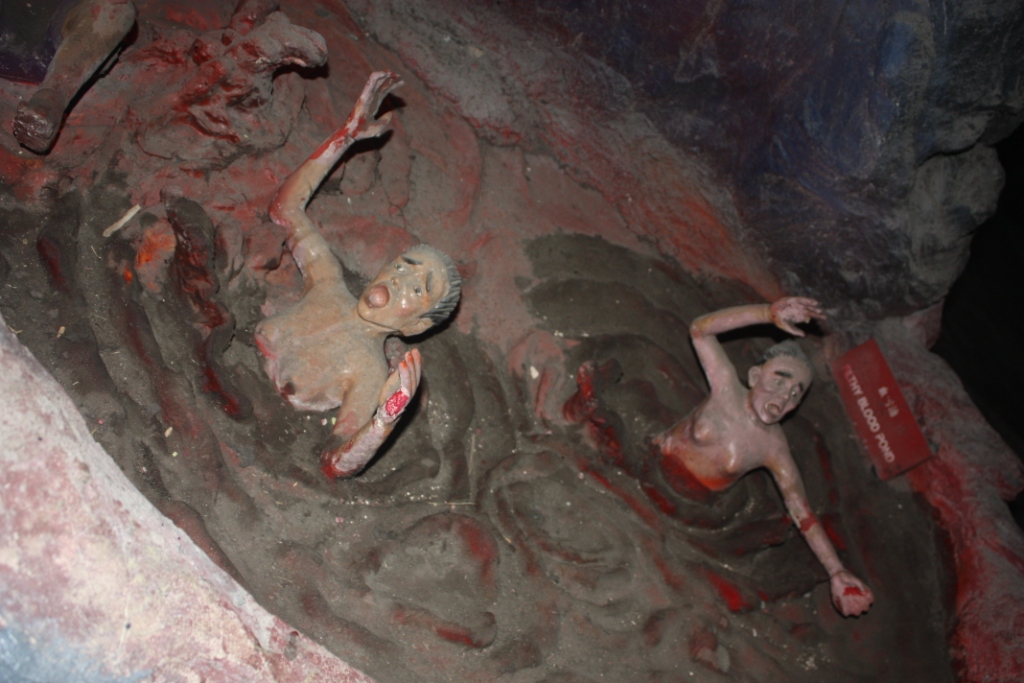
…we should not be too confident in our belief of anything.
cicero; tusculan disputations
No matter what plans you make, no matter what you acquire, the thief will enter from the unguarded side. Be occupied, then, with what you really value and let the thief take something less.
Rumi; Mathnawi II
Very little is needed to make a happy life; it is all within yourself, in your way of thinking.
Marcus aurelius; Meditations
I possess, but I am not possessed by her; since the best thing is to possess pleasures without being their slave, not to be devoid of pleasures.
aristippus [according to Diogenes laertius in lives of the eminent philosophers]
Do not fear the gods. Do not fear death. What is good is easy to attain. What is painful is easy to endure.
philodemus; Herculaneum papyrus [Often referred to as the four cures of epicurus]
Publisher Site – Oxford University Press
This is a brief overview of various types of violence, starting with the question of what counts as violence. The book explores violent acts carried out by individuals, mobs, movements, governments, and religions. It reflects upon how the nature of violence has changed over the centuries while hinting at potential reasons for said changes (along with counterarguments.)
This book raised some provocative questions, such as: Why would people go to watch executions? Does Steven Pinker’s hypothesis that humanity is becoming less violent hold water? [Pinker made this argument in his book The Better Angels of Our Nature, but it has been refuted on number of grounds — definitional, methodological, etc. Though Dwyer only briefly touches on Pinker’s book and its critics in this book and a detailed critique will require looking elsewhere.] How (and why) do violent tendencies vary across cultures. And, when and how did governments end up with a monopoly on legitimate use of force.
I found this book interesting and informative and would recommend it for those looking for answers as to why and how our species is so violent.
"Have you ever made a just man?"
 "Oh, I have made three," answered God,
 "But two of them are dead,
 And the third --
 Listen! Listen!
 And you will hear the thud of his defeat."
Project Gutenberg — Free Online
This book is now more than 120 years old and yet is still widely read and is still provoking thought about the nature of religious experiences and how they should be considered by academia. The book is a write-up of a series of twenty lectures that the famous American Philosopher-Psychologist, William James, delivered at the University of Edinburgh in 1901-02.
There are a few things that impressed me about this book. First, James was skilled with language and clever in conveying ideas, resulting in a good bit of quotable material and stimulating ideas.
Second, James’s writings about Eastern practices and philosophies were impressively clear and faithful. In those days, there wasn’t a lot translated from Sanskrit, Pali, etc. and what had been translated was frequently done by outside academicians with no firsthand experience with Eastern systems — e.g. Hinduism or Buddhism. This meant that the writings about Eastern Philosophy and practices from those days were often contorted by a Western / Abrahamic frame in a way that distorted the true nature of those traditions. James seems to have gained at least some of his understanding from someone with enough practical experience to produce accurate descriptions. Furthermore, James avoids spewing myths and misapprehensions by being humble in stating what is merely his understanding. It should be noted that James does write much more about Abrahamic traditions (as one would expect given his direct experience,) but it’s hard to plumb the depths of mysticism without looking to the East where such practices reached such advanced states.
Finally, I was impressed with James’s ability to walk the line of believer and scholar in a way that was fair both to religion and the religious but also to the scientifically-minded rational sceptic. So much of what I read on the subject takes a vitriolic tone of strict opposition and often unfairly depicts the positions of the other side (to be fair, usually this seems to be because the critic doesn’t understand the views of the other side and so produces an interpretation of the opposing ideas conforming to their own worldview, rather than just lying to win.) [As was attributed to James as well as others, “…people think they are thinking when they are merely rearranging their prejudices.”]
I’d highly recommend this book for readers interested in philosophy of religion and the psychology of religious experience.
Publisher Site – OUP
The first thing that a potential reader should be aware of is that this book isn’t about stage magic or sleight of hand, and that form of magic — in which all parties are aware that techniques are being used to exploit perceptual limitations so as to create the illusion of a supernatural occurrence — doesn’t even really come up as an aside. This book is about magic that (at least some) people believe is a demonstration of actual supernatural happenings in the world.
The book looks at the topic largely from a historical viewpoint; though special emphasis is given to the relationship between religion and magic, in both its congruous and adversarial aspects. That said, for the most part, it’s not arranged historically but rather topically. It does have one chapter on historical perspectives (ch. 3) and one that addresses the ways and degrees to which magical thinking still exists in the modern world (ch. 6.) But it also has chapters on the anthropology of magic (ch.1,) the shifting landscape of thinking about what magic actually is (given that it’s clearly something to many people but isn’t likely the actual exploitation of loopholes in the laws governing the physical world that believers feel it to be — ch. 3,) the role of language in magic (ch. 4,) and the practices of magic (ch. 5.)
The book does focus heavily on the Abrahamic world (Judeo-Christian-Islamic) and its Janus-faced relation to magic over time, but not exclusively so. It brings in African, Chinese, Caribbean, and Native American traditions here and there as well.
I found this book interesting and thought-provoking and would highly recommend it for anyone looking to gain a better insight into how humanity has thought about magic over time and how those beliefs have aligned – or conflicted with – religious beliefs and practices.
Google Books Page
This is one of the most useful books I’ve read on the topic of Jñāna-yoga — the approach to yogic philosophy employed by the studious / inquisitive (in contrast to Bhakti-Yoga [the yoga of those for whom faith and devotion works] and Karma-Yoga [the yoga for those for whom a course of self-less action appeals.]) There are Jñāna-yogic Hindu sects and Buddhism — in general — can be thought of as a school of Jñāna-yoga. The author draws from the teachings of both, principally Sankara for Hindu thinking and Nagarjuna for the Buddhist approach.
A word of warning, the author is a scholarly philosopher, and so — while not as unreadable as many works of academic philosophy — it will be a slog for those who are not used to reading scholarly writing.
That said, Puligandla does a fine job of laying out what he views as the central tenets of Jñāna-yoga in a concise fashion and reviewing them at the end. This is not to say I would agree with all that he proposes, herein. In particular, his Chapter 3 conclusions about consciousness are insufficiently justified to be considered core principles of Jñāna-yoga (in my view.) Of course, the beauty of Jñāna-yoga is that it not only doesn’t insist upon coming to the same conclusions, it generates explanations as to how it’s perfectly possible / reasonable to come to different conclusions (see “The Principle of Superimposition,” herein.) Furthermore, since the author is reporting the ideas of Sankara and Nagarjuna, I can’t really hold these ideas against him.
If you’re interested in Jñāna-yoga, and can handle scholarly prose, I’d highly recommend this book.
In seed-time learn, in harvest teach, in winter enjoy.
Drive your cart and your plough over the bones of the dead.
The road of excess leads to the palace of wisdom.
Prudence is a rich ugly old maid courted by Incapacity.
He who desires, but acts not, breeds pestilence.
The cut worm forgives the plough.
Dip him in the river who loves water.
A fool sees not the same tree that a wise man sees.
He whose face gives no light shall never become a star.
Eternity is in love with the productions of time.
The busy bee has no time for sorrow.
The hours of folly are measured by the clock, but of wisdom no clock can measure.
All wholesome food is caught without a net or a trap.
Bring out number, weight, and measure in a year of dearth.
No bird soars too high if he soars with his own wings.
A dead body revenges not injuries.
The most sublime act is to set another before you.
If the fool would persist in his folly he would become wise.
Folly is the cloak of knavery.
Shame is Pride's cloak.
Prisons are built with stones of law, brothels with bricks of religion.
The pride of the peacock is the glory of God.
The lust of the goat is the bounty of God.
The wrath of the lion is the wisdom of God.
The nakedness of woman is the work of God.
Excess of sorrow laughs, excess of joy weeps.
The roaring of lions, the howling of wolves, the raging of the stormy sea, and the destructive sword, are portions of Eternity too great for the eye of man.
The fox condemns the trap, not himself.
Joys impregnate, sorrows bring forth.
Let man wear the fell of the lion, woman the fleece of the sheep.
The bird a nest, the spider a web, man friendship.
The selfish smiling fool and the sullen frowning fool shall be both thought wise that they may be a rod.
What is now proved was once only imagined.
The rat, the mouse, the fox, the rabbit watch the roots; the lion, the tiger, the horse, the elephant watch the fruits.
The cistern contains, the fountain overflows.
One thought fills immensity.
Always be ready to speak your mind, and a base man will avoid you.
Everything possible to be believed is an image of truth.
The eagle never lost so much time as when he submitted to learn of the crow.
The fox provides for himself, but God provides for the lion.
Think in the morning, act in the noon, eat in the evening, sleep in the night.
He who has suffered you to impose on him knows you.
As the plough follows words, so God rewards prayers.
The tigers of wrath are wiser than the horses of instruction.
Expect poison from the standing water.
You never know what is enough unless you know what is more than enough.
Listen to the fool's reproach; it is a kingly title.
The eyes of fire, the nostrils of air, the mouth of water, the beard of earth.
The weak in courage is strong in cunning.
The apple tree never asks the beech how he shall grow, nor the lion the horse how he shall take his prey.
The thankful receiver bears a plentiful harvest.
If others had not been foolish we should have been so.
The soul of sweet delight can never be defiled.
When thou seest an eagle, thou seest a portion of Genius. Lift up thy head!
As the caterpillar chooses the fairest leaves to lay her eggs on, so the priest lays his curse on the fairest joys.
To create a little flower is the labour of ages.
Damn braces; bless relaxes.
The best wine is the oldest, the best water the newest.
The head Sublime, the heart Pathos, the genitals Beauty, the hands and feet Proportion.
As the air to a bird, or the sea to a fish, so is contempt to the contemptible.
The crow wished everything was black, the owl that everything was white.
Exuberance is Beauty.
If the lion was advised by the fox, he would be cunning.
Improvement makes straight roads, but the crooked roads without Improvement are roads of Genius.
Sooner murder an infant in its cradle than nurse unacted desires.
Where man is not, nature is barren.
Truth can never be told so as to be understood and not to be believed.
Enough! or Too much.
* * * The ancient poets animated all sensible objects with Gods and Geniuses, calling them by the names and adorning them with properties of woods, rivers, mountains, lakes, cities, nations, and whatever their enlarged and numerous senses could perceive.
And particularly they studied the Genius of each city and country, placing it under its mental deity.
Till a system was formed, which some took advantage of and enslaved the vulgar by attempting to realize or abstract the mental deities from their objects.
Thus began Priesthood.
Choosing forms of worship from poetic tales.
And at length they pronounced that the Gods had ordered such things.
Thus men forgot that all deities reside in the human breast.
The head Sublime, the heart Pathos, the genitals Beauty, the hands and feet Proportion.
As the air to a bird, or the sea to a fish, so is contempt to the contemptible.
The crow wished everything was black, the owl that everything was white.
Exuberance is Beauty.
If the lion was advised by the fox, he would be cunning.
Improvement makes straight roads, but the crooked roads without Improvement are roads of Genius.
Sooner murder an infant in its cradle than nurse unacted desires.
Where man is not, nature is barren.
Truth can never be told so as to be understood and not to be believed.
Enough! or Too much.
* * * The ancient poets animated all sensible objects with Gods and Geniuses, calling them by the names and adorning them with properties of woods, rivers, mountains, lakes, cities, nations, and whatever their enlarged and numerous senses could perceive.
And particularly they studied the Genius of each city and country, placing it under its mental deity.
Till a system was formed, which some took advantage of and enslaved the vulgar by attempting to realize or abstract the mental deities from their objects.
Thus began Priesthood.
Choosing forms of worship from poetic tales.
And at length they pronounced that the Gods had ordered such things.
Thus men forgot that all deities reside in the human breast.