BOOK REVIEW: Travels in Siam, Cambodia, Laos, and Annam by Henri Mouhot

Travels In Siam, Cambodia, Laos, And AnnamTravels In Siam, Cambodia, Laos, And Annam by Henri Mouhot

My rating: 3 of 5 stars

Amazon page

If you can stomach the blatant racism and false notions of the virtue of Imperialism, reading the journals of 19th century naturalists and explorers can be fascinating for modern-day travelers. I will say that Mouhot’s work is less offensive than many of his contemporaries in this regard (e.g. the eugenicist polymath Francis Galton.) That is to say, he tries to be objective, and—when he fails–his condescension is as likely to be vaguely complimentary as not (e.g. noting certain “savages” are surprisingly intelligent.) However, one should remember that this is the journal of a journey that took place in years corresponding to the lead up to the American Civil War. (I should note that these snooty inclinations toward superiority aren’t uniquely Western, the Chinese diplomat Zhou Daguan also viewed the Southeast Asian people with condescension.)

Alexander Henri Mouhot left London on April 27th of 1858, traveled to and throughout Southeast Asia, and died in the jungle on November 10, 1861. The journal was received by the explorer’s brother, Charles Mouhot, who is responsible for seeing it published, and for adding some front matter as well as tying up the end of the journal because Henri Mouhot died fairly abruptly of a feverish ailment that he contracted in the jungle.

In many ways, Mouhot’s work is similar to Daguan’s 14th century Record of Cambodia. Mouhot covers a lot more ground, but they both chronicle the natural, cultural, and commercial environment of these lands. Mouhot prides himself in being a naturalist, and he writes quite a bit about the diverse flora and fauna of these lands as well as of the geography. Mouhot collected many specimens of plants and animals that were unknown in his native France. About mid journey, he lost his collection to a maritime accident. However, he was able to reacquire some of these specimens in the latter portion of his journey.

Mouhot writes extensively about the locals and their customs. As I already suggested, these descriptions are often highly biased. For example, he tends to refer to the indigenous spiritual beliefs of the locals as “superstitions” while he bemoans the fact that these people are “living and dying in utter ignorance of the only true God!” However, for the most part he tries to maintain a scholarly detachment, and often he is complimentary of the local people (e.g. his apparent surprise that some of hill people would be offended by being referred to as savages is an example of his benign condescension.)

Also like Daguan, he discusses the possibilities for trade. It’s clear that one of his intended audiences are those interested in the commercial potential of the region. He writes both about what natural resources these nations contain, and what products they might be sold. He is ambiguous about the local market for European goods, first skeptical and then sanguine. He says that the locals don’t have much need for the goods produced in Europe, but then he suggests that the wealthier individuals do like to emulate European style and fashions. Perhaps, he is saying there are potential consumers among the small slice of wealthy individuals, but that is a limited market. Of course, the desire for commodities from Asia in conjunction with the wish to avoid drawing down precious metals reserves (i.e. forcing Asians to buy Western products) was no small cause of Imperialist shenanigans during that time period.

Among the most interesting chapters are those on Angkor Wat and Angkor Thom. In these chapters, one receives an account of the state of Angkor between Daguan’s era (when the Angkor civilization was still active) and a modern-day Angkor that exists in the wake of successive waves of pillaging by the French (and other treasure hunters), the Khmer Rouge, and Vietnamese soldiers.

Mouhot was also interested in whether Jews had settled and integrated in the area. His theory was that there likely were. He says he sees a “Hebrew character” in some faces, but he acknowledges there is no hard evidence to support his belief and that the locals deny such a presence.

I guess the intrigue in Mouhot’s journal is a picture of this region during an era in which the world was not yet homogenized. Now when one travels to “remote villages,” one often sees people wearing the same mass-produced Western clothing that one sees at home, and they sit around with their smart-phones ignoring each other as at home. Mouhot’s era was one in which one traveled by elephant, boat, or by foot and often advanced no more than ten miles in a day in the jungle. It was an era of discovery. This may account for some of the xenophobic biases of that time; the ways of other people were new.

View all my reviews

BOOK REVIEW: A History of the World in 6 Glasses by Tom Standage

A History of the World in 6 GlassesA History of the World in 6 Glasses by Tom Standage
My rating: 4 of 5 stars

Amazon page

Get Speechify to make any book an audiobook

Standage’s book takes a fascinating look at the effect that six key beverages had in the unfolding of world events, as well as how the beverages themselves made friends and enemies. The drinks in question are beer, wine, spirits, coffee, tea, and cola. There are two chapters for each of these drinks. They follow a chronological order based upon when the respective drink rose to prominence, but within the discussion there is overlap of time periods. For example, both the chapters on spirits and tea consider the effect of those beverages on the American Revolution (i.e. the Whiskey Rebellion and the Boston Tea Party, respectively.)

As the author points out, there’s a natural subdivision to the book, which is that the first three beverages are alcoholic and the last three are caffeinated. There’s another way of looking at it, and that’s the means used to achieve a drink that wasn’t a health hazard. The first three drinks achieve germ-killing by fermentation, the next two by boiling, and the last through technology.

The era of beer is associated with the Agricultural Revolution and the growing importance of cereal grains. Geographically, the region of focus is the Fertile Crescent and Egypt. Among the more interesting points of discussion is the role of beer (along with the related commodities of cereal grains and bread) in the development of written language.

The era of wine is associated with the civilizations of ancient Greece and Rome. Readers of the classics will be aware that wine was much celebrated among the Greeks and Romans, so much so that they developed gods of wine in their mythologies (Dionysus and Bacchus, respectively.) Of course, wine played no small role in Christian mythology as well–e.g. Jesus turns water to wine.

Spirits are related to the Colonial period, though they were first developed much earlier. The author emphasizes that these were the first global drinks. While beer and wine were robust to going bad, they could spoil in the course of long sea voyages.

Alcohol of all kinds has always attracted opposition. This conflict, of course, owes to the fact that people under the influence of alcohol frequently act like idiots. One might expect that the transition to discussion of non-alcoholic beverages would correspond to the end of controversy, but that’s not the case. Each of the beverages brought controversy in its wake. There were attempts to ban coffee in the Islamic world where its stimulative effect was conflated with intoxication. Coca-Cola became associated with capitalism and American influence, and drew its own opposition because of it. It seems there’s no escape from controversy for a good beverage.

The most fascinating discussion of coffee had to do with the role of cafés as corollaries to the internet. Centuries before computers or the internet as we know it, people went to cafés to find out stock values and commodity prices, to discuss scholarly ideas, and to find out which ships had come and gone from port.

The role of tea in world history is readily apparent. Besides the aforementioned Boston Tea Party, there were the Opium Wars. This conflict resulted from the fact that the British were racking up a huge tea bill, but the Chinese had minimal wants for European goods. Because the British (through the East India Company) didn’t want to draw down gold and silver reserves, they came up with an elaborate plan to sell prohibited opium in China in order to earn funds to pay their tea bill. Ultimately, Britain’s tea addiction led to the growing of tea in India to make an end-run around the volatile relations with China.

The book lays out the history of Coca-Cola’s development before getting into its profound effect on international affairs. A large part of this history deals with the Cold War years. While Coca-Cola was developed in the late 19th century, it was really the latter half of the 20th century when Coke spread around the world—traveling at first with US troops. The most interesting thing that I learned was that General Zhukov (a major Soviet figure in the winning of World War II) convinced the US Government to get Coca-Cola incorporated to make him some clear Coca-Cola so that he could enjoy the beverage without the heart-burn of being seen as publicly supporting an American entity (i.e. it would look like he was drinking his vodka, like a good Russian should.) General Zhukov was perhaps the only person to stand in opposition to Stalin and live (the General was just too much of a national hero to screw with.)

There’s also an interesting story about how the cola wars played out in the Middle East. Both Coke and Pepsi wanting access to the large Arab market, and were willing to forego the small Israeli market to pave the way for that access. When Coke finally had to relent due to public outrage and accusations of anti-Semitic behavior, Pepsi slid in and followed Coca-Cola’s policy of snubbing Israel in favor of the Arab world.

I enjoyed this book, and think that any history buff will as well. One doesn’t have to have a particular interest in food and beverage history to be intrigued by stories contained in this book.

View all my reviews

BOOK REVIEW: 98.6 by Cody Lundin

98.6 Degrees: The Art of Keeping Your Ass Alive98.6 Degrees: The Art of Keeping Your Ass Alive by Cody Lundin

My rating: 4 of 5 stars

Amazon page

If you’ve seen the Discovery Channel show Dual Survival, you’re familiar with Cody Lundin. He’s the one who looks like a hippie and is always barefoot. 98.6 is a book designed to prepare readers for a wilderness survival situation. To be clear, this book isn’t about going out for a six-week trek. It’s about going out for a day hike and finding your foot stuck in a bear trap or having your jeep washed away in flashflood. It’s about how to stay alive for as much as a few days while search and rescue teams are looking for you (and how to make sure they do look for you.)

As the title suggests, Lundin focuses on the issue of maintaining the body’s core temperature as the key to short-term survival, and special attention is given to the subjects of hypo- and hyperthermia. Besides dressing appropriately, maintaining core temperature involves requirements such as hydration that may not seem relevant at first blush. The heart of the message is that one has to plan for the worst even on apparently mundane treks or drives into the backwoods. Lundin hammers home the importance of letting others know where one is going and by when one will return. However, the bulk of the space is devoted to suggestions about what to pack in your survival kit.

Lundin takes a light-hearted tone while talking about the dire nature of survival in the wild. Many of the graphics are quirky, caricaturesque line drawings (there are also photos–mostly towards the rear of the book in the discussion of gear and kits.) His writing style is conversational—which is to say that he writes like he talks. While this may induce rage in English teachers, I find it’s only problematic if it leads to misunderstandings. (i.e. In conversation there are fewer opportunities for misunderstanding because there is non-verbal communication and the potential for feedback.) Having said that, I can’t recall any cases in which meaning was unclear, so either Lundin is conscientious about this issue, or his editor did a good job of maintaining his style without losing clarity. The conversational tone involves a lot of analogies and metaphors that are sometimes humorous but sometimes over-the-top.

Lundin’s advice runs toward the pragmatic and the frugal. Survival gadgetry and gear is a huge industry, and Lundin’s guide helps a budget-weary amateur outdoorsman know where it’s worth spending a little extra and where it’s likely to be a waste of money. (In some cases, spending more money will leave one worse off in more areas than the pocket-book.)

Despite his folksy tone, it’s clear that Lundin is no stranger to science. One thing that one will get in his guide that’s uncommon in others is scientific explanations–in lay terms–of why some methods or equipment will or won’t work. This ranges from the physics of space blankets to the psychology of fear to the chemistry of nutrition.

Another strength of this guide is that it gives due attention to the crucial nature of the mind in survival. There are a few early chapters devoted to this. Many guides might give a paragraph to the subject before plowing into survival methods. The problem is that some people may die overwhelmed and unable to keep all that knowledge straight. Tips about keeping one’s head seem worth the space.

In addition to the use of humor and anecdotes, there is a clear attempt to make the information memorable. Lundin uses mnemonic devices to help people ingrain information, and frequently recaps important points. He also has a “Cliff Notes” version at the back of the book that condenses his message down into a few pages.

If you like to spend time outdoors, I’d recommend you pick up this book. Of course, reading a book is not going to keep you alive, you have to practice with the gear you assemble, but the book is an important first step.

View all my reviews

BOOK REVIEW: Yoga Sutras by Patanjali [Trans. Charles Johnston]

Yoga Sutras of PatanjaliYoga Sutras of Patanjali by Charles Johnston

My rating: 4 of 5 stars

Amazon page

There are about a billion editions of Patanjali’s The Yoga Sutras. The one I got was a free or very cheap on Kindle, and is, therefore, probably not the best edition. I don’t know that the Kindle version I got still exists because it included a supplemental essay by Swami Vivekananda that the version I linked to on Amazon doesn’t. However, the translation is the same, and is by Charles Johnston.

For many old works, the edition might not matter too much, but for Patanjali’s Sutras it matters a great deal. First, there’s the issue of the quality of the translation. Beyond that, however, is the question of the analysis. The Yoga Sutras are extremely brief, consisting of only 196 aphorisms. Owing to the terse brevity of the Sanskrit language, many of these aphorisms are only a few words long. That means that there isn’t a high degree of precision in the language of the Sutras, and, consequently, there’s a great deal of room for misunderstanding and misinterpretation. It’s for good reason, therefore, that most editions are 90% or greater commentary on Patanjali’s words.

The Sutras are typically divided into 4 chapters (this convention apparently came well after Patanjali wrote them.) The first section lays out the objective of yoga. The central notion is the need for Chitta Vrtta Nirodha, which basically means to transcend the fluctuations of the mind. Patanjali’s point is that the problem faced by mankind is that people’s minds are run amok. There is a need for some system to facilitate correction of all this monkey-mindedness. That’s where Chapter 2 comes in.

The second chapter lays down an outline of Ashtanga Yoga, which is the eight-fold path of Raja Yoga (i.e. Royal Yoga). While modern-day people tend to think of yoga only as pretzel-like physical postures, that’s just one of the eight limbs of yoga. The eight limbs are: commandments (yama), rules (niyama), postures (asana), control of breath (pranayama), withdrawal of the senses (pratyahara), concentration (dhanara), meditation (dhyana), and liberation (samadhi.)

It’s interesting to note that the limb that many think of as yoga, i.e. the postures, is one of the most briefly covered. Most famously, Patanjali says in Ch.2, Sutra #46, “Sukham Sthiram Asanam” (i.e. postures should be stable and effortless.) The massive body of asana that developed in Hatha Yoga were initially just a means to give one the ability to sit still for a long periods of time comfortably enough to get one’s mind in order.

The third chapter talks a little bit about the last three of the eight limbs (i.e. concentration, meditation, and liberation.) However, the bulk of this chapter is devoted to the supposed magic powers that yogis claimed to have had as a result of their work on improving their minds. For skeptics and scientifically-minded individuals (e.g. yours truly), this is where the Sutras take a silly turn. The translation in question came out in 1912, and it’s clear that rationalism was already gaining hold and magic was getting to be a harder sell. I suspect that was the reason for the inclusion of Swami Vivekananda’s essay entitled “The Powers of the Mind”—to capitalize on the gravitas of the renowned yogi to convince people that chapter 3 isn’t bunk.

The fourth chapter wraps up the book neatly–discussing karma and the liberation of the karmic cycle achieved through the state of higher consciousness called samadhi.

If one has more than a superficial interest in yoga, it’s pretty much obligatory to read some edition of Patanjali’s The Yoga Sutras. I didn’t find this edition to be devastatingly poor, but there seems to be a consensus among reviewers that it’s not among the best translations / commentaries.

I would recommend that one read some version of these sutras, be it BKS Iyengar’s Light on the Yoga Sutras of Patanjali, Swami Vivekananda’s edition, or Swami Satchidananda’s version. I don’t have any experience with these other editions, though I have read works by BKS Iyengar and Swami Vivekananda, and found works by both to be well-written and clear. Notwithstanding the parts about magical superpowers, the book does provide a lot of food for thought, and in nice bite-sized pieces.

View all my reviews

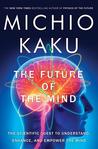
BOOK REVIEW: The Future of the Mind by Michio Kaku

The Future of the Mind: The Scientific Quest to Understand, Enhance, and Empower the MindThe Future of the Mind: The Scientific Quest to Understand, Enhance, and Empower the Mind

by Michio Kaku

My rating: 4 of 5 stars Amazon page

The Future of the Mind continues a line of inquiry that Michio Kaku has been following with his earlier books Physics of the Impossible and Physics of the Future. The central question remains: what sci-fi imaginings might come to fruition, which of them are impossible given the laws of physics in the known universe, and what breakthroughs or discoveries would be necessary to achieve the achievable. Technology is the inevitable gateway to these advanced breakthroughs. Humanity has eliminated gross evolutionary pressures through technology—this might not remain true, but we can certainly not expect X-men style mutations as a result of the foreseeable progression of humanity (which is more likely to be described by the horrible—though probably presagious 2006 movie Idiocracy than it is by the X-men movies.)

The theme of the book, as the title suggests, is the mind. As the most complex system that we know of, the human nervous system offers fertile ground for investigation. Among the sci-fi mainstays considered by Dr. Kaku are telepathy, telekinesis, false memories (think Total Recall), intelligence enhancement, mind control, artificial intelligence, and the nature of alien minds. Along the way he considers the challenges of reverse engineering the brain and whether consciousness could take a non-material form (e.g. embedded in a beam of light.)

As always, Kaku’s book is easy to follow, even for the scientific neophyte. Few others write on the topic with such clarity. While part of Kaku’s book deals with the same concepts covered by Roger Penrose in his book Shadows of the Mind, the Kaku book scores much higher in readability. Of course, the flipside is that Kaku’s book offers less explanatory power. So if one isn’t looking for pop science simplification, The Future of the Mind is probably not for you. However, if you want the jist of the science and have neither the background nor the energy to digest the mathematical and biological nuance, you’ll find this book readable.

Incidentally, Kaku is more optimistic about the ability to computationally replicate consciousness than Penrose, which the latter argues is impossible. Professor Kaku’s optimism runs through all of his books. He takes the stance that if one can imagine it–and figure out a technological or theoretical loophole around the known barriers –one can achieve it. Therefore, some of his discussion of what could come to pass depends upon theories about, for example, black-holes being true. It should be noted that Kaku is quite clear about the differences of opinion that exist about these theories and the role that differences between theory and reality could play in making science fiction into scientific reality.

I enjoyed this book. I’ve been reading a lot about neuroscience lately—entirely on the pop science level- and found this book to be beneficial to my understanding of the subject. It begins by discussing what is known about the brain and consciousness—it turns out that a lot remains unknown, but the technology of recent years has vastly improved our understanding of the brain, and it continues to do so by the day. The book also delves into the depths of what could come to be. There is definitely pragmatic understanding to be gained as well as outlandish, but fun, science fiction ruminations.

For sci-fi fans and writers, it’s definitely worth reading. I had many new conceptions of the future as I read the book. (I might suggest reading Physics of the Impossible first, which gives an overview many “impossible” technologies and explains how few are just flat impossible regardless of technological development and scientific discovery. My review of that book is here.) Many of the ideas covered may seem a bit eccentric, such as what first contact with an alien race would look like. (Kaku is of the notion that the transmission of an immaterial consciousness(es), possibly in conjunction with self-replicating machines would be the likely shape of such an alien presence.)

I recommend this book for almost anyone. We are really only beginning to venture out of the dark ages understanding the mind, and this book provides an interesting map what might be possible.

As I mentioned it, sadly, this may be the more likely future of the human mind:

View all my reviews

BOOK REVIEW: The Tao of Bruce Lee by Davis Miller

The Tao of Bruce Lee: A Martial Arts MemoirThe Tao of Bruce Lee: A Martial Arts Memoir by Davis Miller

My rating: 3 of 5 stars

Amazon page

While one expects this to be a biography of Bruce Lee, the first half of it is much more an autobiography of the author that is loosely themed around Bruce Lee’s influence on his life. It’s an unusual book in this regard. However, while my description may induce visions of a dismal read by a self-absorbed author, it’s really not so bad. The latter half of the book is much more tightly focused on the events of Bruce Lee’s life—or, more dramatically, his death.

To be fair, there’s not much material for a Bruce Lee biography. Few lights have shone so bright that, while brief, they provided decades of afterglow. Bruce Lee was just in the news last week as he was made a character in a new MMA video game—over 40 years after his death. (It might seem odd for Bruce Lee to be featured in an MMA game, but while movie Bruce Lee showed us high-flying, high-kicking kung fu, Bruce Lee the founder of Jeet Kune Do emphasized the ability to fight at all ranges, against opponents of any style, and in a pragmatic fashion.) But Bruce Lee the movie star delivered only four completed movies as an adult (though he had a childhood acting career unrelated to Kung fu.) Martial Artist Bruce had only one real fight that anyone knows about and even it remains a subject of great controversy to this day. There are competing claims about who came out on top, to what degree, and how. According to the book, there’s not even much of a sparring record of which to speak.

With the proceeding information in mind, it might not be such a surprise that the author took the tack he did and still produced only the slim volume that he did. Miller’s description of his own life pulls no punches and he spares himself none of the embarrassment incumbent in being a young man seeking to emulate the squealing man with the fists of fury. He doesn’t come across as the narcissist that one might expect from a person who devotes at half of a biography of a global superstar to his own obscure juvenile years. In fact, his profile is of a scrawny kid who got his fair share of wedgies and other bully-induced torments. The autobiographical parts are more homage than self-aggrandizement.

Just as Miller is honest about his own lost pubescence as a scrawny kid, he will win enemies with his frankness about Bruce Lee and those in the gravitational pull of the kung fu superstar. Those who deify Lee will no doubt be displeased to read intimations that he died not on a walk with his wife and from a rare adverse side-effect of a prescription—but non-illicit–drug, and instead died on the bed of a lover from a hash or pot overdose.

Furthermore, Miller tells of how Bruce Lee told his students to stop teaching Jeet Kune Do, because Lee was worried about where it was going. Miller goes on to report about how Bruce Lee’s martial art went awry according to many. Then there is the suggestion that Lee had little first-hand fighting (or sparring) experience on which to build such a combative art in the first place.

However, the overall portrait of Lee is of an exceptional human being, and one who had such a wide range of influence, from fitness to philosophy. While the Bruce Lee physique is now much sought after and regularly seen among movie stars, all the leading men of Lee’s era were doughy by comparison. (One may look no further than his Way of the Dragon nemesis, Chuck Norris.) Lee wasn’t just a movie star and martial artist; he was also a philosopher and thinker. While it’s true that he didn’t produce much in the way of novel ideas, by Hollywood standards he was a regular Algonquin Roundtable member. Lee oozed charisma so powerfully that after all these decades he’s almost as likely to be seen on a T-shirt as Che Guevara—don’t ask me why the Latin American Guerrilla fighter is so popular in silk screen, but that’s beside the point.

To sum it up, this isn’t a book about Bruce Lee, it’s about how his life and death shaped so many other lives—starting with Miller’s. While I didn’t count pages, there seems to be about as much space devoted to the events surrounding Lee’s death as the events of his life. Of course, there’s a bit of sensationalism, but inquiring minds want to know. People are intrigued about how a man who looked to all appearances to be one of the healthiest men on the planet could have died so young. (It’s an interesting irony that Bruce Lee’s almost complete lack of body fat—estimated at under 1%–could well have exacerbated his oversensitivity to whatever substance killed him.)

I’d recommend this book for anyone curious about the life and death of Bruce Lee.

View all my reviews

BOOK REVIEW: The Rise of Superman by Steven Kotler

The Rise of Superman: Decoding the Science of Ultimate Human PerformanceThe Rise of Superman: Decoding the Science of Ultimate Human Performance by Steven Kotler

My rating: 5 of 5 stars

Amazon page

This is NOT a book about the comic book hero. It’s a book about a mental state called “the flow” and how adventure and extreme athletes have used it to make tremendous strides in their sports. The characteristics of the flow include extreme focus, time dilation / time distortion, a vanishing sense of self, extremely high performance, fearlessness, and a falling away of everything non-essential to the task at hand.

Kotler is by no means the first author to write about the flow. The term was inaugurated by a book entitled Flow first published in 1990 by a University of Chicago Psychology professor named Mihaly Csikszentmihalyi. Csikszentmihalyi coined the term in the process of conducting a study on happiness. He found that happy people tended to engage in activities in which they could immerse themselves and find the zone. Contrary to the early part of Kotler’s book–in which it sounds like adventure athletes cornered the market on flow–Csikszentmihalyi says that said activity could be work or hobby and that the flow is to be found in poetry writing, yoga, martial arts, copy writing, or potentially any activity in which the skill level and challenge are both high.

(To be fair, Kotler does get around to recognizing that extreme athletes neither invented nor exclusively exploit the flow. However, his—well-taken—point is that such athletes are unusually good at finding, and dropping deep into, the flow in part because risk-taking behavior is an important trigger. And for free climbers [rock climbers without ropes], mega-ramp skateboarders, and bodysuit skydivers sometimes there are only two possible states of existence—the flow and being scraped off a rock.) It should be noted that some of the elements of flow sound a lot like the states that have been described by various mystical religious traditions for centuries, e.g. the dissolution of a feeling of separation between self and the rest of the universe. Warning: religious readers may find it disconcerting to read that there are scientific explanations for states that were once attributed to communion with god or the like.

While I’ve given Kotler’s book high rating, I haven’t yet given one reason to read it—and I do recommend people read it. First, while Csikszentmihalyi is the “father” of flow research, his methods were decidedly low tech–i.e. surveys and interviews—but Kotler reports on more recent studies involving neuroanatomy, neuroelectricity, and neurochemistry. Second, while Kotler delves into the science of the flow, he does so in a manner that is approachable to non-scientists. Finally, all of the narrative accounts of extreme athletes interspersed with the more technical commentary make for a very readable book, even if one is not particularly knowledgeable of—or interested in—such sports. I gave this book a high rating both for its food-for-thought value, and because of its high readability.

I will admit that I was not so enamored of the book when I first began it, and other readers may find the same irritation. For one thing, Kotler’s adoration of extreme athletes comes off sounding like diminishment of mainstream athletes and others involved in “flowy” activities. A prime example of this is seen in Chapter 1. Kotler gives us an endearing description of how gymnast Kerri Strug won the gold in the 1996 Olympics by sticking a landing on a shattered ankle. However, he then comes off a bit douchey when he suggests that Strug’s achievement pales in comparison to Danny Way’s skateboard jumps at the Great Wall of China.

For another thing, in his zealousness to prove that extreme sports practitioners are full-awesome while mainstream athletes are “meh,” Kotler makes some comparisons that seem apples and oranges to a neophyte such as me. If they are fair comparisons, he certainly doesn’t explain why they should be considered so. The best example of this is when he states that Olympic divers took decades to achieve increases in rotation that extreme skiers and skateboarders surpassed in much less time. This seems unreasonable for two reasons. First, divers have a very standard distance in which to achieve their acrobatics. In other words, they don’t get to build a “mega-platform” that’s 50% taller like Danny Way creates “mega-ramps” that were bigger than ever before. Of course, if you can increase the distance between yourself and the ground you can increase your spins, rotations, or whatever much more quickly (yes, your danger goes up vastly, I’m not diminishing that.) Second, the divers gained zero advantage from technological improvements, but the same cannot be said for skiers and skateboarders. In other words, if you go from skis made of oak to ones made of carbon nanotubes (that are 50 times stronger and 1/100th of the weight) of course you’re going to make gains faster.

Perhaps, I’m overstating Kotler’s disdain for mainstream athletics, but that’s what happens when one uses a national hero as a set up to show how much more awesome a relatively unknown skateboarder is (among skateboarders Way is extremely well-known but he’s not a household name as the Olympian was–at least for a short time in the late 90’s.) I suspect that Kotler was just trying to convince a general audience that the athletes he’s speaking about aren’t pot-smoking knuckleheads who are as likely to be seen on America’s Funniest Home Videos crushing their nads on a handrail as setting a new world record. These men and women are serious people engaged in serious activities, and they give it their all. They do deserve more respect for that than they are probably given by broad sectors of the populace. Perhaps, the importance of what these folks are achieving does need to be conveyed because the demographic that reads books and the one that follows extreme sports probably has wide wings of non-overlapping area. (I’m not saying skateboarders are illiterate or bookworms don’t skate–just that the Venn diagram has substantial areas of mutual exclusivity.)

As I indicated above, in each chapter we get both some insight into the nature of the flow and its triggers and stories of adventure / extreme athletes that serve as examples of what’s being discussed. In chapter 2 we learn what the flow looks like in terms of brain waves (i.e. high theta/low alpha, or between meditation and a relaxed / resting state of wakefulness.) In chapter 3, we learn about the neuroanatomy of the flow in terms of what areas of the brain it lights up, and what areas shut down–which is more important to flow states. In chapter 4, we learn about the neurochemistry of the flow and that a cocktail of dopamine, norepinephrine, endorphins, anandamide, and serotonin makes up the chemistry of flow, but, critically, not so much with the adrenaline. The subsequent chapters deal with triggers of the flow, and what conditions best set up achievement of this state of mind.

Chapter 9 stands out as an important, but quite different, portion of the book. It deals with the downside (or dark side) of the flow. This has a lot to do with the fact that the aforementioned internal substances (and the flow state in general) are quite addictive. While it’s unfair to say, and unlikely, that the extreme athletes Kotler writes about (i.e. the ones at the top of their games) are drug addicts as some might assume of skate boarders, snow boarders, and the like, it may not be unreasonable to say that they have a kind of monkey on their backs—albeit a perfectly legal one rooted in their own neurochemistry.

As I’ve said, I recommend this book for anyone who is interested in this state of mind. One needn’t be interested in extreme sports to get a lot out of the book.

View all my reviews

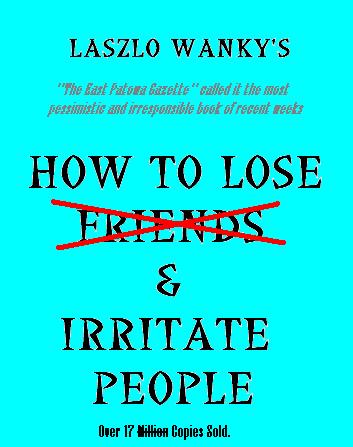
BOOK REVIEW: How to Lose Friends & Irritate People by Laszlo Wanky

Cover_How_to_Lose_Friends


How to Lose Friends and Irritate People by Laszlo Wanky

My Rating: 5 out of 5 Stars

Amazon Page


Wanky pays an homage to Dale Carnegie’s seminal self-help book by calling it, “a book for its time–that time being one in which people were lonely, pathetic, and didn’t understand social networking.” The author’s central premise is that we live in very different times, and today people are inundated by Facebook friends they neither like nor find interesting. Furthermore, Wanky goes on to argue, gone are the days when likable people are  liked. We live in an era in which douche-bags and drug-addled celebrities are gods among men. The book offers many headline examples, such as how Miley Cyrus’s career crashed as the sweet and admirable Hannah Montana, but then she caught her second wind by adopting the persona of a meth-addicted prostitute.


Roughly half of the book is dedicated to how to find success in defriending unwanted virtual amigos. Wanky suggests that the usual tactic of subtly “un-adding” people almost always fails because people are too “wussified” to make it stick. The only effective strategy, according to the author, is to trick others into removing you from their list of pseudo-friends. Be forewarned, however, being uninteresting and annoying is not enough–one must be spectacularly despicable. This is hard for most people–whom Wanky calls “the sychophantic masses”–because they slobber over being liked. Wanky devotes three chapters to helping people get over their love of being liked. The most cogent of these chapters is, “Kim Jong Un or Gandhi: Who Ya Wanna Party With?


The aforementioned chapters also help set up Part II of the book, which explains how one can put a skyrocket on one’s career by borrowing the techniques of the likes of Howard Stern, Rush Limbaugh, and Piers Morgan. Wanky shows how, like these individuals, one can be thoroughly unlikable while having people hang on your every word.  Again, three chapters form the core of this part of the book. They are: “Loud = True”, “Bombastic Fact Picking for Beginners”, and “Your Hairstyle Makes You Sound Stupid.”


I’m not going to pretend that Mr. Wanky’s language is fluid or graceful.  The author’s prose is colloquial… at best. A typical sentence–seen in chapter 8–is, “If ya wanna get with the boom-chiggy-booms, you gotta shout those fart-monkeys down, cause if they hear ’em they’ll all be like, ‘who’s the fart-monkey now, bitch, who’s the fart-monkey now?'”


The book’s strengths include its incredible brevity. Weighing in at only 26 pages, four chapters consist entirely of 27-syllable haiku. It also features fine graphics such as a picture of a “fart-monkey” that any grandmother would be proud to stick on their refrigerator. (The color choices were bit odd, but Wanky was clearly limited to the 16-color box of Crayolas.)


I’d recommend this book for anyone who doesn’t like friends and who really despises people’s indifference toward them. I have no doubt that by following Mr. Wanky’s recommendations, one can become a thoroughly loathsome individual in a matter of days.


Lastly, Happy April Fool’s Day.


BOOK REVIEW: The Science of Yoga by William Broad

The Science of Yoga: The Risks and the RewardsThe Science of Yoga: The Risks and the Rewards by William J. Broad

My rating: 3 of 5 stars

I brought a great deal of interest and enthusiasm towards this subject as I began reading this book. As I proceeded to read, my feelings about The Science of Yoga became much more mixed. At its best, the book shows the state of scientific research on yoga and crushes myths that are deeply ingrained, and it points out risks of which yogis and yoginis should take notice. At its worst, it is sensationalism run-amok–suggesting hugely expensive solutions to issues that are either relatively small problems or that the author fails to prove are really problems at all. Put more simply, at its best it’s outstanding, but at its worst it’s tripe. What I will say about this book is the same thing that its author says about yoga, which is that—on balance—it does more good than harm.

The book is arranged into seven chapters, each of which discusses the scientific research on a different dimension of controversial beliefs about yoga. These include the historic claims of supernatural yogic abilities, the issue of whether yoga increases cardiovascular health, the role of yoga in mental health and well-being, the safety of practicing yoga, the role of yoga in healing, the sexual claims of yogis, and whether yoga enhances creativity. It is written in a scholarly format, heavily end-noted and with bibliographic citations. There is front matter giving information about key people, time lines, and yoga styles in outline form.

In an afterword, Broad points out that this has been his most controversial book to date. I can see why, but, to be fair, I’m sure much of the criticism is unfairly based on a failure to read the book or a desire for the author to treat many of yoga’s mythical aspects as science (as many of its practitioners do.) The former problem was exacerbated by the fact that a single chapter excerpt was published in the New York Times as a teaser for the book. Designed to spark controversy (always good for readership), it was one of the most negative of chapters—the one dealing with yoga injuries. Some who took umbrage probably didn’t realize that Broad is a yoga practitioner, and that there are chapters that are overwhelmingly positive on yoga (e.g. the chapter on “mood” which deals with yoga’s influence on psychology has mostly great things to say about the discipline.) While all of the chapters combine a mix of good and bad news, one comes away from some of them seeing a positive picture of yoga and others with a negative one. In the first half of the book it seems as though chapters may have been arranged to alternate positive and negative dimensions.

Of course, there will also be people who are outraged because of the discussions of the debunking of the con games of their beloved yogis, or for a failure to discuss the critical importance of things like Chakra fluffing. It should be noted that Broad doesn’t deride or mock such spiritual beliefs, he more or less ignores them beyond the occasional off-hand mention—as one would expect in a book about science.

My primary criticism with The Science of Yoga is a common one consideration of problem-solving utilizing public policy (not just with respect to yoga), which is to become so impassioned about a problem that you lose all sight of cost-benefit considerations or the negative feedback effects incentivized by your “solutions.” The problems about which Broad gets so exercised as to suggest an overhaul of yoga as we know it, largely fall into two categories. First, there are problems that are exceedingly rare but catastrophic for in individual involved. This is exemplified by the apparent heightened incidence of strokes among individuals engaged in certain inversions (e.g. a shoulder stand in which the neck is under compression.)

In an interesting turn away from science, Broad makes assumptions in the face of lack of evidence about the incidence of stroke in yoga practitioners. He assumes that yogis have at least the same incidence of stroke due to vertebral artery injury as the general population because of inversions and other yogic activities that put pressure on blood vessels in the neck. He does make clear that it’s just a guess, but one could equally well speculate that those who practice yoga suffer a diminished rate of such strokes because of greater flexibility and strength in the neck. (For the most part the human body is an anti-fragile system, i.e. it grows stronger when subjected to stresses—up to a point—than when shielded from stresses.) While he does call for increased study of the issue, he’s also simultaneously calling for expensive reforms. In essence, he’s calling for a solution before awaiting the evidence that there’s actually a real problem. Stroke is the 800 pound gorilla of the risks the Broad writes about in terms of damage, and so it’s not surprising that he paints the risk in ominous terms. He criticizes the Yoga Journal for dismissing it as a “minuscule number of cases”, but even taking his estimate of 300 (and realizing it could be much lower and is compared to 800,000 cases of stroke per year in the US according to the CDC) “minuscule” does not sound that out of line in a country of 314 million people.

Second, there is the issue of bad information being spread by yoga teachers and authors either because they don’t know any better or because they have an incentive to deceive. This is exemplified by the widespread notion that yoga (and particularly pranayama— breathing exercises) increases one’s cardiovascular fitness. Is it wrong? Yes, but it’s not clear that this propagation of bad information has hurt anybody. That may sound harsh, but—think about it–many people lead long and fruitful lives believing things that aren’t true. Now you may say, “Yes, but people who believe the Earth is flat can’t get hurt believing that, but yoga practitioners can be hurt by wrong information.” I would agree that some wrong information could be damaging, but consider the example given, which–I might add–is one of the main thrusts of Broad’s book. If it were the case that many people got fat because they thought yoga would help their cardio when instead it decreased their metabolism (as the evidence suggests it does), then no one would believe the myth. The idea wouldn’t have the strong hold that it does. What happens more often is that people either lose weight because they stress and eat less or they stay the same—either way they haven’t been hurt any more by bad information. Even if someone came to yoga to lose weight and gained some, they will abandon yoga and go to Zumba or Taebo with greater flexibility and probably a diminished risk of injury for having done yoga.

By spreading information about the risks and the state of scientific understanding of them Broad is doing good work. However, he goes on to suggest that we need lots of bureaucrats to monitor and license yoga and that we need much more rigorous requirements for yoga teachers than the 200 or 500 hour Yoga Alliance certifications that currently exist (or the teaching certificates issued by the gurus or teacher trainers of various styles of yoga), and herein lies two problems. It’s not clear that a problem exists to merit such an expensive solution.

First of all, many of the worst cases that he points out were people engaged in questionable practices on their own. I’m sorry for my frankness, but you can’t regulate stupid out of existence. There was one kid who sat for hours in Vajrasana (sitting on haunches), one who fell asleep in a forward bend, and another who had a stroke after holding a shoulder stand on a hard surface for hours. Now, my experience may not be as extensive as others, but I’ve attended yoga classes in the US, India, and Thailand. I’ve had teachers tell me to hold a pose for 5 deep breaths. I’ve even had teachers tell me to hold a pose for 10 deep breaths. No teacher has ever said to me, “Hold that pose for four hours or until you have a stroke, whichever comes first.” Even teachers with a couple hundred hours of instruction and a couple hundred more of experience don’t—as a rule—give patently stupid advice. (To the degree that there are rare exceptions, thinking that no teacher would ever again give a piece of bad advice if they just all had PhDs is a little presumptuous.)

The major problem with Broad’s suggestion of a need to overhaul the system and install bureaucratic gatekeepers and overseers and to make teachers jump through vastly more educational hoops is that it increases the cost of doing yoga with a teacher. Now, I know that yoga is associated with relatively affluent people, but—believe it or not–there are yoga practitioners who aren’t SUV-driving, Abercrombie&Fitch-wearing, maid-hiring suburbanites. If the monthly cost of attending yoga class goes from tens of dollars to hundreds of dollars because every yoga teacher has to have a PhD in Kinesiology and every studio has to comply with the extensive regulations and licensing fees of the newly formed Department of Yoga Management, then many people who are happy with the level of instruction they are currently getting are going to be emulating books and videos and injury rates could actually go up.

Another example of a “problem” that is not definitively shown to be a problem is Broad’s extensive criticism of an author of a popular book on yoga (i.e. Larry Payne) for using a Ph.D. designation that was from a southern Californian diploma-mill. While there is something objectionable about putting a PhD behind one’s name that wasn’t justly earned, it’s not at all clear that this was a problem. One expects to hear how Larry Payne left a pile of wrecked souls in his wake. However, while Broad devotes pages to ridiculing Payne for putting PhD after his name, the few mentions of the Payne’s interactions with others suggest that he helped them get healthier (e.g. Dr. Ursatine) and that he furthered the state of his professional field. The implication being that the credential matters vastly more than the individual’s experience and diligence. Interestingly, Dr. Fishman (for whom Broad has nothing but kind words—presumably because he holds an MD) is quoted as speaking glowingly about Payne and his contributions to the field.

Another example of sensationalism can be seen in the chapter on sexuality. While we would expect this chapter to be entirely about the claims of yoga being able to enhance one’s sex life, a fair amount of it is devoted to pointing out instances of lecherousness among yogis. I’m not saying that it’s bad to point out bad behavior of gurus in terms of harassing or molesting their female students, but unless there’s some evidence that this inclination is tied the sexual practices of yoga, this would seem to be the wrong venue for the discussion. In other words, if yogis are no more lecherous on the whole than other teachers or coaches, then it would seem that mention of this issue is just to titillate. If yogis are uncontrollable horn-dogs because of yogic practices, then fine, but you’ve got to establish that there’s evidence for that somehow.

Overall, I’d recommend that individuals interested in the scientific literature on yoga read this book. It provides a good overview of the literature, and is well-cited. The books weakness comes from insisting that a large number of mole hills are really the Himalayas. These mole hills can be addressed with education, but can never be eliminated. Suggesting we upend the apple cart to produce “solutions” to marginal problems is ridiculous. We may think a world in which there was never another fatal traffic accident would be nice, but I assure you we would not want to live in the world in which all the actions were taken necessary to achieve said goal. If one compares the extrapolated estimates of hospital visits for yoga injuries, they are really quite few and we have no reason to believe that the vast majority aren’t life-threatening or permanently disabling.

For me it would have been a great book if it laid out the risks and rewards, and suggested caution. Of course, then it probably wouldn’t have gotten any more attention than the many books that already exist on the subject of yoga injuries, so maybe some good can come of Broad’s implication that going to the yoga studio is akin to storming the beaches at Normandy and that we need to stop the horrors or yoga practice.

View all my reviews

BOOK REVIEW: The Miracle of Mindfulness by Thich Nhat Hanh

The Miracle of Mindfulness: An Introduction to the Practice of MeditationThe Miracle of Mindfulness: An Introduction to the Practice of Meditation by Thích Nhất Hạnh

My rating: 4 of 5 stars

Amazon page

This book by the renowned Vietnamese Buddhist monk, activist, and poet, Thich Nhat Hanh, offers pointers on how to live a life of mindfulness. Like most of Hanh’s works, this one is brief, concise, and the front and back matter account for about as much verbiage as the chapters themselves.

The seven chapters that make up the book proper examine mindfulness from various angles, with various approaches, and have a loose organization. The most readable of these chapters–owing to its narrative format–is the last, which retells a Tolstoy story about an Emperor who receives three questions and–unable to find suitable answers by offering a reward to his subjects–dons a disguise and visits a hermit sage. Needless to say, the sage (and life events) enlighten the Emperor, and the answers revolve around the theme of mindfulness. Among the most thought-provoking of the chapters is one that proposes that one take one day of the week to focus on mindfulness. Hanh offers advice on how to best select and structure such a day.

While the appended matter of some of Thich Hhat Hanh’s books can read like filler (intended to reach a page quota), that isn’t so much the case with this book. The most valuable of the appendices gives 32 exercises for building mindfulness. Many of these exercises are variations on a theme, and some are much more extensive than others, but it’s a crucial section and might even be called the heart of the book. Likewise, there are five sutra translations that will be appreciated by readers who are actually Buddhist. (Non-Buddhists may find the sutras to be a less colorful and more repetitive restatement of what Hahn has told them in the chapters. If one pays attention to the chapters and does the exercises, reading the sutra’s isn’t necessary for those who are not students of the religion.)

There is an odd postscript by one of Hanh’s students that is like those I’ve seen in other Hanh books. It’s an odd little testimonial. I put it in the filler category as anyone buying the book knows who Thich Nhat Hanh is and about the accolades he has received and, therefore, they don’t need a prologue telling them how awesome he is. It actually detracts from his persona as a wise man, because it makes one wonder who inspired the little ego trip. I suspect this is more a publisher desired addenda than an author inspired one, but, at any rate, it’s not useful. It can be interesting to hear about the war days, but there’s an outlet for that. Furthermore, I would think the place to tell us how awesome the author is would be at the beginning of the book–not the end. If one gets to the back matter, he must have done something to impress one.

I’d recommend this book for meditators, would-be meditators, and anyone who thinks that life is slipping through his or her fingers because of constant stress and a runaway mind.

View all my reviews