Allow me to make a
    Socratic suggestion:
 That you pursue the lowly
    Art of the question.

Showing you love knowing
   More than you love learning
 Shows only that you're not
   Discerning, and lack requisite
 Yearning to find the Truth.
Allow me to make a
Socratic suggestion:
That you pursue the lowly
Art of the question.
Showing you love knowing
More than you love learning
Shows only that you're not
Discerning, and lack requisite
Yearning to find the Truth.
 Fluent Forever: How to Learn Any Language Fast and Never Forget It by Gabriel Wyner
Sometime not too distant,
   There will come a day
 When you will return to
   A frequent state of play.

When that day comes around,
   You'll have lost all concern
 For the adults' belief that
   Frivolity must be spurned.

You'll take to tossing balls
 And climbing up the walls,
 Just like you used to do
  When you were one or two --
    Before that human zoo
     Got its hooks in you.
I’ve often been surprised how little intuitive grasp people have of basic mathematical or statistical ideas or relationships, even when they have had the education to understand with a little effort.
One example of this is what I call “unilateral mathematics” where people fixate on one term or side of an equation while ignoring that changing a term changes the equation’s other side (or to keep the other side static, something else has to give.) For example, I hear people getting so excited by the new salary they will earn when they move to a new place. Then they get to the new locale only to find that the cost of living is so much higher that even their hefty pay boost supports only a diminished quality of life. One sees this tendency a great deal in people’s policy discussions when someone will say, “just set a maximum (or minimum) price” without understanding that shortages or surpluses will come along for the ride. [The Law of Unintended Consequences is another good answer to this prompt.]
We all saw flaws in statistical thinking during the pandemic when people said things like, “See, she got the vaccine and then she got COVID, so obviously the vaccine doesn’t work!” I’m convinced this is because people don’t have good intuition for statistical thinking and — instead — they want to treat a low probability as an impossibility and a high probability as a certainty.
By the way, you see this from people of all persuasions, including those who are highly educated, conservatives, progressives, believers, atheists, etc. One can see the universality of the flaw most commonly in climate change comments. You’ll hear one person say, “See, it’s the hottest day on record, that’s evidence global warming is real!” Another person will say, “See, it’s the coldest day on record, global warming is obviously hokum!” Somehow, even with diametrically opposed viewpoints, these two manage to both be wrong because one day’s WEATHER is not instructive of what is happening to the CLIMATE. In other words, a sample of one provides no insight into state changes in the population. [Maybe it’s more appropriate to use Wolfgang Pauli’s terms and say the two are “not even wrong.”]
By the measure of having taught still useful lessons about HOW to think (those who taught me WHAT to think are largely forgotten along with their lessons,) that would be a tie between my 11th grade Psychology teacher and an undergrad Religious Studies professor. The former, among other ideas, first exposed me to what I would come to believe is the most important lesson of human existence under his label of the “gestalt of expectations.” [I’ve never heard anyone else refer to it as such, but the lesson was sound and I would latter find it in philosophies from Buddhism to Stoicism.] The latter teacher, among other ideas, exposed me to two common opposing modes of fallacious thinking, what he called “the outhouse fallacy” and “the first-est is best-est fallacy” (he was a folksy, if erudite, professor.)
In terms of personal growth and development, generally speaking, there are numerous teachers of martial arts, yoga, and other mind-body practices that are incomparable and thus unrankable. Not to mention, a sound argument can made for the repugnantly unhumble statement that I am my most influential (and most important) teacher. (I state this claim not as though I am unique, but as one that could apply to anyone.)
Every so often I run into a sentence that blows my mind a little bit. Here are a few recent examples:
We may be in the universe as dogs and cats are in our libraries, seeing the books and hearing the conversation, but having no inkling of the meaning of it all.
William james
One must read ten thousand books and travel ten thousand miles to be an educated man.
Old chinese adage (As Translated by ha jin in The Banished Immortal)
Poetry is an echo asking a shadow to dance.
Carl Sandburg
Distrust of grammar is the first requisite of philosophizing.
Ludwig wittgenstein
He who knows only his own side of the case knows little of that.
John stuart mill
What colleges have you attended?
Indiana University, Georgia Tech, and Georgia State University. Also, technically, University of Maryland and City Colleges of Chicago (through the military.)
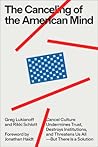 The Canceling of the American Mind: Cancel Culture Undermines Trust and Threatens Us All―But There Is a Solution by Greg Lukianoff
What podcasts are you listening to?
I don’t really, though I do catch YouTube rebroadcasts of Joe Rogan, Lex Fridman, and some standup comics.
What was your favorite subject in school?
Depends on the year. In twelfth grade, I remember enjoying Physics the most. In Eleventh, Psychology was the best class I attended. There was a year when I got the most out of an English class that focused on Creative Writing. I guess my most longstanding preference was for classes like Geography and Social Studies, wherein we learned about the world outside our world.


 Tiger Riding for Beginners