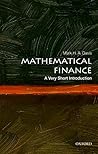
BOOK: “Mathematical Finance: A Very Short Introduction” by Mark H. A. Davis

Mathematical Finance: A Very Short Introduction (Very Short Introductions)Mathematical Finance: A Very Short Introduction by Mark H.A. Davis
My rating: 4 of 5 stars

Publisher Site – OUP

This is Oxford University Press’s Very Short Introduction to the field of the “Quants,” individuals who apply mathematics to questions of how to value financial assets and assess risks. The book begins by laying out how banking and financial markets work, then discusses how interest rates are determined, and then explores the quantification of various risks faced by lenders. The book finishes by discussing how the 2008 financial crisis impacted the field and how it operates in the wake of that event. (The 2008 crisis was described in an intriguing fashion in the book and movie The Big Short. It basically resulted from deceptive grading of mortgage-backed securities such that investors who thought they had the ultimate default-proof asset in fact had assets that not only could collapse, but — in fact — were bound to.)

Even though this book is a concise introduction, it shouldn’t be confused for a simple guide. It is not only mathematically intense but also jargon dense. It’s not a complete waste for someone without any advanced mathematics and / or economics / finance background to read, but there will be large patches that will likely be lost on one. (And if you’re not at all used to reading scholarly writing, it may be excessively daunting.)

If you want a quick guide to the field of quantitative finance, and you have an understanding of the mathematical notation used in calculus and statistics, I’d recommend this book. If you are interested in the topic but aren’t at all mathematical, you might start elsewhere (the aforementioned, The Big Short, might be a good place.)

View all my reviews

PROMPT: Live Anywhere

Daily writing prompt
If you could live anywhere in the world, where would it be?

Someplace inexpensive, with beaches and hikeable hilly / mountainous terrain within a reasonable distance, and where beer prices are not disproportionately high vis-a-vis the general cost of living. FYI — I call the latter the “stick-up-the-bum” index because if beer prices are relatively high, it usually means they are heavily sin-taxed (it’s not an expensive product to make,) and so disproportionately high beer prices suggest the society is trying to micromanage personal behavior. I may or may not want a beer (I’ll want one,) but I prefer to live in a society with a live-and-let-live mentality. Candidates exist in Southeast Asia, Latin America, and the Central Asia / Caucus region.

PROMPT: Personal Item

Daily writing prompt
Name the most expensive personal item you’ve ever purchased (not your home or car).

I think it was a sword, back in the days when swordsmanship was among the subjects i studied. But I can say, with some measure of pride, that I really don’t know for sure because I don’t really put much value in owning things and have become ever less interested in possessing more stuff.

When you’re a traveler, they’re all just anchors, and not goods.

Anything expensive I buy better be absolutely essential, have multiple uses, or —ideally— both.

PROMPT: Podcasts

Daily writing prompt
What podcasts are you listening to?

I don’t properly listen to any, but I watch clips and segments from many on YouTube — mostly those of comedians, but some of a popular science or current events / international affairs / macroeconomic nature.

PROMPT: Brands

Daily writing prompt
What brands do you associate with?

Unless and until they cut me a check, I have no “association” with any brand.

I believe loyalty to friend, family, and nation can all be great virtues, but loyalty to a corporation is just silly. (They certainly won’t be loyal to you when it conflicts with what is best for the profit margin.)

ZAMBIA LIMERICK

PROMPT: Cities

Daily writing prompt
How would you design the city of the future?

I suspect cities are on the way to becoming passé. They worked great for an economy built around humans exchanging time and effort for a salary, but in an economy in which machines do virtually all productive tasks better, faster, and more efficiently than humans, the benefits seem less clear.

Plus, there’s a lot of discussion of an epidemic of loneliness, and so it seems — as a basic organizational structure — cities (admittedly ironically) don’t serve humanity well. People are adapted for families and tribes — more close-knit communities.

Furthermore, Asia is already beginning to see the problem of downward scalability of cities, as many cities shrink less elegantly than they grew. Birth rates are declining everywhere as humanity reaches its upper limit for this planet.

Maybe the future is artist colonies.

The End of the World as We Know It [Free Verse]

Humans have been hunters,
gatherers,
farmers,
machines,
thinkers,
and creators,

And have no idea what we'll next be.

I think that people will next be
-- simply --
Human Beings,
Full-time Human Beings --
More Human,
More Being...

And many will fail spectacularly.

PROMPT: Harmony

Daily writing prompt
What could you let go of, for the sake of harmony?
My wonkish need to analyze the train wreck that is our present state of governance and social discourse.

“Epigram for Wall Street” by Edgar Allan Poe [w/ Audio]

I'll tell you a plan for gaining wealth,
Better than banking, trade or leases —
Take a bank note and fold it up,
And then you will find your money in creases!
This wonderful plan, without danger or loss,
Keeps your cash in your hands, where nothing can trouble it;
And every time that you fold it across,
'Tis as plain as the light of the day that you double it!