One's-Self I sing, a simple separate person,
Yet utter the word Democratic, the word En-masse.
Of physiology from top to toe I sing,
Not physiognomy alone nor brain alone is
worthy for the Muse, I say the Form complete
is worthier far,
The Female equally with the Male I sing.
Of Life immense in passion, pulse, and power,
Cheerful, for freest action form'd under the laws
divine,
The Modern Man I sing.
Category Archives: body
Spine [Lyric Poem]
BOOKS: “Play” by Stuart Brown
Play: How It Shapes the Brain, Opens the Imagination, and Invigorates the Soul by Stuart M. Brown Jr.My rating: 4 of 5 stars
Amazon.in Page
Why does biology encourage play? Why does it stop encouraging play at some point? Should play end, or should one maintain a dedication to play throughout life? These are principal questions addressed by this book.
Brown explores the advantages of leading a playful life, and he doesn’t restrict himself to childhood play. In fact, the book doesn’t restrict itself entirely to human play, but also presents insights derived from the study of other playful species. One of the most profound lessons from the book comes from a story about a sled dog that has repeated playful interactions with a polar bear — a hungry polar bear, at that.
The book is presented more like an essay or a collection of essays than the usual popular science or pop psychology book. That is to say, it is not annotated and lacks a bibliography. The author sites the occasional book or study in the text, but it’s in the manner one would see in journalism or essays. This approach has its advantages, but the flipside of those advantages are the disadvantages. On the positive side, the author is able to communicate more freely, including the ability to discuss more speculative possibilities than one would expect from scientific reporting (with its usual “just the facts” approach.) Of course, the extensive speculation will be frustrating to readers who want to know what evidence has been produced for the proposed benefits. Furthermore, it often feels like the speculation in question is of the “when you’re a hammer every problem is a nail” nature — i.e. when one is a play researcher, one may be inclined to see play as a panacea for all the ills facing humanity (it surely is for some, but probably not all.) [To be fair, the book is almost fifteen years old, and I suspect it was / is probably harder than pulling teeth to get academic funding for play research outside of early childhood development, and so part of what the book was probably trying to do was build enthusiasm for supporting this kind of research, which necessitated talking about possibilities that were outside the known.]
The book does have a chapter on “the dark side of play.” It deals with compulsive behaviors like gambling and video game playing addiction (i.e. not people who like playing video games once in a while, but those who go 48 hours without sleep and who live in cave-like darkness to limit screen glare.) Much of the chapter argues that, while those problems are real and of concern, the activities aren’t play, not as per the definition presented early in the book.
This book does make a sound case for a number of benefits of play and for not abandoning play in one’s youth. If you’re interested in how play can help one to cope in a world of uncertainty, to keep one’s mind and body healthy, and to maintain or grow one’s capacity for imagination, this book is well worth reading.
View all my reviews
Worlds, Inner & Outer [Free Verse]
PROMPT: Physical Activity
I don’t have a favorite, but there are several that I could not maintain health and sanity without, including: hiking, yoga, calisthenics, taiji / qigong, free movement, and at least one cardio (I currently swim and run.) I’m currently struggling with juggling.
PROMPT: Lazy Days
Rested. Definitely. I believe one has to think of rest and recovery as part of the process of living. If one thinks of it as just wasting time between “doing things,” then one isn’t going to get the most out of body and mind.
Machine Flow [Free Verse]
This machine can flow,
moving over, around,
& through.
Skin conforms to the contours
of musculature.
Muscle binds to bone,
muscle that thickens
and lengthens and ripples
and pulses.
Bones that flex and recoil.
But that machine can flow --
over, around, and through.
It can cause air to pop
and water to slosh
and earth to tremor.
It crawls through liquid,
slices through gases,
and slams the solids,
but can move over, around,
and through.
BOOK REVIEW: The Exquisite Machine by Sian E. Harding
The Exquisite Machine: The New Science of the Heart by Sian E. HardingMy rating: 5 of 5 stars
Amazon.in Page
Release date: September 20, 2022
Get Speechify to make any book an audiobook
In this book, a renowned heart researcher presents an overview of what we know (and don’t know) about the human heart: i.e. what can go wrong with it and why, how [and to what degree] it fixes itself, and what modern medicine can do to treat or replace a damaged heart. I learned the most from the middle of the book – i.e. chapters five through seven. Chapter five explores plasticity in the heart, plasticity is a concept that most people associate with the brain and its ability to rewire itself to contend with damage or changing needs. The other two chapters look at how the heart can be damaged, specifically as a result of emotional experience. A “broken heart” isn’t necessarily a misnomer.
Chapter four is also intriguing but takes the win for “which one of these things is not like the others.” It deals with big data, though not in a general sense but rather as it applies to gaining a better understanding of the heart. This chapter discusses a common challenge of medical research: that it’s hard to come up with large enough study groups of patients with close enough to the same problem to draw solid conclusions. Four also discusses the potential of the vast amount of data that exists, e.g. Fitbit heart rate figures.
The last couple chapters deal largely with the future of heart repair through genetic / biological means (as opposed to via mechanical hearts and technologies, which are dealt with in Chapter nine.) This is where the book gets to be a challenging read for a readership of non-experts. It gets technical and jargon- / acronym-heavy.
The heart is an astounding entity, relentlessly at work, rarely giving up despite regularly being subjected to intense shocks, an organ tied to our whole being in a way that humans have always felt – if only just begun to understand. If you’re interested in learning more about this magnificent organ, check this book out.
View all my reviews
BOOK REVIEW: Karate Science by J.D. Swanson
Karate Science: Dynamic Movement by J.D. SwansonMy rating: 4 of 5 stars
Amazon.in Page
When I picked up this book, I did so with the hope that it would be to striking as Jiichi Watanabe’s excellent book “The Secrets of Judo” [now sold as “The Art and Science of Judo”] is to grappling. That didn’t turn out to be the case. If Watanabe’s book has a fifty / fifty split between science and judo, Swanson’s book is about 80 percent Karate manual and 20 percent science. It’s a fine book about karate techniques, but if you want to understand biomechanics and how to optimize your movement, I think you can do better (particularly, if you would like insights that apply beyond Okinawan Karate.)
The book had two failings, keeping it from living up to its potential. First, it didn’t use graphics as well as it could have to help the reader visualize what is being said, or to point out the subtleties under discussion. Second, it generally presents the science at a shallow level. I’d been pleased to see that there was a chapter on breath, because I think that’s one of the most important and under-discussed factors in any system of movement (martial or otherwise.) However, I was disappointed to see that there wasn’t much to it besides some philosophizing about ki-ai.
There were a few valuable tid-bits here and there, points about which the book adds to one’s scientific / bodily understanding. The best example of this is probably the discussion of Intra-Abdominal Pressure (IAP,) which is where the book most shines with respect to offering some food for thought.
If you study Okinawan Karate and are looking for discussions about the difference between how various schools perform techniques, this may be the book for you. However, if you’re expecting some science in a book entitled “Karate Science,” I suspect you can do better.
View all my reviews
Balance & the Value of Learning to Fall
I saw something sad in the park this morning. A boy was trying to learn to ride a bicycle, but I could see that he never would — not with his present approach. Why? He had one training wheel, and the bike was leaning about 15-degrees off vertical as he struggled to use the bicycle as a tricycle. I could see that the metal arm that supported the training wheel was starting to bend from the strain — thus making the lean ever more pronounced. [Incidentally, with two training wheels, I think he might rapidly learn to ride because he’d experience tipping from one side to the other, through the balance point.]
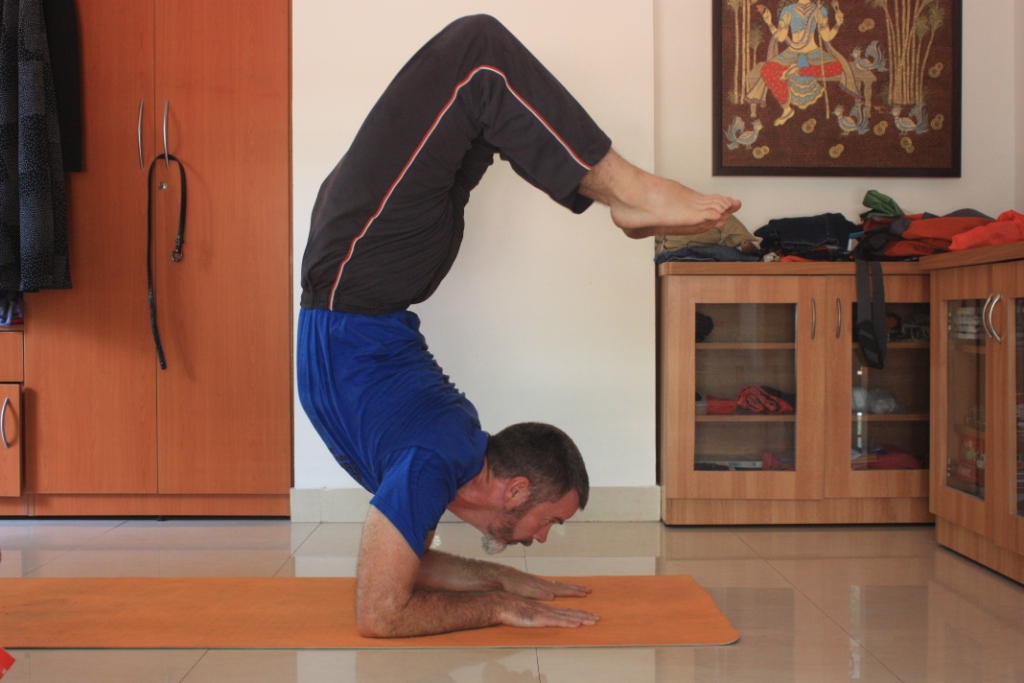
I’ve told yoga students before that there are three timelines for learning inversions (upside-down postures, which all require one’s body to learn to balance 180-degrees out of phase with the balance we all mastered as toddlers.) The first timeline is if you are willing to learn break-falls (i.e. how to safely land when — not if, it will happen — one loses balance.) If so, one can learn any inversion (that one is otherwise physically capable of performing) in an afternoon. Second, if one gets near (but not up against) a wall, and only uses the wall when one is falling towards over-rotation, then one can learn the inversion in a month — give or take. Finally, one can lean up against the wall for a million years and one will not spontaneously develop the capacity to independently do the posture. Why? Because one’s center of gravity is outside one’s body, which means one is in a perpetually unstable state, and one cannot stabilize into a balanced position from a state of falling (and leaning is just falling with a barrier in the way.)
Finding balance requires that the body be able to adjust toward any available direction to counteract the beginning of a fall in the opposite direction. I was fortunate to have studied a martial art that required learning break-falls from the outset, this made learning balances (not just inversions, but also arm balances, standing balances, etc.) much easier because there was no great concern about falling. I knew my body could fall without being injured.
Without falling there’s no learning balance, and if you only fall into the under-rotated position, you are still not learning to achieve stable balance. At some point, you will need to experience the dread fall towards over-rotation.
Time to ditch the training wheels.