BOOK REVIEW: The Storyteller’s Handbook by Elise Hurst

The Storyteller's HandbookThe Storyteller’s Handbook by Elise Hurst
My rating: 5 of 5 stars

Amazon.in Page

Out: June 14, 2022

This is a book, but not one that one reads but rather one that one writes. It contains more than 50 imaginative and fantastical artworks intended to help creative parents build their own stories, while helping their children learn to become storytellers. There is a forward by Neil Gaiman (who has worked with the artist on previous occasions) and an introduction by Hurst, but otherwise there’s almost no text.

The animate subjects of the book are children and animals, but not just any animals. They are mis-sized, misplaced, mythical, imaginary, anthropomorphized, and extinct creatures in search of a clever explanation for their existence and behaviors. The usual suspects of our beloved stories are most well-represented: bears, lions, foxes, rabbits, birds, and fish – for example. But there are also less well-known creatures: mollusks, a mantis, kangaroo, koala, and armadillo. The settings are also designed to fuel the imagination: oceans, hot air balloons, impossibly floating places of all sorts, cities of gothic and fantastical architecture.

If you’re looking for a storybook where you have a graphic prompt to trigger your own story, this is a beautifully illustrated example of such a work.


View all my reviews

BOOK REVIEW: Romanticism: A Very Short Introduction by Michael Ferber

Romanticism: A Very Short IntroductionRomanticism: A Very Short Introduction by Michael Ferber
My rating: 4 of 5 stars

Amazon.in Page

Romanticism was a literary, artistic, and philosophical movement of the late 18th and early 19th century. It’s commonly believed to have been a response to the Enlightenment, a desire to not throw out the baby with the bathwater as the influence of religion waned. In this book, we learn that that’s a misleading oversimplification, but not one completely devoid of truth.

Like a lot of “movements,” Romanticism is a fairly loose set, containing a disparate band of entities. This is exacerbated because it’s not just, say, a style of painting or of music, but rather it cuts across a diverse range of activities. Because of that, the book offers the least clarity in the opening chapters (ch. 1&2) and in the last one (ch. 6.) The first two try to rope in Romanticism and to differentiate it from “sensibility,” a movement oft-confused for Romanticism. The last chapter attempts to show the commonality that cuts across different domains, e.g. how are Romantic paintings similar to Romantic novels, or – for that matter – Idealist philosophy.

However, starting with chapter three, the book provides clear insight into the nature of Romanticism. Chapter three investigates poetry. Chapter four examines philosophy and Romantic attitudes towards religion and science. This was quite eye opening to me because I’d previously contrasted Romanticism with the Enlightenment, and here I learned that the Romantics’ views on religion and science were far from the opposite end of a spectrum. Chapter five shines light on the social context of Romanticism, focusing on politics, the French and the Industrial Revolutions, and War, but also evaluating what influence, if any, Romanticism had on changing views toward women.

I feel I came away from the book with a better understanding of Romanticism, and so I’d recommend it for others interested in learning more.

View all my reviews

BOOK REVIEW: Puella Mea by e.e. cummings

Puella MeaPuella Mea by E.E. Cummings
My rating: 5 of 5 stars

Amazon.in Page

Free online at: Project Gutenberg

This is a single poem, Cummings’s longest, a love poem to his first wife. It’s a longform poem – at least by the standards of poets of the Modern era, though at less than 300 lines it’s far from epic in scale. It’s a beautiful love poem, favorably comparing the wife in question to Helen of Troy, Medea (from “Jason and the Argonauts,”) Guinevere, and other historic beauties.

It’s a highly readable poem; its short lines pack a lot of punch, and while Cummings writes in free verse, he’s not afraid to drop a rhyme or play with the texture of meter to give his lines an appealing sound quality.

The edition I read included art from Paul Klee, Pablo Picasso, Amedeo Modigliani, and Kurt Roesch. It’s definitely worth checking out this edition, particularly if you enjoy Modern and Surreal art.

I’d highly recommend this for poetry readers.

View all my reviews

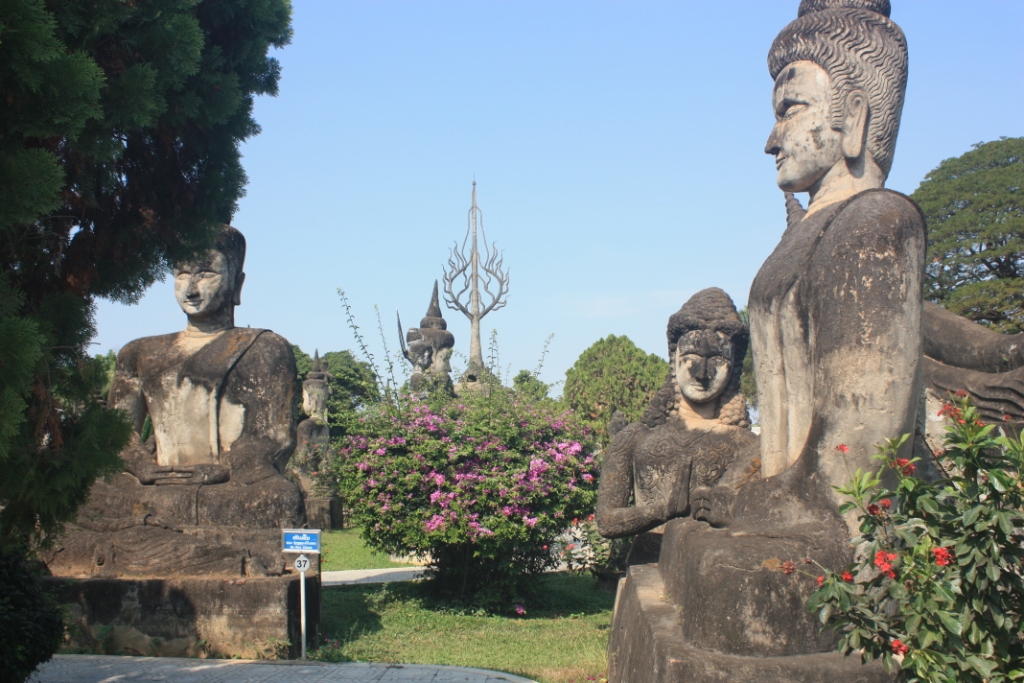
DAILY PHOTO: Seated Section of the Buddha Park

Taken in January of 2019 at Xieng Khuan [The Buddha Park] outside Vientiane

BOOK REVIEW: Dark Tourist by Hasanthika Sirisena

Dark Tourist: EssaysDark Tourist: Essays by Hasanthika Sirisena
My rating: 5 of 5 stars

Amazon.in Page

This collection of, mostly autobiographical, essays rambles over a territory that includes: grief, the immigrant experience, sexuality, art and catharsis, and the profound impact of self-perception on one’s experience of life. The title most directly links to one of the more evocative essays, “Confessions of a Dark Tourist,” which is about the author’s travels back to her native country, Sri Lanka, to visit the northern region where a vicious civil war played out most intensely. [For those unfamiliar with the term, “dark tourism” is travel to areas that have recently experienced upheaval due to war, economic collapse, intranational conflict, or large-scale accidents and disasters.]

I used the term “rambles” in my opening sentence, and these essays (even within essays) can take the reader places a lawyer would object to on the grounds of relevance. That said, it’s a far better thing to be rambling and interesting than tidy and dull, and this book does a good job of keeping it interesting, using stories that are (I presume) meant to symbolically link to a point at hand. Sometimes, that symbolism hits, and sometimes it might not, but it does make for a compelling read. The author is valiantly candid about her personal struggles, particularly as they pertain to issues of self-perception owing to a lazy eye and her [bi-] sexuality.

If you’re a reader of essays and creative nonfiction, I’d recommend you give this book a look.


View all my reviews

DAILY PHOTO: Jagganath Street Art, Puri

Taken in Puri in December of 2021

Sculpture Charnel House [Haiku]

a charnel house
of sculpted anatomy 
amid the ruins

Pensive [Free Verse]

In days of old,
did pensive dancers loaf about,
leaning on temple doorjambs?

Or, was that only the case
 in the minds of sculptors?

DAILY PHOTO: Buddha Head, Ratnagiri Museum

Taken in December of 2021 at the Ratnagiri Archeological Museum

BOOK REVIEW: Zen Art for Meditation by Stewart W. Holmes and Chimyo Horioka

Zen Art for MeditationZen Art for Meditation by Stewart W. Holmes
My rating: 5 of 5 stars

Amazon.in Page

This is a clear and insightful exploration of what puts the Zen in Zen art. Zen Buddhism has long been associated with mind states conducive to peak performance in everything from tea making to swordsmanship. This book examines how Zen philosophy and mindset shows up in paintings and haiku poetry.

Fifteen tenets of Zen are presented, and for each of them two paintings (i.e. sumi-e) and several poems (i.e. haiku or tanka) are shown that have subject matter exemplifying the precept in question. The text points the way to understanding how the art is informed by Zen ideas.

I’ve read other books on the nexus between Zen and art, but this one became my favorite. It is concise, well-organized, and illuminating. There are a number of classes of people for whom I’d highly recommend this book. If you are studying Zen meditation (or peak mental performance more generally,) this book is for you. If you are a poet interested in Japanese forms, this book is for you. If you are an artist or a student of Chinese and Japanese painting styles, this book is for you. And, if you are interested in philosophy, be it Buddhist philosophy or aesthetics, this book is for you.


View all my reviews