Positive? Negative? Who’s to say? Like the Taoist farmer, I’ll withhold judgement.
Tag Archives: Taoism
BOOK: “Stories and Myths of Eight Immortals” Trans. by Li Yanjia and Nathaniel Hu
Stories and Myths of Eight Immortals by AnonymousMy rating: 3 of 5 stars
Available online – Internet Archives
This is a fine collection of stories about the adventures of the Eight Immortals (mostly as individuals, but with a few stories that feature the whole group.) There are twenty-eight chapters, but a few less than that of stories because the first chapter is an introduction to the Eight Immortals, and there are a couple of chapters at the end that discuss the origins of cultural artifacts associated with the Eight Immortals.
The stories are pulled from varied sources. I would give the stories a five, but this edition is loaded with grammatical mistakes — to the point of being distracting and unpleasant to read. It reads not like a present-day Google Translate translation, but rather as if it was being spoken by someone with an uneven (remedial to elegant) grasp of English. [Not everywhere, but enough to be problematic.]
The stories themselves are engaging, often have moral, and are quick reads (mostly a page, a few more than three pages.)
If you can tolerate reading through patches of bad grammar, this is not a bad collection of stories and information about the Eight Immortals, but if it’s too much to stomach, you might want to look elsewhere. The stories themselves are widely available, though not necessarily in English and, if so, not necessarily collected into a single volume. With editing, this would be an excellent collection of stories.
View all my reviews
Surrender [Lyric Poem]

Let the flood sweep
one away — out
of the shallows,
into the deeps.
Don’t ever cry;
Don’t ever weep;
Just feel the speed
Carry one on.
PROMPT: Instincts
More and more each day. And I’m starting to trust reason less and less.
BOOKS: “The Activist” by Daniel Fried
The Activist: A Daoist Protest Manual by Daniel FriedMy rating: 4 of 5 stars
Publisher Page — Prometheus Books/
Release date: March 3, 2026
Taoist philosophy has been applied to many a subject over the centuries, from war to business to governance to relationships, but this is the first time I’ve seen it applied to activism in a substantive way. The book caught my eye because I’ve long recognized the central truth behind Fried’s work, which is that the tactics and mindsets of protesters often does them no favors and may even ensure failure (if one presumes the objective to be to change behavior and attitudes on a given topic into line with the protesters’ stance.) The problem is that protesters are often angry and combative, characteristics which may keep the choir (preaching to itself) warm and feeling self-righteous, but which seldom brings in new converts from among the undecided [let alone from the opposing side.] And if you didn’t need converts to your side, you wouldn’t have to protest in the first place. Given this tendency, Taoism could be argued to be an ideal source of strategy. Taoism proposes going with the grain, not leading with a fight, and avoiding useless activity.
This book provides interesting food-for-thought about how protesters might have more impact by adopting fewer belligerent and self-serving tactics. Unfortunately, the book also has stretches of stream-of-consciousness writing that — while perhaps consistent with the Taoist love of spontaneity — can be a bit of a strain on the reader’s ability to follow. This mostly takes place in the latter chapters.
I found this book to be intriguing. I can’t say that I came away from it having answered the question of whether Taoist philosophy is reconcilable with activism on a practical level. Taoism asks one to let the natural unfold, while protest movements want to guide a society in a particular direction (notably one by definition at odds which that which has fallen into place organically.) It’s not for lack of discussion that I haven’t reached a conclusion, but rather that questions remain for me on the pragmatic level (rather than the level of theory.) That said, I found the book well worth reading, despite a few points of low readability.
View all my reviews
PROMPT: Working On
What have you been working on?
Being…. POW!… more spontaneous. 自然 (zìrán) in the Taoist conception.
PROMPT: Principles
What principles define how you live?
Before traveling, empty my cup. Before returning home, empty my cup.
Collect experiences, not geegaws.
Wishing for the world to be some other way is a grand waste of time.
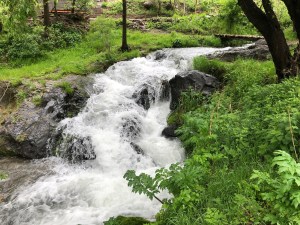
If there is a river flowing toward where I want to be, surrender to it.
See humor everywhere, especially in myself.
Be content with who I am at the moment, while struggling to be a better version in future editions.
Strive to find the non-adversarial path.
Keep looking until I see what is beautiful in all things and creatures.
Don’t attempt to construct anyone else’s list of principles to live by.
Feel the sensations that arise without letting the mind amplify them out of proportion.
Seek only simple pleasures, enjoy them fully, and then move on.
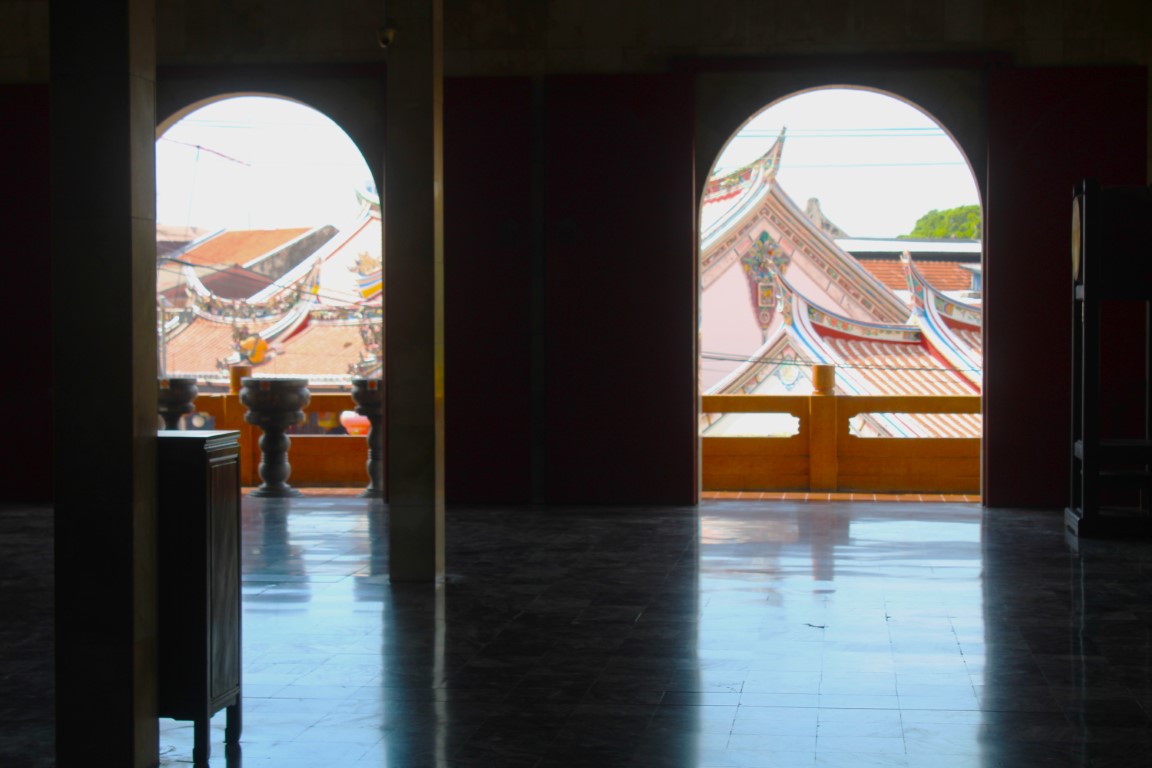
DAILY PHOTO: Quán Thánh Temple, Hanoi


BOOK: “The Poetry of Zen” Ed. / Trans. Sam Hamill & J.P. Seaton
The Poetry of Zen by Sam HamillMy rating: 5 of 5 stars
Publisher Site – Shambhala
This poetry anthology consists of translations of Chinese and Japanese poetry that play in the Zen aesthetic. They are not Zen Buddhist poetry in the sense of being sutras or sutra-like expositions on Buddhist philosophy or theology (at least, not mostly.) And while there are many monks and Buddhist layperson poets represented, not all of those included were Buddhists. (In fact, there is even some verse from the Daodejing included, though Taoism is certainly philosophically related to Zen.)
About half the book is Chinese poetry, including pieces from Han Shan, Li Bai, Bai Juyi, Wang Wei, Du Fu, and many other greats of Chinese poetry. (Note: my spellings of author names varies from those used in the book because Hamill and Seaton use Wade-Giles spellings.) The other half of the book consists of works by Japanese poets, including: Saigyo, Dogen, Basho, Ryokan, Buson, Issa, and others. The Japanese part includes a few haibun (prose poems interspersed with haiku,) adaptations of Chinese-style poems, as well as the various Japanese fixed form styles (i.e.. haiku, tanka, etc.)
The two translators, Sam Hamill and J.P. Seaton, initial the poems that each translated (some were dually translated and others singularly.) I enjoyed the translations and felt they were fine reading in their own right. With haiku and tanka, the translators stuck fairly close to the traditional form (in as much as the aesthetic could be maintained doing so,) but with Chinese lyric styles they often took a freer approach to form.
If you’re interested in poetry that conveys Zen sentiment, this book is worth investigating.
View all my reviews
“Drinking Alone in the Rainy Season” by Tao Yuanming [陶渊明] (a.k.a. Táo Qián, or 陶潜]
Whatever lives must meet its end --
That is the way it has always been.
If Taoist immortals were once alive,
Where are they today?
The old man who gave me wine
Claimed it was the wine of the immortals.
One small cup and a thousand worries vanish;
Two, and you'll even forget about heaven.
But is heaven really so far away?
It is best to trust in the Tao.
A crane in the clouds has magic wings
To cross the earth in a moment.
It's been forty years of struggle
Since I first became reclusive.
Now that my body is nearly dead,
My heart is pure. What more is there to say?
NOTE: This is the translation of Sam Hamill found in The Poetry of Zen (2004); Shambhala Publications: Boston, MA, p.24.