


 Lost in the Twentieth Century by Albert Szent-Györgyi
 The Last Brother by Nathacha Appanah
Crazy. He stumbles, flops, gets up,     and trudges on again.
 He moves his ankles and his knees     like one wandering pain,
 then sallies forth, as if a wing     lifted him where he went,
 and when the ditch invites him in,     he dare not give consent,
 and if you were to ask why not?     perhaps his answer is
 a woman waits, a death more wise,      more beautiful than this.
Poor fool, the true believer:     for weeks, above the rooves,
 but for the scorching whirlwind,     nothing lives or moves:
 the housewall's lying on its back,      the prunetree's smashed and bare;
 even at home, when darkness comes on,     the night is furred with fear.
Ah, if I could believe it!     that not only do I bear
 what's worth the keeping in my heart,     but home is really there;
 if it might be! -- as once it was,      on a veranda old and cool,
 where the sweet bee of peace would buzz,     prune marmalade would chill,
 late summer's stillness sunbathe     in gardens half-asleep,
 fruit sway among the branches,     stark naked in the deep,
 Fanni waiting at the fence     blonde by its rusty red,
 and shadows would write slowly out     all the slow morning said --
 but still it might yet happen!     The moon's so round today!
Friend, don't walk on. Give me a shout     and I'll be on my way.
Bolond, ki földre rogyván     fölkél és ujra lépked,
s vándorló fájdalomként     mozdít bokát és térdet,
de mégis útnak indul,     mint akit szárny emel,
s hiába hívja árok,     maradni úgyse mer,
s ha kérdezed, miért nem?     még visszaszól talán,
hogy várja őt az asszony     s egy bölcsebb, szép halál.
Pedig bolond a jámbor,     mert ott az otthonok
fölött régóta már csak     a perzselt szél forog,
hanyattfeküdt a házfal,    eltört a szilvafa,
és félelemtől bolyhos     a honni éjszaka.
Ó, hogyha hinni tudnám:     nemcsak szivemben hordom
mindazt, mit érdemes még,     s van visszatérni otthon,
ha volna még! s mint egykor     a régi hűs verandán
a béke méhe zöngne,     míg hűl a szilvalekvár,
s nyárvégi csönd napozna     az álmos kerteken,
a lomb között gyümölcsök     ringnának meztelen,
és Fanni várna szőkén      a rőt sövény előtt,
s árnyékot írna lassan     a lassu délelőtt, --
de hisz lehet talán még!     a hold ma oly kerek!
Ne menj tovább, barátom,     kiálts rám! s fölkelek!
NOTE: Originally titled, ERŐLTETETT MENET, and dated September 15, 1944 (in Bor, Serbia,) this poem was found on Radnóti’s person after his execution by fascists in 1944. The translation used is that of Zsuzsanna Ozsváth and Frederick Turner: i.e. Radnóti, Miklós. 2014. Foamy Sky: The Major Poems of Miklós Radnóti. ed. & trans. Zsuzsanna Ozsváth and Frederick Turner. Budapest: Corvina Books, pp. 228-229.
What historical event fascinates you the most?
It varies over time. For a long time, it was the Second World War and the Holocaust. How do you get the rise of Nazis and the horrors that sprang therefrom? Sadly, I think that question has been answered to my — for lack of a better word— satisfaction.
The execution of Socrates has spurred a great deal of thought.
In terms of what is not so much a historical event, but historical processes, I’m intrigued by the life of Buddha.
Then there are a lot of explorer / adventurer travels.
 He Who Fights With Monsters by Francesco Artibani
 Freiheit!: The White Rose Graphic Novel by Andrea Grosso Ciponte
My rating: 4 of 5 stars
Out: March 4, 2021
This tragic story tells the tale of a small college-centric anti-Nazi resistance group, doing so in graphic novel form. While it touches upon the story of six White Rose members who were executed, special emphasis is given to the sister-brother duo of Sophie and Hans Scholl. White Rose was largely involved in distributing leaflets to encourage others to engage in resistance activities against the Nazis. (Note: the translated text of the White Rose pamphlets is included as an appendix.) There is so much attention given to the truly fascinating question of how a bunch of fascist lunatics managed to run a country into such diabolical territory that it can easily be missed that there was at least some resistance within Germany. I, for one, was oblivious to the story of White Rose before reading this book.
The arc of the story takes the reader from the upbeat stage during which White Rose was succeeding in distributing articulate and persuasive flyers, through some of their close calls and other frustrations (e.g. the Scholl’s father being arrested), and on to the bitter end. Much of what I’ve seen previously about resisters centered on communists. One sees in White Rose a different demographic. There are a number of religious references without the “workers of the world unite” lead that would be taken by leftist groups.
I believe the author overplayed the stoicism with which the executed individuals accepted their fate. This is based upon a true story, and so this may seem an unfair criticism because perhaps that’s how it appeared in reality. However, from a storytelling perspective, it felt surprisingly devoid of emotional content [given the events provide loads of potential for it.] There is a great tragedy in young people being executed by the State for asking others to resist fascism, but as a reader I didn’t really feel an intense visceral connection to events. As I said, I suspect this had to do with the author wishing to show that the Scholls took it in all in stride, but I think some display of angst or anger might have made for a more intense reading experience. I don’t know whether it was more a textual or graphic issue that left me unmoved.
All in all, the book was an interesting insight into resistance to the Nazis in an academic environment. I did find reading the pamphlet translations themselves to be insightful. The flyers give one insight into where the student-resisters were coming from, and what buttons wished to push in others. It might have been a bit more gripping, but it was an interesting telling of events.
If you’re interested in learning more about Germans who resisted the fascists, this book provides a quick example of how (and by whom) it was done, and I’d recommend you give it a read.
 The Photographer of Mauthausen by Salva Rubio
My rating: 5 of 5 stars
Due out: September 30, 2020
This “graphic novel” tells the story of a Spanish photographer, Francisco Boix, who was sent to the Mauthausen Concentration Camp as a Communist during the Second World War. [Note: I only put graphic novel in quotes because it’s not a fictitious story, which “novel” implies, but graphic novel seems to be the accepted term for any graphically depicted story – fact or fiction.] Mauthausen was a camp in Austria. While it wasn’t technically one of the extermination camps, it was legendary for the death toll associated with the granite mine where many of the inmates labored. Its “staircase of death” was the location of untold fatalities, including: murders by the Nazis, suicides, and even tripping accidents that will happen when an emaciated prisoner has to carry 50 kg stones up almost 200 uneven steps with no railing day after day.
Boix, who had been a journalistic photographer previously, was assigned to work for a Nazi officer who took pictures in the camp – particularly pictures of fatalities. Boix carried equipment, set up lighting, developed negatives, and made prints. His boss, Ricken, is depicted as bizarre character. On the one hand, Ricken seems not so bad by Nazi SS standards, but, on the other hand, he has a sociopathic inclination to see death as art. Boix takes advantage of his position to make copies of the negatives with the idea that they will be evidence when the war comes to the end. At first, there is support for this plot among the Spanish Communists, who help hide the negatives away in places like the carpentry shop. However, this support dwindles when it becomes clear that the Germans will lose the war, and – thus –surviving to the end becomes everyone’s primary focus. Soon Boix is on his own to figure out how to get the photos out. He develops a plan involving one of the boys at the camp (children being less intensely scrutinized) and an Austrian woman, who is a sympathizer.
The book climaxes with the operation to get the negatives out of the camp, but resolves with the immediate post-War period when Boix attempts to generate interest in the photographs as well providing testimony at the Nuremberg Trials. Boix is portrayed as fiery and impassioned. When the others at Mauthausen just want to survive to the end, he maintains that any risk is worth it. While he is shown to have some conflict about putting a boy’s life at risk with (arguably) the riskiest step in the process, he doesn’t seem waiver. At the trials he’s outraged about the panel’s insistence on “just the facts.” He wants to freely and fully tell the story of Mauthausen, and they – like courts in democracies everywhere – wish to maintain an appearance of the dispassionate acquisition of facts.
I found this book to be engaging and well worth the read. The artwork is well-done and easy to follow. The story is gripping. While there are a vast number of accounts of events at places like Auschwitz, there aren’t so many popular retellings of events at Mauthausen. I highly recommend this book for those interested in events surrounding World War II and the Holocaust.
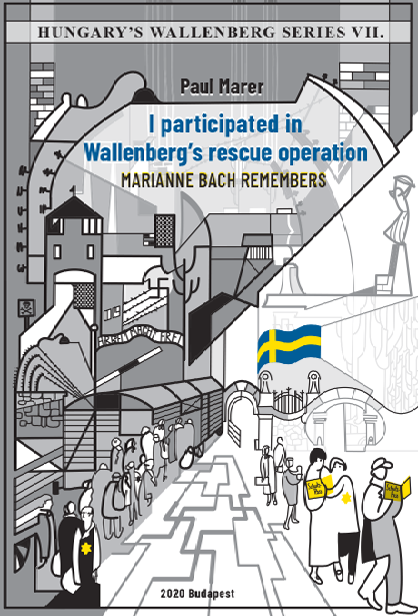
 I Participated in Wallenberg’s Rescue Operations by Paul Marer
My rating: 5 of 5 stars
Inquiries about purchasing the book can be made here.
In 1944, the Nazis were working to eradicate the European Jews. Among the last major Jewish populations accessible to Hitler that had yet to be shipped to the death camps were those from Budapest. Among the most effective forces arrayed against the Nazis and the Arrow Cross Militia (the Hungarian fascists) in the days before the Red Army arrived were neutral nation diplomats who issued protective documentation, offering at least a thin shield of legal protection that saved thousands of lives.
Perhaps the most intriguing story of such diplomats is that of the Swedish envoy, Raoul Wallenberg – not because his operation was bigger or riskier than those of the others, but because his story didn’t end with the war. Wallenberg was captured by the Soviets at the end of the Siege of Budapest for reasons that remain speculative, and he died in a Soviet prison. This book draws on the experience of Marianne Bach, a young member of Wallenberg’s team. Given the loss of Wallenberg, and the fact that the other members of his operation are now deceased, Bach’s story is an important last chance to learn more detail about what happened in Budapest during those dark days.
The book is chronologically arranged. The first two and the last three chapters discuss Marianne Bach’s life before and after, respectively, her days working as part of Wallenberg’s team. A reader might dismiss such chapters as humdrum, if necessary, background information, and starkly contrast them with the more high-octane, life-and-death, fascist-fighting core of the book. However, Marer fixes his sights on an intriguing focal point throughout these chapters, identity (and crises, thereof.) Both before and after the war, Bach was challenged by questions of identity – religious, cultural, and national identity. Living abroad, she was a foreigner, but at “home” in Hungary there’d been a great effort to eliminate her people. It was smart to focus on events and questions at the crux of identity. It makes these chapters engaging to a degree that a broad biographical sketch would be hard-pressed to achieve.
The core of the book (ch. 3 – 8) doesn’t just tell Bach’s story – in fact, it doesn’t just tell the Wallenberg story, it delves into the broader question of the fate of the Budapest Jews and all those who intervened to save whomever they could. This isn’t to say that the closeup story is absent. Readers get a detailed view of the operations that Bach was involved in and an overview of the Wallenberg story – including discussion of his fate as a secret Soviet prisoner. It’s just that those closeup stories are embedded within a broader context that includes activities like Carl Lutz’s Glass House operation, Hitler’s order to take over of Hungary before it could defect from the Axis, and the Danube executions by Arrow Cross Militiamen that followed that takeover.
This book provides a gripping examination of a disturbing time, and I’d highly recommend it.







 Tiger Riding for Beginners