FIVE WISE LINES [December 2025]

William Blake painting of Urizen praying to the world he created, an illustration from "Song of Los."
William Blake:
Urizen prays to the world he created (1795)
Song of Los

I must create a system
or be enslaved by another man’s…

william blake; Jerusalem: The emanation of the great albion

Saying Yoga exists to make one more flexible
is like saying that it exists to wring farts out of one’s body,
both will happen — neither is the primary objective.

Me

He that is without sin among you,
let him first cast a stone at her…

JESUS; John 8:7

The best government is that which governs least.

Henry david thoreau, Civil Disobedience

Gods always behave like the people who make them…

zora neale hurston; Tell my horse

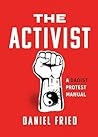
BOOKS: “The Activist” by Daniel Fried

The Activist: A Daoist Protest ManualThe Activist: A Daoist Protest Manual by Daniel Fried
My rating: 4 of 5 stars

Publisher Page — Prometheus Books/

Release date: March 3, 2026

Taoist philosophy has been applied to many a subject over the centuries, from war to business to governance to relationships, but this is the first time I’ve seen it applied to activism in a substantive way. The book caught my eye because I’ve long recognized the central truth behind Fried’s work, which is that the tactics and mindsets of protesters often does them no favors and may even ensure failure (if one presumes the objective to be to change behavior and attitudes on a given topic into line with the protesters’ stance.) The problem is that protesters are often angry and combative, characteristics which may keep the choir (preaching to itself) warm and feeling self-righteous, but which seldom brings in new converts from among the undecided [let alone from the opposing side.] And if you didn’t need converts to your side, you wouldn’t have to protest in the first place. Given this tendency, Taoism could be argued to be an ideal source of strategy. Taoism proposes going with the grain, not leading with a fight, and avoiding useless activity.

This book provides interesting food-for-thought about how protesters might have more impact by adopting fewer belligerent and self-serving tactics. Unfortunately, the book also has stretches of stream-of-consciousness writing that — while perhaps consistent with the Taoist love of spontaneity — can be a bit of a strain on the reader’s ability to follow. This mostly takes place in the latter chapters.

I found this book to be intriguing. I can’t say that I came away from it having answered the question of whether Taoist philosophy is reconcilable with activism on a practical level. Taoism asks one to let the natural unfold, while protest movements want to guide a society in a particular direction (notably one by definition at odds which that which has fallen into place organically.) It’s not for lack of discussion that I haven’t reached a conclusion, but rather that questions remain for me on the pragmatic level (rather than the level of theory.) That said, I found the book well worth reading, despite a few points of low readability.

View all my reviews

BOOK REVIEW: “New Story of the Stone” by Jianren Wu [Trans. by Liz Evans Weber]

New Story of the Stone: An Early Chinese Science Fiction NovelNew Story of the Stone: An Early Chinese Science Fiction Novel by Jianren Wu
My rating: 5 of 5 stars

Publisher Site – Columbia University Press

This book is presented as a sequel to the Chinese literary classic (alternatively) known as Dream of the Red Chamber or Story of the Stone. The central character is a scholarly traveler by the name of Baoyu. The first part of the book is set in China around the time of the Boxer Rebellion, an event that features in the story. Throughout this portion, the book reads like historical fiction. However, Baoyu’s travels eventually bring him to a hidden realm, a technologically advanced utopia within China. It is here where Baoyu’s adventures get fantastical and otherworldly, and the book ventures into the domain of Science Fiction.

The setting of the book reminds me a little of Marvel’s Wakanda from Black Panther. Perhaps both instances of worldbuilding were motivated by the humiliated colonists’ fantasy of being more advanced than those who pull the strings for once, or of showing their (respective) lands to be places of “crouching tigers and hidden dragons” (i.e. where great talents exist but remain unseen.) (Note: While China wasn’t on-the-whole colonized by a Western country, its interaction with England and other Western nations left it forced to accept terms unfavorable and undesirable to China (not to mention the outright colonized enclaves such as Hong Kong and Macau.) While the publisher has emphasized the science fiction aspect of this work, it is an anticolonial work through and through. The book can come across as xenophobic and nationalistic in places, but this only reminds the reader of how such positions might be arrived at under the boot of foreign influence.

The book is readable though philosophical and is well worth reading for those interested in developing a deeper insight into Chinese perspectives.

View all my reviews

PROMPT: Future

What are you most worried about for the future?

A global rise in governance by populist authoritarians in which people give up abstract conceptual benefits like checks and balances and rule of law in exchange for the more tangible bread and circuses.

I’m not so concerned about the demographic crises because I think those long-scale issues work themselves out, just as when Malthus predicted the human population was growing too fast and global famine was inevitable.

I’m also not so worried about [G]AI because if we make machines that can crush us, we deserve to be crushed to make way for the new. That said, I think we are at the beginning of a crisis of modernity that will reach its apex when machines can do all productive tasks better than can humans. But, I’m pretty sure I’ll outrun that, and by choosing to focus on the art of being human, it’s not so impactful, personally.

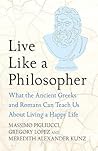
BOOKS: “Live Like a Philosopher” by Massimo Pigliucci, Gregory Lopez, and Meredith Alexander Kunz

Live Like A Philosopher: What the Ancient Greeks and Romans Can Teach Us About Living a Happy LifeLive Like A Philosopher: What the Ancient Greeks and Romans Can Teach Us About Living a Happy Life by Gregory Lopez
My rating: 4 of 5 stars

Publisher Site — Hachette / Headline Press

This book is for a person in the market for a philosophy of life, but who only knows that they want a system rooted in Ancient Greece. While the coauthors are all Stoics, the book explores twelve additional philosophies and gives each roughly equal consideration. In addition to the expected systems, such as Epicureanism, Stoicism, Platonism, and Skepticism, there are also several lesser known or defunct philosophies such as Cyrenaic hedonism, Cynicism, Pyrrhonism, and Megarianism.

The book is organized into four parts. The first examines schools that value pleasure (Cyrenaicism and Epicureanism,) the next investigates schools that focus on virtue and character (Aristotelian Peripatetics, Stoicism, Cynicism, and Political Platonism,) the penultimate focuses on systems encouraging doubt or caution in knowledge (Socratic philosophy, Academic Skepticism, Sophism, and Pyrrhonism,) and the last set are posed as questionable candidates for a life philosophy (i.e. those of the Pythagoreans, Megarians, and Neoplatonists.) The last three schools are questioned on various grounds, including: is enough known about what its practitioners believed, did they live their philosophy or just ruminate on it, and could the system be considered a full-fledged philosophy (as opposed to a stance on a specific issue or issues.)

The book is presented in self-help fashion, with each chapter ending in a set of exercises designed to help the reader build practical understanding of each school. The goal of these exercises (as comes together in an appendix) is to help the reader determine which philosophy is best suited to their disposition and inclinations.

I enjoyed this book. The authors use stories to convey ideas and the book’s readability is kept inviting to general readers. If you’re interested in better understanding Greek schools of philosophy, I’d recommend the book as quick and easy way to get a better grasp.

View all my reviews

PROMPT: Freedom

Daily writing prompt
What does freedom mean to you?

Of the universe of all possible actions, one can choose to attempt any (or refrain from any) but those curtailed by a small number of laws intended to keep one from impinging upon the freedoms of others or imposing costs / burdens on them to which they did not consent, or by self-imposed limitations (e.g. one’s own ethical belief system or one’s physical / mental limitations.)

Often it is wrongly confused with comfort. A maximally free society is not maximally comfortable for anyone, because one has to accept that others will make all sorts of choices that one would not make oneself (and that it’s none of your business.)

PROMPT: Disagree

Daily writing prompt
What public figure do you disagree with the most?

These days? Trump — hands down. Beyond a few of his stated policy objectives, there is more and more I disagree with every day. (I emphasize “stated” because there is so little that’s coherent in his actions to prove he is really interested in advancing said objectives.) For example, I do agree that the swelling deficits (budget and trade) are something that should be treated as unsustainable. I’m not of the “a current account deficit is just a capital account surplus, so turn that frown upside-down” ilk. However, erratic and untargeted tariff policies that hurt successful sectors (e.g. agriculture and services) and which will only put the toothpaste back in the tube (bring [human] factory labor back to the US on a huge scale) by crashing the US into Third World status are not the way.

I disagree with this inexplicable monomaniacal obsession with heavy industry, while injuring those sectors that have done well in recent decades.

I agree with… Powell, that there is a high chance of stagflation if the Fed takes a loose money stance. The problem is… Trump. Ordinarily, it would be good to dump some money on an economy that is struggling. But the problem is that Trump is like a salesperson that would like to sell customers something, but he also enjoys chasing them around the store with an axe. The problem is that people and companies don’t make big purchases when they are afraid and the future is uncertain. (This is why even getting investment in robotic factories isn’t happening.) There’s uncertainty because of the tariffs. There’s uncertainty about whether companies will have to pay bribes to Trump, personally. There’s uncertainty about whether the legal and institutional frameworks that have so long made America an appealing place to invest and innovate will survive. So, if the Fed injects money but consumer confidence and investment are flat because of said uncertainty, then that money will be purely inflationary. [Remember, inflation is too much money chasing too few goods. More money needs to meet more demand for stuff.]

I disagree that one can have one’s cake and eat it, too. Specifically, tariffs need to be either for revenue generation or for policy negotiations, they can’t be both, but Trump talks like he doesn’t understand this. If tariffs are going to be the new primary source of government income, they need to bring in money sustainably. If they are a negotiating tool to lever policy, you need to be ready to negotiate them away in return for your own objective wins.

I definitely disagree with the ignoring of Supreme Court decisions. It’s particularly disconcerting to see him ignore 9 – 0 decisions, which means that even his own appointees could not find a hairsbreadth of wiggle room in the law by which his actions could be viewed as lawful.

I disagree with picking a raft of pretty-idiots / talking-heads for positions that require high levels of emotional intelligence and — you know — intelligence intelligence. If it weren’t for the fact that America has the most awesome and professional military in the world, I’d be especially afraid that Hegseth was going to destroy it. But while I think the US Military will be around long after he’s gone, I’m suspect he will have done damage to morale and operational efficiency.

I disagree with favoring dictators over longtime allies. [While I would agree that it’s good that Europe is taking on more of the burden of their own defense, I’m concerned that trashing relations to do so will not prove a sound approach.]

I disagree with all the attempts to play from the Putin-Orban Populist Dictators’ Playbook.

While I’m not at all averse to seeing cuts to the Federal bureaucracy, I do disagree with — you know — firing people before you understand what they do and whether it’s critical to health and safety, the necessary conduct of governance, or oversight against fraud and abuse.

I disagree that one should talk about making loophole end-runs around Constitutional prohibitions.

But, I ramble on…

BOOKS: “Wen-Tzu” Trans. by Thomas Cleary

Wen-TzuWen-Tzu by Lao-Tzu
My rating: 5 of 5 stars

Publisher Site – Shambhala

This work is presented as “further thoughts of Laozi [老子].” Readers of the Dàodé jīng [道德经] will recognize many a familiar statement of that work, but this book is much more extensive and detailed. I say “presented as” because scholars no longer believe this was a product of Laozi and his lifetime (if such an individual ever existed.) For one thing, the book seems more syncretic than the Dàodé jīng, that is to say there are points at which it sounds strikingly Confucian — rather than purely Taoist.

As with the Dàodé jīng the Wénzǐ [文子] covers a lot of ground from metaphysics to individual ethics to political philosophy, but this book has more room to sprawl on each subject.

As with other Cleary translations, it’s a pretty readable translation.

I’d recommend it for readers interested in Chinese Philosophy.

View all my reviews

PROMPT: Community

Daily writing prompt
How would you improve your community?

That’s a tough one because while I see value in communities, I’m also concerned that there is a rising trend toward tribalism and nationalism that will not be good for anyone — not to mention a shift toward virtual communities where anonymity and disconnect lead to people to act as though they were raised by hyenas. (I do know that, in reality, that’s an insult to the marvelous hyena, but I think it makes a sort of point for the non-hyena expert.)

I’ve been amazed at how India manages to have an intense sense of community in such a vastly super-tribal environment. (I’m using “supertribe” in Desmond Morris’s sense — i.e. a community which is too big for everyone to know everyone else, and which has a group dynamic that reflects that fact.) But it’s not as though there isn’t a dark side to this intensity of community — patriarchy, sectarian conflict, disempowered societal segments, etc.

America, by comparison seems to be experiencing a dearth of true community, which is driving people toward virtual “communities,” and in virtual communities people seem to fall into the shittiest versions of themselves. Not to mention the lack of community’s contribution to what I’ve heard called a “mental health crisis.”

I guess my preferences would be that community be: 1.) real and not virtual. 2.) that it exploit the advantages of diverse membership instead of wallowing in homogeneity and group think. 3.) that it doesn’t create overclasses and underclasses. And that, 4.) Community norms minimally negate individual freedoms.

That said, I’m not at all sure that the above criteria can be reconciled. Maybe the tradeoffs are too strong. Maybe – in our super-tribal world – the closest-knit society will always be the most xenophobic [fearful / disliking of outsiders,] and maybe tolerance and egalitarianism will always be accompanied by societal degradation. I have observed a strong inclination for people to think of compassion as a zero-sum game.

As I said, a tough one.

“Once there came a man” by Stephen Crane [w/ Audio]

Once there came a man
Who said:
"Range me all men of the world in rows."
And instantly
There was a terrific clamor among the
people
Against being ranged in rows.
There was a loud quarrel, world-wide.
It endured for ages;
And blood was shed
By those who would not stand in rows,
And by those who pined to stand in rows.
Eventually, the man went to death, weeping.
And those who stayed in the bloody scuffle
Knew not the great simplicity.