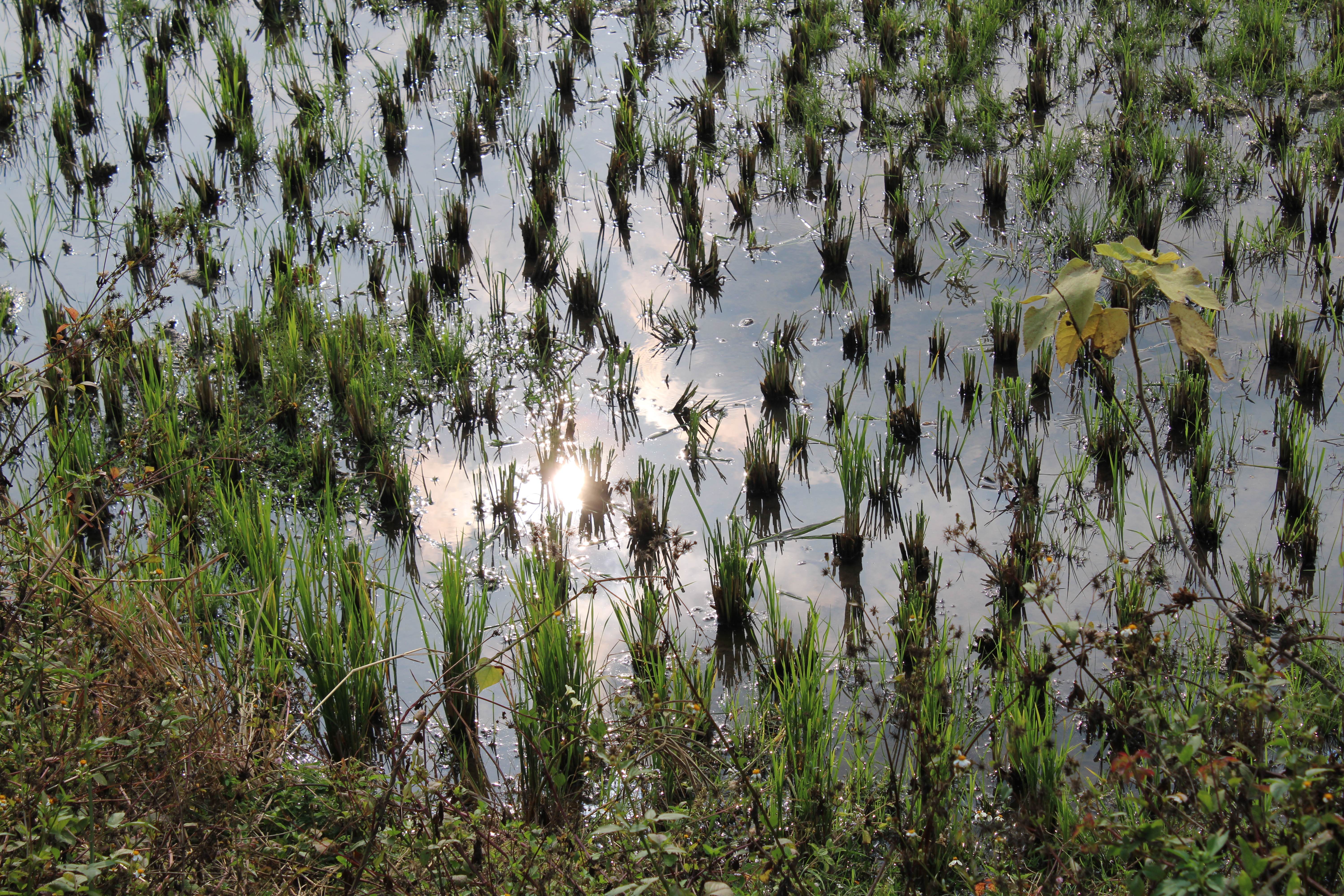
Hoeing farmer, as heat haze roils,
   His flowing sweat waters the soil.
 All those who know food on a plate
   Should feel each grain comes of that toil.
NOTE: The title of this poem (悯农, or Mǐn Nóng) is often translated as “Toiling Farmers,” though “Compassion for Farmers” or “Pity Farmers” would be closer to the literal translation.
Lonely and longing to travel;
   All alone and lacking a tribe.
 Like the crane up on the mountain,
   Or the cloud that enshrouds its peak.
 Like the portraits painted by past
   Masters, of souls you couldn't have known.
 Like a leaf drifting on swift winds,
   Bounding through the boundless spaces.
 You'll never be able to hold it,
   But can hear the song it dances to,
 Those who accept this can tune in,
   And the signal will only get stronger.
NOTE: The late Tang Dynasty poet, Sikong Tu (a.k.a. Ssŭ-k‘ung T‘u,) wrote an ars poetica entitled Twenty-Four Styles of Poetry. It presents twenty-four poems that are each in a different tone, reflecting varied concepts from Taoist philosophy and aesthetics. Above is a translation of the twenty-second of the twenty-four poems. This poem has been alternately titled “Abstraction,” “Elegance,” and “Drifting Aloof” by varied translators, but its original title is 飘逸.
My song has put off her adornments.
 She has no pride of dress and decoration.
 Ornaments would mar our union;
 they would come between thee and me;
 their jingling would drown thy whispers.

My poet's vanity dies in shame before thy sight.
 O master poet, I have sat down at thy feet.
 Only let me make my life simple and straight,
 like a flute of reed for thee to fill with music.
NOTE: This poem is sometimes titled, “My song has put off her adornments,” or – simply – Song VII.
There was an Old Man with a beard,
 Who said, "It is just as I feared! --
     Two Owls and a Hen,
     Four Larks and a Wren,
 Have all built their nests in my beard!"
NOTE: This poem no. 1 of Lear’s The Book of Nonsense.
No hawk hangs over in this air:
 The urgent snow is everywhere.
 The wing adroiter than a sail
 Must lean away from such a gale,
Abandoning its straight intent,
 Or else expose tough ligament
 And tender flesh to what before
 Meant dampened feathers, nothing more.

Forceless upon our backs there fall
 Infrequent flakes hexagonal,
 Devised in many a curious style
 To charm our safety for a while,
   Where close to earth like mice we go
   Under the horizontal snow.
Quit seeking to firm up the soul;
 Return to the unadorned truth.
   One can seek the shape of water;
   One can write of a pleasant spring.
 Winds shift the shapes of clouds,
 Flowers stand tall, and flowers droop.
   The great waves of a sprawling sea,
   The mountain's craggy ruggedness...
 They all emulate the Great Way.
   Every wonderful thing is dust.
 Find semblance beyond shape or form.
 In this person, the multitudes.
NOTE: The late Tang Dynasty poet, Sikong Tu (a.k.a. Ssŭ-k‘ung T‘u,) wrote an ars poetica entitled Twenty-Four Styles of Poetry. It presents twenty-four poems that are each in a different tone, reflecting varied concepts from Taoist philosophy and aesthetics. Above is a translation of the twentieth of the twenty-four poems. Translated titles vary. This one has been titled “Descriptive” and “Form and Feature” by varied translators.













 Tiger Riding for Beginners