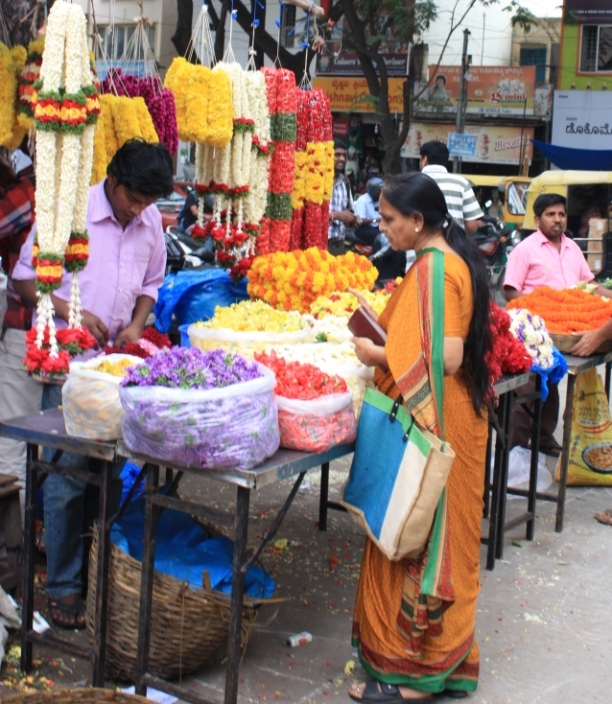
Enough with the Indian Food Warnings, Already

Bengali Authentic Full Meal; Source Nandinissaha (via Wikipedia)

Bengali Full Meal; Source Nandinissaha (via Wikipedia)

When I tell people that I’m moving to India, a common–but strange–response is for them to issue warnings about the food and water. I find this odd for two reasons.

First, said warnings are often issued without much firsthand experience of developing world dining (not including high-brow resorts), and without knowledge of my dining history.

Here are few facts that might help one to better understand my approach. I’ve dined on cold seafood salad in a Phnom Penh cafe. I’ve noshed on snake-on-a-stick in China. I once supped at a home/restaurant in the Peruvian Andes whose latrine consisted entirely of a squat-hole cantilevered out over a  cliff side. A couple of days in Bangkok, I consumed nothing but street-food. I was raised on a farm with non-pasteurized milk, and had a father who wasn’t above cooking up a nice-looking piece of road kill. Not a bloated opossum mind you– but I’ve gnawed clean the drumstick of a pheasant that died not by birdshot, but on the grill of a Peterbuilt. (Funny story, spellcheck wanted to change “pheasant” in the preceding sentence to “peasant.” That would have really freaked you out.) So while my home life has been first world, I’ve got a little third world in my gut.

Now you’re probably thinking, “This idiot is infinitely lucky to be alive, and given his behavior he will probably die soon.” Au contraire mon frère. It’s not that I randomly engage in high-risk behavior. Even locals get Delhi Belly if they don’t choose wisely–despite the full panoply of aggressive gut organisms working on their behalf. I’m quite aware of the hazards, and take calculated risks backed up with sensible precautions.

It’s funny that people live in terror of street food–not that there aren’t some carts that one should run from screaming. However, do you really know what the pimply-faced teenager is touching or scratching during the act of assembling your burger at Chili’s? I know exactly what the hands of the old lady grilling my moo ping on Sukhumvit Road looked like. I got a good look because there was always a line that I had to wait in– and gladly so. (FYI – sanitary wipes or hand sanitizer are one thing you should take with you wherever you go in this world.)

I’m not saying that I’ve never gotten an upset stomach, but I’ve done some remote third world travel and never experienced anything worse than resulted from any given trip to Taco Bell.

I’m quite fond of Indian food, and am sure I will cope well with having it for the majority of my meals for the next couple years. Yes, I’ll have to severely reduce my intake of ice-cold beverages and raw foods. (Ice and wash water are the hidden killers that probably cause more food-borne ailments than anything else.) However, ice-cold beverages –while refreshing and pleasant– are not really that healthy for a body in high temperatures anyway. (Flash heating or cooling of things at the other end of the temperature spectrum is bound to cause problems–one’s organs aren’t that different.) While I like raw vegetables, the human body is more efficient at extracting nutrients from cooked food, so there’s a side advantage there as well.

I think people freak themselves out and miss out on some excellent food. One individual who traveled widely once told me that she never ate the local food for fear of getting sick. I felt bad for her. She traveled to the source of some of the world’s best food, and then dined on American fast food–that’s a squandering of no small part of the travel experience. Of course, some people have very weak systems, and that may have been the case for her. (American fast food may be bad for you, but it is uniformly bad throughout the world.)

The second thing that I find strange is that when I was moving to England 25 years ago, no one warned me that I would be going to one of the most gastronomically unappealing places on the planet. Let’s face it, the reason Britain took over India in the first place was so that they could get something decent to eat. Curry is also the reason they didn’t let go easily.

Is there some bias whereby people tend to respond with negativity when one says that one is moving to the developing world, versus positive responses to moving within the developed world?  One probably shouldn’t respond with negativity to news someone is moving anywhere, but–if you must– you should tailor it to the individual concerned.  For example, if one said to me, “That shrill flute in their music is going to get on your last nerve.”  Well, sorry, but that’s probably a correct statement. (No offense, I’m sure it sounds lovely if you were brought up with it, but it will be–at best– an acquired taste for me.)

Outsourced as a Guide to Indian Corporate Culture?

As my wife and I prepare for our move to Bangalore, we are doing research to help us avoid inadvertent insult and blasphemy . We’ve learned such useful facts as: a.) don’t tug on a Sikh man’s beard, and b.) don’t buy a statue of the goddess Durga to use as a hat rack.

Source: Dipankan001 (via Wikipedia)

Durga Source: Dipankan001 (via Wikipedia)

These are just the kind of faux pas a well-meaning but uninformed American couple might make. (Oh, you say, not really?)

Every culture has its little proclivities that seem insane from the outside, but which are so deeply ingrained as to be invisible from the inside. (In fact, I had trouble thinking up such American cultural proclivities, but I believe they exist. Our norms are just so ingrained as to be hard to see. Of course, we are also a  diverse society, a young nation, and tend toward the irreverent in the social domain– all of which may make our cultural idiosyncrasies look a bit different from those of more traditional societies.)

We’ve been reading books like Culture Shock! India, which is one of a series of books that explain the various cultural idiosyncrasies of different countries. (I was first introduced to the series through Culture Shock! Cambodia, though I have read other such books about China and Japan.)  Such guides are extremely useful for explaining do’s and don’ts. However, they don’t necessarily prepare one for the corporate culture of India, which is a mix of Indian, Western, and   multinational business cultures. For insight into the corporate culture we turned to:

OutsourcedFor those of you unfamiliar, Outsourced was a sitcom that ran for one season (2010-2011) on NBC. The premise of the show was that the manager of a novelty company call center is moved from the US to Mumbai. He becomes acquainted with Indian culture as he must teach his staff enough about American culture  so that they can communicate with the customers they are on the phone with all day. Some of the humor comes from the exposure of a very conservative workforce to products that include dildos and slutty Halloween costumes, but much of it is just cultural tension more broadly. The show was popular with critics and Americans familiar with India. Unfortunately, that was not enough to keep it on the air, particularly when Americans who buy tacky crap and couldn’t find India on a map were the butt of the joke at least as much as were Indians. (Americans who buy tacky crap and are geographically illiterate are a large demographic within the television viewing public.) At any rate, the show was clever and well-acted.

One may scoff at the use of a sitcom as reference material, but the show seemed to be well-researched. For example, I know that its discussion of the famous Indian head bobble matched the description in the cultural guide quite well. The bobble is a non answer that can mean virtually anything. The video below gives a more detailed explanation, but the visual is not so good. From what I’ve seen, most people tend to do this action more with the top of the head staying relatively stationary while the jawline swings side-to-side.

This left us wondering whether other elements of the show will ring true. The show introduced me to a new term, “holiduping.” This is when one’s employees convince a manager that a day is a holiday, when in reality it isn’t. To get the joke, you must know that Indians have enough work holidays to make US Federal employees say, “Damn, that’s a lot of holidays!” Furthermore, not all the holidays are national. There may be days taken off in Karnataka that are not in Gujarat, and vice versa. This can make it a challenge for new comers to keep track.

I’m curious as to the views of people in-the-know about how accurate Outsourced was. Most of the cast were Americans of Indian origin, but it doesn’t look like the same was true of the lead writers.

10 Tips for Averting Tiger Attacks

As with mean drunks, never interrupt a drinking tiger

As with mean drunks, never interrupt a drinking tiger

I was working on a short story that involved a tiger attack, and–knowing almost nothing about the subject–I did a little research. I found some fascinating factoids. Here are some important tips to keep in mind in tiger country:

1.) Avoid squatting postures as it’s thought that many tiger attack victims are cases of mistaken identity. That is, sometimes an individual crouching to do his business or whatnot is mistaken for a tastier species. Apparently, tigers don’t realize that humans are the only creatures that wear clothing. Despite attempts by missionaries to educate tigers on biblical stories such as that of Adam and Eve, tigers continue to see themselves as god’s favorites.

2.) Avoid wearing leather, it makes you smell and taste like cow. While cows are sacred in India, tigers have denied receiving that memo. Or perhaps tigers are like members of PETA and are attacking those wearing animal hides to make a bold statement… but I doubt it.

3.) Avoid carrying meat in your pockets. Enough said.

4.) If one is attacked, don’t immediately counter-attack. Some tigers are just trying to express their passionate feelings on the subject of breakfast cereal, and one would not like a needless fight to ensue. One should only partake in needless fights when one has a good shot at winning– no offense to any one who has ever fought Manny Pacquiao.

5.) Don’t leave your dead out and about. Apparently, human is an acquired taste that tigers will find a fun exotic treat once they get used to it. We are the Rocky Mountain Oysters of the tiger world.

6.)  Be aware of your surroundings, and–as with Zombies–CARDIO-CARDIO-CARDIO. Tigers can run at speeds of up to 35 miles per hour (56km/hr.) for short bursts, but have the stamina of a pack-a-day smoker. If you can keep them from getting close to you, they’ll lose interest.

7.) Stay in the city. Tigers almost never go into the city because they tend to attract unwanted attention. The average tiger weighs about 400 pounds (180 kg.) and the orange and black stripe pattern that camouflages surprisingly well in wild sticks out everywhere except Paul Brown Stadium or the lingerie section of an inner-city K-Mart.

8.) If you are attacked, the tiger will leap up and put its fore paws on one’s shoulders to push one over onto one’s back so that the cat can leisurely crush one’s neck in his or her mouth. When the tiger rears up on its hind-legs you may either try a kick to the crotch or to engage the predator in a foxtrot. The former offers a 1 in 10,000,000 chance of success. The latter has never been tried before, and so no one can rightly speak to its likelihood of success, though it’s suggested that one not try to lead (You must recognize that–at that point– you are the tiger’s bitch.)

9.)  Because humans aren’t ideal tiger food but we are slow, weak, and are skilled in disciplines like “managerial analysis” rather than hunting or survival in the wild, man-eating tigers tend to be the old and infirm cats that find gazelle and antelope both too fast and jungle savvy. Because only the oldest of cats tend to attack, a sure strategy is to get your attacker talking about how things were back in his day and how the current generation of tigers are all misfits and hooligans.

10.)  If you’re attacked, make loud noises and violent “shooing” gestures with your arms. You’ll still be eaten, but you will appear quite brave on the video in comparison to those who go fetal and poo themselves.

Best wishes and be safe out there.

Transmigration of Blog

india_sm_2012We’re down to about a month until our move to India.

The house is largely in order with only a few odds and ends remaining.

Most of our worldly possessions are in storage, and I haven’t really missed any of it. (A lot of “moss” collects when your stone stops rolling for a few years.) The house now echoes. Movers will be coming to get the small amount of stuff we’ll ship to India in the next couple weeks. Then we’ll really be living minimalist.

We’ve got all our shots with the exception of the final doses for Hepatitis. We’ll get those in country. With respect to shots, when moving to India, one has to get… well,  all of them.

Visas are in the works though we’ve had some delay on that front. However, fortuitously, the local Indian Consulate is beginning to take applications, and so I won’t have to send my application off to another city and can eliminate the time and risk of postal transit.

My list of things to do consists of fewer large, all-consuming tasks and more quick and easy jobs.

All of this means that I’m getting back to writing.  This is a bit like getting a corroded junk-yard jalopy running again. It’s remarkable how much the creative juices curdle when one spends a few months focusing on home repairs, monitoring contractors, getting shots, and other mundane tasks of international relocation. I worked almost exclusively on drafting two novels for a period of a little over a year, and now–as I resume writing and revisions–I’m having to re-read just to figure out what they’re about. On the bright side, I sometime surprise myself with what I wrote. For me, there’s definitely economy of scale in long writing  projects. Writing eight hours a day yields a lot more than eight times writing for one hour a day. I lose voices, character idiosyncrasies, and plot detail so easily unless I’m immersed in them.

As for this blog, I think a rebirth is in order. Since I’m moving to India, I’ve invoked the concept of transmigration of soul. In Hinduism, some sects of Buddhism, as well as a few lesser known religions, there’s a belief in reincarnation in which the soul may be reborn into an altogether different type of container. For example, if you were good in your last life, you might come back as a lama or a lap cat. If you were bad in your last life, you might come back as a slug or a Congressman. So the question of the moment is what this blog will be reborn as when  it sputters up from out of the ashes.

I would like the site to remain (or, perhaps, become)  humorous, but I’d like the humor to be less curmudgeonly. This presents a challenge because I’m not sure that I know how to be funny without being a curmudgeon. In point of fact, I’m not sure I know how to not be a curmudgeon–funny or otherwise.

I want this site to be reflective of my new life. I’ll continue posting photos, though after the move they will be disproportionately from Bangalore, India, and a few adjacent countries to which I will be traveling. So it’ll remain part travel site. I’m sure I’ll have plenty of lessons learned about travel in India to share.

When I’m not writing or sleeping, I’ll be engaged in a quest of self-improvement. The development of mind and body have been raised to high art in India, and I hope to  find some of those individuals with that knowledge.

Expanding my abilities and understanding of martial arts is one of my goals for this period. It’ll be a challenge to keep from becoming rusty in the jissen kobudō (Japanese old school martial arts that emphasize pragmatic skills) that I have been studying my entire adult life. However, in addition to working on what I know, there are other activities that I think will help expand my understanding while keeping me suitable limber and conditioned. I would like to learn  a little about indigenous Indian martial arts such as kalaripayattu, silambam, and–if time permits–gatka. Furthermore, I would like find a place to train in Bangalore where I can do some training in what I’d call general jissen (practical fighting) skills.

However, my attempts to improve myself will not be limited to martial arts alone. India might be cursed with plagues of poverty, pollution, and–well–plague, but they have no shortage of gurus–whether I can find one that’s reputable and willing is another matter. The older I’ve gotten, the more I’ve realized that I don’t have a firm grasp of my mind. My mind runs and I don’t pay enough attention to what it is telling me; I don’t put enough effort into fixing what is broken. I read a quote recently about people who put great effort into studying the external world, but who remain ignorant of themselves.  This struck close to home, but it’s not just me–it’s widespread. People study psychology in school and learn about cognitive biases, but they don’t put the information to use in becoming more virtuous people. For example, a person might learn about the “self-serving bias” –whereby people claim responsibility for successes but place blame for failures on external factors–and say, “yeah, it’s funny that other people totally do that.”

Part of practicing martial arts is keeping one’s self healthy, against all odds. While I’ve never practiced yoga, I appreciate the belief that mind and body are inseparable. I would like to work on building a body that is less likely to be crippled by the practice of martial arts as I age. I intend to study Thai yoga massage, which incorporates stretching and pressure point massage. There’s an interesting connection between India and Thailand with respect to this form of bodywork. While it’s most closely associated with Thailand, some claim that its roots are in Northern India with a master called Guru Jivaka. While visiting Thailand, I developed an appreciation for the health benefits of this type of massage–particularly for one prone to have things out of whack. However, I didn’t have the time to study it during that visit. There is also the more distinctly indigenous holistic healing system of India, Ayurveda, and I would like to learn more about it as well.

In short, I intend to have a pretty full agenda while living in India, and I hope readers will find my posts about these experiences interesting and worthwhile.

BOOK REVIEW: A Search in Secret India by Paul Brunton

A Search in Secret IndiaA Search in Secret India by Paul Brunton

My rating: 4 of 5 stars

Amazon page

A Search in Secret India is a travelogue by Paul Brunton as he wondered through India in search of sages. In the process, he found a number of masters of body, mind, and both. However, he finds these individuals as rare nuggets in a sea of frauds.

Brunton states up front that he won’t waste time with any of the blatant frauds or suspected frauds, but he does devote space to a number of the more impressive ones. Impressive either by way of a large following or artfulness of technique. He also finds individuals he doesn’t know what to make of. These individuals appear to have impressive otherworldly skills, but skills that he can neither reconcile with known scientific understanding nor uncover as hoaxes despite his best skeptical inquiry. Given Occam’s Razor, he seems to be left suspecting that these are masters of illusion, but he maintains skepticism of his skepticism. A prime example of this is a Yogi who seems to be able to conjure any scent upon request.

Brunton also runs across individuals who are able to do amazing things that are inconsistent with his knowledge of the world, but which his exhaustive investigations leave little room to dispute. For example, there is one yogi who can completely cease his respiration for a seemingly impossible length of time, and who resumed breathing not with a gasp but with a slow, calm series of breaths.

As suggested above, this book is really an attempt to analyze India’s spirituality through the lens of Western logical and scientific approaches. The author is a Brit and the book was first published in the 1930’s. His worldview is consistent with that status. While Brunton would like to master his own mind, he is unwilling to let himself be duped.

There is another side to this juxtaposition of East and West. The yogis and gurus with which Brunton comes into contact often have trouble grasping the Western mindset (there is one notable exception.) What these wise-men have difficulty understanding is why a people, like the British, devote so much time to mastering the external world (and with a great measure of success it must be added), but put so little effort into mastering or understanding the self. Most of the gurus appreciate that a Brit is taking an interest in the spiritual and yogic ways of India, but with their own skepticism. They find Westerners materially rich, but bankrupt of the mind. They find the Brits strong, but lacking the supple power that yoga introduces.

After completing his travels, it seems the book is set to draw to an end. However, Brunton realizes that while there were a number of skilled individuals that he came across in his travels,there is one that stands out as someone he should not miss an opportunity to learn more from. Therefore, instead of getting on a steamer back to England, he returns to South India to a man called the Maharishee in order to find out if the guru will take him as a student. The last couple chapters describe his time under the Maharishee’s tutelage as well as under one of the guru’s most advanced students. The Maharishee is a sage the likes of which Brunton has not seen in all his travels. The guru has the humility to say that he cannot teach Brunton anything, but instead can only show him some things that he learned on his own journey.

If there is a lesson for those who would like to follow in Brunton’s footsteps, it seems to be that there is an inverse relationship between how easy a guru is to find(/how eager a guru is to talk to one) and the level of skill of that teacher. In almost all cases, Brunton had to take great initiative and steer off the beaten path to find the true masters. On the other hand, most of the individuals who were easily found, and eager to talk, were just con men.

I recommend this book for those interested in development of the mind and body.

View all my reviews

Is India More Rape-prone Than Other Countries?

india_sm_2012As I prepare to move to India with my wife, the string of high-profile rapes that have taken place in recent months in India have not gone unnoticed. This past week two such cases were in the news. An American tourist was gang-raped in Himachal Pradesh, and a businessman in West Bengal was charged with the rape of an Irish NGO worker. Other recent cases include a Swiss cyclist in the countryside south of New Delhi and that of a British woman who jumped out of her hotel window because a group of men were trying to force entry into her room in the middle of the night.  While one might argue whether these cases should be given particular prominence just because their victims were foreign, they do speak to a certain level of boldness. In these cases, the criminals didn’t know anything about their victims, and while this makes the act no more or less reprehensible, it does suggest the attackers were particularly audacious.

Of course, the case that has garnered the most attention and outrage was the brutal gang-rape and beating of a young Indian physical therapy intern and the thrashing of her male friend last December. This case gained particular attention both because the victim later died, but probably also because the circumstances seemed like those that anybody could fall into. This wasn’t a drunk girl hitchhiking through the countryside at witching hour. The girl and her friend were going home from a movie at 9:30pm and were lured aboard a bus that was said to be going their way. In some sense, the victim was doing most things right. She was not traveling alone. It was not particularly late. She was not in an isolated area.

However, it turned out that the private bus was under the control of six joyriders. All six men, including the driver, participated in the violence. It may seem odd that the victims would get on this bus that was not  a normal city bus. However, for those used to traveling in the developing world, private buses and collectivos are not that out of the norm–and sometimes are the only way to get the place you’re going.

So the question remains, is rape more common in India than elsewhere? It turns out that this question is hard–if not impossible–to answer. If one takes the statistics at face value, then one should be more worried living in America. The U.S. had almost four times as many police-reported rapes in 2010 as India. When one normalizes this for population (accounting for the fact that India’s population is over 1 billion and America’s is only 300 million), this disparity becomes even more exacerbated.

However, it’s impossible to know what these numbers really tell one. While it is a sad fact that many rapes go unreported in the U.S., there is reason to believe that unreported rapes are even more prevalent in India. In absolute  terms, India has one of the highest numbers of police-reported rapes, but it also has one of the biggest populations in the world–and the biggest for a democracy. When one normalizes for population, India drops way down the list. However, up toward the top of the population-normalized list is Sweden, which would seem to speak to how important the incidence of reporting is. (I don’t imagine Sweden to be home of a disproportionate hostility toward women, but I could be wrong.)

I would also say that India is likely not as bad as many countries which institutionalize misogyny, e.g. theocracies. However, one of the breaks of being a democracy is that one gets held to a higher standard. Yes, there is a lunatic fringe in India. This was most vocally personified by Asaram Bapu, a Hindu guru who shifted blame to the victim by saying that she should have fallen to her knees, held her tormentors hands, and invoked their common religion; and, in doing so, she could have prevented the attack. Another break of democracy is having to accept that you’ll have ass-clown douche-bags with the power of the microphone. As much as most Indians might like to ship Asaram Bapu off to an island with the likes of Todd Akin (the Missouri candidate for Senate who said that women don’t get pregnant if they are really raped [presumably because, “it’s devastating to my case, Your Honor”]), that’s part of liberty–the freedom to say really stupid stuff.

As I’ve been reading about these cases, there are a number of explanations that I’ve heard that hold varying degrees of sway. Some have suggested that alcohol is the culprit. Wrong! Yes, alcohol makes one stupid, but this stupidity is usually restricted to the making and accepting of ill-considered marriage proposals. Millions of people get drunk every week without perpetrating violence other than badly sung karaoke.

There are a few cultural arguments. One is that there’s a bodice-ripping theme in Indian entertainment. This sounds like the alcohol argument and a few other arguments that shift blame away from the attackers–in this case by suggesting that they were just confused about what women want by pop culture depictions.  Speaking as a man, we are all perpetually confused about women want, but knowing that a person doesn’t want to be beaten up or lose control of her body is a no-brainer.

Another argument is that Indian tendencies towards rape reflects the vestiges of ingrained power dynamics. While India may have abandoned the caste system, the idea that some class of people have the right to exert power over others may not be entirely dead.

I don’t know if India has a more extreme problem than other countries in this domain, but I’ll take the recent outrage as a good sign. If there is some societal proclivity that contributes to the problem, perhaps it is about to go down.

Most importantly, be careful out there.

Paul Brunton’s Search for Sages in India

Source: Kalyan Kumar by way of Wikipedia

Source: Kalyan Kumar by way of Wikipedia

As I prepare to move to India, I’ve begun to read up on this subcontinent about which I know too little. For example, I’d never heard of Paul Brunton before a week ago, but now I am immersed in his book A Search in Secret India. Brunton was a Brit who, like a number of his contemporaries living in the first half of the 20th century, struck out to experience the mysteries locked in the heart of India. Like many, he wanted to gain access to the country’s treasure, but the treasure he sought had nothing to do with material wealth or ancient artifacts. He sought living sages, and the lessons they could teach him. The book I’m reading tells the story of this search.

Something about India drives internal reflection and the spirituality that often accompanies it. It’s the home of Hinduism, Buddhism, Sikhism, and Jainism, as well as many non-denominational wisemen (and wisewomen) who at once can be seen as followers of no religion and believers in many religions.  Value for the unity of mind and body can be seen in the popular national practice of Yoga, which is the antithesis of mindless exercise in which one jumps on a treadmill with an i-Pod and zones out for an hour as one’s body churns through its paces. Yoga, like Tai Chi, requires one’s full attention, and that one’s movement, one’s breath, and one’s awareness are all working toward the same purpose.

So far, Brunton’s work has appealed to me not only because he is in search of wisdom, but because he goes about this pursuit as a skeptic. In the introduction he tells how he edited out the many meetings with charlatans and frauds. Charlatans always abound in the presence of sages because it’s quite lucrative to convince people that they can achieve self-improvement effortlessly through some patented approach. (I’m here to tell you that self-improvement is a struggle that requires your physical and mental energy all the way–what I cannot yet tell you is whether it is worth it or not.) If one cannot see the cloud-enshrouded destination, it’s easy to sell maps–whether one knows the route oneself or not–and many are all too ecstatic to buy a map that shows a secret route that takes them to the pinnacle by way exclusively downhill paths.  The fact that Brunton enters his quest with a degree of skepticism suggests he didn’t fall for such traps; traps that should be obvious but that appeal to those for whom the force of wanting to believe is stronger than the force of truth. [As I am only a few chapters in, I reserve the right to change this prognosis. At some point, I’ll put up a review with my final thoughts.]

I look forward to discovering whether wisdom is alive and well on the subcontinent. Hopefully, the hucksters haven’t won the war for the mind’s of seekers.

Why I’m a Slacker Lately: or, Mysterious India

What's this India I hear so much about?

What’s this India I hear so much about?

I haven’t been writing, editing, or conducting research much as of late. This has probably gone unnoticed in the vastness of the cyberspace, but in the spirit of blogging I thought I’d answer a question that no one asked. I recently learned that my wife and I will probably be moving to Bangalore, India later in the year. This has kept me physically occupied with home repair and boxing up the house. In my non-labor moments, my mental faculties are largely devoted to understanding the country in which I will be living. I’ve never been there before.

India is a harder nut to crack than one might think. Yes, there is the obvious. At 1.2 billion people, it has the world’s second largest population and is screaming up on China for number one. It’s the seventh largest country by land area. It’s the birthplace of that most excellent yoga that keeps all the twisty people twisty. It’s home of tandoori chicken and naan bread, both of which I love.

However, that’s all superficial. I must sadly admit that–until recently–my in-depth knowledge has come from three sources:

1.) The Jungle Books by Rudyard Kipling

2.) A junior high school field trip to see the film Gandhi, which I had been under the impression was six hours long, but, according to Wikipedia, is only a little over three hours long. I guess that, just as kids think everyone is taller, a kid’s perception of Oscar-winning motion picture run times is greatly distorted.

3.) A ton of reading about the Indo-Pakistani rift and its strategic implications as a graduate student studying International Affairs with a focus on Strategic Studies.

With respect to number 3, the amount of study of this region was not commensurate with the fact that the Indo-Pakistani border region is generally voted “Most Likely Point of Origin for Global Nuclear Winter.” I’m not suggesting that the relationship between India and Pakistan is any more dysfunctional, unstable, or rooted in irrationality than other relationships between nuclear powers. However, the adjacency of the two countries is a problem from the perspective of strategic stability.  When alarms went off in the U.S. or the U.S.S.R. back in the day, there was at least a little time to evaluate and communicate. Being next-door neighbors makes the Indo-Pakistani conflict particularly troubling. That said, they’ve had some pretty big strain tests on their relationship without blowing up the world, so that’s a positive sign.

So why does this country, which should be so front and center in the global consciousness, remain so mysterious? One way we know countries is by those grand competitions through which nations–friends and enemies alike–interact.   In this domain, India really hides its light under a bushel. India has won 26 Olympic medals in 23 games, this is fewer than either Kenya or Jamaica–and both of those countries did it in fewer games. Yesterday, in a post about a book by Nobel Prize-winning Hungarian, Imre Kertész, I may have mentioned that Hungarians have won 12 Nobel Prizes–that’s more than India by a large margin.  Now, while India has had its problems, it’s 100 times more populous than Hungary, and has a history of publishing scientific literature in English (an undeniable advantage in this domain.) Depending upon which country Rudyard Kipling is counted toward, India has either eight or nine Nobel Prize wins. Of course, it would be ridiculous to think that India doesn’t have the human capital to excel in such domains.  While I realize it may not be a representative sample, I think almost every Indian I’ve met in person has had an advanced degree and has been smart as a whip. So it’s certainly NOT true that this is a country that undervalues education.  With a third of the world’s population, statistically speaking, they must be home to physical and mental specimens of humanity that are as impressive as any, but somehow either the will or ability to convert that human capital into winners on the global stage is missing.

I do know a little more about India. It’s the birthplace of both Hinduism and Buddhism, as well as a bunch of other religions. As a martial artist, I’ve heard that  many believe most Asian fighting systems could trace their origins back to India. I don’t know how much truth there is to this belief. Martial arts always evolve into optimization with the local conditions and culture, and, therefore, a lack of superficial similarities doesn’t discount the possibility of such a connection. One of the origin myths the Indo-centric martial arts is the story that Bodhidharma brought a fighting style to China that would be the stepping off point for most of the myriad Asian martial arts. The current consensus among historians seems to be that this part of the Bodhidharma story is not true (See: Meir Shahar’s The Shaolin Monastery.) However, that being said, there is an odd but clear connection between this most pacifistic of world religions, Buddhism, and some of the world’s most kick-ass martial arts. Whether one is talking about China’s Shaolin monks or Japan’s legendary warrior-monk Benkei, it’s clear that some exceptional martial arts have developed in tandem with the spread of Buddhism. Of course, even this just creates more questions, namely: Why should a pacifist religion have legendary fighters sprouting up anywhere near it?

I’m looking forward to getting to know more about India than that it’s huge and its Chicken Vindaloo is scrumptious. It’s a country with a long and intriguing history. I want to see its jungles, its deserts, its mountains, and its beaches. I want to visit its temples and learn from its sages. I’m eager to see its vivid colors and smell [at least some] of its pungent scents. At some point I expect to have some awesome posts about my time there, and hopefully some bold pictures as well. In the mean time, please forgive my slacking.

BOOK REVIEW: A Dead Hand by Paul Theroux

A Dead Hand: A Crime in CalcuttaA Dead Hand: A Crime in Calcutta by Paul Theroux

My rating: 4 of 5 stars

Amazon page

A Dead Hand opens with the protagonist, Jerry Delfont, receiving an unexpected and unusual letter. Delfont is a traveling writer who is temporarily in Calcutta. The letter is from an American businesswoman and philanthropist who seems to have gone native in India. The woman, Merrill “Ma” Unger, asks Delfont to investigate a mysterious event involving her son’s boyfriend, a young Indian man named Rajat.

Rajat claims to have woken up one night in his cheap hotel room to find the dead body of a boy on the floor. Rajat panicked and left, and is living in fear that he will be picked by the police.

The book in part traces Delfont’s investigation of this mysterious body, and in part describes his burgeoning relationship with “Ma” Unger. The former is slow going through the first 2/3 of the book, and at some points one wonders if Delfont has forgotten about the investigation altogether.

The title has a dual meaning. It describes both the writer’s block Delfont is suffering at the beginning of the book and the actual physical hand that turns up as the sole remaining trace of the dead boy who turns out really was in Rajat’s room.

Coming from famed traveling writer Paul Theroux, it’s no surprise that the development of setting is phenomenal. Theroux not only gives one a sense of the sights, sounds, and scents of Calcutta, he also gives the reader insight into the human dimension of India through a number of supporting characters. There is a passionate young woman who writes poetry and practices the Indian martial art of Kalaripayattu. She is a strong, bright, and independent woman but is stuck in a world of arranged marriages and sexual repression. Despite the official end of the caste system, we see completely subservient Indians as well as others who think they are beyond talking to a lowly writer.

The plotting is solid. It’s neither exceptional nor so flat or formulaic as to be boring. I, who am not particularly good at foreseeing plot twists, did anticipate the ending–at least in broad brush stroke terms. However, the book kept me interested and reading. There was a clear narrative arc and the main character definitely undergoes a change over the course of the book (more on that below.)

In my opinion, the book’s weakness is in character development, and specifically Delfont’s character. We are introduced to a Delfont who is having a tough time, but is essentially a likable guy with his head on straight. However, as he begins to fall for “Ma” Unger, he seems increasingly pathetic. Specifically, he falls into this weird relationship in which he seems to see her both sexually and maternally, and–like a schoolboy with a crush–he wants to do anything he can to please her and to gain her attention. Now, being pathetic is a little like being crazy. If the character knows or suspects they are crazy, then how crazy can they really be? Because Delfont recognizes he’s being pathetic, he remains a sympathetic character. However, I think Theroux over hammers the degree to which Delfont is smitten until we begin to think he is obsessed. The problem is that it makes his transformation and that of his relationship with “Ma”, which happens like the flip of a switch, less credible.

All and all, I would recommend this book. I think it’s particularly interesting for one who wants greater insight into India and, specifically, Calcutta.

View all my reviews