BOOKS: “The Story of Malacca” by Allein G. Moore

Sultans and Spices, Guns and Greed, Race and Religion: The Story of MalaccaSultans and Spices, Guns and Greed, Race and Religion: The Story of Malacca by Allein G. Moore
My rating: 4 of 5 stars

Publisher Website

With an upcoming trip to Malacca (a.k.a. Melaka) planned, I decided it would be good to learn something about the city of Malacca besides that it shares a name with the pirate-infested strait that it sits beside. Fortunately, given the tremendous historical import of this town, there were at least a few English-language resources available. I settled on this history and was pleased with my choice. [It’s definitely the most up-to-date work in English that I found.]

The book covers the history of Malacca from its earliest human occupants through to the COVID pandemic [during which it was published.] (Actually, the last chapter is a wishful forecast of what the author hopes for the near-term future of Malacca (i.e. over the next decade or so.)) The core chapters are chronologically oriented and sorted by the ruler of the day (of which Malacca had an impressive sequence: Indian, Chinese, Portuguese, Dutch, British, Japanese, British (again,) and then Independence and a Malay-led government of its own.) Interspersed with these chronological chapters are a few topical ones, beside the aforementioned chapter about the future, these include chapters on the mythology of the city and one of biographical sketches of prominent historical figures.

I found this book to be educational and full of fascinating tidbits. While I appreciated that it brings the reader up to date, the last couple chapters do sometimes veer from “just-the-facts” description of events into a combination city planning rant / wish-list (Pollyanna, in places) regarding the state of the city and its future. I did like that the book touched upon cultural dimensions, from language to martial arts, in addition to a telling of historical events. The book is well worth reading for travelers and / or history buffs.

View all my reviews

BOOKS: “Moonwalking with Einstein” by Joshua Foer

Moonwalking with Einstein: The Art and Science of Remembering EverythingMoonwalking with Einstein: The Art and Science of Remembering Everything by Joshua Foer

My rating: 5 of 5 stars

Author’s Book Site

This fascinating work of immersion journalism offers insight into the human memory at its best (and worst,) and throughout the book one follows the author’s experience in preparing for and competing in the American and World Memory Championships. A central theme of the book is how humanity’s attitudes toward (and approach to) memory have changed over time. The tactics that allow competitive mnemonists to perform astounding feats of memorization were well-known in the ancient world and Middle Ages but began becoming less practiced from the dawn of the printing press, becoming almost unheard of by the general population in this, the internet age. Questions such as whether education’s shunning of memorization is, indeed, a sound move are explored. (The mnemonists argue that memorization is done poorly by our educational system, but — if it was done correctly — it would offer tremendous value.)

I found this book to be quite compelling. Foer pulls no punches when presenting individuals who are (or appear to be) charlatans — though in a way that is fair and doesn’t deny things are not always straightforward. (Most of the mnemonists he talks to are clear that they do not have particularly good memories but rather are well-practiced in a set of techniques — e.g. the “memory palace” — that allow even mediocre memories to memorize stacks of cards, chains of random numbers, or even poems at lightening speeds.) Hence the author, with no such background, can learn the skills well enough to be competitive in the US national competition after practicing about a year.

The author speaks to semi-celebrities such as Kim Peek (whom Dustin Hoffman’s character in “Rain Man” is very loosely based upon,) and self-help guru Tony Buzan. But he also interviews a man who has no long-term memory (except from his childhood) and speaks to experts in optimal human performance.

I’d highly recommend this book. It is intensely readable. The stories are riveting and sometimes humorous and the throughline of Foer’s preparation and competition just add icing to the cake.

View all my reviews

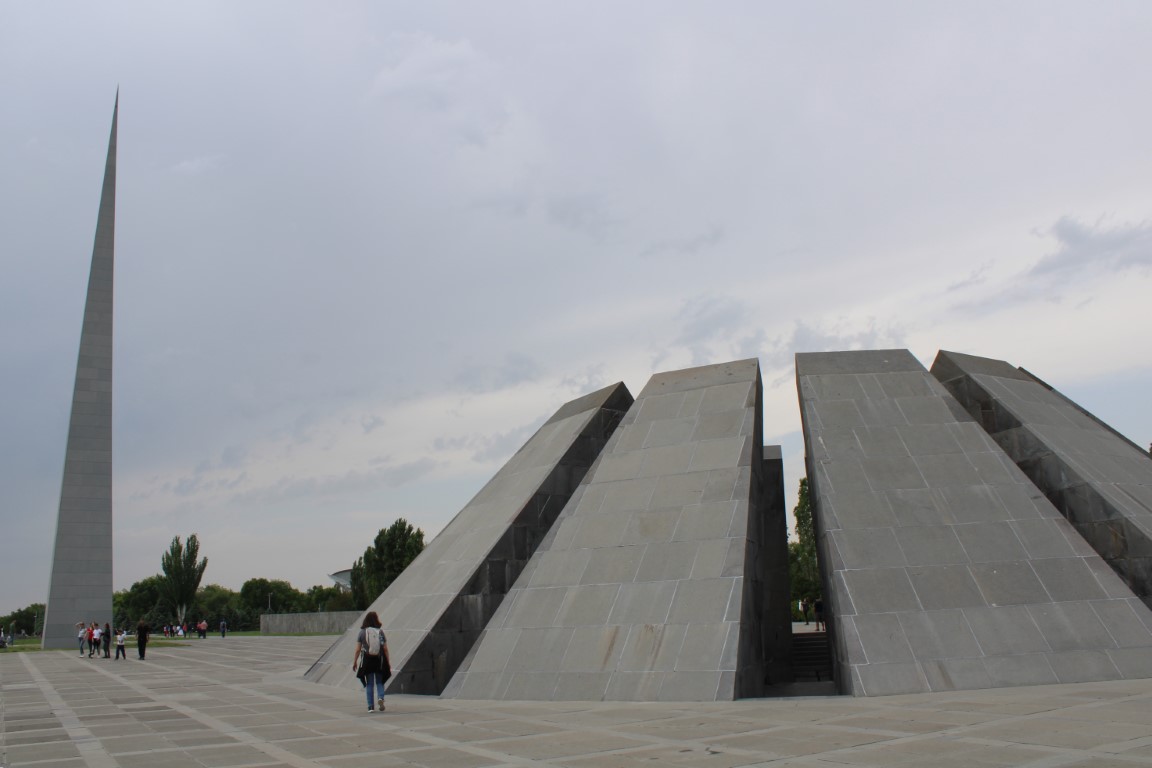
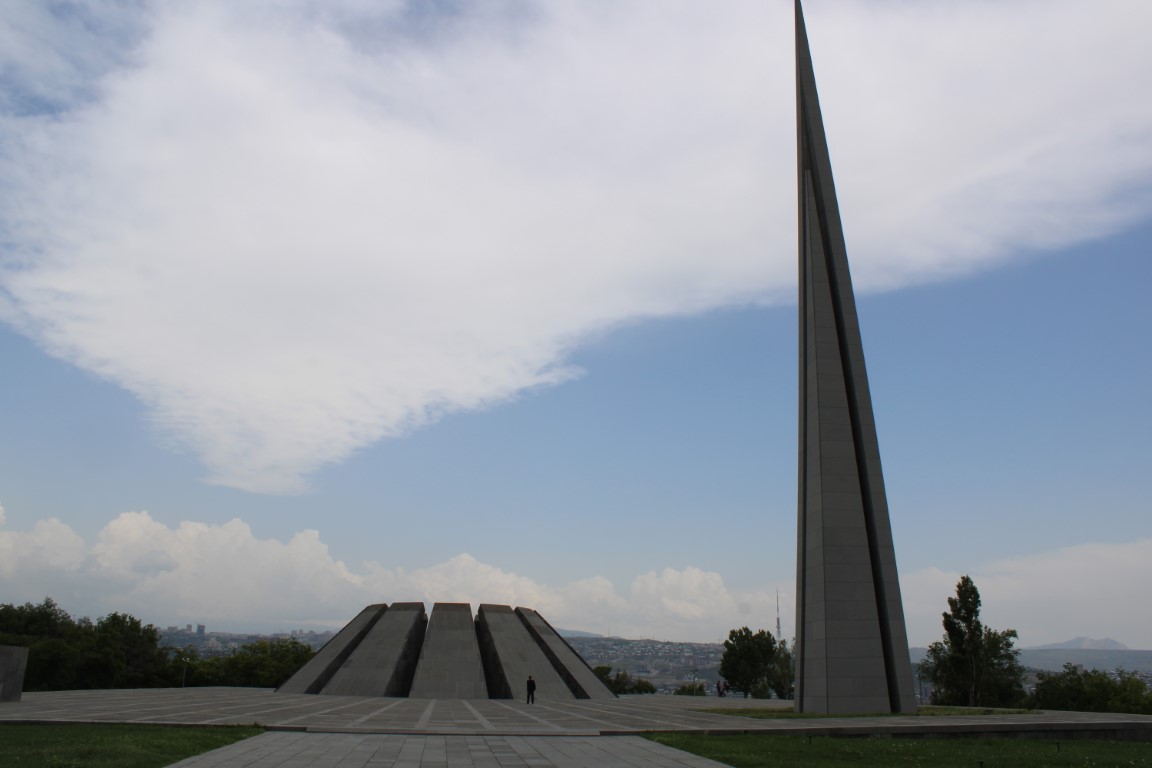
DAILY PHOTO: Genocide Memorials: Miniature and Full-Size

We stumbled onto this roadside miniature replica of the Genocide Memorial of Yerevan a few miles up the road from Tatev Monastery in Southeastern Armenia. The actual memorial:

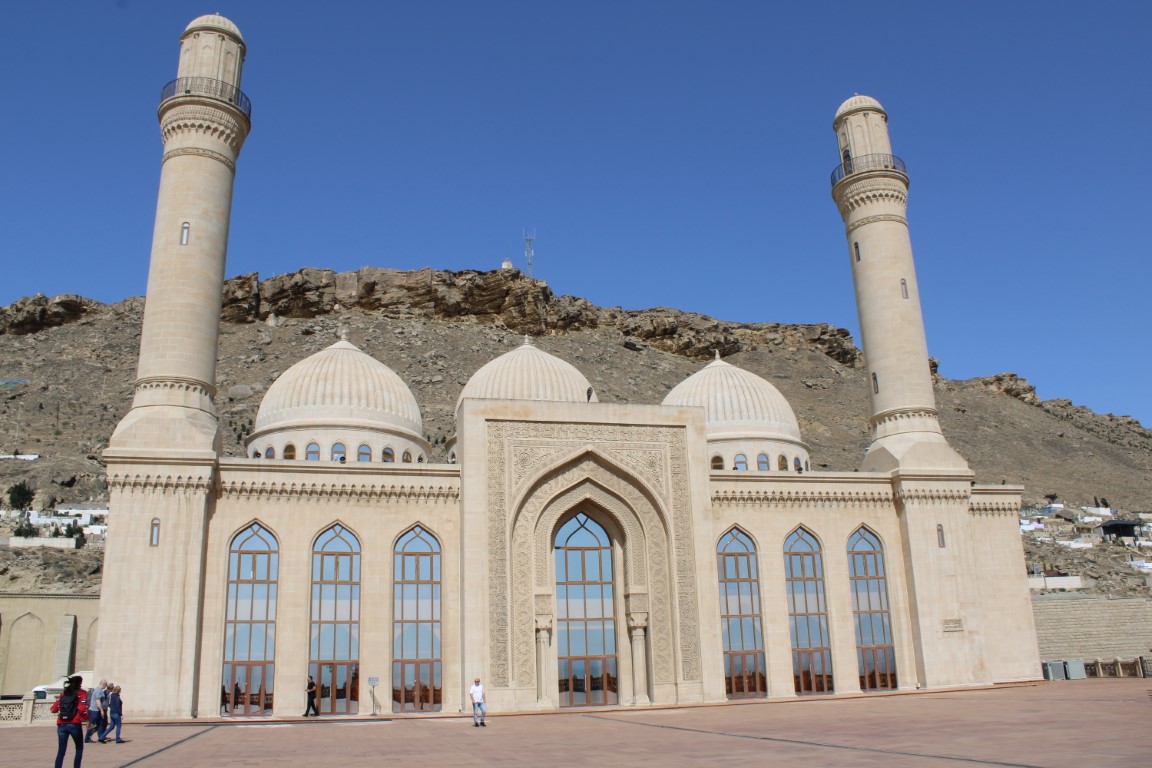
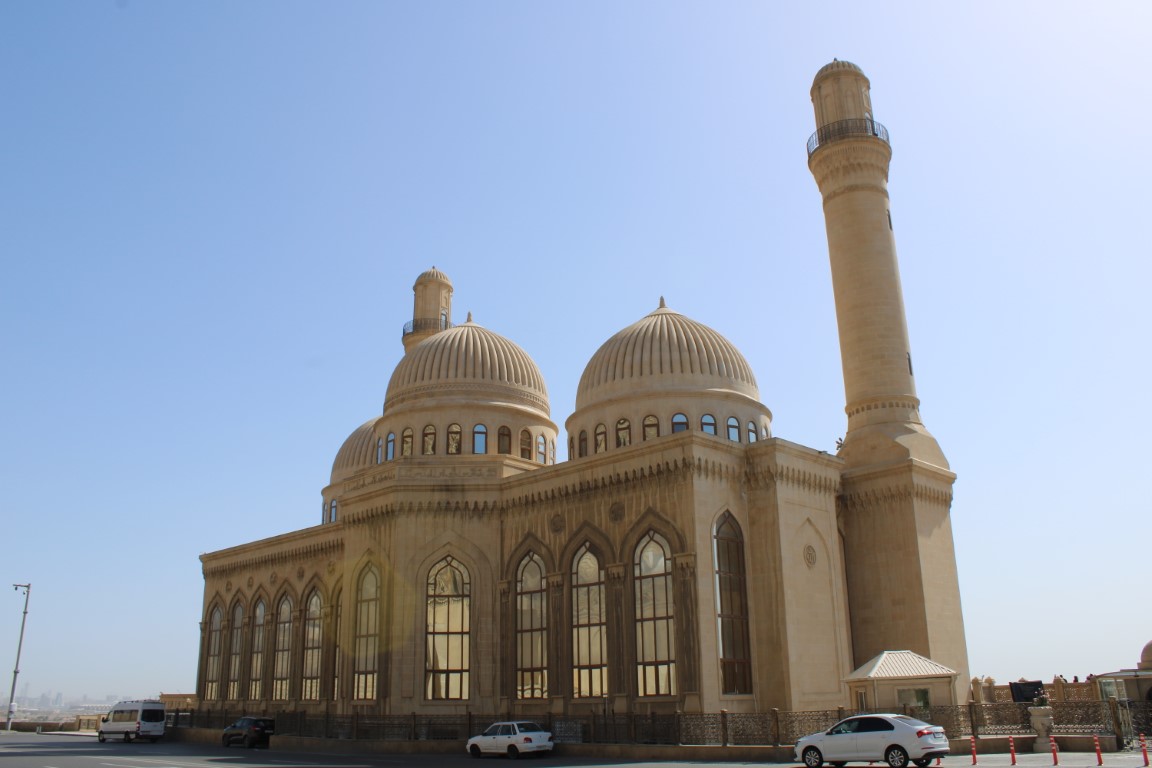
DAILY PHOTO: Bibi-Heybat

This is the replica of a mosque that dates back to the 13th century. The original was built at the behest of Shirvanshah Farrukhzad II Ibn Ahsitan II, and was destroyed by the Bolsheviks when the Soviets took over in the 1930’s. The existing version was built in the 1990’s after the demise of the USSR.

BOOKS: “The Dangerous Life and Ideas of Diogenes the Cynic” by Jean-Manuel Roubineau

The Dangerous Life and Ideas of Diogenes the CynicThe Dangerous Life and Ideas of Diogenes the Cynic by Jean-Manuel Roubineau
My rating: 5 of 5 stars

Amazon.in Page

This is a translation of a French book about the life and philosophy of Diogenes the Cynic. It’s a thin volume, as there is much that’s unknown about the life of Diogenes, and the dearth of surviving texts means that some of what is believed about Diogenes and Cynic philosophy maybe corrupted by the reports of detractors. I learned a great deal from reading this book, but not because I learned much new about Diogenes, himself. The colorful anecdotes from his life have been extensively discussed.

With respect to what I did learn, it largely fell into three categories. First, I gained insight into the context and environment in which Diogenes lived. Second, I discovered that many of the stories of Diogenes’ life are far less certain than we have been led to believe through the presentations of them in so many books. For example, we know Diogenes was exiled from his native Sinope in relation to a scheme involving currency debasement. This is often straightforwardly stated as “Diogenes was a counterfeiter,” but Roubineau shows that we don’t know much (if anything) about the degree to which Diogenes was involved (i.e. whether he was mastermind, accomplice, or an unwitting pawn.) Third, I benefited from the comparing and contrasting of Cynic philosophy with that of predecessors (e.g. Socratics) and successors (e.g. Stoics,) and – in a few cases – comparisons between Diogenes and other Cynics.

The book consists of four chapters. The first is a discussion of what is known about Diogenes as a historical figure. The second focuses on the Cynics views on economy, wealth, and related ideas. The third explores the Cynic view of the human body and related topics like sex, pleasure, and pursuit of health and well-being. The last chapter considers Diogenes as a teacher and the Cynic approach to practicing philosophy.

I’d highly recommend this book for readers interested in philosophy.


View all my reviews

BOOKS: “The Comedians” by Kliph Nesteroff

The Comedians: Drunks, Thieves, Scoundrels, and the History of American ComedyThe Comedians: Drunks, Thieves, Scoundrels, and the History of American Comedy by Kliph Nesteroff
My rating: 5 of 5 stars

Amazon.in Page

This book presents a fascinating history of standup comedy and the various ancillary activities that comedians have taken on to make ends meet, to advance their careers, and – in a surprising number of cases – to pay for drugs — e.g. from writing to radio and television performances to hosting interview shows. The book’s exploration runs from the days of Vuadville to today’s world of Twitter and podcasts.

The book reveals a great deal about which readers may be unaware. If you, like me, watched The Marvelous Mrs. Maisel and wondered whether the mob was really that involved in the entertainment industry, turns out, they were. In fact, Nesteroff addresses the violence and threats experienced by comedians in a way that is much more explicit than in that TV show. There are tales of early insult comedians running afoul of wiseguys who were in the audience unbeknownst to the comedian. There is even a chapter devoted to the building of Las Vegas to meet certain needs of organized crime, as well as discussion of the mob’s decline (or, perhaps, legitimization) in the industry.

Another discovery that was interesting to me was how wild some of the early comedians were, both in their stage and in their personal lives. There were a number of names that were familiar to me from re-runs of highly censored network television programs. I’d wrongly assumed that these individuals were as bland and wholesome as their on-air personas. Buddy Hackett is a prime example of someone who wasn’t at all what I expected.

It’s remarkable to see how many ups and down standup comedy has had in its relatively short life span — cycles of boom and bust.

If you’re interested in standup comedy and how comedy has progressed as a form of entertainment in America, I’d highly recommend this book.

View all my reviews

BOOKS: “Nuclear War” by Annie Jacobsen

Nuclear War: A ScenarioNuclear War: A Scenario by Annie Jacobsen
My rating: 5 of 5 stars

Amazon.in Page

Release Date: March 28, 2024

Annie Jacobsen’s new book is fascinating and — quite frankly — horrifying from cover to cover. The book presents a hypothetical minute by minute unfolding of events that culminate in full-scale nuclear war and the end of the world as we know it. A four-hundred-page book that breaks down the events of an hour may sound like a recipe for tedium, like Joyce’s seven-hundred-plus page elaboration of the events of a single day in “Ulysses.” But, it is anything but. There is so much to explore amid the concepts like “the nuclear football” and MAD (Mutually Assured Destruction,) and EMP’s (Electromagnetic Pulse weapons.) There is also so much to go wrong, and much that is virtually certainly go wrong.

That last sentence might suggest that the book takes an excessively pessimistic view to create drama. Sadly, it does not need to. The ultra-fast timeline of nuclear calculus does the work of ensuring that many things will go terrifyingly and irreparably wrong. Decision makers have a short window to make decisions, and “use-’em-or-lose-’em” thinking plays a major role in decision making. (i.e. One can’t count on delaying a decision about a counter response because one’s delivery infrastructure — notably, the human bit of it — will likely be destroyed if one absorbs the first strike.) There is also the fact that — counter to all the abort buttons seen in the movies — once missiles are launched, there is no way to stop them. [A bit of “Dr. Strangelove” writ into the system.] At many of the points at which it may seem that Jacobsen is being pessimistic for effect, she explains the basis for her pessimism: from historical events like the failure of the nuclear hotline to commentary by experts.

Lest one think that nuclear warfare is a threat of the past, and that it’s a solved problem, Jacobsen’s scenario reminds us that it’s not just a matter of NATO v the Warsaw Pact (i.e. America v the USSR in the common conception) anymore. She does this by using North Korea as the instigator. We don’t ever learn the Kims’ theoretical motivation, but all one really needs to know to make one nervous is that the DPRK has been quite happy playing the role of pariah, engaging in a number of activities in violation of international law and norms, as well as that Kim Jong Un might just believe some of the ridiculous things his yes-men tell him. (Not to mention the famines and other destabilizing conditions that could lead some other inside actor or group of actors to take unanticipated actions.) The truly disturbing part is to see how easily a strike by the DPRK could draw Russia or possibly China into the nuclear exchange. [Russia because it’s in the path between the US and the DPRK, and China because it could suffer massive casualties from strikes on North Korean facilities near the border that send radiation to sizable Chinese population centers.]

This book is a must-read for anyone who thinks nuclear weapons are the problem of a bygone era.

View all my reviews

BOOKS: “Smoke and Ashes” by Amitav Ghosh

Smoke and Ashes: A Writer's Journey through Opium's Hidden HistoriesSmoke and Ashes: A Writer’s Journey through Opium’s Hidden Histories by Amitav Ghosh
My rating: 5 of 5 stars

Amazon.in Page

Release Date: February 15, 2024 [NOTE: for this edition; the book is already out in some markets in some additions.]

Ghosh has written a fascinating exploration of the profound global consequences of that pretty red flower, the opium poppy. I find the events surrounding the Opium Wars to be among the most incredible stories humanity has written. It is mind-blowing that a substance could be so utterly addictive as to spur wars and global social and economic upheavals. That substance is, of course, tea. Ah, you thought I was going to say opium (or its relative, heroin,) didn’t you? But while opium is fantastically addictive, its addicts were by-and-large in peaceful stupors in (or on) their clouds during the time in question. It is the uppity Earl Grey addict who was draining Britain’s treasury of precious metals, and — as addicts do in their impoverished desperation — turned to dealing drugs.

There have been many books written on this subject, but Ghosh carves himself a niche. First, while accounts often focus tightly upon the central adversarial relationship of Britain versus China, Ghosh examines at leisure the roles of two lesser discussed players — India (not only as a subject of Great Britain but also as an autonomous actor) and America. The importance of India’s involvement, from being a major producer and processor of opium to sourcing the sepoys who actually fought the Opium Wars, has been largely ignored, and Ghosh helps to clear up distortions in the historical record. Second, the book investigates questions around America’s opioid crisis and what history can tell us about its drivers. In particular, what does the China’s explosion of addiction tell us about what might have spurred America’s crisis?

This is a readable and compelling nonfiction exploration of the influence of opium from a writer who has produced novels (e.g. the “Sea of Poppies” trilogy) set around these historical events.

I’d highly recommend this book for individuals interested in the influence of Opium, particularly if one is curious about how history relates to the recent crises and what role Indians and Americans played in events.

View all my reviews

BOOKS: “The Banished Immortal” by Ha Jin

The Banished Immortal: A Life of Li Bai (Li Po)The Banished Immortal: A Life of Li Bai by Ha Jin
My rating: 5 of 5 stars

Amazon.in Page

Li Bai is considered to be one of China’s best poets of all time, writing during the Tang Dynasty (618-907 AD,) a time swole with poetic greats. However, it’s not just a prolific collection of extant masterpieces that make Li Bai worthy of a biography intended for a general audience. Li Bai was also a compelling character. He was, at once, a drunk and a genius; a swordsman of some skill and a card-carrying Daoist. It’s not just that he could edit drafts into brilliant poems, but he was said to be gifted at spontaneously spouting clever verse. He was constantly struggling to gain a post in government, but failed time and again. Even when his poetic renown became so great that he was given a post in the Imperial court, he was disappointed to find that it was largely ceremonial and that he would have no great impact on anything. He had a stunning fall from grace when he aligned with the wrong side during a civil war and was lucky to have been exiled rather than executed.

Ha Jin, a prominent present-day Chinese author best known for the novel Waiting, does an excellent job of exploring Li Bai’s life. What I particularly enjoyed is that Ha Jin (a poet himself) discusses how events in Li’s life spurred some of his great poems (which are often included in whole or in part.) Ha Jin is also careful to make clear when biographical accounts diverge, and there are many unknown or disputed details of Li’s life. In fact, there is a bit of a mythology around Li Bai, as one might guess from the title – which refers to a nickname bestowed upon the poet based on the belief that he was a Daoist immortal.

I’d highly recommend this book for readers of biography, those interested in Chinese history, or those who are intrigued by rebellious poetic souls.

View all my reviews

PROMPT: Historical Figure

If you could meet a historical figure, who would it be and why?

Assuming no babel fish technology – i.e. that we’d need a common language – I’d say William Blake, Walt Whitman, or Mark Twain. The latter would probably be the most fun, the middle the most uplifting, and the first the most insightful (or perhaps most mystical.)