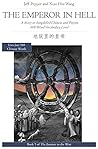
BOOK: “The Emperor in Hell” [Book 5 of the “Journey to the West” Series] ed. by Jeff Pepper; trans. by Xiao Hui Wang

The Emperor in Hell: A Story in Simplified Chinese and Pinyin, 600 Word Vocabulary LevelThe Emperor in Hell: A Story in Simplified Chinese and Pinyin, 600 Word Vocabulary Level by Jeff Pepper
My rating: 4 of 5 stars

Publisher Site – Imagin8 Press

This is the fifth volume in a series that abridges and simplifies the classic Chinese novel, Journey to the West, so that it can be read by a language learner with about a HSK 3 grasp of Chinese. It tells the story from Chapters 10 and 11 of the original novel. Like the preceding volume, this one doesn’t deal with Sun Wu Kong (i.e. the Monkey King — protagonist of the novel overall,) and doesn’t even deal with the monk Xuanzang — the protagonist of the true story on which the novel was based.) These chapters tell a story that feels like a diversion, though it will be involved in the segue back to the actions of the main cast.

In this book, the Jing River Dragon King gets in trouble when he makes a bet with a fortune-teller. The Dragon King has to cheat to save his pride, but this runs him afoul of the Jade Emperor. The Dragon King appeals to the human Emperor, Taizong, who agrees to help. When wires get crossed, Taizong ends up in the underworld for judgement. With the help of others and with promises made, Taizong is allowed to return to earth.

It’s an interesting story and gives some insight into Chinese mythology. As is always the case with a book such as this, events of the story must be cut or rushed. Readers may vary in their views about whether the right material was cut or thinned.

I continue to enjoy this series. This book was a little more challenging to read than earlier volumes, not because the vocabulary was harder. I think it was more that contextual cues were fewer, owing to it not being so tightly tied to the overall story.

If you’re just learning to read Chinese, I’d recommend this series as an interesting story made readable to a language learner.

View all my reviews

BOOK: “Stories and Myths of Eight Immortals” Trans. by Li Yanjia and Nathaniel Hu

Stories and Myths of Eight ImmortalsStories and Myths of Eight Immortals by Anonymous
My rating: 3 of 5 stars

Available online – Internet Archives

This is a fine collection of stories about the adventures of the Eight Immortals (mostly as individuals, but with a few stories that feature the whole group.) There are twenty-eight chapters, but a few less than that of stories because the first chapter is an introduction to the Eight Immortals, and there are a couple of chapters at the end that discuss the origins of cultural artifacts associated with the Eight Immortals.

The stories are pulled from varied sources. I would give the stories a five, but this edition is loaded with grammatical mistakes — to the point of being distracting and unpleasant to read. It reads not like a present-day Google Translate translation, but rather as if it was being spoken by someone with an uneven (remedial to elegant) grasp of English. [Not everywhere, but enough to be problematic.]

The stories themselves are engaging, often have moral, and are quick reads (mostly a page, a few more than three pages.)

If you can tolerate reading through patches of bad grammar, this is not a bad collection of stories and information about the Eight Immortals, but if it’s too much to stomach, you might want to look elsewhere. The stories themselves are widely available, though not necessarily in English and, if so, not necessarily collected into a single volume. With editing, this would be an excellent collection of stories.

View all my reviews

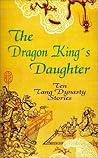
BOOK: “The Dragon King’s Daughter” Trans. by Yang Xianyi and Gladys Yang

The Dragon King's Daughter: Ten Tang Dynasty StoriesThe Dragon King’s Daughter: Ten Tang Dynasty Stories by Gladys Yang
My rating: 5 of 5 stars

Google Book Site

This thin anthology contains ten stories from varied writers of the Tang Dynasty. The stories include a mix of speculative fiction, political fiction, and love stories — some being cross-genre pieces that mix elements of more than one of these categories.

I found a wide variation in how engaging the stories were. The best of them were quite good. The Spendthrift and the Alchemist, The White Monkey, and the titular The Dragon King’s Daughter were among my favorites. Each of those stories included a supernatural element, but also a thought-provoking premise.

If you enjoy Tang Dynasty literature and would like to try some of this golden literary age’s short fiction, this book is a quick and pleasant read.

View all my reviews

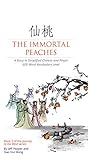
BOOK: “The Immortal Peaches” [Vol. 3 of “Journey to the West”] Ed. by Jeff Pepper / Trans. by Xiao Hui Wang

The Immortal Peaches: A Story in Simplified Chinese and Pinyin, 600 Word Vocabulary (Journey to the West Book 3)The Immortal Peaches: A Story in Simplified Chinese and Pinyin, 600 Word Vocabulary by Jeff Pepper
My rating: 5 of 5 stars

Publisher Site – Imagin8

This is the third volume in this Journey to the West series aimed at language learners. It covers Chapters 5, 6, and 7 of the book, which includes events from Sun Wukong’s return to heaven acknowledged with the title “Great Sage Equal to Heaven” through the conflicts that result from his lack of control and decorum to Buddha’s bet with Monkey King.

I’ve enjoyed this series. The pinyin is interspersed with an abridged and linguistically simplified Chinese telling of the story on a paragraph basis, and the English translation is at the end. This allows one relatively quick access to the pinyin without continually cheating by stray glance. Also, one can determine whether one wants to read the English translation before or after reading the Chinese, as is appropriate to one’s level and language learning strategy. The book also has a glossary of all the Chinese words it uses, and the words beyond the most basic (beyond HSK3, or so) are footnoted. (I read on kindle, so looking up translations of any words is as quick as highlighting them.)

This is a great language learning tool, featuring one of Chinese literature’s most engrossing stories. I’d highly recommend it for those learning Mandarin Chinese with Simplified script.

View all my reviews

BOOK REVIEW: “New Story of the Stone” by Jianren Wu [Trans. by Liz Evans Weber]

New Story of the Stone: An Early Chinese Science Fiction NovelNew Story of the Stone: An Early Chinese Science Fiction Novel by Jianren Wu
My rating: 5 of 5 stars

Publisher Site – Columbia University Press

This book is presented as a sequel to the Chinese literary classic (alternatively) known as Dream of the Red Chamber or Story of the Stone. The central character is a scholarly traveler by the name of Baoyu. The first part of the book is set in China around the time of the Boxer Rebellion, an event that features in the story. Throughout this portion, the book reads like historical fiction. However, Baoyu’s travels eventually bring him to a hidden realm, a technologically advanced utopia within China. It is here where Baoyu’s adventures get fantastical and otherworldly, and the book ventures into the domain of Science Fiction.

The setting of the book reminds me a little of Marvel’s Wakanda from Black Panther. Perhaps both instances of worldbuilding were motivated by the humiliated colonists’ fantasy of being more advanced than those who pull the strings for once, or of showing their (respective) lands to be places of “crouching tigers and hidden dragons” (i.e. where great talents exist but remain unseen.) (Note: While China wasn’t on-the-whole colonized by a Western country, its interaction with England and other Western nations left it forced to accept terms unfavorable and undesirable to China (not to mention the outright colonized enclaves such as Hong Kong and Macau.) While the publisher has emphasized the science fiction aspect of this work, it is an anticolonial work through and through. The book can come across as xenophobic and nationalistic in places, but this only reminds the reader of how such positions might be arrived at under the boot of foreign influence.

The book is readable though philosophical and is well worth reading for those interested in developing a deeper insight into Chinese perspectives.

View all my reviews

BOOKS: “Attack on Titan, Vol. 1” by Hajime Isayama

Attack on Titan, Vol. 1Attack on Titan, Vol. 1 by Hajime Isayama
My rating: 5 of 5 stars

Publisher Site – Kodansha

A bit like Starship Troopers in that it features a group of youths drawn into military service to defend humanity from an existential threat, this series revolves around humanity besieged by giants. This introductory volume opens many questions that it leaves to be answered, such as: what are the Titans? Where do they come from? Can humanity survive them?

What this opening volume does a good job of is building a cast of characters one can connect with, as well as showing how humanity has been losing ground to its mammoth enemies. The reader enters this conflict in the middle, humanity living in walled cities that periodically come under attack, and that not only sets a tone but builds engagement with the story.

I found this volume intriguing and would highly recommend it for comic book readers. Note: the book is formatted in manga style and thus reads backwards from the perspective of an English language book reader.

View all my reviews

BOOK: “Zatanna” by Paul Dini, et. al.

ZatannaZatanna by Paul Dini
My rating: 4 of 5 stars

Publisher Site — DC Comics

Zatanna is a magician, both in the sense of being a professional stage illusionist and in the sense of making real magic offstage. The stories contained herein are about her heroic use of the latter magic, though they are often set to the backdrop of her professional life, i.e. clubs and other entertainment venues. Daughter to a deceased legend of stage prestidigitation, The Great Zatara, Zatanna makes magic through verbal spells.
 
This sixteen-issue run consists mostly of standalone stories. There are a couple story arcs that span three or four issues, but for the most part the stories are wrapped up within an issue. Some of these stories dedicate panels to what’s happening with Zatanna’s long-running nemesis, Brother Night, even when the main story is unrelated to him (presumably so as to keep the readers ready to receive some larger arc.)

The stories are good, light-hearted escapism — even – perhaps – when they don’t mean to be. By that I mean that the subject matter is often dark, dealing in demons and nightmares personified, but Zatanna is usually so overpowered compared to her enemies and the book attempts to maintain a quippy comedic effect, and so the reader never feels their heroine is at risk of true danger. That said, the authors do put Zatanna in dire situations, and so the stories often do hook one into a state of wonder about how she will escape some awful fate (even while not doubting for an instant that she will.) Zatanna does have weaknesses and there is some attempt to suggest that magic has risks and consequences (otherwise, the stories would devolve into lukewarm absurdism rather quickly.)

I enjoyed this run. The art is crisp and imaginative, and the stories are often clever — if rarely taut.

View all my reviews

“Beggar to Beggar Cried” by William Butler Yeats [w/ Audio]

"Time to put off the world and go somewhere
And find my health again in the sea air,"
Beggar to beggar cried, being frenzy-struck,
"And make my soul before my pate is bare;

"And get a comfortable wife and house
To rid me of the devil in my shoes,"
Beggar to beggar cried, being frenzy-struck,
"And the worse devil that is between my thighs.

"And though I'd marry with a comely lass,
She need not be too comely -- let it pass,"
Beggar to beggar cried, being frenzy-struck,
"But there's a devil in a looking glass.

"Nor should she be too rich, because the rich
Are driven by wealth as beggars by the itch,"
Beggar to beggar cried, being frenzy-struck,
"And cannot have a humorous happy speech.

"And there I'll grow respected at my ease,
And hear amid the garden's nightly peace,"
Beggar to beggar cried, being frenzy-struck,
"The wind-blown clamor of the barnacle-geese."

BOOKS: “Strange Tales from a Chinese Studio” by Pu Songling [Trans. by John Minford]

Strange Tales from a Chinese StudioStrange Tales from a Chinese Studio by Pu Songling
My rating: 5 of 5 stars

Publisher Site – Penguin

This is a collection of short stories, almost entirely speculative fiction, dating from the Qing Dynasty (specifically, the late 1600’s to early 17oo’s.) Ghosts, folkloric creatures, and Taoist magic all feature prominently in the stories. The stories average about five pages, but with a wide deviation from stories scarcely longer than today’s micro-fiction to extensive pieces. The Penguin edition collects 104 out of a much larger collection of stories.

The best of these stories are clever and highly engaging, and there are many such tales. Being from Qing Dynasty China, the stories offer a perspective different from one’s typical horror and fantasy short stories. Many of the stories prominently feature eroticism, but not graphically so.

As for the weakness of the volume, even though it selects only a portion of Pu Songling’s original, there are many stories that blend together, failing to distinguish themselves. This is most notable among the fox-spirit stories, of which there are just so many. [A number of them are fantastically unique, but others are just variations on the same.] So, the book can seem a bit repetitive in that sense. However, before you get to the point where you feel you can’t read one more fox-spirit story, you’re quite likely to read a tale that blows your mind.

I greatly enjoyed many of the stories herein. Perhaps, the volume could have benefited from further abridgement, but it’s well worth the read.

View all my reviews

BOOKS: “Nightwing, Vol. 1: Leaping into the Light” by Tom Taylor

Nightwing, Vol. 1: Leaping into the LightNightwing, Vol. 1: Leaping into the Light by Tom Taylor
My rating: 5 of 5 stars

Publisher Site – DC Comics

As in a lot of the Batman stories, in this volume, Nightwing (Dick Grayson) is fighting a two-front war. On the one hand, there is a mysterious central villain du jour, Heartless — an augmented masked criminal who is killing in impoverished neighborhoods by (literally) stealing his victims’ hearts. Then, on the other hand, there is the usual systematic corruption and organized crime of his chosen city, Blüdhaven. These two fights bump into each other here and there but are largely independent of one other (at least as far as one can tell in this, the first, volume of a run.) Barbara Gordon and Tim Drake / Robin participate in the story, but other than that the only hero appearances are cameos.

I enjoyed the pacing and emotional arc of this story. My reading pleasure surprises even me because I think I would ordinarily feel the book had a poor resolution to hook ratio. (i.e. I would feel that not enough was resolved to make this feel like as satisfactory standalone story.) However, there was a resolution that offered satisfaction, but it was just not what I (or -probably- the typical reader) would think of as a normal comic book resolution. (i.e. It was not a resolution achieved by kicking and punching, but rather by soul-searching.)

At any rate, I’d highly recommend this book for comic book readers.

View all my reviews