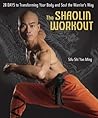
BOOKS: The Shaolin Workout by Shi Yan Ming

The Shaolin Workout: 28 Days to Transforming Your Body and Soul the Warrior's WayThe Shaolin Workout: 28 Days to Transforming Your Body and Soul the Warrior’s Way by Yan Ming
My rating: 4 of 5 stars

Amazon.in Page

This book presents an exercise regimen based on Shaolin Kung fu as taught by a prominent New York City martial arts teacher. The book moves from gentle joint articulations suitable for anyone through to movements that require some degree of flexibility and athleticism. The sequence is presented in such a way as to build on itself, adding a bit more each time until one is doing the entire sequence.

Interspersed with the descriptions of the physical exercises are meditations, mostly of a contemplative nature. The illustrations are color pictures and provide the sequences of movement, though the textual descriptions will be necessary in many cases to clarify the transitional movements. There are a number of full-page color plates that are very well shot, though mostly for aesthetic (versus educational) purposes.

The book is probably the most pep-talk laden book I’ve ever read. That said, there’s not much discussion of modifications or capacity building for individuals who are incapable of doing the full expression of the techniques.

The practices often reminded me more of yoga than of martial arts. There are many deep stretches and low positions, e.g. similar to Warrior I (Virabhadra I.) It’s true that there are punch and kick movements, but they are done in more of a range-of-motion building way than as one would in combative arts.

It is an interesting set of movements, and I’d recommend it for those who like to work with unconventional workouts and movement systems.

View all my reviews

PROMPT: Physical Exercise

What is your favorite form of physical exercise?

I play no favorites. I love calisthenics, yogasana, running, swimming, functional movement, movement drills (e.g. martial arts,) etc.

I do have least favorites though, and – collectively – those are exercises where I have to go somewhere in particular to have access to some specialized equipment. So, for example, I don’t care for weight lifting or using ellipticals or climbers, etc. (I still enjoy the exercise well enough, but it’s more hassle than it needs to be.)

My whole equipment inventory consists of a yoga mat, a pull-up / dip apparatus, and a few resistance bands, and I can make do without those quite nicely — e.g. when traveling.

PROMPT: Lazy Days

Daily writing prompt
Do lazy days make you feel rested or unproductive?

Rested. Definitely. I believe one has to think of rest and recovery as part of the process of living. If one thinks of it as just wasting time between “doing things,” then one isn’t going to get the most out of body and mind.

PROMPT: Walk or Run

How often do you walk or run?

Every day. And sometimes I crawl, and – if there are monkey bars – I swing.

PROMPT: Comfort

What strategies do you use to increase comfort in your daily life?

I don’t, but I have a lot of strategies for being more content in the face of various situations and environments — including uncomfortable ones. These include the yogic practice of dispassionate witnessing, minimalism, travel (and specifically minimalist travel to places – the less familiar the better,) and intense physical activity.

I think comfort as a major objective in life is overrated, and virtually insures a discontented life. A life in which one can be content, whatever may come along, is a happy life.

BOOK REVIEW: Mindfulness in Wild Swimming by Tessa Wardley

Mindfulness in Wild Swimming: Meditations on Nature & Flow (Mindfulness series)Mindfulness in Wild Swimming: Meditations on Nature & Flow by Tessa Wardley
My rating: 4 of 5 stars

Amazon.in Page

Release Date: June 13, 2023

As the title suggests, this is a book about combining mindfulness and swimming in natural bodies of water. It’s part of a large series of “Mindfulness and …” books, and this particular volume is a re-release of a title that came out a couple years back.

While the book does provide an overview the basic methods and considerations for both mindfulness meditation and wild swimming, it’s largely a peptalk or enticement to take up wild swimming as a means to improve awareness (as well as to bolster physical health and mental well-being.) That said, some of this peptalk is artfully, almost poetically, written, and the book is a pleasure to read.

The book discusses solo swims versus those in a group, and it even explores using onshore experiences to bolster mindfulness — e.g. using the sensory experience of the water as a focal point for practicing awareness. The around- (v. in-) water discussions are probably in part because the book uses seasons as a secondary mode of organization, and long and leisurely winter swims in lakes and rivers aren’t an option for people in many parts of the world.

I picked up some interesting food-for-thought in the book, and — as I say — it made for enjoyable reading.

View all my reviews

BOOK REVIEW: Training and Conditioning for MMA ed. by Dias / Oliveira / Brauer & Pashkin

Training and Conditioning for MMA: Programming of ChampionsTraining and Conditioning for MMA: Programming of Champions by Stéfane Beloni Correa Dielle Dias
My rating: 5 of 5 stars

Amazon.in Page

Release Date: September 15, 2022 [It may already be out in some formats and markets]

Get Speechify to make any book an audiobook

This book provides an overview of fitness building for Mixed Martial Arts athletes. It covers program design, athletic assessment, nutrition, exercises and conditioning practices, and injury prevention methods. On the positive side, it’s not only comprehensive, but – also – presents some of the best and latest methods in combative sports training based on sound scientific research. On the other hand, the book does assume a certain level of understanding of sports science, and it gets pretty deep in the weeds with respect to technical detail and to scientific and specialty jargon. If one doesn’t have such background, one may find some of the content (particularly the early chapters) a bit daunting. That said, it offers an excellent reference for those who are interested in methods and sports science not just for MMA, but for combative sports, in general.

The book uses color photographs throughout. I found the photos to be clear, well-sized, and well-lit. While there is definitely an attempt to keep the number of photos to a reasonable level, they do offer multiple angles where necessary and – generally – give enough pictures to make the action clear. There are also tables after each of the methods sections to give a handy summary of sets, reps, and scheduling suggestions for various exercises. In the early chapters, the ones that convey more technical content, there’re charts, graphs, and diagrams as needed. There’s an extensive bibliography, though it should be noted many if not most of the references are not in English. (The team of editors and contributors is large and international.)

This book offers an excellent reference for coaches, trainers, and athletes. While it does get quite technical, it’s great that it offers insight into cutting edge science and training methods.


View all my reviews

BOOK REVIEW: Yoga Anatomy, 3rd Ed. by Leslie Kaminoff and Amy Matthews

Yoga AnatomyYoga Anatomy by Leslie Kaminoff
My rating: 5 of 5 stars

Amazon.in Page

This book has several competitors, and so this review will focus on a few of the features that I believe make it one of the best books on yoga anatomy, and the most appropriate for many users. To clarify, H. David Coulter’s “Anatomy of Hatha Yoga” has some advantages over this book, but Coulter’s book is also denser and will send neophyte readers to the glossary / internet / library much more often. On the other hand, some of the other yoga anatomy books fixate entirely on postural yoga and treat it entirely as a matter of skeletal alignment and muscular engagement. While a lot of this book (and any such book, really) focuses on skeletal alignment and muscular engagement, I appreciated the books exploration of breath and the nervous system – topics that are often neglected. In short, this book offers a mix of reader-friendliness and detail that makes it at once approachable and tremendously informative.

One important feature of this book is that it avoids the dogmatism of some yoga texts, encouraging experimentation and recognizing that a one-size-fits-all approach to bodies is bound to fail. This can best be seen in the “Cueing Callout” boxes that explore the pithy adjustment directives for which yoga teachers are famous (and often satirized,) advice that is often misunderstood in ways detrimental to a student’s progress.

A second key feature involves keeping anatomy and physiology distinct from the folk science of yoga / ayurveda. While Kaminoff and Matthews do refer to ideas like prana and apana, they do so in a broad, conceptual way that doesn’t conflate said ideas with science. A common problem in yoga texts is conflation of science with folk science such that confused readers are left with a muddle of puzzle pieces that don’t belong to the same puzzle.

Finally, as one who’s found pranayama (breathwork) to be one of the most profoundly transformative elements of a yoga practice, I appreciated that the book not only had a chapter on breath dynamics, but that all the posture discussions included a “breath inquiry” section that encouraged readers to reflect upon the effect of the posture on breathing, as well as suggesting ways in which a practitioner might experiment to improve one’s breathing.

The only criticism I have is that many of the text-boxes in the early chapters seemed to contain random information that could have been incorporated into the text, into footnotes, or edited out altogether. [In contrast to the aforementioned “Cueing Callout” boxes that had a clear and distinct purpose.] If you’re a yoga teacher or dedicated practitioner without a deep scientific background, you’d be hard-pressed to do better than this book for learning about the anatomy of yoga.


View all my reviews

BOOK REVIEW: Ageless Intensity by Pete McCall

Ageless Intensity: Effective Workouts to Slow the Aging ProcessAgeless Intensity: Effective Workouts to Slow the Aging Process by Pete McCall
My rating: 4 of 5 stars

Amazon.in Page

Know thyself. If you’re getting up there in years but have maintained a high level of fitness via a well-rounded fitness program throughout your adult life, this book is an excellent reference and you should definitely give it a look. However, if you kind of let yourself go a bit during your working years and – approaching retirement – want to increase your quality-of-life and lifespan through fitness activities you never had / took time for when you had a full-house and were climbing the corporate ladder, this isn’t a good starting point and probably won’t work for you. McCall successfully argues that older people can (and should) safely do high-intensity fitness activities, but the book doesn’t offer much in the way of modifications and adaptations to transition people who might have limited range of motion, bone density issues, or atrophied muscles. It presents a lot of solid information on aging, exercise, and the confluence between them, but the workout guidance is largely the same as would be offered to a twenty-something athlete.

The organization of the book is typical of workout manuals: background information (including on aging), chapters describing exercises for various types of high-intensity workouts, a chapter on sequencing, and a chapter about various approaches to building a routine (i.e. home v. gym, etc.) [I will say the book’s approach isn’t minimalist / cheapskate friendly, and presumes access to a wide range of weights, machines, and gear. (As one whose fitness regimen is built around three items – 1.) a pair of running shoes; 2.) a single pull-up bar / dip apparatus; and 3.) a yoga mat – it was more complicated / expensive than I go for; but I understand most have other preferences.) It does offer some guidance for budget exercisers, but not many of the exercises discussed use bodyweight.)

As I say, know thyself.

View all my reviews

BOOK REVIEW: Functional Training Anatomy by Kevin Carr & Mary Kate Feit

Functional Training AnatomyFunctional Training Anatomy by Kevin Carr
My rating: 4 of 5 stars

Amazon.in page


Exercise regimens that improve the body’s ability to coordinate movements in order to carry out particular actions relevant to the exerciser’s life have increasingly come to be valued in recent years. (Traditionally, fitness regimens often focused on one muscle / body part at a time without an eye toward whether the strengthened muscles worked well together when applied to the required motion – or sometimes regimens focused entirely on how the muscles look.) This book is designed to show muscle activation for a wide range of functional fitness training exercises. It is one volume in a series of anatomy for sports / exercise books put out by the publisher, Human Kinetics.

Each exercise under discussion features an anatomical cut-away drawing showing the muscles that are working, as well as a list of the primary and secondary muscles, a diagram showing which planes are being worked in during the exercise, a step-by-step description of how each exercise is performed, and a brief discussion of what functionality is improved by doing the exercise in question — always with a supporting drawing of a relevant action / motion. Some of the exercises offer a variation.

The book consists of nine chapters. The first chapter gives an overview of what functional training is (and how it contrasts with other approaches,) and provides the necessary background to understand the exercises explanations (e.g. the planes of the body,) the rationale for what exercises are included, and what must be kept in mind with this approach to exercise. Chapters two through five look at various types of exercise, besides strengthening exercises. These include: mobility / flexibility exercises (ch. 2,) motor control / movement preparation exercises (ch. 3,) plyometric exercises and kettle-ball (ch. 4,) and power exercises using heavy weights (ch 5.) Chapters six through eight focus on strength exercises by body part: upper body (ch. 6,) lower body (ch. 7,) and core / rotational strength (ch. 8.) The last chapter provides advice on how to put a program of functional training together.

The book doesn’t include much ancillary matter. The front matter consists of a brief preface, and the back matter provides an “exercise finder,” a detailed index to find the desired exercise rapidly. [The latter has a nice feature. It includes a drawing of the exercise. That’s useful because exercise names, while prosaically descriptive, can often be confusing (e.g. what two trainers call a “hip extension” may vary, though they will both no doubt feature extension of the hip joint in some way.)] There is a page for those who are using the book for Continuing Education (CE) credit that explains what resources are available.

I found this book to be beneficial and educational. I learned a few new exercises, and was provided with some interesting food for thought. The drawings are clear, both in their representation of the exercise and the anatomical cutaways. If you are looking for information on functional training, particularly which discusses muscle activation, I’d recommend you give this book a look.

View all my reviews