DAILY PHOTO: A Hazy Day in Xian

Image

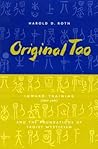
BOOKS: “Original Tao” by Harold D. Roth

Original Tao: Inward Training (Nei-yeh) and the Foundations of Taoist Mysticism (Translations from the Asian Classics)Original Tao: Inward Training (Nei-yeh) and the Foundations of Taoist Mysticism by Harold D. Roth
My rating: 5 of 5 stars

Publisher site – Columbia University Press

This book is built around a translation of an old Taoist manual called “Inward Training” (i.e. 内业,) and the book serves not only to elaborate the meaning of the twenty-six poems that make up the manual, but also to put this work in a context with respect to its place in early Taoist mysticism — which raises further questions as to what constitutes early Taoism and early Taoist mysticism. (Just as the earliest followers of Jesus didn’t think of themselves as “Christians” – at least not as we understand that term – it’s an open question as to when people started to think of themselves as Taoists and how that start relates to when people began holding a set of proto-beliefs that formed the basis of the school(s) of philosophy.)

“Inward Training” presents breathwork and meditational exercises that Roth calls “inner cultivation” — or what some have called “inner alchemy.” The book does contain the entire manual both in Traditional Chinese and an English translation, as well as a much more extensive elaboration of the teachings of the manual. The latter is necessary because, like many old manuals, sparse description, archaic language, and assumptions about common knowledge du jour make it difficult for the layman to get any depth of understanding from the manual, itself.

This is a scholarly work, which means that its readability isn’t the highest and it does dive into matters that will be arcana for non-expert readers. That said, particularly as works of academic philosophy go, its readability isn’t bad. The book is heavily annotated and offers and extensive bibliography.

If you are interested in Taoist practices of breath, meditation, and alignment, this book is well worth investigating.

View all my reviews

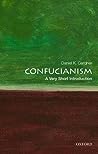
BOOKS: “Confucianism: A Very Short Introduction” by Daniel K. Gardner

Confucianism: A Very Short Introduction (Very Short Introductions)Confucianism: A Very Short Introduction by Daniel K. Gardner
My rating: 5 of 5 stars

Publisher Site – OUP

This is a brief guide to Confucianism from the early life of Confucius (孔子 -Kǒngzǐ) to the ups and downs the philosophy experienced in the twentieth century. It has chapters exploring the system’s thinking with respect to personal development as well as with respect to governance and also discusses how later thinkers (most notably Mencius and Xunzi) expanded on Confucius’s ideas — but also created schisms. The book examines the laudable elements of the philosophy such as its sanction of benevolence among leaders, but also its less laudable elements such as its unenlightened views on women and what they are capable of [and, of course, the many ideas in between that could be seen in varied lights.)

As with other books in this series, it has a few graphics as well as a bibliography and further reading section.

I found this book to be readable, well-organized, and of a level appropriate for its intended purpose. I’d highly recommend it for individuals looking for a concise introduction to Confucianism.

View all my reviews

BOOKS: 三字经 by 王应麟 [“Three Character Classic” by Wang Yinglin]

三字经三字经 by 章炳麟
My rating: 5 of 5 stars

Available online — Project Gutenberg

This is a Confucian primer written in lines of three characters. It’s a children’s book in the sense that it’s aimed at children, but not necessarily with respect to being presented in a manner most conducive to childhood learning. (While it’s concise, the material isn’t presented in an interesting or memorable form. i.e. It’s intended for brute force rote memorization.)

The book consists of five sections, ranging between twenty-four and one hundred and six lines (72 to 318 characters per chapter.) The first introduces Confucian virtues. The second offers a broad overview of classics of Chinese philosophy. The third section lists the dynasties of China. The penultimate section describes ideal behavior from a Confucian perspective. The last, and briefest, section is largely a pep talk on studying hard.

As someone learning Mandarin Chinese, it’s interesting to see how sentences are formed in this sparse format, and this text offers insight into Chinese history and philosophy, in addition to providing a good early reader.

If you are interested in learning elementary Confucianism or you’re learning Chinese and looking for short and simple texts for reading, I’d recommend one look into the Three Character Classic.

View all my reviews

BOOKS: “Buddha Jumps Over the Wall” by Ying Chang Compestine

Buddha Jumps over the Wall, and Other Curiously Named Classic Chinese Dishes: A Graphic Cookbook—26 Recipes & StoriesBuddha Jumps over the Wall, and Other Curiously Named Classic Chinese Dishes: A Graphic Cookbook—26 Recipes & Stories by Ying Chang Compestine
My rating: 5 of 5 stars

Publisher’s Site – Chronicle Books

Cookbooks don’t get more interesting than this. As the title suggests, the author selected dishes that have colorful names (and often histories or folklore to match) and presents lessons in culinary history as well as teaching the reader how to make each dish. The graphic novel format conveys these stories compactly and with a bit of added liveliness. The graphic novel approach is also used to “demonstrate” the preparation process — in lieu of photographs.

In addition to the twenty-six recipes (5 appetizers, 16 main course, and 5 desserts,) the book has five appendices and some front matter to both help readers who are entirely new to Chinese cooking as well as those who’d like a bit more depth of culinary cultural insight. (I should point out that the book looks at Chinese food broadly, including items like Chop Suey and Fortune Cookies that developed outside of China, and either don’t exist within China or have subsequently been introduced from foreign lands.)

If you are interested in learning to cook Chinese food, or are interested in Chinese culinary history and culture, I’d highly recommend this book.

View all my reviews

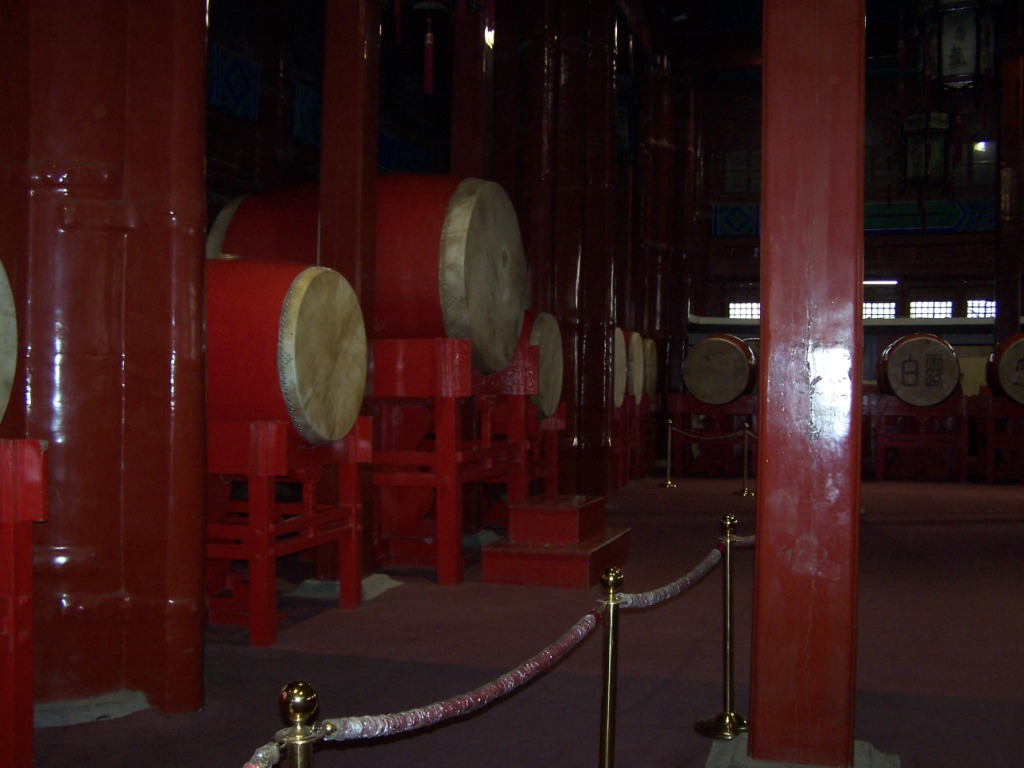
DAILY PHOTO: Drum Tower [鼓楼] of Beijing

BOOKS: “The Zen Teaching of Bodhidharma” Translation by Red Pine

The Zen Teaching of Bodhidharma (English and Chinese Edition)The Zen Teaching of Bodhidharma by Bodhidharma
My rating: 5 of 5 stars

Publisher’s Site

Bodhidharma was a Buddhist Monk who is credited with bringing an approach to Buddhism to China that would become Zen. This book presents four of his surviving lectures in their entirety: “Outline of Practice,” “Bloodstream Sermon,” “Wake-up Sermon,” and “Breakthrough Sermon.” It is a bilingual edition, featuring Traditional Chinese script juxtaposed with the English translation.

Bodhidharma was an intriguing and important character in the history of Buddhism, so much so that a legend has grown up around him that is in all likelihood substantially false. The most well-known element of the legend is that he taught monks the martial art that became Shaolin Kung Fu. (Historians refute the likelihood of this because there was no evidence of it in the documentation in the centuries immediately after Bodhidharma’s death. The story came along much later and caught on like gangbusters, so much so that it is routinely repeated today as if established fact. For elaboration, see Meir Shahar’s “The Shaolin Monastery.”) There is simply not a lot known about Bodhidharma (or even the extent which there was a Bodhidharma,) and what is known is not without controversy. Popular accounts put his homeland in Tamil Nadu, India, but dissenting accounts put it as far away as Persia (Iran.)

The reason I mention all this is because some potential readers may expect a kind of fabled story, full of kung fu and magic, and — in point of fact — these teachings offer a clear and straightforward approach to the practice of Buddhism. I’d highly recommend the book for readers interested in Buddhism, Zen, and meditational practices – generally. It is a clear and thought-provoking work. But, if you’re expecting a thrilling recitation of legend and woo-woo, this isn’t it.

View all my reviews

BOOKS: “Thirty-Six Stratagems” by Sun Bin [or Anonymous]

Thirty-Six Stratagems: Bilingual Edition, English and Chinese 三十六計: The Art of War Companion, Chinese Strategy Classic, Includes PinyinThirty-Six Stratagems: Bilingual Edition, English and Chinese 三十六計: The Art of War Companion, Chinese Strategy Classic, Includes Pinyin by Sun Bin
My rating: 3 of 5 stars

This is a collection of idioms on strategy with brief explanatory commentaries on each. The idioms, themselves, are thought-provoking and worth studying, but the book is problematic in a couple of regards. First, some of the work seems to either be plagiarized or has been plagiarized. Let me explain that accusation, because the actual thirty-six stratagems are clearly in the public domain, dating to the Sixth Century AD. However, while checking out the Wikipedia site to learn more about the author (incidentally, attribution of this work to Sun Bin is not accepted by consensus,) I discovered that the whole English translation of commentaries is verbatim the same as in Wikipedia. (Wikipedia has a tag on the article that it may contain original research and solicits further information.) I further noticed that the commentaries aren’t straight translations of the original Chinese text, but rather are reformulations written to be understandable to a present-day reader of English with no particular insight to Classical Chinese culture and history (which they are.) I can’t say whose work it is or whether it isn’t a misunderstanding that would be cleared up with additional information, but my point is that I wouldn’t recommend forking over any money to the publisher without knowing that the actual work (not the copy / pasting, but the intellectual work) either belongs to them or is in the public domain. Especially, given that it’s freely available on the internet.

That brings me to a second problem, a problem that is clearly on the publisher. There is a very limited sense in which this is a bilingual edition. Yes, the idioms themselves are presented in Chinese characters with pinyin as promised, but the commentary is wholly in English. The idioms, themselves, are largely Chengyu and other forms of Chinese idiom (so 4 characters, give or take, are all that is in Chinese for each.) So, if you’re purchasing this book to work on learning to read Chinese, it’s of limited benefit, and you’ll have to go elsewhere to get the Chinese commentary.

There is an appendix that explains a little about Classical Chinese. I can’t say whether this is original work or exists elsewhere on the internet. I can say that it also isn’t presented in a bilingual fashion either, excepting a few characters for some of the vocabulary. The appendix does have some interesting information.

My recommendation to readers would be not to buy this text when you can read both the Chinese and the exact English translation on Wikipedia for free. My recommendation to the publisher would be, if the commentaries are their original work, to put in a complaint to Wikipedia to pull it as copyright infringement. (And if they were the ones who lifted the text, to stop it already.)

View all my reviews

BOOKS: “Chinese Folktales for Language Learners” by Vivian Ling and Peng Wang

Chinese Folktales for Language Learners: Famous Folk Stories in Chinese and English (Free online Audio Recordings)Chinese Folktales for Language Learners: Famous Folk Stories in Chinese and English by Vivian Ling
My rating: 5 of 5 stars

Publisher Website

As the title suggests, this is a collection of fifteen Chinese folktales presented bilingually in a manner optimized to language learners. To clarify the “optimized for language learners” comment, these stories are paced differently than they would be if the central objective was to entertain. That old writerly chestnut of “show don’t tell” is often violated and the stories are kept short and sweet in a way that can feel like they sprint through critical moments. This is not criticism. I think it is the best way to give individuals learning Mandarin (or presumably Mandarin speakers learning English) a user-friendly book that doesn’t feature dense blocks of text and overly complicated language. (Note: it’s also not bad for those who just want the quick and dirty version of these tales.)

Each of the stories includes a section with some background information on the history and cultural elements behind the stories (stories which display a range of realism and are from distant times,) a list of terms and phrases in English and Chinese, and a brief set of questions to help the reader develop deeper insight into the stories. These ancillary features are all quite useful to the student of language.

As stories, some of these folktales are more compelling than others. A number of them are dry, but what they lack in intrigue they make up for in insight into the history and culture of China. And some of the stories, e.g. “Judge Bao Takes on the Emperor’s Son-in-Law,” are fascinating.

I’d highly recommend this book for those who are trying to learn Mandarin, but it would also serve those who wish to learn some Chinese folklore in a condensed and readable format.

View all my reviews

BOOKS: “Smoke and Ashes” by Amitav Ghosh

Smoke and Ashes: A Writer's Journey through Opium's Hidden HistoriesSmoke and Ashes: A Writer’s Journey through Opium’s Hidden Histories by Amitav Ghosh
My rating: 5 of 5 stars

Amazon.in Page

Release Date: February 15, 2024 [NOTE: for this edition; the book is already out in some markets in some additions.]

Ghosh has written a fascinating exploration of the profound global consequences of that pretty red flower, the opium poppy. I find the events surrounding the Opium Wars to be among the most incredible stories humanity has written. It is mind-blowing that a substance could be so utterly addictive as to spur wars and global social and economic upheavals. That substance is, of course, tea. Ah, you thought I was going to say opium (or its relative, heroin,) didn’t you? But while opium is fantastically addictive, its addicts were by-and-large in peaceful stupors in (or on) their clouds during the time in question. It is the uppity Earl Grey addict who was draining Britain’s treasury of precious metals, and — as addicts do in their impoverished desperation — turned to dealing drugs.

There have been many books written on this subject, but Ghosh carves himself a niche. First, while accounts often focus tightly upon the central adversarial relationship of Britain versus China, Ghosh examines at leisure the roles of two lesser discussed players — India (not only as a subject of Great Britain but also as an autonomous actor) and America. The importance of India’s involvement, from being a major producer and processor of opium to sourcing the sepoys who actually fought the Opium Wars, has been largely ignored, and Ghosh helps to clear up distortions in the historical record. Second, the book investigates questions around America’s opioid crisis and what history can tell us about its drivers. In particular, what does the China’s explosion of addiction tell us about what might have spurred America’s crisis?

This is a readable and compelling nonfiction exploration of the influence of opium from a writer who has produced novels (e.g. the “Sea of Poppies” trilogy) set around these historical events.

I’d highly recommend this book for individuals interested in the influence of Opium, particularly if one is curious about how history relates to the recent crises and what role Indians and Americans played in events.

View all my reviews