BOOKS: Travels with Epicurus by Daniel Klein

Travels with Epicurus: A Journey to a Greek Island in Search of a Fulfilled LifeTravels with Epicurus: A Journey to a Greek Island in Search of a Fulfilled Life by Daniel Klein
My rating: 5 of 5 stars

Amazon.in Page

With the wave of renewed interest in Philosophies of Life lately, it’s nice to see a book that puts Epicurus at the fore. In a number of ways, I believe Epicurus was the most advanced of Ancient Greek philosophers, and yet he doesn’t get much attention compared to Plato, Aristotle, and the Stoics. (In part this is because the vast majority of Epicurus’s writings were lost, and in part it’s because little-“e” epicureanism [i.e. being culinarily hedonistic] has become much more familiar to people than big-“E” Epicureanism [i.e. a materialist philosophy that values pleasure, but not in so hedonistic way as to lose sight of virtue and the countervailing costs of pursing pleasure.] While adjectival forms have done a number on Cynicism and Stoicism as well, the former is – for all intents and purposes – dead and the latter has become much more well-known to present-day people from a pile of podcasts, books, and vlogs.)

I should point out that Klein doesn’t solely focus on the philosophy of Epicurus, he also tells readers what other schools of philosophy teach us about how to age well (and to not turn into a curmudgeon) — most notably: Buddhism, Stoicism, and Existentialism. That said, it’s fair to call Epicureanism the backbone of this book.

One who reads the title might wonder whether this is a pop philosophy book on aging or a travelogue. It’s definitely both, but the philosophy part dominates. I would call it 70/30 pop philosophy to travelogue (maybe 65/35.) The book uses the individuals Klein interacts with on Hydra (and elsewhere in Greece) as examples of how people age well, and in the process shows the reader [textually] a beautiful part of the world. But the core of the book is about philosophy as it pertains to such topics as play, perception of time, idleness, and changing views of spirituality.

I will warn the reader that, while the book offers many great thoughts for a philosophy of aging well, I didn’t agree with everything in the book. Klein contrasts his philosophy for living well into old age and for adapting one’s life to changing roles to the people he calls the “forever young” crowd. I wouldn’t put myself in the “forever young” category as I don’t believe I’m grasping at youth and all its blessings and pains. However, I suspect Klein would put me in that group because I work out intensely, watch what I eat / manage my vices, and am trying to work things so that my heart explodes while I’m still physically and mentally capable — i.e. before I become decrepit or senile. My point is, I’m not sure Klein’s dichotomy is that useful or reflective of reality, and that being health-conscious should necessarily be contrasted with enjoying the pleasures of age. [Truth be told, I’d say the biggest driver for people being more health-conscious into old age is seeing earlier generations live longer, but with a decreased quality of life through that period of increased longevity — See: Being Mortal by Atul Gawande.]

Still, overall, the book is quite readable and offers much excellent food for thought, and I’d recommend it for anyone who is interested in moving into advanced age in a way that isn’t misery filled.

View all my reviews

Five Wise Lines from Chōmei’s Hōjōki

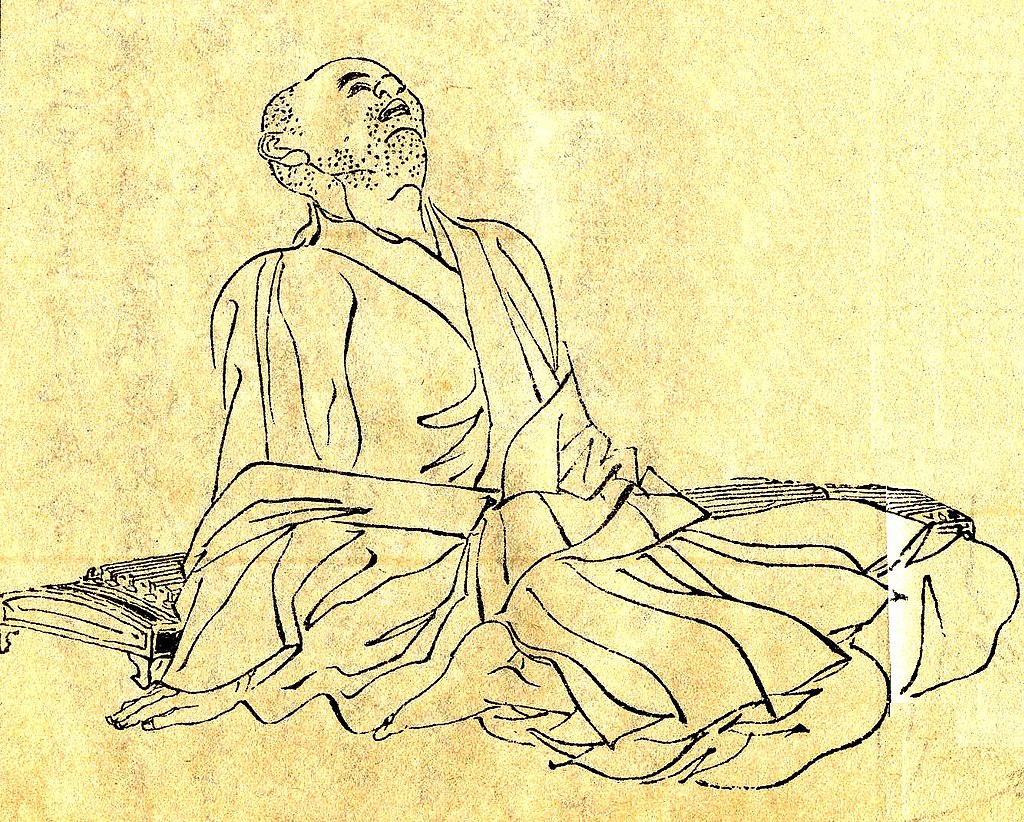
drawing by Kikuchi Yōsai

On flows the river ceaselessly, nor does its water ever stay the same.

 Kamo no Chōmei, Hōjōki

No one owns a splendid view, so nothing prevents the heart’s delight in it.

Kamo no Chōmei, Hōjōki

Knowing what the world holds and its ways, I desire nothing from it, nor chase after its prizes. My one craving is to be at peace; my one pleasure is to live free from troubles.

Kamo no Chōmei, Hōjōki

These days, I divide myself into two uses — these hands are my servants, these feet my transport.

Kamo no Chōmei, Hōjōki

When I chance to go down to the capital, I am ashamed of my lowly beggar status, but once back here again I pity those who chase after the sordid rewards of the world.

Kamo no Chōmei, Hōjōki

Reference: Saigyō Hōshi, Kamo no Chōmei, Yoshida Kenkō. 2021. Three Japanese Buddhist Monks. New York: Penguin Books. 112pp.

Available Here
Footprints [Haiku]

footprints in stone --
 outside the temple; how do
  Buddhists step so hard?

Crow Sound [Tanka]

the sharp caw
 of a crow triggers a monk's
  enlightenment.
 a second crow responds.
 a sailor doesn't look up.

The Most Important Lesson in All of Human Living [DAILY PROMPT]

Describe something you learned in high school.

A Psych teacher told us a story of what he called “a gestalt of expectations.” A man from a city in the East is driving out West, and he passes a gas station – despite being low on fuel. (He’s used to gas stations being everywhere.) Anyhow, he runs out of fuel. He can’t see anything around except desolate desert bisected by a line of asphalt. He decides to walk back to the gas station he passed ten miles back. There is no one traveling on this remote stretch of desert road. As he’s walking in the intense heat, it comes to his mind that the employee at the service station is really going to gouge him on the price of gas and a jerry can. As he walks and walks, skin prickling with the heat, he keeps thinking about how he’s going to get screwed by the gas station attendant and also how he’ll be chided and ridiculed for running out of gas in the middle of the desert. He imagines it in great detail. Finally, bedraggled and with heaving breaths, he arrives at the station. The gas station attendant rushes out to help this poor man, and the man punches the attendant square in the nose (for all the offenses taking place solely in the man’s mind.)

In a broader formulation, I think this is the most important lesson any human can learn. Our personal perception of what we experience is not equal to what it is that we experience (the exterior world.) This is why some people dealt a crappy hand can turn it into a wonderful life, and also why some people who seem to have it all commit suicide in the prime of life.

I could be angered or dismayed that the single most important lesson I learned in secondary school was via off-curriculum ramblings during an elective class, but I choose not to. Instead, I’ve been trying all my life to make that bit of knowledge into wisdom.

BOOK REVIEW: The Pocket Chögyam Trungpa by Chögyam Trungpa

The Pocket Chogyam TrungpaThe Pocket Chogyam Trungpa by Chögyam Trungpa
My rating: 5 of 5 stars

Amazon.in Page

This pocket-sized guide consists of 108 excerpts drawn from the writings of Chögyam Trungpa, a prolific — if controversial — teacher of Tibetan Buddhism. Chögyam Trungpa may have been most famous in the West for coining the English term “Crazy Wisdom,” and for founding Naropa University in Boulder, Colorado. [Note: while he coined the term “Crazy Wisdom,” he didn’t originate the concept, which existed already – arguably in multiple forms — in Vajrayana Buddhism from olden times.] Beyond basic Buddhist philosophy, he wrote extensively on Buddhist Psychology, Tantric Buddhism, and the Buddhist conception of warriorship.

The book is designed to be picked up at any point. There isn’t a formal grouping of concepts, but rather the book meanders around, revisiting ideas such as Enlightenment, Emptiness, emotional intelligence in multiple locations throughout the book. The entries are between a paragraph and a page long in most cases.

I found a great deal of food-for-thought in this book and would highly recommend it for those wishing to dip a toe into the teachings of Chögyam Trungpa.


View all my reviews

Satori [Free Verse]

It was a moment 
 of silent spaciousness.

In the midst of a fight,
 there was no enemy --
  just the effortless
   dance of the thing.

That moment 
 expanded to the infinite,
  & snapped back 
   to one tick after the tock.

Since then, 
 no catastrophe has felt 
  too great for a smile.

BOOK REVIEW: Singing and Dancing Are the Voice of the Law by Busshō Lahn

Singing and Dancing Are the Voice of the Law: A Commentary on Hakuin's “Song of Zazen”Singing and Dancing Are the Voice of the Law: A Commentary on Hakuin’s “Song of Zazen” by Bussho Lahn
My rating: 5 of 5 stars

Amazon.in Page

Release Date: December 20, 2022 [In India, may be out in your area.]

This book consists of a collection of essays inspired by the poem, “Song of Zazen,” written by the 18th century Zen master, Hakuin. Hakuin’s poem is brief (about forty lines,) and the essays composed by a present-day Zen priest (Lahn) offer commentary on a stanza-by-stanza basis. The book is divided into fourteen chapters, though the final chapter isn’t a stanza commentary.

I enjoyed reading this book and learned a great deal from it. The book benefits from the fact that the author is not rigidly sectarian. Therefore, the book is not doctrinaire, which warms the reader to the teachings. It’s also useful because it allowed the author to freely draw examples and quotes from a variety of sources, some of which may be more familiar or relatable to neophyte readers.

The last chapter offers a discussion of the fundamentals of zazen (seated meditation) as well as some other ancillary information that may be useful to readers new to Zen Buddhism, its practices, and its sutras. If you’re interested in Zen Buddhist meditation and philosophy, you may want to give it a look.


View all my reviews

In the Temple [Free Verse]

i enter an empty temple. 

it’s not silent.

footfalls resonate
&
floorboards creak.

but flickering flames
&
sleepy-eyed Buddhas
are quiet enough

in an hour,
the monks will filter in
with great punctuality:
monks, young and old.
(i would say, “and ages in-between,”
but they all seem young or old.)

there will be chanting,
and the din of finger cymbals
and deep-toned drums.

and i will leave
for the solace
of the world
outside the temple.

Slack Flags [Haiku]

prayer flags hang still.
i hear them go silent
as i sit - eyes closed